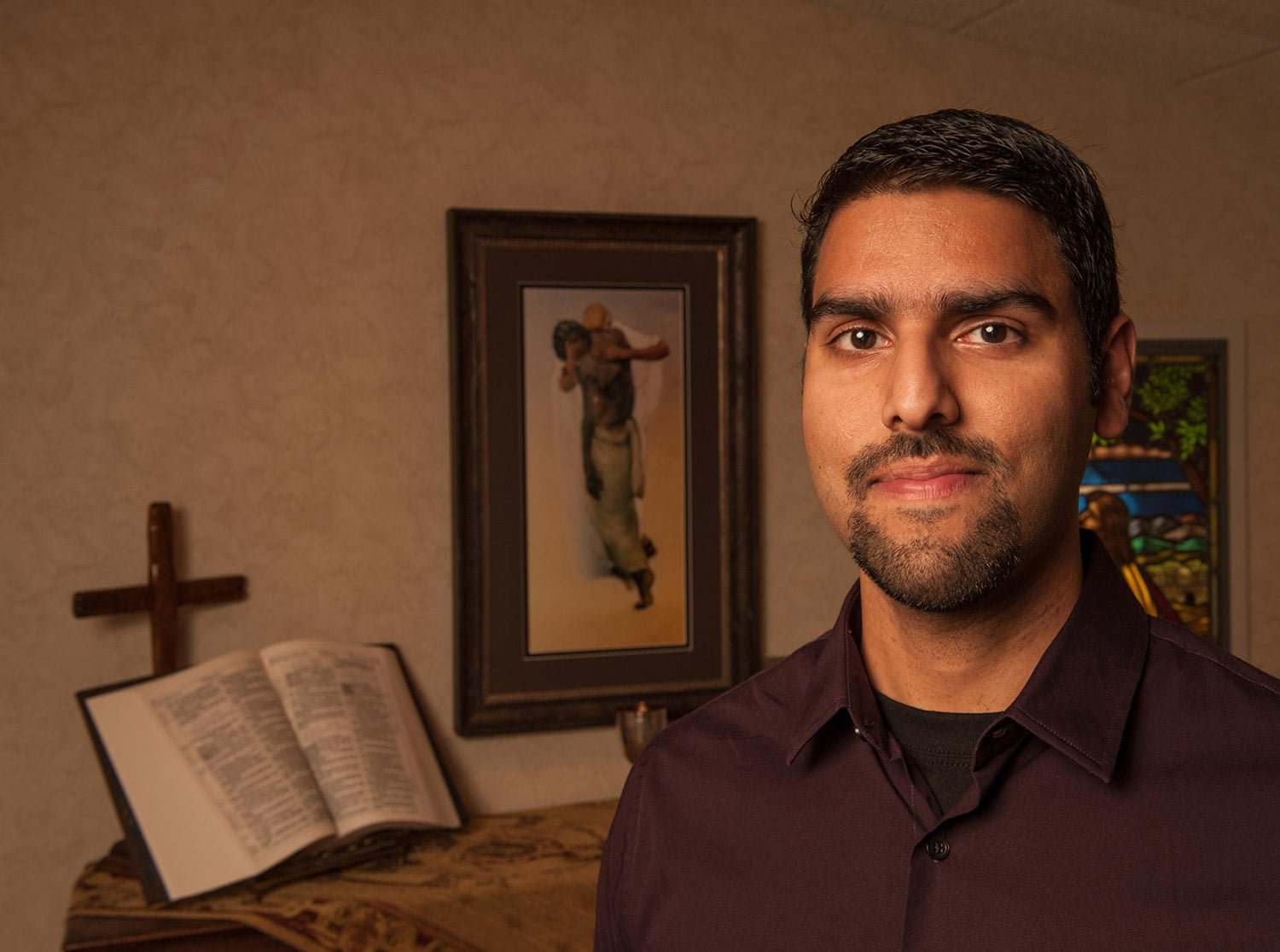
Romans 9. Who is Blessed?
Yesterday I was walking my dog and got into conversation with a lady I had met previously and had given her the article, ‘Mistakes, Minor, Major and Catastrophic’ that can be found on this website (www.bvpalmer.com). After chatting about the article for a while I asked her whether she was a Christian or wasn’t sure. She replied in a way so many do today:
“I was brought up as a Christian but I’m not involved in a church now – but I do try to be kind and thoughtful to others.”
What a great opening this was to explain to her what the Bible teaches, that no-one can get right with God by what we do. To be accepted by God , to be deemed righteous, can only be the result of a gift from God, but he has said how this wonderful status can be given – this is only to those who turn back to God and agree to live on his terms. This was how people were saved in Old Testament times. This is how we can be saved today though we know much more about how God saved us by entering this world as Jesus and becoming the final sacrifice for our sin himself.
This morning I was reading the Bible story of how Jacob dressed in Esau’s clothes in order to be blessed by his father, Isaac. Esau was distraught when he discovered how Jacob had cheated and lied to receive Isaac’s blessing:
“‘He has deceived me these two times: he took my birthright, and now he’s taken my blessing!’ Then he asked, ‘Haven’t you reserved any blessing for me?”
Isaac answered, ‘I have made him Lord over you and have made all his relatives his servants, and I have sustained him with grain and new wine. So what can I possibly do for you my son?” Genesis 27:36-37
The lesson is clear – such a blessing is irrevocable!
Today the concept of being blessed has been trivialised. Someone sneezes and the response is ‘Bless you!’ Your team scores a goal or wins a match and people think, ‘We were blessed!’ or in other words a blessing is a transient fortune.
God’s blessing is a serious commitment. It confers a permanent status on the person who is blessed. We cannot earn this blessing by the way we live. The thief who died alongside Jesus was told that he would be with Jesus in paradise. This was the gift of God, he had no time to achieve a righteousness by the way he lived! We may be despicable selfish people, like Jacob, and yet be blessed by God. Jacob only experienced this relationship many years later when he wrestled with God – and surrendered! The surprising doctrine is that the status of being righteous is a gift given to few, it can never be earned through good living. There is, however, always a purpose behind God blessing the few – it is that those who are blessed by him have been chosen to live for God’s glory.
There can be two children in a family, one may be blessed but not the other, in other words one may want to be God’s person and one not. That decision reflects whether they have been blessed by God.
Paul explains this when he discusses the issue of the twins, Jacob and Esau:
“Yet, before the twins were born or had done anything good or bad – in order that God’s purpose in election might stand: not by works but by him who calls – she (Rebecca) was told, ‘The older will serve the younger.’ Just as it is written, ‘Jacob have I loved, but Esau have I hated.’” Romans 9:11-13
To many modern minds this seems unfair but even people in Paul’s day thought this was asking, ‘Is God unfair?’ Paul continued,
“What shall we say? Is God unjust? Not at all! For he says to Moses, ‘I will have mercy on whom I have mercy, I will have compassion on whom I have compassion.” It does not, therefore, depend on man’s desire or effort, but on God’s mercy.” Romans 9:14-15
What is the purpose of God’s blessing?
The purpose of any activity of God is ultimately that God and his Son will be honoured. Paul reminds his readers of this. Moses was told to explain this to the Pharaoh of Egypt before he freed the Israelites from slavery:
“I raised you up for this very purpose, that I might display my power in you and that my name might be proclaimed in all the earth.” Romans 9:17 and Exodus 9:16
Who is righteous?
It is a tragedy that many in churches today seem to think that the gospel is primarily for their benefit. I was invited to give a series of mid-week evening talks on the Christian Basics in a well attended Roman Catholic church. About thirty people came to the first evening. At the end a very pleasant Irish lady came up to thank me. I felt chuffed. She then added,
“I don’t know why everybody isn’t a Christian,” and I heartedly agreed with her.
She then added something that showed how little she really understood,
“ . . .after all, all God wants is one hour a week!”
Job was a moral, upright man but he was also self-centred. Reading Job’s speech in Job 16:4-22 reveals this. He talks about himself all the time. ‘I’ and ‘me’ come 47 times in these few verses. Job knew however that he was a sinner. Yet he is also called righteous. This is strange. How can a sinful person be righteous when righteousness is a quality that only God has?
“There is no-one righteous, not even one . . .” Romans 3:10
“. . . for all have sinned and fall short of the glory of God.” Romans 3:23
The Bible teaches in both the Old and New Testament that we can only be righteous if God declares us right. This gift is given and we are therefore given the status of being right in God's sight when we commit ourselves to Jesus, the Son of God, who came to this earth as a man to save people for himself.
Job was not righteous because he was an upright, moral man with integrity. He was only considered righteous because he had turned to God in repentance and had trusted him for forgiveness and had therefore been given the status of being ‘a righteous one’. There has never been any other way to be considered ‘righteous’. Job clearly believed in personal salvation and said,
“I know that my redeemer lives, and that in the end he will stand upon the earth. And after my skin has been destroyed, yet in my flesh I will see God; I myself will see him with my own eyes – I and not another. How my heart yearns within me.” Job 19:25-27
It was only because of the grace of God that Abram, later to be called Abraham, the Father of God’s people, was made righteous – it was a gift of God:
“Abram believed the LORD, and it was credited to him as righteousness.” Genesis 15:6
Phinehas, Aaron’s grandson who executed Zimri and his Midianite wife (Numbers 25) and so averted a plague was granted the status of being righteous,
“But Phinehas stood up and intervened, and the plague was checked. This was credited to him as righteousness . . .” Psalm 106:30-31
This gift of being made righteous, of being blessed by God, is given to all who bend their knee, figuratively, before Jesus and so allow him to be their Lord and Redeemer or Saviour. As John says,
“Yet to all who received him (Jesus), to those who believed in his name, he gave the right to become children of God.” John 1:12
What greater blessing can there be that to be adopted into God’s family and kingdom? Jesus put this same truth another way,
“I tell you the truth, whoever hears my word and believes him who sent me has eternal life and will not be condemned; he has crossed over from death to life.” John 5:24
A student was talking to the Australian Christian teacher, John Chapman. The student did not like the doctrine that God had to call people and bless them if they are to be saved. He thought everything depended on him.
“I could commit my life to Christ if I wanted to,” the student arrogantly exclaimed.
“No you can’t,” replied Chappo.
“Yes, of course I can.” the student responded.
“Go on then, do it, turn to God now.”
The student hesitated and then said,
“No, I don’t want to!!!!”
That student hadn’t received the call of God so he couldn’t make that decision to ask Jesus to be his Redeemer and Lord.
The same is true for all of us. If you can turn to God then you know that he has called you to be his representative in the way you live and in the way you speak about him.
BVP
Nabeel Qureshi - A Muslim Seeking God, BUT Finding Jesus
Nabeel Qureshi was a passionate Muslim, raised in a devout Ahmadi Muslim family. When a student he loved arguing with Christians , trying to dissuade them from their often superficial faith. One day he was sharing a room with a colleague, David Wood, who had become a Christian whilst in prison. He saw David reading his Bible and exclaimed:
“You know that the book you are reading is not trustworthy - it been corrupted over time.”
David looked up, closed his Bible and simply said,
“Go on’”
Nabeel then gave his standard argument that had floored many others:
“Jesus spoke in Aramaic. The church in Israel spoke Hebrew. The New Testament was written in Greek. Then it was translated into Latin, then German and finally into English. So what you have is a translation from a translation from a translation. There are now many versions so which one is the Word of God?”
Then David replied:
“Nabeel, let me ask you a question. A few minutes ago you spoke to your mother on the phone. When you told me in English what she told you. was that a corrupted translation? When you are multilingual you can take a message and relay that message into another language accurately.
That is what the disciples did. Whatever Jesus said in Aramaic, they wrote down in Greek. There are over 6,000 copies of New Testament manuscripts, 10,000 Latin, Coptic and Syriac translations of these early manuscripts. There are over 30,000 quotations in the writings of the early church Fathers, enough to reconstruct the whole of the New Testament. We know precisely what Jesus and his apostles taught.”
Nabeel was stunned, thinking that David must have made this up as it was so different to what he had been taught about the Scriptures having been corrupted.
Both Nabeel and David agreed that it is truth that matters and they continued to debate the evidence. A year later they had become very good friends. Nabeel came to accept that the New Testament is reliable and that it is not possible for it to have been corrupted - but he still did not accept the gospel message.
Is Jesus God?
Having been brought up as a Muslim this was one doctrine he could not accept. It is the major sticking point for Muslims. Although the Qur’an recognises Jesus to be a great man and a mighty prophet of God they totally reject the doctrine that he was God, that he was crucified and that he then rose from the dead. They teach that to say Jesus is God is the worst blasphemy any person can commit. The Qur’an teaches that if a person believes Jesus is God they will go to hell.:
“Believers! Always be on your guard against encounters.” Surah 4:71
“And surely they disbelieved when they said: 'Christ, the son of Mary, is indeed God'; whereas Christ had said: 'Children of Israel! Serve Allah, Who is your Lord and my Lord.' Allah has forbidden Paradise to those who associate anything with Him in His divinity and their refuge shall be the Fire. No one will be able to help such wrong-doers.” Surah 5:72
The Qur’an also describes a conversation said to be between Allah and Jesus:
“And imagine when thereafter Allah will say: 'Jesus, son of Mary, did you say to people: "Take me and my mother for gods beside Allah?" and he will answer: "Glory to You! It was not for me to say what I had no right to. Had I said so, You would surely have known it. You know all what is within my mind whereas I do not know what is within Yours. You, indeed You, know fully all that is beyond the reach of human perception.” Surah 5:116
When Nabeel discussed this with David, his response was to hand Nabeel a copy of the gospel of John and asked him to look at the first few verses. He read:
“In the beginning was the Word, and the Word was with God, and the Word was God. He was with God in the beginning. Through him all things were made; without him nothing was made that has been made.” John 1:1-3
This lead onto a discussion on who the Word is. He was asked to look on to verse 14:
“The Word became flesh and made his dwelling among us. We have seen his glory, the glory of the one and only Son, who came from the Father, full of grace and truth.” John 1:14
This gave Nabeel a real problem. He had accepted that the New Testament was unchanged and yet they taught that Jesus was God and the world’s creator. He thought hard for a way out.
“But this was written by John, the last of the apostles to write. Could this be his own development of doctrine?”
David, who knew the Scriptures well, asked him to look on to see what the Jews understood Jesus to be saying when he said:
“Though you do not know him, I know him. If I said I did not, I would be a liar like you, but I do know him and obey his word. Your father Abraham rejoiced at the thought of seeing my day; he saw it and was glad.”
“You are not yet fifty years old,” they said to him, “and you have seen Abraham!”
“Very truly I tell you,” Jesus answered, “before Abraham was born, I am!”
At this, they picked up stones to stone him, but Jesus hid himself, slipping away from the temple grounds.” John 8:55-80
The reason they tried to stone Jesus was because he claimed to be God, stoning was the recognised punishment for such a presumption. When Jesus claims the name ‘I am’ he is using the very name of God. When God met Moses, at the burning bush, he was commissioned to go back to Egypt and, with God’s help, to set the Jews free from slavery under the Egyptians:
“Moses said to God, “Suppose I go to the Israelites and say to them, ‘The God of your fathers has sent me to you,’ and they ask me, ‘What is his name?’ Then what shall I tell them?” God said to Moses, “I am who I am. This is what you are to say to the Israelites: ‘I am has sent me to you.’” Exodus 3:13-14
‘I am’ is the name of God and Jesus often applied this to himself. They countered by saying:
“You are not yet fifty years old,” they said to him, “and you have seen Abraham!” John 8:58
Jesus does claim to have existed before Abraham, ‘Before Abraham was, I am.’. He then uses the same name that God had told Moses he was called, ‘I am’. Jesus repeated used this name for himself.
Later Jesus said to the Jews:
“I and the Father are one.” John 10:30
Their response made it clear that they did understand what Jesus was claiming:
“Again the Jews picked up stones to stone him.”
Jesus then asked which of the miracles he had performed had upset them and they replied:
“We are not stoning you for any good work,” they replied, “but for blasphemy, because you, a mere man, claim to be God.” John 10:33
After the resurrection Jesus met up with his disciples a second time and on this occasion the doubtful Thomas was with them. He now saw the risen Jesus:
“Thomas said to him, “My Lord and my God!” John 20:28
This doctrine was clearly a problem for Nabeel who had accepted that the New Testament documents were reliable but rejected the divinity of Jesus. He suggested that it was just John’s gospel which had been modified from what Jesus actually said and that these passages were inserted as the doctrine of Jesus’ divinity developed.
David was up to this challenge and suggested that they look at Mark’s gospel which is widely accepted to be the first one written, perhaps only 20-30 years after the death of Jesus. At the trial of Jesus:
“Again the high priest asked him, “Are you the Messiah, the Son of the Blessed One?”
“I am,” said Jesus. “And you will see the Son of Man sitting at the right hand of the Mighty One and coming on the clouds of heaven.”
The high priest tore his clothes. “Why do we need any more witnesses?” he asked. “You have heard the blasphemy. What do you think?”
They all condemned him as worthy of death.” Mark 14:61-64
So Peter, who was behind Mark’s gospel, clearly taught that Jesus claimed to be God. This is the very opposite of what the Qur’an teaches.
David continued to show that this was the teaching of all the New Testament. Paul wrote:
“If you declare with your mouth, “Jesus is Lord,” and believe in your heart that God raised him from the dead, you will be saved.” Romans 10:9
Note these three doctrines that are essential to be accepted, Jesus is the Lord God, he was crucified and he was raised from death. Furthermore these doctrines must be spoken about publicly
Jesus said something similar:
“Whoever acknowledges me before others, I will also acknowledge before my Father in heaven. But whoever disowns me before others, I will disown before my Father in heaven.” Matthew 10:32-33
This is the very opposite of what the Qur’an teaches and what he had been taught. They deny the crucifixion, resurrection and the divinity of Jesus.
Could Jesus have been deluded or mad? Some psychiatric patients do claim to be God but there are always other indications to show they are deeply disturbed people. Jesus was clearly sane and well balanced yet he said these extraordinary statements about himself. The question is ‘Why did he do so’
After Peter had recognised that Jesus was the Messiah, Jesus made it clear what this word meant. He had not come as a victorious General to defeat the Romans but as a Saviour who had come to defeat the power of sin. He was going to killed as the ultimate sacrifice for sin but would then rise again. This was to be the absolute proof, on top of all the other miracles that he had done, that his claim to be God were true.
“He then began to teach them that the Son of Man must suffer many things and be rejected by the elders, the chief priests and the teachers of the law, and that he must be killed and after three days rise again.” Mark 8:31
He kept repeating this prophecy that he would rise from the dead:
“He said to them, “The Son of Man is going to be delivered into the hands of men. They will kill him, and after three days he will rise.” But they did not understand what he meant and were afraid to ask him about it.” Mark 9:31-32
“We are going up to Jerusalem,” he said, “and the Son of Man will be delivered over to the chief priests and the teachers of the law. They will condemn him to death and will hand him over to the Gentiles, who will mock him and spit on him, flog him and kill him. Three days later he will rise.” Mark 10:33-34
The resurrection is the vindication of Jesus’ claim. That he died by crucifixion is not in doubt. Even sceptics like Bart Ehrman, John Dominic Crossan, and Gerd Lüdemann acknowledge the crucifixion of Jesus as a historical fact, citing non-Christian sources like the Roman historian Tacitus and the Jewish historian Josephus, along with the early Christian creedal material and non-Christian contemporary accounts from the Talmud and the Greek satirist Lucian. These skeptical scholars argue that the crucifixion is as certain as any historical event can be.
Similarly the case for the resurrection is extremely strong, any independent jury would be convinced by the evidence. There are several prominent historical and modern figures who began as sceptics and later became convinced of Jesus' resurrection. These include early figures mentioned in the New Testament:
Paul the Apostle: Before his conversion, Paul (then known as Saul) was a Pharisee who violently persecuted early Christians. He experienced a radical transformation after what he described as an appearance of the resurrected Jesus. This account is considered especially compelling by Christian apologists because it came from a dedicated opponent of the faith.
James, the brother of Jesus: During Jesus' ministry, his own family, including his brother James, did not believe he was the Messiah. Early historical sources indicate that James was converted after a resurrection appearance and later became a prominent leader of the Jerusalem church, eventually suffering martyrdom for his faith.
Thomas the Apostle: The Gospel of John describes the apostle Thomas as initially unwilling to believe that Jesus had risen from the dead unless he could personally see and touch his wounds. After Jesus appeared to him, he made one of the most direct confessions of faith in the New Testament, stating, "My Lord and my God".
There are many more recent sceptics who looked at the evidence and became convinced such as:
Lee Strobel: A former investigative journalist for the Chicago Tribune and a self-proclaimed atheistic Jew, Strobel set out to use his journalistic skills to disprove the claims of Christianity. After extensive research and interviews with scholars, he became convinced by the evidence for the resurrection and converted to Christianity. He documented his journey in the book The Case for Christ.
Frank Morison: A British lawyer, Morison began writing a book intended to debunk the resurrection. As he meticulously examined the evidence, he was forced by the historical data to change his mind. He instead wrote Who Moved the Stone?, with its first chapter titled "The Book That Refused to Be Written," detailing why he became convinced of the resurrection.
Antony Flew: A well-known atheist philosopher for decades, Flew eventually converted to deism (the belief in a god based on reason, not revelation) after re-evaluating scientific and philosophical evidence. In a debate with Christian apologist William Lane Craig, Flew is cited as affirming that ‘the evidence for the resurrection is better than for claimed miracles in any other religion’. While Flew did not become a Christian, his dramatic shift away from atheism shocked many in the atheist community.
Lew Wallace: A Union general and lawyer, Wallace also set out to write a book that would disprove Christianity and the resurrection. However, his research had the opposite effect. He ended up defending the faith in his famous novel Ben-Hur, which became one of the most influential books of the 19th century.
An excellent and convincing overview of this evidence can be found in the book by Gary Habermas and Michael R. Licona, ‘The Case for the Resurrection’.
By now Nabeel was in a quandary. He had accepted the validity of the Christian Scriptures, which the Qur’an also affirmed. He was sure from the evidence that Jesus had been crucified and that he had risen but his belief in Islam was so deeply ingrained in him that he could not change and commit himself to Christ.
His friend David Wood then challenged him to test the Qur’an as vigorously as he had tested the validity and teaching of the New Testament, using the same level of scepticism and search for historical truth.
This search disturbed him as he discovered many problems when the Qur’an was examined critically. Muhammad had died in 632 AD, so why are there no contemporary references to him. Why are there no early manuscripts of the Qur’an? Why weren’t he direction of the Qiblas of early mosques pointing towards Mecca. Why was the Qur’an written in Nabatean Arabic and not Sabaic, the text used around Mecca. Why is there no mention of Mecca in the 7th century and how could thousands live there where there was no water? Why do coins of the 7th century have crosses on them? Why does the Qur’an speak so much about Jesus? In the Quran, Jesus, known as `Īsā, is referred to by name 25 times but the total number of references to him is much higher when his various titles and descriptions are included. Some analyses suggest he is mentioned over 100 times indirectly. Islam corroborates that Jesus was born to a virgin, was sinless, performed miracles, and was superior to other prophets. It teaches that the Christian Scriptures are the word of God. Yet, Islam also teaches that Jesus was no more than a prophet. It denies the central message of Christianity by denying Jesus’ divinity, crucifixion, and resurrection. Thus the Qur’an itself causes many problems.
The Qur’an is taught to be the exact unchanging word of God but Nabeel discovered that that could not be true. He concluded,
“When you apply the same level of scepticism to any other world religion, Christianity comes out top every time.”
The problem of shame and punishment
Having been raised in a close Muslim family, Nabeel felt a great loyalty to his family and their traditions so found it very hard indeed to ‘come out’ as a Christian. On top of that there is the law of apostasy in Islam. All four schools in traditional Sunni Islam and all three major schools in Shj’a Islam teach that if you leave Islam you should, in certain circumstances, be killed. Islamic scholar, Abu’ala Maududi declares:
“To everyone acquainted with Islamic law it is no secret that according to Islam the punishment for a Muslim who turns to kufr (infidelity, blasphemy) is execution.”
Islamic law stipulates that:
“When a person who has reached puberty and is sane voluntarily apostasies from Islam, he deserved to be killed … There is no indemnity [expiation] for killing an apostate”.
Why should apostates be killed? Another Islamic scholar answers:
“Those Muslims who are weak in faith and others who are against Islam may think that the apostate has only left Islam because of what he has found out about its real nature.. So they learn from him all the doubt, lies and fabrications which are aimed at extinguishing the light of Islam and putting people off from it. In this case, executing the apostate is obligatory, in order to protect [Islam]…”
In other words, all opposition must be squashed by whatever means, even by killing. What is significant is that the penalties are not being carried out by God himself, which he is well able to do, but Islam teaches that this responsibility has been delegated to men, which is surprising as God is all-powerful.
No wonder Nabeel was in a quandary. If he came out as a Christian, his family life and social life would be irreparably damaged and his life would be at risk. What should he do?
In Islam even prophets don’t communicate with God, they communicate via angels as intermediaries. One way that Muslims expect to hear from God is through visions and dreams.
One day Nabeel prayed for God’s help:
“Tell me who you are! If you are Allah, show me how to believe in you. If you are Jesus, tell me! Whoever you are, I will follow you, no matter the cost”.
He requested a vision or dream to show him whether Christianity was really true. He did have a vision of crosses but dismissed this as a trick of his mind. He then asked for a dream that would confirm the vision, stating,
“If the dream corroborates the vision, I will become Christian”.
He subsequently had three meaningful dreams. In the second dream he was standing outside a narrow arched doorway, just wide and tall enough for him to pass through. This archway was 5 to 7 feet deep. On the far side were several round tables all prepared for a feast, with people sitting around the food. Everyone was in fine clothes and they were waiting for the owner to enter. That room was definitely heaven. Then he saw his friend David was blocking the way in, he couldn’t get past him.
“I thought we were going to eat together’
“You haven’t responded” David replied.
Nabeel just knew that he had not responded to Jesus’ invitation. He then woke up. He called David and told him the dream, asking what it meant. David replied:
“This dream is so clear. I don’t need to interpret it for you. Just go to Luke 13:23-25.”
There Nabeel read these words, words he had never read before:
“Someone asked him (Jesus), “Lord, are only a few people going to be saved?”
He said to them, “Make every effort to enter through the narrow door, because many, I tell you, will try to enter and will not be able to. Once the owner of the house gets up and closes the door, you will stand outside knocking and pleading, ‘Sir, open the door for us.’“But he will answer, ‘I don’t know you or where you come from.’”
He knew this message was from God, God had told him plainly where he stood. Nabeel responded - but only by asking for another dream!
A little later, when driving his car when he prayed,
“God, I know what I need to do but I need time to mourn.”
He went back to his apartment, took out both his Qur’an and his Bible and asked God to comfort him. When he opened the Qur’an, looking for something to comfort him, he realised that there was not a single verse in the Qur’an designed to help a hurting man - not one. He concluded,
“This book does not apply to my life”
He then took up the Bible he had been given and stated to read the New Testament, starting at Matthew chapter 1. That was a genealogy so he skipped that. He came to Matthew chapter 5 and read:
“Blessed are those who mourn, for they shall be comforted.”
This phrase jumped of the page, Nabeel realised he said that for him. Then he read on till he came to Matthew 10 where he read:
“Whoever acknowledges me before others, I will also acknowledge before my Father in heaven. But whoever disowns me before others, I will disown before my Father in heaven.” Matthew 10:32-33
By this time Nabeel knew that the good news about Jesus was true but he had never openly acknowledged his commitment to Jesus. But then the thought came to him:
“If I do this I will have to give up my family.”
He then read the next verses:
“Do not suppose that I have come to bring peace to the earth. I did not come to bring peace, but a sword. For I have come to turn ‘a man against his father, a daughter against her mother, a daughter-in-law against her mother-in-law - a man’s enemies will be the members of his own household.’
“Anyone who loves their father or mother more than me is not worthy of me; anyone who loves their son or daughter more than me is not worthy of me. Matthew 10:34-37
He then realised that he would put at risk not only his relationship with his family but also his whole life. He read on:
“Whoever does not take up their cross and follow me is not worthy of me. Whoever finds their life will lose it, and whoever loses their life for my sake will find it.” Matthew 10:38-39
He knew this was true, so he got on his knees and prayed
“Lord, I believe you are Jesus. I thank you for taking my sins when you died on that cross and that you rose from the dead. I want to follow you with my life.”
From that time on his life changed. He began to see the world as Jesus did. When he saw someone walking across the road he realised:
“That is someone Jesus was willing to die for.”
As a Muslim he had imagined God to be sitting on his distant throne. This God would never deign to enter the world. He was its judge. But in contrast the Bible says that God was willing to enter into this world, live as a poor carpenter, live with people who would to betray him, was willing to go to his death nailed to a cross, to suffer and die for the sake of us sinners. Such love!
Nabeel understood that the God who created this universe was willing to die for you and me. He said:
“As I have loved you, so you must love one another.” John 13:34
The gospel is not something you just hear and believe. If it doesn’t change your life it hasn’t hit you yet.
Nabeel came to realise:
“This God is worth everything. This story is worth sharing with our lives. If we die today, serving our Lord, we will be taken care of.”
Nabeel went on to become a great advocate for his Lord. His story is written in his book, ‘Seeking Allah, Finding Jesus.’
BVP
They Tried to Disprove the Resurrection
Above all other books combined, the Bible has been hated, vilified, ridiculed, criticized, restricted, banned, and destroyed, all because it challenges the wrong principles of many people’s lives. Yet it has been to no avail.
In A.D. 303, the Roman Emperor Diocletian issued an edict to stop Christians from worshipping Jesus Christ and to destroy their Scriptures. Every official in the empire was ordered to raze the churches to the ground and burn every Bible found in their districts (Stanley Greenslade, Cambridge History of the Bible). Twenty-five years later Diocletian’s successor, Constantine, issued another edict ordering fifty Bibles to be published at government expense (Eusebius).
In 1778 the French sceptic Voltaire boasted that in 100 years Christianity would cease to exist, but within 50 years the Geneva Bible Society used his press and house to publish Bibles (Geisler and Nix, A General Introduction to the Bible, 1986, pp. 123, 124).
Robert Ingersoll (1833 – 1899), was nicknamed ‘the Great Agnostic’. He was an American lawyer, writer, and orator during the Golden Age of Free Thought, who campaigned in defence of agnosticism. He once boasted, “Within 15 years I’ll have the Bible lodged in a morgue.” However the opposite has happened, Ingersoll is dead, and the Bible remains alive and well.
In fact, many who set out to disprove the Bible have been converted, instead. The following are a few examples:
Gilbert West (1703-1756)
Gilbert West was included in Samuel Johnson’s Lives of the Most Eminent English Poets. As a student at Oxford, West set out to debunk the Bible’s account of Christ’s resurrection. Instead, having proved to himself that Christ did rise from the dead, he was became a Christian. West published his conclusions in the book ‘Observations on the History and Evidences of the Resurrection of Jesus Christ’(1747). On the fly-leaf he had the following printed: “Blame not before thou hast examined the truth.”
West concluded his book with these words:
“If Christ had not risen and proved himself by many infallible tokens to have risen from the dead, the Apostles and Disciples could have had no inducement to believe in him, that is to acknowledge him for the Messiah, the Anointed of God; on the contrary, they must have taken him for an impostor, and under that persuasion could never have become preachers of the Gospel, without becoming enthusiasts or impostors, in either of which characters it is impossible they should have succeeded, to the degree which we are assured they did, considering their natural insufficiency, the strong opposition of all the world to the doctrines of Christianity, and their own high pretensions to miraculous powers, about which they could neither have been deceived themselves, nor have deceived others. Supposing therefore that Christ did not rise from the Dead, it is certain, according to all human probability, there could never have been any such thing at all as Christianity, or it must have been stifled soon after its birth. This is a fact about which there is no dispute, but Christians and Infidels disagree in accounting for this fact. Christians affirm their religion to be of divine origin, and to have grown up and prevailed under the miraculous assistance and protection of God; and this they not only affirm, and offer to prove by the same kind of evidence, by which all remote facts are proved, but think it may very fairly be inferred form the wonderful circumstances of its growth and increase, and its present existence. Infidels, on the other hand, assert Christianity to be an imposture, invented and carried on by men. In the maintenance of which assertion, their great argument against the credibility of the Resurrection, and the other miraculous proofs of the divine original of the Gospel, founded in their being miraculous, that is, out of the ordinary course of nature, will be of no service to them, since they will still find a miracle in their way, namely, the amazing birth, growth, and increase of Christianity. Which facts, though they should not be able to account for them, they cannot however deny. In order therefore to destroy the evidence drawn from them by Christians, they must prove them not to have been miraculous, by shewing how they could have been effected in the natural course of human affairs, by such weak instruments as Christ and his Apostles (taking them to be what they are pleased to call them, enthusiasts or impostors) and by such means as they were possessed of and employed.” (Observations on the History and Evidences of the Resurrection of Jesus Christ, pp. 442-445).
George Lyttelton (1709-1773)
George Lyttelton was an English statesman, author, and poet who was educated at Eton and Oxford. Among other things he published a History of Henry II.
As a young man he set out to prove that Paul was not converted as the Bible states. However, as a result of his researches, he wrote a book containing evidence that Paul was indeed converted and that his conversion is evidence that Jesus rose from the dead. The book was titled ‘Observations on the Conversion and Apostleship of St. Paul’ (1747). Lyttleton observed that from an earthly perspective Paul had absolutely nothing to gain and everything to lose by testifying that he had seen the risen Christ. Giving up his position and prestige as a Jewish religious leader, he joined the despised Christian sect and was hounded, mocked, and persecuted for the rest of his life, finally paying the ultimate price for his Christian faith, death by beheading.
Lyttelton began his book with these words:
“In a late conversation we had together upon the subject of the Christian religion, I told you, that besides all the proofs of it which may be drawn from the prophecies of the Old Testament, from the necessary connection it has with the whole system of the Jewish religion, from the miracles of Christ, and from the evidence given of his Resurrection by al the other Apostles, I thought the conversion and the apostleship of St. Paul alone, duly considered, was of itself a demonstration sufficient to prove Christianity to be a divine Revelation. As you seemed to think that so compendious a proof might be of use to convince those unbelievers that will not attend to a longer series of arguments, I have thrown together the reasons upon which I suppose that proposition” (page 4).
The famous British lexicographer Samuel Johnson said “infidelity has never been able to fabricate a specious answer” to Lyttelton’s book.
He had, in the pride of juvenile confidence, with the help of corrupt conversation, entertained doubts of the truth of Christianity; but he thought the time now come when it was no longer fit to doubt or believe by chance, and applied himself seriously to the great question. His studies, being honest, ended in conviction. He found that religion was true, and what he had learned he endeavoured to teach (1747) by "Observations on the Conversion of St. Paul," a treatise to which infidelity has never been able to fabricate a specious answer. This book his father had the happiness of seeing, and expressed his pleasure in a letter which warrants quoting:–
“I have read your religious treatise with infinite pleasure and satisfaction. The style is fine and clear, the arguments close, cogent, and irresistible. May the King of Kings, whose glorious cause you have so well defended, reward your pious labours, and grant that I may be found worthy, through the merits of Jesus Christ, to be an eye-witness of that happiness which I don't doubt he will bountifully bestow upon you. In the meantime I shall never cease glorifying God for having endowed you with such useful talents, and giving me so good a son.
Your affectionate father,
Thomas Littelton."
Simon Greenleaf (1783-1853)
Simon Greenleaf, Royall Professor of Law at Harvard University, was one of the most celebrated legal minds in American history. His Treatise on the Law of Evidence “is still considered the greatest single authority on evidence in the entire literature of legal procedure.”
As a law professor, he determined to expose the “myth” of the resurrection of Christ once and for all, but his thorough examination forced him to conclude, instead, that Jesus did rise from the dead. In 1846 he published An Examination of the Testimony of the Four Evangelists by the Rules of Evidence Administered in the Courts of Justice.
Thus, one of the most celebrated minds in the legal profession of the past two centuries took the resurrection of Christ to trial, diligently examined the evidence, and judged it to be an established fact of history! And this was in spite of the fact that he began his investigation as a sceptic.
One of Greenleaf’s points is that nothing but the resurrection itself can explain the dramatic change in Christ’s disciples and their willingness to suffer and die for their testimony.
Consider an excerpt:
“Their master had recently perished as a malefactor, by the sentence of a public tribunal. His religion sought to overthrow the religions of the whole world. The laws of every country were against the teachings of His disciples. The interests and passions of all the rulers and great men in the world were against them. The fashion of the world was against them. Propagating this new faith, even in the most inoffensive and peaceful manner, they could expect nothing but contempt, opposition, revilings, bitter persecutions, stripes, imprisonments, torments, and cruel deaths. Yet this faith they zealously did propagate; and all these miseries they endured undismayed, nay, rejoicing. As one after another was put to a miserable death, the survivors only prosecuted their work with increased vigour and resolution. The annals of military warfare afford scarcely an example of the like heroic constancy, patience, and unblenching courage. They had every possible motive to review carefully the grounds of their faith, and the evidences of the great facts and truths which they asserted; and these motives were pressed upon their attention with the most melancholy and terrific frequency. It was therefore impossible that they could have persisted in affirming the truths they have narrated, had not Jesus actually risen from the dead, and had they not known this fact as certainly as they knew any other fact. ... If then their testimony was not true, there was no possible motive for its fabrication” (Greenleaf, ‘An Examination of the Testimony of the Four Evangelists by the Rules of Evidence’).
Albert Henry Ross (Frank Morison) (1881-1950)
Albert Ross was a lawyer, journalist, and novelist who grew up in Stratford-on-Avon, England. He was deeply affected by the scepticism of the times, particularly the attacks on the Bible by theological liberalism and Darwinism. After becoming a lawyer he set out to write a book to disprove the resurrection of Jesus Christ. Instead, he was converted and wrote a book in defence of the resurrection entitled ‘WHO MOVED THE STONE?’ -- which is still in print today. He wrote the book under the name of Frank Morison.
“If you will carry your mind back in imagination to the late nineties [1890s] you will find in the prevailing intellectual attitude of that period the key to much of my thought. ... the work of the higher critics -- particularly the German critics -- had succeeded in spreading a prevalent impression among students that the particular form in which the narrative of His life and death had come down to us was unreliable, and that one of the four records was nothing other than a brilliant apologetic written many years, and perhaps many decades, after the first generation had passed away.
“Like most other young men deeply immersed in other things, I had no means of verifying or forming an independent judgment upon these statements, but the fact that almost every word of the Gospels was just then the subject of high wrangling and dispute did very largely colour the thought of the time, and I suppose I could hardly escape its influence.
“But there was one aspect of the subject that touched me closely. I had already begun to take a deep interest in physical science, and one did not have to go very far in those days to discover that scientific thought was obstinately and even dogmatically opposed to what are called the miraculous elements in the Gospels. Very often the few things the textual critics had left standing science proceeded to undermine. Personally I did not attach anything like the same weight to the conclusions of the textual critics that I did to this fundamental matter of the miraculous. It seemed to me that purely documentary criticism might be mistaken, but that the laws of the universe should go back on themselves in a quite arbitrary and inconsequential manner seemed very improbable. Had not Huxley himself declared in a peculiarly final way that ‘miracles do not happen,’ while Matthew Arnold, with his famous gospel of ‘Sweet Reasonableness,’ had spent a great deal of his time in trying to evolve a non-miraculous Christianity?
“It was about this time - more for the sake of my own peace of mind than for publication - that I conceived the idea of writing a short monograph on what seemed to me to be the supremely important and critical phase in the life of Christ - the last seven days - though later I came to see that the days immediately succeeding the Crucifixion were quite as crucial. The title I chose was ‘Jesus, the Last Phase,’ a conscious reminiscence of a famous historical study by Lord Rosebery.
“Such, briefly, was the purpose of the book I had planned. I wanted to take this last phase of the life of Jesus, with all its quick and pulsating drama, its sharp, clear-cut background of antiquity, and its tremendous psychological and human interest--to strip it of its overgrowth of primitive beliefs and dogmatic suppositions, and to see this supremely great person as He really was.
“I need not stay to describe here how, fully ten years later, opportunity came to study the life of Christ as I had long wanted to study it, to investigate the origins of its literature, to examine some of the evidence at first hand, and to form my own judgment on the problem it presents. I will only say that it effected a revolution in my thought. Things emerged from old-world story that previously I should have thought impossible. Slowly but very definitely the conviction grew that the drama of those unforgettable weeks of human history was stranger and deeper than it seemed. It was the strangeness of many notable things in the story that first arrested and held my interest. It was only later that the irresistible logic of their meaning came into view.”
The first chapter of this book ‘Who Moved the Stone?’ is titled “The Book That Refused to Be Written.” In this chapter he explains, “I want to try, in the remaining chapters of this book, to explain why that other venture never came to port, what were hidden rocks on which it foundered, and how I landed to me, an unexpected shore.”
Morison concluded that the only explanation that can satisfy all of the historical facts was that Jesus Christ actually rose from the dead.
William Mitchell Ramsay (1851-1939)
William Ramsay was a renowned archaeologist and New Testament scholar from Scotland. He was knighted by the British crown for his work in archaeology.
He was raised an atheist, and as a brilliant student at the University of Aberdeen in Scotland and at Oxford University in England, he sat at the feet of theological modernists and skeptics who disbelieved the Bible. It was assumed that the Bible is not historically accurate and that it contains a large portion of mythology. It was thought that the book of Acts was not written until 150 A.D., about a century after the events it describes.
When Ramsay began archaeological and historical research in Asia Minor beginning in 1881, he expected and hoped to find more evidence against the Bible. Instead, he discovered fact after fact that supported the Bible. He eventually concluded that the book of Acts was written during the lifetime of the apostles and that it is historically accurate. His discoveries led to his conversion to Christianity.
"He had spent years deliberately preparing himself for the announced task of heading an exploration expedition into Asia Minor and Palestine where he would [find] the evidence that the book was the product of ambitious monks, and not the book from heaven it claimed to be. He regarded the weakest spot in the whole New Testament to be the story of Paul's travels. These had never been thoroughly investigated by one on the spot. Equipped as no other man had been, he went to the home of the Bible. Here he spent fifteen years digging. Then in 1896 he published a large volume, Saint Paul, the Traveler and the Roman Citizen. ... The book caused a furor of dismay among the skeptics of the world. Its attitude was utterly unexpected because it was contrary to the announced intention of the author years before. For twenty years more, book after book from the same author came from the press, each filled with additional evidence of the exact, minute truthfulness of the whole New Testament as tested by the spade on the spot. And these books have stood the test of time, not one having been refuted, nor have I found even any attempt to refute them” (Josh McDowell, The New Evidence That Demands a Verdict, p. 62).
Ramsay testified:
“The present writer takes the view that Luke’s history is unsurpassed in respect of its trustworthiness. At this point we are describing what reasons and arguments changed the mind of one who began under the impression that the history was written long after the events and that it was untrustworthy as a whole” (The Bearing of Recent Discovery on the Trustworthiness of the New Testament, 1915).
Viggo Olsen
The following is excerpted from “From Agnostic to Ambassador to Bangladesh,” Thanthropos.org:
Viggo Olsen was a brilliant surgeon who graduated cum laude from medical school and later became a diplomat of the American Board of Surgery and a fellow of the American College of surgeons. In 1951 he was challenged by his wife’s parents to examine the claims of Christianity for himself.
Olsen recalled, ‘
Just alike a surgeon incises a chest, we were going to slash into the Bible and dissect out all its embarrassing scientific mistakes.’
After he started his investigation he ran into problems. He remembers that he had trouble finding scientific mistakes. ‘We’d find something that seemed to be an error, but on further reflection and study, we saw that our understanding had been shallow. That made us sit up and take notice.’
After examining the evidence, Olsen became a Christian and later gave his life to be a missionary in Bangladesh. He was later honoured for his contributions to the country.
This is a man who was well educated, a brilliant surgeon, someone who was not willing to take a blind leap of faith, and after exhaustive research he was willing to admit, like so many others have, that the historic Christian faith is much more than a religion, it is based on a man who walked this Earth as the Theoanthropos, the God-Man. The evidence that supports the resurrection of Jesus is so overwhelming it demands a verdict and Christianity lives and dies by the fact of the resurrection--without it, Christianity does not hold water.
Olsen went from an agnostic to giving up his academic surgical career, to serve poor people in Bangladesh. Olson testified:
‘It was the greatest adventure we could ever have. When you’re in a hard place, when you’re in over your head again and again, when you’re sinking and beyond yourself and praying your heart out - then you see God reach out and touch your life and resolve the situation beyond anything you could have ever hoped. . . That’s living it up! In my opinion, finding the purpose for which God made you - whatever it may be - and then fully pursuing it, is simply the very best way to live.’
Olsen tells the story of his life in his book titled ‘Daktar’.
Josh McDowell
Josh McDowell, the author of ‘Evidence That Demands a Verdict’, was a skeptic when he entered university to pursue a law degree. There he met some Christians who challenged him to examine the evidence for the Bible and Jesus Christ. Following is his testimony:
As a teenager, I wanted the answers to three basic questions: ‘Who am I?’ ‘Why am I here?’ ‘Where am I going?’ . . . So as a young student, I started looking for answers.
I thought that education might have the answer to my quest for happiness and meaning. So I enrolled in the university. What a disappointment! I have probably been on more university campuses in my lifetime than anyone else in history. You can find a lot of things in the university, but enrolling there to find truth and meaning in life is virtually a lost cause.
I used to buttonhole professors in their offices, seeking the answers to my questions. When they saw me coming they would turn out the lights, pull down the shades, and lock the door so they wouldn’t have to talk to me. I soon realized that the university didn’t have the answers I was seeking. Faculty members and my fellow students had just as many problems, frustrations, and unanswered questions about life as I had. A few years ago I saw a student walking around a campus with a sign on his back: ‘Don’t follow me, I’m lost.’ That’s how everyone in the university seemed to me. Education was not the answer!
Prestige must be the way to go, I decided. It just seemed right to find a noble cause, give yourself to it, and become well known. The people with the most prestige in the university, and who also controlled the purse strings, were the student leaders. So I ran for various student offices and got elected. It was great to know everyone on campus, make important decisions, and spend the university’s money doing what I wanted to do. But the thrill soon wore off, as with everything else I had tried.
Every Monday morning I would wake up with a headache because of the way I had spent the previous night. My attitude was, Here we go again, another five boring days. Happiness for me revolved around those three party-nights: Friday, Saturday, and Sunday. Then the whole boring cycle would start over again.
Around this time I noticed a small group of people on campus--eight students and two faculty--and there was something different about them. They seemed to know where they were going in life. And they had a quality I deeply admire in people: conviction. But there was something more about this group that caught my attention. It was love. These students and professors not only loved each other, they loved and cared for people outside their group.
About two weeks later, I was sitting around a table in the student union talking with some members of this group. ... I turned to one of the girls in the group and said, ‘Tell me, what changed your lives? Why are you so different from the other students and faculty?’
She looked me straight in the eye and said two words I had never expected to hear in an intelligent discussion on a university campus: ‘Jesus Christ.’
‘Jesus Christ?’ I snapped. ‘Don’t give me that kind of garbage. I’m fed up with religion, the Bible, and the church.’
She quickly shot back, ‘Mister, I didn’t say ‘religion’; I said ‘Jesus Christ.’
Then my new friends issued me a challenge I couldn’t believe. They challenged me, a pre-law student, to examine intellectually the claim that Jesus Christ is God’s Son. I thought this was a joke. These Christians were so dumb. How could something as flimsy as Christianity stand up to an intellectual examination? I scoffed at their challenge.
I finally accepted their challenge, not to prove anything but to refute them. I decided to write a book that would make an intellectual joke of Christianity. I left the university and traveled throughout the United States and Europe to gather evidence to prove that Christianity is a sham.
One day while I was sitting in a library in London, England, I sensed a voice within me saying, ‘Josh, you don’t have a leg to stand on.’ I immediately suppressed it. But just about every day after that I heard the same inner voice. The more I researched, the more I heard this voice. I returned to the United States and to the university, but I couldn’t sleep at night. I would go to bed at ten o’clock and lie awake until four in the morning, trying to refute the overwhelming evidence I was accumulating that Jesus Christ was God’s Son.
I began to realize that I was being intellectually dishonest. My mind told me that the claims of Christ were indeed true, but my will was being pulled another direction. I had placed so much emphasis on finding the truth, but I wasn’t willing to follow it once I saw it. I began to sense Christ’s personal challenge to me in Revelation 3:20: ‘Here I am! I stand at the door and knock. If anyone hears my voice and opens the door, I will come in and eat with him, and he with me.’ But becoming a Christian seemed so ego-shattering to me. I couldn’t think of a faster way to ruin all my good times.
I knew I had to resolve this inner conflict because it was driving me crazy. I had always considered myself an open-minded person, so I decided to put Christ’s claims to the supreme test. One night at my home in Union City, Michigan, at the end of my second year at the university, I became a Christian.
I said, ‘Lord Jesus, thank You for dying on the cross for me.’ I realized that if I were the only person on earth, Christ would have still died for me.’ ... I said, ‘I confess that I am a sinner.’ No one had to tell me that. I knew there were things in my life that were incompatible with a holy, just, righteous God. ... I said, ‘Right now, in the best way I know how, I open the door of my life and place my trust in You as Saviour and Lord. Take over the control of my life. Change me from the inside out. Make me the type of person You created me to be’ (Josh McDowell, “He Changed My Life,” The New Evidence That Demands a Verdict, Thomas Nelson, 1999, pp. xxv).
McDowell concludes:
“After trying to shatter the historicity and validity of the Scripture, I cam to the conclusion that it is historically trustworthy. If one discards the Bible as being unreliable, then one must discard almost all literature of antiquity.
“One problem I constantly face is the desire on the part of many to apply one standard or test to secular literature and another to the Bible. One must apply the same test, whether the literature under investigation is secular or religious.
“Having done this, I believe we can hold the Scriptures in our hands and say, ‘The Bible is trustworthy and historically reliable” (The New Evidence, p. 68).
Lee Strobel
Lee Strobel has a law degree from Yale University and worked as an investigative reporter for one of America’s largest newspapers, the Chicago Tribune. He was an atheist. After his wife became a Christian in 1979, he was upset at her decision and determined to prove that the Bible is not true and that Jesus Christ is not the Son God. For two years he pursued this objective, using all of his legal and journalistic skills, but in the end he had proved to himself that the Bible is the Word of God and Jesus rose from the dead. He became a Christian in 1981 and has since written many books defending the Christian faith.
“It wasn’t a phone call from an informant that prompted me to reexamine the case for Christ. It was my wife. Leslie stunned me in the autumn of 1979 by announcing that she had become a Christian. I rolled my eyes and braced for the worst, feeling like the victim of a bait-and-switch scam. I had married one Leslie--the fun Leslie, the carefree Leslie, the risk-taking Leslie--and now I feared she was going to turn into some sort of sexually repressed prude who would trade our upwardly mobile lifestyle for all-night prayer vigils and volunteer work in grimy soup kitchens.
“Instead I was pleasantly surprised - even fascinated - by the fundamental changes in her character, her integrity, and her personal confidence. Eventually I wanted to get to the bottom of what was prompting these subtle but significant shifts in my wife’s attitudes, so I launched an all-out investigation into the facts surrounding the case for Christianity.
“Setting aside my self-interest and prejudices as best I could, I read books, interviewed experts, asked questions, analyzed history, explored archaeology, studied ancient literature, and for the first time in my life picked apart the Bible verse by verse.
“I plunged into the case with more vigour than with any story I had ever pursued. I applied the training I had received at Yale Law School as well as my experience as legal affairs editor of the Chicago Tribune. And over time the evidence of the world--of history, of science, of philosophy, of psychology--began to point toward the unthinkable” (Lee Strobel, ‘The Case for Christ: A Journalist’s Personal Investigation of the Evidence for Jesus,’ 1998, p. 14).
Strobel became convinced that the Bible is true and that Jesus Christ rose from the dead. He has written many books defending the Christian faith, including ‘The Case for Christ: A Journalist’s Personal Investigation of the Evidence for Jesus’ and ‘The Case for the Resurrection.’
BVP
These short biographies were adapted from www.wayoflife.org/reports/men-who-were-converted-disprove-bible-pt1.php
“Can a person be right with Almighty God?”
This question was asked by a patient who had disseminated cancer and did not have long to live, “Can a person be right with Almighty God?”. It is an age old question - similar questions are asked three times in the book of Job, possibly the oldest book in the Old Testament:
“Can a mortal man be more righteous than God. Can a man be more pure than his maker?” Job 4:17
“But how can a mortal man be righteous before God?” Job 9:2
“How then can a man be righteous before God? How can one born of a woman be pure?” Job 25:4
Can this question be answered? Certainly it can, this what the word ‘gospel’ or ‘good news’ means? This is the message Jesus brought and passed on to us through his apostles’ writings, this message is indeed ‘good news’ for every person who is willing to listen to Jesus.
There is Good News
When Paul wrote his letter to the Romans, a group of Christians he had not yet met, he was answering this same question. It was this message from God that Paul longed to share with as many people as possible.
“I long to see you that I may impart some spiritual gift to make you strong . . . That is why I am so eager to preach the gospel also to you who are at Rome.” Romans 1:11-15
The gift he wanted to share was knowledge, the good news about Jesus. This knowledge is vital as it is through a response to this that people can become right with God – or in other words made ‘righteous’. Paul continues,
“I am not ashamed of the gospel, because it is the power of God for the salvation of everyone who believes: first for the Jew, then for the Gentile. For in the gospel a righteousness from God is revealed . . .” Romans 1:16-17
A lady who was dying came to understand the gospel for the first time and she committed herself to the Lord Jesus. When visiting her in the local hospice I wanted to emphasise God’s ‘good news’ or gospel for us. I wrote her name on a piece of paper and opened my Bible.
“Let the Bible represent the Lord Jesus. You now belong to him because you have committed yourself to him. You are now ‘in Christ’.”
I closed the Bible hiding the paper with her name on it within its pages.
“Now when God looks at us he does not see our sin, the good we have failed to do as well as the wrong things we have done, instead he only sees the righteousness of the Lord Jesus. We now share in Christ’s righteousness. Furthermore, because Jesus is now in heaven, as we are in him, we also will join him in heaven.”
I then shared with her that great verse on assurance that shares the sense of security that God wants all Christians to have,
“There is therefore now no condemnation for those who are in Christ Jesus . . .” Romans 8:1
The Bad News
What a tragedy it is for the Christian message to be summarised as ‘God is love’, forgetting that he is also a holy, righteous God. My wife and I attended a funeral of a man who was known to be antagonistic to the Christian faith, yet his funeral was in a church. The vicar told us that the last time the man had been in the church was at his wedding over fifty years before. The vicar went on,
“But now he is back with us and his spirit has gone to a better place to be with the God who loves him!”
That is not the message of the Bible. The Lord God hates all rebellion against him and his Son. The fate of those who reject his rule is hell, according to Jesus and his apostles.
So often people think there is another way to please god and say such things as,
“I try to live a good life.”
“I’ve never done anyone any harm.”
“I’m not a sinner!”
“I’m a religious person!”
In the next section of Paul’s letter to the Romans he corrects such misunderstanding. In God’s eyes we are all sinners, no-one reaches God’s standard. It is because of this that we all need a Saviour. The good news is that a Saviour has come. Being religious is not an answer. However religious a person may be, they still fall short of God’s standard of perfection.
Paul continues to explain that religious Jews have the same problem as heathen Gentiles, in God’s eyes we are all sinful people and therefore we all need a Saviour.
“I am not ashamed of the gospel, because it is the power of God for the salvation of everyone who believes: first for the Jew, then for the Gentile. For in the gospel a righteousness from God is revealed, a righteousness that is by faith from first to last” Romans 1:16-17
Until we grasp how much God hates our sin we can never understand the ‘good news’. Paul continues,
“For the wrath of God is being revealed from heaven against all the godlessness and wickedness of men who suppress the truth by their wickedness.” Romans 1:18
This section in Paul’s letter (Romans 1:18 – 3:20) keeps emphasising this ‘bad news’. He emphasises what the Old Testament teaches,
“There is no-one righteous, not even one: there is no-one who understands, there is no-one who seeks God.” Romans 3:10-11
Religious and irreligious people have the common problem:
“There is no difference, for all have sinned and fall short of the glory of God.” Romans 3:22-23
The great preacher, Dr. Martin Lloyd-Jones, has stressed this fact,
“No man can be a Christian without recognising his utter hopelessness.”
The Very Good News
Straight after this depressing section describing the plight of all people comes the exciting phrase,
“But now . . .” Romans 3:21
There is a solution to our problem. All true Christians have had a ‘But now’ experience. Paul likes to use this phrase as it reveals the radical change that takes place when we accept the gift of God’s righteousness by being ‘in Christ’. Here are a few examples:
“But now that you have been set free from sin and have become slaves of God, the benefit you reap leads to holiness, and the result is eternal life.” Romans 6:22
“But now, by dying to what once bound us, we have been released from the law so that we serve in the new way of the Spirit, and not in the old way of the written code.” Romans 7:6
“But now in Christ Jesus you who once were far away have been brought near by the blood of Christ.” Ephesians 2:13
“For you were once darkness, but now you are light in the Lord. Live as children of light.” Ephesians 5:8
“But now he has reconciled you by Christ’s physical body through death to present you holy in his sight, without blemish and free from accusation . .” Colossians 1:22
How can I become right with God?
Paul now gives us us God’s answer. This summarises the gospel, it explains how we can be seen by God as righteous:
“21 But now apart from the law the righteousness of God has been made known, to which the Law and the Prophets testify.
22 This righteousness is given through faith in Jesus Christ to all who believe. There is no difference between Jew and Gentile,
23 for all have sinned and fall short of the glory of God,
24 and all are justified freely by his grace through the redemption that came by Christ Jesus.
25 God presented Christ as a sacrifice of atonement, through the shedding of his blood—to be received by faith. He did this to demonstrate his righteousness, because in his forbearance he had left the sins committed beforehand unpunished—
26 he did it to demonstrate his righteousness at the present time, so as to be just and the one who justifies those who have faith in Jesus. Romans 3:21-26
This passage has been described as:
“ . . . possibly the most important single paragraph ever written.”
Dr. Martin Lloyd-Jones said,
“It is no exaggeration to say of this section that it is one of the greatest and most important sections of the whole of Scripture.”
Note what ii says. Righteousness is a gift, given to those sinners who are following Jesus. True Christians are now, at this present time, considered by God to be justified (just as if I’d never sinned!) because of what Jesus, the Son of God and Son of Man did ‘once for all’ for us on that cross.
The whole Bible is clear that, however exemplary our lives are, we still fall far short of God’s righteous standards and so we all need a Saviour. Our religious devotion and our good deeds can never qualify us to join with the presence of God. Trying to keep God’s law, to obey religious rules, is doomed to be an inadequate solution.
Martin Luther was a devoted monk who came to realise that all his efforts to live in a religious, godly way were a failure. He had been taught that God’s righteousness meant that God condemned sinners and Luther recognised that that was where he stood. He had tried hard to satisfy God by his religious devotion and the way he lived but still his conscience gave him no rest. In his autobiography he wrote,
“Though I lived as a monk without reproach, I felt that I was a sinner before God with an extremely disturbed conscience. I could not believe that he was placated by my satisfaction. I did not love, yes, I hated the righteous God who punishes sinners, and secretly, if not blasphemously, certainly murmuring greatly, I was angry with God, . . . and also by the gospel threatening us with his righteousness and wrath!
Thus I raged with a fierce and troubled conscience. Nevertheless, I beat importunately upon Paul at that place, most ardently desiring to know what St. Paul wanted. At last, by the mercy of God, meditating day and night, I gave heed to the context of the words, namely,
“In it the righteousness of God is revealed, as it is written, ‘He who through faith is righteous shall live.’”
There I began to understand that the righteousness of God is that by which the righteous lives by a gift of God, namely by faith. And this is the meaning: the righteousness of God is revealed by the gospel, namely, the passive righteousness with which [the] merciful God justifies us by faith, as it is written, ‘He who through faith is righteous shall live.’ Here I felt that I was altogether born again and had entered paradise itself through open gates. There a totally other face of the entire Scripture showed itself to me.”
What joy and peace such an understanding of this gospel brings us. This righteousness in not something I can achieve by the way I live but it is a status that God has given me because I now belong to him and his Son. Luther understood that by trying to keep God’s law it was not possible for anyone to enter into a right standing with God. The only remedy for our plight is what Jesus, the Son of God, has done for us. Jesus gives the status of being righteous to all those who personally commit themselves to him – it is only by being in such a relationship that forgiveness can be given to us.
A repeated message
This is the repeated message throughout the Bible and it is one that every church should be teaching. What we do cannot satisfy God but Jesus has won the right to present us holy because we have turned, repented, and now follow him:
“For it is by grace you have been saved, through faith—and this is not from yourselves, it is the gift of God — not by works, so that no one can boast.” Ephesians 2:8-9
Grace is the kindness of God that we do nor merit. Salvation is a gift of God because we belong to his Son. Jesus died to be our substitute.
“God made him who had no sin to be sin for us, so that in him we might become the righteousness of God.” 2 Corinthians 5:21
We are given this status of being ‘righteous’ because we are ‘in him’, that is we now belong to Jesus.
“But when the kindness and love of God our Saviour appeared, he saved us, not because of righteous things we had done, but because of his mercy. He saved us through the washing of rebirth and renewal by the Holy Spirit, whom he poured out on us generously through Jesus Christ our Saviour, so that, having been justified by his grace, we might become heirs having the hope of eternal life.” Titus 3:4-7
Note the tenses used here. We have been saved, we have been justified because we belong to the Lord Jesus. This is very different to belonging to a church. Church membership cannot save us.
A young lady visited my clinic wearing a beautiful silver cross round her neck. After sorting out the medical question I said,
“Excuse me asking, but I was admiring your cross. Does that mean that you are a Christian?”
“Yes, I have been baptised - - but it depends on what you mean by a Christian!”
“Surely the Bible teaches that a Christian is someone who is sold out to the Lord Jesus.”
“Oh!” and then after a pause she said, “Then I’m not!”
Being a Christian is not an insurance policy that a person takes on ‘just in case’ by going through the rites of being baptised or confirmed. Putting my faith in the Lord Jesus, trusting him for my salvation, is the beginning of a radical new life, lived for his ends and his glory. If that effect is not present then it is unlikely that a person is yet saved.
BVP
What does ‘To Be Born Again’ mean? (Copy)
Before his conversion, St. Augustine was a brilliant but restless and worldly individual who was deeply involved in intellectual pursuits and worldly pleasures. He was a talented rhetoric professor, but lived a hedonistic life that included a long-term affair and fathering an illegitimate son. He also pursued heretical philosophies, most notably Manichaeanism, a gnostic religion based on the conflict between good and evil, despite his devout Christian mother's fervent prayers for his salvation. One day he was in his garden, feeling lost and guilty for the way he was living, when something happened:
“I was weeping in the most bitter contrition of my heart, when I heard the voice of children from a neighbouring house chanting, ‘take up and read; take up and read.’ I could not remember ever having heard the like, so checking the torrent of my tears, I arose, interpreting it to be no other than a command from God to open the book and read the first chapter I should find. Eagerly then I returned to the place where I had laid the volume of the apostle. I seized, opened, and in silence read that section on which my eyes first fell:
‘Not in revelry and drunkenness, not in licentiousness and lewdness, not in strife and envy; but put on the Lord Jesus Christ, and make no provision for the flesh, to fulfil its lusts.’ (Romans 13:13-14)
No further would I read, nor did I need to. For instantly at the end of this sentence, it seemed as if a light of serenity infused into my heart and all the darkness of doubt vanished away.”
Augustine realised how his life had been very contrary to that which God wanted of him and he opened his life to Christ. He turned to God not only for forgiveness but for the power to live a completely new life, a godly life. He was to become one of the most effective Christian thinkers of all time. He brought the church back to Jesus and the Bible.
There always have been many people who think they are acceptable to God but who do not meet God’s requirements. It is only because of Jesus and his death as our substitute that we can feel secure and then only if we are devoted to living with and for him. There are some who have a warped sense of assurance. They feel that because they are in a recognised denomination, are committed to the church and are moral people that they must be safe. That is not true. Even popular, gifted, ordained church leaders may not be right with God. Jesus himself warned:
“Not everyone who says to me, ‘Lord, Lord,’ will enter the kingdom of heaven, but only the one who does the will of my Father who is in heaven. Many will say to me on that day, ‘Lord, Lord, did we not prophesy in your name and in your name drive out demons and in your name perform many miracles?’ Then I will tell them plainly, ‘I never knew you. Away from me, you evildoers!’” Matthew 7:21-23
The only way to God is through an utter reliance on the death or blood of Christ.
What does it mean to be ‘born again’?
The specific phrase "born again" is a New Testament term, most famously used by Jesus in his conversation with Nicodemus.
“Very truly I tell you, no one can see the kingdom of God unless they are born again.” John 3:3
Jesus rebuked Nicodemus, a "teacher of Israel," for not understanding the concept.
“Very truly I tell you, no one can enter the kingdom of God unless they are born of water and the Spirit. Flesh gives birth to flesh, but the Spirit[ gives birth to spirit.” John 3:5-6
Born of Water
What did Jesus mean by using the phrase ‘born of water’? In arid lands such as the Middle East water means ‘life’. Jesus describes himself as the ‘water of life’. It is a metaphor for Jesus providing salvation eternal life, , and spiritual nourishment, symbolised by a life-giving spring that quenches the soul's thirst. In Jesus’ discussion with the Samaritan woman in the next chapter he said:
“. . . but whoever drinks the water I give them will never thirst. Indeed, the water I give them will become in them a spring of water welling up to eternal life.” John 4:14
Jesus used this same analogy later on the last day of the Feast of Tabernacles. Each morning during this feast in Jerusalem a priest would fill a golden pitcher with water from the Pool of Siloam and would then lead a joyful procession up to the Temple, often accompanied by trumpets and singing. The water was then poured into a silver basin at the base of the altar. The ceremony represented prayers for a good harvest in the coming year. It also held a spiritual meaning, connecting to prophecies of an outpouring of the Holy Spirit, or ‘living water’. Jesus clarifies that this ‘living water’ refers to life in himself.
“On the last and greatest day of the festival, Jesus stood and said in a loud voice, ‘Let anyone who is thirsty come to me and drink. Whoever believes in me, as Scripture has said, rivers of living water will flow from within them.’ By this he meant the Spirit, whom those who believed in him were later to receive. Up to that time the Spirit had not been given, since Jesus had not yet been glorified.” John 7:37-39
The Spirit provides constant spiritual nourishment, guidance, and the power to live a new life aligned with God's will. The imagery of ‘rivers’ of living water flowing from within the believer (John 7:38) suggests an abundant, inexhaustible supply. This spiritual overflow is meant not just for personal benefit but to be a channel of blessing, hope, and life to others in the world.
So born of water can mean ‘reborn as a follower of Jesus’
However in his discussion with Nicodemus he uses the word water in a different way, by using the word ‘of’:
“You must be born of water’. John 3:3
At this time everybody knew of the ministry of John the Baptist. He had called people to come back to God, to repent and to show they meant to live a new life by being publicly baptised in or of water. So in this context ‘born of water’ probably refers to a genuine turning back to God and being washed, both of our sins and of our unclean hearts. Hence ‘water’ refers to my action of turning back to God to be cleansed. Jesus teaches again and again that repentance, turning to trust and follow him is the door to eternal life. At the end of this discussion with Nicodemus we read:
“For God so loved the world that he gave his one and only Son, that whoever believes in him shall not perish but have eternal life.” John 3:16
Jesus himself said:
““I am the way and the truth and the life. No one comes to the Father except through me.” John 14:6
Born of the Spirit
What does ‘born of the Spirit’ mean? The gift of the Holy Spirit is God’s action in each of his people. He gives his Spirit to those who turn to Jesus Christ. At Pentecost the Holy Spirit came down and entered every follower of Jesus. The Spirit empowered them to live for Christ boldly. He radically leads us into a new lifestyle of holiness and evangelism. The Scriptures are clear,
“You, however, are not in the realm of the flesh but are in the realm of the Spirit, if indeed the Spirit of God lives in you. And if anyone does not have the Spirit of Christ, they do not belong to Christ.” Romans 8:9
No wonder Jesus said to this upright moral leader of men,
“You must be born again”
Jesus is also, referring back to what the Prophet Ezekiel had said to explain his use of this idiom. This Old Testament passage was one that Nicodemus, as a teacher of Israel, would have known well. Jesus is emphasising both aspects of the gospel, forgiveness and empowerment to live a new life, that he alone can give to individuals. He will bring a people together, will wash them of their sins and then put a new heart, a new spirit into them: Ezekiel was shown what the coming of Jesus would result in.
“I will gather you from all the countries and bring you back into your own land. I will sprinkle clean water on you, and you will be clean; I will cleanse you from all your impurities and from all your idols. I will give you a new heart and put a new spirit in you; I will remove from you your heart of stone and give you a heart of flesh. And I will put my Spirit in you and move you to follow my decrees and be careful to keep my laws.” Ezekiel 36:24-27
Ezekiel was written during the captivity in Babylon but he uses the future tense. This prophecy was fulfilled by Jesus.
This spiritual transformation, is the essence of what is called being "born again" in the New Testament. The general principle that sinful humanity needs divine intervention to be put into a right relationship with God is a foundational Old Testament concept. The only hope for a spiritually dead person is to be made alive by God, which is the core idea of the ‘new birth’.
In Exodus 12, God makes clear that a foreigner who chooses to follow God's commands and keeps the Passover becomes "native born" among the Israelites. This idea of a spiritual change in status, making an outsider an insider by faith, provides a parallel to the New Testament's spiritual ‘new birth’.
So to be born again is not just having our sins forgiven, it is a radical change where we start a new life living as God wants with Jesus is controlling;
Being ‘born gain’ is not only taught in John’s record of what Jesus said and did. James, the brother of Jesus also said,
“He chose to give us birth through the word of truth, that we might be a kind of firstfruits of all he created.” James 1:18
Here the ‘new birth’ describes what happened to Christians when they first accepted God’s authority over their lives. This authority, or word, is found both in Jesus himself, for he is called ‘the word’ (John 1:1- 2) and in the word of God, the Bible. Rebirth is not just ‘wiping the slate that lists our sins’ clean, it means the beginning of a completely new live. Bad habits such as anger, lying promiscuity become a thing of the past. 'Firstfruits' is a metaphor from an ancient harvest offering, symbolising that believers are a special, dedicated offering to God, a foretaste of the future, complete harvest of redemption. This concept highlights that God has chosen and set them apart, signifying their role as an example of His power and grace. True Christians will begin to become the ideal that God intended when he created the world.
The apostle Peter begins his first letter with this same concept:
“Praise be to the God and Father of our Lord Jesus Christ! In his great mercy he has given us new birth into a living hope through the resurrection of Jesus Christ from the dead, and into an inheritance that can never perish, spoil or fade.” 1 Peter 1:3-4
Again this ‘new birth’ is clearly when the Christian life begins. It starts when he become followers of Jesus but gives us great confidence for the future. Just as Jesus rose from the dead so will we. Peter recognises that people can have a spurious faith but tests of a saving faith are that we really love Jesus, are willing to suffer for him and yet are fulled with the joy security and confidence:
“. . . even though you do not see him now, you believe in him and are filled with an inexpressible and glorious joy, for you are receiving the end result of your faith, the salvation of your souls..” 1 Peter 1:8-9
Peter doesn’t say that we will receive salvation but that we are receiving salvation - our present lives are in the process of being changed.
He later goes on to explain other consequences of being ‘born again’.
“Now that you have purified yourselves by obeying the truth so that you have sincere love for each other, love one another deeply, from the heart. For you have been born again, not of perishable seed, but of imperishable, through the living and enduring word of God”. 1 Peter 1:23-24
Those who are ‘in Christ’ will try to live godly lives that are in accordance with what he teaches us in his word and were demonstrated by the life of Jesus. It will mean that the Christians will come together as a team and will ‘love one another deeply’. No Christian should ever separate themselves from other Christians within a Bible teaching church. They will revere and study the Scriptures because these are “living and enduring word of God’.
The writer of the book of Hebrews wrote about this new life Christian have embarked on:
“And let us run with perseverance the race marked out for us, fixing our eyes on Jesus, the pioneer and perfecter of faith. For the joy set before him he endured the cross, scorning its shame, and sat down at the right hand of the throne of God.” Hebrews 12:1-2
Becoming a Christian, the rebirth, is only the beginning, we have been washed of our sins but also our hearts have been washed so that we long to live as he wants.
What does belief in Christ mean?
Throughout John’s record of the gospel we read that people are saved by ‘believing’ in Jesus:
“Yet to all who did receive him, to those who believed in his name, he gave the right to become children of God . . .” John 1:12
To believe in Jesus’ name is equated with ‘receiving him’. Those who ‘receive Jesus’ are the children of God. John continues:
“. . . that everyone who believes may have eternal life in him. For God so loved the world that he gave his one and only Son, that whoever believes in him shall not perish but have eternal life.” John 3:15-16
‘Belief’ in Jesus is essential for salvation. A little later Jesus further expanded on what ‘belief’ means:
“Very truly I tell you, whoever hears my word and believes him who sent me has eternal life and will not be judged but has crossed over from death to life.” John 5:24
To ‘hear’ must mean to listen and then obey. We have to feed on what Jesus teaches.
“Very truly I tell you, the one who believes has eternal life. I am the bread of life.” John 6:47-48
To believe is therefore not simply an acceptance of certain doctrines about Jesus but to ‘feed on him’, to depend on him, to live closely with him, to love him. Later, when teaching his disciples, shortly before his arrest and crucifixion, Jesus made it clear what it meant to believe and love him:
“If you love me, you will keep my commandments.” John 14:15
“He who has my commandments and keeps them, it is he who loves me.” John 14:21
“If anyone loves me, he will keep my word, and my Father will love him, and we will come to him and make our home with him.” John 14:23
Paul starts and ends his letter to the Romans with this reminder that belief means a commitment to obey and follow Jesus. This key teaching bookends the rest of this book.
“Through him we received grace and apostleship to call all the Gentiles to the obedience that comes from faith for his name’s sake. And you also are among those Gentiles who are called to belong to Jesus Christ.” Romans 1:5-6
“Now to him who is able to establish you in accordance with my gospel, the message I proclaim about Jesus Christ, . . . so that all the Gentiles might come to the obedience that comes from faith.” Romans 16:26=27
So belief or faith means nothing less than a commitment to love, obey and follow the Lord Jesus.
Joshua’s concern
Joshua was now an old man who had led the Jews to capture the land of Canaan. When he was born in Egypt his parents called him ‘Hoshea’ which means Saviour. When he was becoming a leader of the people Moses changed his name as no man can save others. Moses changed it to Jehoshua or ‘Joshua’ which means ‘YHWH saves’. This was shortened to Yeshua in Aramaic, which became the name of Jesus in his native language. The English name ‘Jesus’ is a further translation from the Greek Iēsoûs, which itself was the Greek transliteration of Yeshua. Therefore, the names are linguistically share the same meaning of ‘the Lord is salvation’. The only hope of eternal salvation is if the Lord steps in to save us - this is what Jesus did for people of all ages..
Joshua became very concerned that God’s people had lapsed in their commitment to follow the Lord. At the very end of his life he warns the people about this and what the consequences will be if they fail to believe. He dies this three times:
Joshua 22 - Joshua address the tribes living east of the river Jordan
Joshua 23 - Joshua addresses all the leaders of Israel
Joshua 24 - Joshua addresses all the people of Israel
Joshua 22
The tribes of Reuben, Gad and the have tribe of Manasseh had faithfully supported the other tribes in capturing Canaan. Now they were returning to their own lands on the east side of the river Jordan. Joshua reminds them what it means to live by faith.
“But be very careful to keep the commandment and the law that Moses the servant of the Lord gave you: to love the Lord your God, to walk in obedience to him, to keep his commands, to hold fast to him and to serve him with all your heart and with all your soul.” Joshua 22:5
This has always been what God wants the relationship with his people to be like, a personal loving relationship of obedience.
Joshua 23
Some years later Joshua summonsed the leaders of all the tribes of Israel and reminded them what the Lord had done for them and what their response must be.
“Be very strong; be careful to obey all that is written in the Book of the Law of Moses, without turning aside to the right or to the left. . . . But you are to hold fast to the Lord your God, as you have until now. . . . So be very careful to love the Lord your God.” Joshua 23:6-11
What God requires of his people has never changed, he has always wanted our constant love. He then goes on to remind them to remain true to the Word of God - again nothing has changed over the centuries, God wants the same devotion today. He also warns them that if they drift away from living as God’s holy people he will turn his back on them, with awful consequences.
“You know with all your heart and soul that not one of all the good promises the Lord your God gave you has failed. Every promise has been fulfilled; not one has failed. But just as all the good things the Lord your God has promised you have come to you, so he will bring on you all the evil things he has threatened, until the Lord your God has destroyed you from this good land he has given you. If you violate the covenant of the Lord your God, which he commanded you, and go and serve other gods and bow down to them, the Lord’s anger will burn against you, and you will quickly perish from the good land he has given you.” Joshua 23:14-16
Joshua 24
Joshua then had all the people of Israel assemble at Shechem. This was his last official act and it demonstrates what he longed for most of all, the holiness of all God’s people. He begins his talk by reminding them all that the Lord had done supernaturally to rescue a people for himself from Egypt where they had been slaves for 400 years. and establish them in their new land. He then applies what this should mean:
“Now fear the Lord and serve him with all faithfulness. Throw away the gods your ancestors worshiped beyond the Euphrates River and in Egypt, and serve the Lord.” Joshua 24:14
The word ‘serve’ comes 14 times in this chapter. The relationship they had with God meant that they should live in awe of him and obey him, which is what ‘serve’ means. Without a desire to ‘serve the Lord’ any conversion is spurious. Joshua shares with the people the personal decision he and his family have made:
“But as for me and my household, we will serve the Lord.” Joshua 24:14
Then the people all responded:
“We too will serve the Lord, because he is our God.” Joshua 24:18
Joshua then reminded them how easy it is to say the right words when life is easy but, as pressures come, it is all too easy to turn away from the Lord:
“You are not able to serve the Lord. He is a holy God; he is a jealous God. He will not forgive your rebellion and your sins. If you forsake the Lord and serve foreign gods, he will turn and bring disaster on you and make an end of you, after he has been good to you.” Joshua 24:19-20
However the people then said to Joshua:
“No! We will serve the Lord.” Joshua 24:21
Joshua, like Jesus (see John 2:23-25). knew how fickle the hearts of men are so he then says:
““You are witnesses against yourselves that you have chosen to serve the Lord.”
“Yes, we are witnesses,” they replied.
“Now then,” said Joshua, “throw away the foreign gods that are among you and yield your hearts to the Lord, the God of Israel.”
And the people said to Joshua, “We will serve the Lord our God and obey him.” Joshua 24:22-24
Only when the people had fully understood what this commitment to the Lord meant, did Joshua publicise eir decision. We have this document in the book of Joshua. He also established a remembrance sign for them, a large stone, that the people could constantly look back on to remind them of this covenant they have entered with the Lord.
“On that day Joshua made a covenant for the people, and there at Shechem he reaffirmed for them decrees and laws. And Joshua recorded these things in the Book of the Law of God. Then he took a large stone and set it up there under the oak near the holy place of the Lord.“See!” he said to all the people. “This stone will be a witness against us. It has heard all the words the Lord has said to us. It will be a witness against you if you are untrue to your God.” Joshua 24:25-27
Today we also have the Scriptures to remind us both of what God has done for us in Christ and of what being God’s people should mean. Christians can look back to their baptism as the sign that we are committed to living wholeheartedly for Christ as his people and should read the Scriptures regularly.
George Whitefield (1714-1770) was a great Christian preacher who helped to bring about the revival in both England and the Americas in the 18th century. He realised that there were many spurious conversions, people who were outwardly rejoicing in the gospel but whose lives deep down had not been changed. He wrote:
“There are so many stony ground hearers who receive the Word with joy that I have determined to suspend my judgment till I know the tree by its fruits ...Do you think any farmer would have a crop of corn next year unless he plowed now? You may as well expect a crop of corn on unploughed ground as a crop of grace until the soul is convinced of its being undone without a Saviour. That is the reason we have so many mushroom converts, so many persons that are always happy! happy! happy! and never were miserable. Why? Because their stony ground is not ploughed up; they have not got a conviction of the law . . . they fall away . . . That makes me so cautious now, which I was not thirty years ago, of dubbing converts too soon. Now I wait a little, and see if people bring forth fruit; for there are so many blossoms which March winds blow away that I cannot believe they are converts till I see fruit brought forth.”
John the Baptist had similarly said,
“Produce fruit in keeping with repentance.” Matthew 3:8
This "fruit" is evidence of a genuine transformation and includes behaviours such as a refusal to do what is wrong and a turning to love, kindness, honesty generosity, and obedience to what the Scriptures teach. It will include a commitment to join in with God’s people. This phrase ‘Produce fruit’ serves as a call to each of us, urging us to be real Christ-like people and to demonstrate our changed hearts through tangible good deeds, not just in words.
When I was a first year medical student I went to hear a talk given by a young American, George Verwer in a room in my college. His text was:
“Dear children, let us not love with words or speech but with actions and in truth.” 1 John 3:18
As he spoke, I knew that my commitment to the Lord Jesus had only been skin deep and I went back to my room and prayed, asking that the Lord would indeed be my Lord.
BVP
What Does the Future Hold? Judgment
Any visitor to modern Egypt will be offered copies of one of the ancient judgment scenes. The following image is one such picture, it is called the Papyrus of Hunefer. Hunefer and his wife Nasha lived around 1310 B.C.E.. He was a "Royal Scribe" and "Scribe of Divine Offerings." He was also "Overseer of Royal Cattle," and the steward of King Sety I. Hunefer's high status is reflected in the fine quality of his Book of the Dead, which was specially produced for him. Pictures such as these were to remind the Egyptians that after death there is both a judgment and an afterlife.
This shows a deceased person’s heart being weighed against a feather, the feather of truth The jackal-headed god, Anubis, is supervising this judgment. The ibis-headed god, Thoth, scribe to Osiris and the other gods, is recording the results. If the heart is lighter than the feather, the dead person is allowed to enter the afterlife. If he fails the test he is eaten by the waiting crocodile-headed god, Ammit. The picture suggests that his heart is lighter that a feather but that is from the perspective on men.
The details of such a judgment may seem bizarre to us but the Bible also warns us that there is a judgment to come for all people and there is a heaven and hell.
Old Testament
“For God will bring every deed into judgment, including every hidden thing, whether it is good or evil.” Ecclesiastes 12:14
“When you see this, your heart will rejoice and you will flourish like grass; the hand of the Lord will be made known to his servants, but his fury will be shown to his foes. See, the Lord is coming with fire, and his chariots are like a whirlwind he will bring down his anger with fury, and his rebuke with flames of fire. For with fire and with his sword, the Lord will execute judgment on all people, and many will be those slain by the Lord.” Isaiah 66:14-16
Jesus on Judgment
The prime reason Jesus gave for his entering his world is that people may be saved from this judgment to come, a judgment that we will all fail if left to our own devices - we all need a Saviour and we need to acknowledge out allegience to him by word and action.
“ But I tell you that everyone will have to give account on the day of judgment for every empty word they have spoken. For by your words you will be acquitted and by your words you will be condemned.” Matthew 12:36
“Do not judge, or you too will be judged. For in the same way as you judge others, you will be judged, and with the measure you use, it will be measured to you.” Matthew 7:1-2
“‘Do not judge, and you will not be judged. Do not condemn, and you will not be condemned. Forgive, and you will be forgiven.” Luke 6:37
“For God did not send his Son into the world to condemn the world, but to save the world through him.” John 3:17
“Whoever believes in the Son has eternal life, but whoever rejects the Son will not see life, for God’s wrath remains on him.” John 3:36
“He who does not honour the Son does not honour the Father who sent him.” John 5:23
“I tell you the truth, whoever hears my word and believes him who sent me has eternal life and will not be condemned; he has crossed from death to life.” John 5:24
“I have come into the world as light, so that whoever believes in me may not remain in darkness. If anyone hears my words and does not keep them, I do not judge him; for I did not come to judge the world but to save the world. The one who rejects me and does not receive my words has a judge; the word that I have spoken will judge him on the last day.” John 12:46-48
“My sheep listen to my voice; I know them, and they follow me. I give them eternal life, and they shall never perish; no-one can snatch them out of my hand.” John 10:27-28
“For the Son of Man came to seek and to save the lost.” Luke 19:10
The bible is clear that if anyone is not personally committed to Christ there is no salvation. Church membership saves nobody, it is only through a real commitment to obey and live for the Lord Jesus that we are promised his salvation.
The Apostles on Judgment
“For we must all appear before the judgment seat of Christ, that each one may receive what is due to him for the things done while in the body, whether good or bad.” 2 Corinthians 5:10
“For we shall all stand before God’s judgment seat. It is written, ‘As surely as I live,’ says the Lord, ‘Every knee will bow before me; every tongue will confess to God.’ So then, each of us will give an account of himself to God.” Romans 14:10-12
“For he has set a day when he will judge the world with justice by the man he has appointed. He has given proof of this to everyone by raising him from the dead.” Acts 17:31
“But as it is, he has appeared once for all at the end of the ages to put away sin by the sacrifice of himself. And just as it is appointed for man to die once, and after that comes judgment, so Christ, having been offered once to bear the sins of many, will appear a second time, not to deal with sin but to save those who are eagerly waiting for him.” Hebrews 9:26-28
“But by the same word the heavens and earth that now exist are stored up for fire, being kept until the day of judgment and destruction of the ungodly.” 2 Peter 3:7
“Then I saw a great white throne and him who was seated on it. The earth and the heavens fled from his presence, and there was no place for them. And I saw the dead, great and small, standing before the throne, and books were opened. Another book was opened, which is the book of life. The dead were judged according to what they had done as recorded in the books. The sea gave up the dead that were in it, and death and Hades gave up the dead that were in them, and each person was judged according to what they had done. Then death and Hades were thrown into the lake of fire. The lake of fire is the second death. Anyone whose name was not found written in the book of life was thrown into the lake of fire.” Revelation 20:11-15
The apostles essential message is that we will all fail this judgment unless we have a Saviour who has clothed us with His righteousness so we can enter God’s presence.
BVP
God in the Dock
By placing what, at first sight, seems reasonable, that man defines what is true, had far reaching consequences. It opened the doors to many subsequent philosophies, most of which accepted Descartes foundation that man is the judge of all things. Even the existence of God is brought before the mind of man to decide whether that concept is reasonable.
The tide was turning. Now it is God who is in the dock and man is the judge. Man is supreme and God, instead of being worshipped and obeyed, becomes the object of study. The difficulty is that it is impossible to put God under a finite microscope when he himself is infinite and we are definitely finite!
The scholar and writer, C.S.Lewis astutely analysed this tendency man always has to minimise his own sin and to place Almighty God in the dock, saying:
”The greatest barrier I have met is the almost total absence from the minds of my audience of any sense of sin. The early Christian preachers could assume in their hearers, whether Jews, Metuentes (God fearers), or Pagans, a sense of guilt. (That this was common among Pagans is shown by the fact that both Epicureanism and the mystery religions both claimed, though in different ways, to assuage it.) Thus the Christian message was in those days unmistakably the Evangelium, the Good News. It promised healing to those who knew they were sick. We have to convince our hearers of the unwelcome diagnosis before we can expect them to welcome the news of the remedy. The ancient man approached God (or even the gods) as the accused person approaches his judge. For the modern man, the roles are quite reversed. He is the judge: God is in the dock. He is quite a kindly judge; if God should have a reasonable defence for being the god who permits war, poverty and disease, he is ready to listen to it. The trial may even end in God’s acquittal. But the important thing is that man is on the bench and God is in the dock..’”
‘The Lord bless you’
When a person sneezes it is still common practice for someone nearby to say “Bless you’. Why do we do this? Originally ‘Bless you’ meant ‘God bless you.’ Are we trying to protect the sneezers from evil spirits? Are we fending off the Devil? Is this a remnant of an ancient recognition that sneezers aren't long for this world, thus we are commending their souls to God? It was taught that this tradition arose in the days when the bubonic plague epidemic was rife. However it started much earlier than this. In Pliny the Elder’s books, ‘Natural History,’ written in 77AD, he said,
“Why is it that we salute a person when he sneezes, an observation which Tiberius Caesar, they say, the most unsociable of men, as we all know, used to exact, when riding in his chariot even?”
Apuleius wrote in 150 AD his bawdy novel the Metamorphoses, otherwise known as The Golden Ass. In this he said
“‘Bless you, my dear!’ he said, and ‘bless you, bless you!’ at the second and third sneeze.”
It therefore appears to have been an empty tradition for many millennia. However the benefit of being blessed by God goes back much further, it originated with something God said to Moses when the Israelites had fled from captivity in Egypt and were travelling for forty years through the wilderness.
“The LORD said to Moses. ‘Tell Aaron and his sons, ‘This is how you are to bless the Israelites. Say to them:
‘The LORD bless you and keep you;
the LORD make his face shine upon you and be gracious to you;
the LORD turn his face towards you and give you peace’
So they will put my name on the Israelites, and I will bless them.” Numbers 6:22-27
Today we frequently use empty phrases that sound good:
“How are you?”
“Have a good day.”
“Nice to meet you.”
“All the best.”
This blessing from God is very different, it is full of substance. In those days these words were said by ordinary men but now our priest is much more than a gifted man, he is the Son of God himself who entered his world. The need for God’s blessing is immense and we disregard this at our peril. This blessing is only given to God’s own people, it was then and is now.
The LORD matters
It is obvious that the central theme of this blessing is the Lord himself. He is the source of blessing and the purpose of his blessing his people is made abundantly clear,
“ . . .So they will put my name on the Israelites.” Numbers 6:27
The role of the minister is to remind people that all blessings come from God and his role is simply to remind people of this fact.
How often people say casually, “I’ll pray for you,” or even “Bless you” but the focus is on us as the speaker and not on the Lord! Since Jesus entered this world as the Lord God of his universe, he and he alone is the God who can bless us. In eternal terms the only way we can be blessed, when we come face to face with God at our judgment, will be if we belong to Jesus Christ.
The role of Aaron and his descendants was to remind people of this fact, just as it is the duty of all Christians today to pass on this message to those around us.
When Alexandre Solzhenitsyn was young, he became a communist, a believer in the ideals of Marxism and an atheist. After serving in the Russian army during the Second World War he was arrested by SMERSH, the Russian secret police, simply because he had been captured by the Germans. He was subsequently imprisoned in the Gulag for 8 years. It was there, in spite of all its horrors, that he came to realise that there were real values that matter and that there really is a God who had created this world. He became a Christian and subsequently an outspoken critic of communism. He was later expelled from Russia for his criticisms of Stalin and he moved to live in the United States of America. He wrote some remarkable books such as ‘The Gulag Archipelago’ that have sold in the millions. He analysed much of what has gone wrong in Russia since the revolution and said,
“Over half a century ago, while I was still a child, I recall hearing a number of old people offer the following explanation for the great disasters that had befallen Russia.
‘Men have forgotten God, that’s why all this has happened.’
But if I were asked today to formulate as concisely as possible the main cause of the ruinous revolution that swallowed up some 60 million of our people, I could not put it more accurately than to repeat,
‘Men have forgotten God, that’s why all this has happened.’”
He subsequently analysed the problems facing countries in the west and came to precisely the same conclusion,
“Men have forgotten God.”
To forget God, to leave him out of our lives, is indeed the most catastrophic mistake a person can make. We do this because were are self-centred and stupid. It was Albert Einstein who said,
“Two things are infinite, the universe and human stupidity; and I’m not sure about the universe.”
God is largely irrelevant to most people today. Even some of those, who say they believe in him, live during the week as practical atheists.
The Judgment
In the parable Jesus told about the ‘Sheep and the Goats’ he is describing this final judgment when all people will be separated, the saved ‘sheep’ on the right and the damned ‘goats’ on the left. The Lord then says to the sheep,
“Come, you who are blessed by my Father; take your inheritance, the kingdom prepared for you since the creation of the world.” Matthew 25:34
The greatest blessing we can have is to be accepted by God into his ‘kingdom’, to be adopted by him into his family and to receive an inheritance. The alternative is dreadful:
“Then he will say to those on on his left, ‘Depart from me, you who are cursed, into the eternal fire prepared for the devil and his angels.” Matthew 25:41
The Blessing
When the Lord chose Abraham to head up a special people for himself he said to him,
“I will make you into a great nation, and I will bless you;
I will make your name great, and you will be a blessing.
I will bless those who bless you, and whoever curses you I will curse;
and all peoples on earth will be blessed through you.” Genesis 12:2-3
God’s blessing is fundamental but it can be passed on to others by passing on the faith that Abraham had. Paul understood this clearly,
“Understand, then, that those who have faith are children of Abraham. Scripture foresaw that God would justify the Gentiles by faith, and announced the gospel in advance to Abraham: ‘All nations will be blessed through you.’ So those who rely on faith are blessed along with Abraham, the man of faith.” Galatians 3:7-9
The bible is clear that the only way we can be blessed by God is to be followers of the Lord Jesus, God’s only Son. It was this understanding that thrilled the early Christians,
“Praise be to the God and Father of our Lord Jesus Christ, who has blessed us in the heavenly realms with every spiritual blessing in Christ.” Ephesians 1:3
The Protection
We are all very weak people, we desperately need help to keep going on the path God has set before us. This is how the Lord blessed Abraham:
“The LORD bless you and keep you,” Numbers 6:24
God’s people are not only blessed by being given the status of ‘children of God’ but we are also given God’s power, his Holy spirit’ to keep and protect us.
Isaac’s ‘prodigal son’ Jacob fled from the anger of his brother Esau because he had cheated him of the birthright and had received God’s blessing from his father This blessing meant that he would be kept by God. He then had a vivd dream of a stairway to heaven and the Lord promised him,
“I am the Lord, the God of your father Abraham and the God of Isaac. I will give you and your descendants the land on which you are lying. Your descendants will be like the dust of the earth, and you will spread out to the west and to the east, to the north and to the south. All peoples on earth will be blessed through you and your offspring. I am with you and will watch over you wherever you go, and I will bring you back to this land. I will not leave you until I have done what I have promised you.” Genesis 28:13-15
As we journey to the heavenly city we will inevitably face what Isaac Newton in his hymn called ‘many dangers, toils and snares’. How we all need this same protection from our Lord.
Psalms 120 to 134 are a series of short psalms that Jewish pilgrims used to sing as they travelled towards Jerusalem. They are repeatedly reminded of the protective blessing God will give to his people. For example:
“I lift up my eyes to the mountains - where does my help come from? My help comes from the Lord, the Maker of heaven and earth.
He will not let your foot slip - he who watches over you will not slumber; indeed, he who watches over Israel will neither slumber nor sleep.
The Lord watches over you - the Lord is your shade at your right hand; the sun will not harm you by day, nor the moon by night.
The Lord will keep you from all harm - he will watch over your life; the Lord will watch over your coming and going both now and forevermore. Psalm 121:1-8
What a great reminder this is for christians who are on this same difficult journey through life. The blessing given by God through Moses to the children of Israel when they fled Egypt was conditional. This blessing is not a magic spell that is valid whatever the state of the receiver. The whole of the Old Testament reminds us that God’s covenant is one of blessing for those who do not rebel against him through disobedience. Similarly we must remain close to the Lord Jesus today if we are to remain under his blessing.
“But you, dear friends, by building yourselves up in your most holy faith and praying in the Holy Spirit, keep yourselves in God’s love as you wait for the mercy of our Lord Jesus Christ to bring you to eternal life.” Jude 20-21
We keep ourselves in God’s love by being outward looking, we must care about the eternal salvation of others whilst remaining godly in our personal lives.
“Be merciful to those who doubt; save others by snatching them from the fire; to others show mercy, mixed with fear—hating even the clothing stained by corrupted flesh.” Jude 22-23
This is why all christians need to develop strong habits that keep reminding us of God’s grace, We need to be regularly meeting up with other Christians to encourage them and learn from God;s word, we need to read God’s Word and to be praying regularly that we can help others find the blessing that we have received through the Lord Jesus. We are responsible for fellow Christians to protect them from falling away from their only hope.
The Enjoyment
Blessing is nota theoretical concept, it brings tangible benefits and one of these is joy. When a person is blessed by God they become a ‘somebody’, a child of God and part of his family:
“. . . the LORD make his face shine upon you and be gracious to you;” Numbers 6:25
A repeated prayer in the Old Testament is for God’s face to ‘shine on his people’. This phrase is frequently associated with the need for salvation. King David wrote,
“Let your face shine on your servant; save me in your unfailing love.” Psalm 31:16
Another psalmist prayed,
“May God be gracious to us and bless us and make his face shine upon us.” Psalm 67:1
When his people were facing difficult times they begged of God, who they recognised to be increasingly powerful:
“Restore us, O Lord; make you face shine upon us, that we may be saved.” Psalm 80:3
“Restore us, O Lord God; make you face shine upon us, that we may be saved.” Psalm 80:3
“Restore us, O Lord God Almighty; make you face shine upon us, that we may be saved.” Psalm 80:3
When the Beatitudes at the beginning of the Sermon of the Mount are read, the phrase ‘Blessed are . . .’ can be translated ‘O the bliss of those’! Salvation is meant to be a vivid joyful experience.
Unfortunately this is not every Christians experience. I had a phone call this week from an elderly lonely lady who no longer had this peace and joy. This can be for several reasons. Loneliness, a lack of fellowship, can bring this dismal state on. Another possible cause is sin – putting myself at the centre of my thoughts instead of my Lord. In the New Testament Peter wrote,
“For the eyes of the Lord are on the righteous and his ear is attentive to their prayer, but the face of the Lord is against those who do evil.” 1 Peter 3:12
When we die our experience of God will become vivid, either in a wonderful way for those who belong to the Lord Jesus or in a horrendous way for those who, however important they were on earth, rejected his reign:
“Then the kings of the earth, the princes, the generals, the rich, the mighty, and everyone else, both slave and free, hid in caves and among the rocks of the mountains. They called to the mountains and the rocks, “Fall on us and hide us from the face of him who sits on the throne and from the wrath of the Lamb! For the great day of their wrath has come, and who can withstand it?” Revelation 6:15-17
The eyes of God are now the eyes of Christ. He is either our greatest friend who will look on us as a fiancee looks at her fiance or he will be our dreaded foe. When Jesus was transfigured in the presence of Peter, James and John, they saw his radiance.
“There he was transfigured before them. His face shone like the sun, and his clothes became white as light.” Matthew 17:2
When the apostle John described the risen exalted Christ he records,
“His face was like the sun, shining in all its brilliance.” Revelation 1:16
When Paul wrote to the troubled church at Corinth he reminded them of one of the opening verses in Genesis but gives this a spiritual meaning:
“For God, who said, ‘Let light shine out of darkness,’ made his light shine in our hearts to give us the light of the knowledge of the glory of God in the face of Christ.” 2 Corinthians 4:6
What a wonderful experience awaits those who love the Lord Jesus. John wrote in his ‘revelation’ to members of the suffering church, to remind them that a day was coming when their devotion to the Lord will be rewarded, they will be thrilled to be knwn as followers of the Lord Jesus.
“They will see his face, and his name will be on their foreheads. There will be no more night.” Revelation 22:4-5
Fanny Crosby wrote over eight thousand hymns in spite of being blind because of a mistake made by a quack doctor when she was just six weeks old. She later wrote,
“When I get to heaven, the first face that shall ever gladden my sight will be that of my Saviour.”
God’s Grace
No-one can see God so we are dependant on him revealing himself to us if we are ever to know him. If he has done this then he must want us to be able to relate to him. The character of the God of the Bible is abundantly clear – when he revealed himself to Moses on Mount Sinai he described something of his nature:
“Then Moses said, “Now show me your glory.” And the Lord said, “I will cause all my goodness to pass in front of you, and I will proclaim my name, the Lord, in your presence. I will have mercy on whom I will have mercy, and I will have compassion on whom I will have compassion. But,” he said, “you cannot see my face, for no one may see me and live.” Exodus 33:18-20
The Lord then continued to describe his character,
“And he passed in front of Moses, proclaiming, “The Lord, the Lord, the compassionate and gracious God, slow to anger, abounding in love and faithfulness, maintaining love to thousands, and forgiving wickedness, rebellion and sin. Yet he does not leave the guilty unpunished; he punishes the children and their children for the sin of the parents to the third and fourth generation.”
Moses bowed to the ground at once and worshiped. “Lord,” he said, “if I have found favour in your eyes, then let the Lord go with us. Although this is a stiff-necked people, forgive our wickedness and our sin, and take us as your inheritance.” Exodus 33:6-9
The Lord has revealed himself and shown us his character. This is further demonstrated by Jesus, God’s only Son. The apostle John introduced Jesus in these terms at the beginning of his gospel,
“The Word became flesh and made his dwelling among us. We have seen his glory, the glory of the one and only Son, who came from the Father, full of grace and truth.
(John testified concerning him. He cried out, saying, “This is the one I spoke about when I said, ‘He who comes after me has surpassed me because he was before me.’”) Out of his fullness we have all received grace in place of grace already given. For the law was given through Moses; grace and truth came through Jesus Christ. No one has ever seen God, but the one and only Son, who is himself God and is in closest relationship with the Father, has made him known.” John 1:14-18
Paul summarised the great news about Jesus and the fact than any person can not be credited with God’s righteousness if they commit themselves to be Christ’s people. This is grace indeed, it is a gift that we could never deserve.
“This righteousness is given through faith in Jesus Christ to all who believe. There is no difference between Jew and Gentile, for all have sinned and fall short of the glory of God, and all are justified freely by his grace through the redemption that came by Christ Jesus. God presented Christ as a sacrifice of atonement, through the shedding of his blood—to be received by faith.” Romans 3:22-25
Paul frequently wrote about this astonishing grace of God,
“For it is by grace you have been saved, through faith—and this is not from yourselves, it is the gift of God - not by works, so that no one can boast.” Ephesians 2:8-9
One of the great dangers of being religious is that we can drift into thinking that it is how I live that makes me acceptable to God. Jesus was clear that we must never drift from a reliance on God’s grace to us sinners. Outside of Christ there is no salvation.
“To some who were confident of their own righteousness and looked down on everyone else, Jesus told this parable: “Two men went up to the temple to pray, one a Pharisee and the other a tax collector. The Pharisee stood by himself and prayed: ‘God, I thank you that I am not like other people—robbers, evildoers, adulterers—or even like this tax collector. I fast twice a week and give a tenth of all I get.’
“But the tax collector stood at a distance. He would not even look up to heaven, but beat his breast and said, ‘God, have mercy on me, a sinner.’
“I tell you that this man, rather than the other, went home justified before God. For all those who exalt themselves will be humbled, and those who humble themselves will be exalted.” Luke 18:9-14
Self-righteousness is very ugly. For salvation we are utterly dependent on the grace of God fulfilled in Jesus.
God’s interest in us
The atheist Richard Dawkins says that the universe has ‘no design, no purpose, no evil, no good, nothing but pitiless indifference.’ How different his view is both to that of the Bible and to the values that we all admire. We instinctively feel that our lives have a purpose, that some things such as Putin’s invasion of Ukraine or Hitlers extermination of the Jews are evil, we admire those people who do good deeds and caring for others is highly appreciated.
In God’s blessing to his people he included,
“ . . .the LORD turn his face towards you . . .” Numbers 6:26
When the going is tough, how reassuring it is to know that our heavenly Father not only knows about all our problems but cares passionately for us. How comforting a friendly smile can be when we are in trouble, so how much more will an appreciation of what God thinks of us give us strength. David was going through a bad patch and he describes this in a psalm, but then he comes to his senses and remembers that he has a loving heavenly Father:
“I will exalt you, Lord, for you lifted me out of the depths . . . For his anger lasts only a moment, but his favour lasts a lifetime; weeping may stay for the night, but rejoicing comes in the morning.
When I felt secure, I said, “I will never be shaken.”
Lord, when you favoured me, you made my royal mountain stand firm but when you hid your face, I was dismayed.” Psalm 13:1-7
This understanding is repeated by David in another psalm. He knows how dependent he is on God but then remembers that he has a responsibility to seek him and follow him.
“Hear my voice when I call, Lord; be merciful to me and answer me. My heart says of you, “Seek his face!” Your face, Lord, I will seek. . .
Though my father and mother forsake me, the Lord will receive me.
Teach me your way, Lord; lead me in a straight path . . .
I remain confident of this: I will see the goodness of the Lord in the land of the living.
Wait for the Lord; be strong and take heart and wait for the Lord.” Psalm 27:7-14
How easy it is for our feelings to spoil a close relationship with God. Whatever the circumstances, even when everything appears to be going pear-shaped we still have a loving heavenly Father who longs for us to trust and obey him.
God gives his people peace
Some philosophers, such as Hegel, have summarised the world’s history as man’s search for freedom. The problem is that individual freedom can also be a snare. Freedom to do what I want can so easily lead to alcohol and drug addiction, broken relationships and divorce. What God offers his people is great peace. Even when facing a terminal illness we can know this peace because we know God has promised us a great reward at the end of the journey.
The Hebrew word for ‘peace’, shalom, means the sum total of all god’s good gifts. We can only experience this partially on this earth but in the next we will experience it in abundance. This experience can only be found in a relationship with God.
“ . . . the LORD . . . give you peace.’ Numbers 6:26
‘Grace’ and ‘peace’ are intimately linked in the Bible. It is present in this Mosaic blessing,
“ . . .the LORD . . . be gracious to you; the LORD . . . give you peace.’ Number 6:25-26
The majority of the New Testament letters (all except Hebrews, James, 1 John and 3 John) begin with a greeting linking ‘grace and peace’ echoing the blessing in Numbers.
Peter began his first letter to scattered Christians who were facing tough times:
“ . . . who have been chosen according to the foreknowledge of God the Father, through the sanctifying work of the Spirit, to be obedient to Jesus Christ and sprinkled with his blood: Grace and peace be yours in abundance.” 1 Peter 1:2
Essentially all peace ultimately comes because we have peace with God, because we have been forgiven because of what the Lord Jesus did for us on that cross. When Peter first explained the gospel to the Gentile centurion, Cornelius and his guests he summarised the gospel in these terms,
“You know the message God sent to the people of Israel, announcing the good news of peace through Jesus Christ, who is Lord of all.” Acts 10:36
The apostles did not hesitate to remind their readers that this peace is at heart ‘peace with God’ which comes as a result of our commitment or faith in the Lord Jesus. It is a gift of God and not a quirk of our psychological makeup.
Firstly this peace is ‘peace with God’. Paul wrote,
“Therefore, since we have been justified through faith, we have peace with God through our Lord Jesus Christ, through whom we have gained access by faith into this grace in which we now stand.” Romans 5:1
Secondly there is an inner tranquility that people cherish. In March 2020, during the global Covid pandemic, sixty-five British churches combined to sing the numbers blessing. The video has had around five million hits. People love the thought of being ‘at peace’ but too often fail to recognise who this peace is promised to. In the Numbers 6 blessing the word ‘you’ comes six times in the three verses. The blessing of God is only given to those who are his chosen people. It is only by learning to trust our Lord that we can experience this inner peace and a lack of anxiety. Paul wrote,
“Do not be anxious about anything, but in every situation, by prayer and petition, with thanksgiving, present your requests to God. And the peace of God, which transcends all understanding, will guard your hearts and your minds in Christ Jesus. Philippians 4:6-7
Thirdly there is a peace between rivals. In the early church there was a deep tension between the Gentile Christians and those from Jewish backgrounds.
The Lord does long to bless all of us but it is always on his terms.
BVP
Acts 17:16-34 A Passion for Christ (Copy)
Why is it that the Christian message seems to be making so little impact in western societies? This account of Paul’s first visit to Athens has much to teach us both about what our message is and about how to pass this message on.
Paul had had to leave Berea urgently because of the animosity of the crowds that was stirred up by Jewish authorities. He travelled down to Athens and was waiting for Silas and Timothy, who had remained in Berea, to join him. As he looked around the city he was greatly distressed to see the many temples and idols there. Following his usual practice he first visited the synagogue and ‘reasoned’ with them that Jesus is the Messiah foretold in their Scriptures. He also went into the local market place where he met many people and there he discussed the Christian message with as many as possible.
Paul’s anguish
“While Paul was waiting for them in Athens, he was greatly distressed to see that the city was full of idols.” Acts 17:16
The Acropolis is the rocky hill standing above the city on which the Parthenon sits. This was built as a temple to the goddess Athena in 438 BC after a military victory over the Persians. One writer has described this as,
“One vast composition of architecture and sculpture, dedicated to national glory and the worship of the gods.”
The area contained magnificent statues of Jupiter, Apollo, Mercury, Bacchus, Neptune and Diana. Paul must have visited this site as he said,
“For as I walked around and looked carefully at your objects of worship . . .” Acts 17:23
No wonder he was so distressed. Nothing motivates Christians so much as to see godliness prosper and Christ demeaned. There is much benefit to be had by reading the biographies of Christians who have gone before us. Henry Martyn was a late teenager who was encouraged to consider the claims of Christ by his older sister who had become a Christian. He became convinced and also committed his life to Christ. He was very gifted academically and went to Cambridge University to read Mathematics when just seventeen years old. He attended Holy Trinity Church where the minister was the great Charles Simeon who helped him get know and love the Bible. At the end of his first year he became Senior Wrangler, the top student in Maths in the whole university. He then changed to study Classics and in his final exams he again became the top student. His hobby was studying linguistics. He was ordained and became curate to Charles Simeon before being appointed as a Chaplain to the East India Company and he moved to India. He had studied Hebrew and Greek and set about producing a translation of the Bible in Hindustani so that the local people could read about the gospel for themselves. He then moved up to Persia and translated the Bible into Persian. He then developed a fever and died aged thirty one in 1812 AD!
On one occasion he was invited to have dinner with a Muslim friend. His host described a painting he had seen of Jesus bowing down before Muhammad. Martyn tells us what happened next:
“I was cut to the soul at this blasphemy. Mirza Seid Ali perceived that I was considerably disordered and asked what it was that was so offensive? I told him, ‘I could not endure existence if Jesus was not glorified; it would be hell to me if He were to be always dishonoured.’ He was astonished and again asked, ‘Why?’ . . . ‘It is because I am one with Christ that I am thus dreadfully wounded.”
A similar feeling must have passed over Paul as he looked at the idols that were being worshipped. He was indignant. God had entered his world as Jesus, his son and people reject him. He died on that cross so that people can be forgiven, but he is overlooked. He loves us and longs to be known by all but most turn the other way. Paul wasn’t willing for God to be misrepresented.
This love for Christ is the only thing that will cause people to speak out boldly for Christ at a cost to themselves. It is an offence to God that he is so tarnished. The great Bible teacher John Stott thought that this is why many churches are so week, saying:
“Why is it that in spite of the great needs and opportunities of our day, the church slumbers peacefully on, and that so many Christians are deaf and dumb? Deaf to Christ’s commission, tongue-tied in testimony. I think the major reason is this. We do not speak as Paul spoke because we do not feel as Paul felt.”
It is the glory of god that drives us to speak to others, it is a deep care for people who are facing judgment that drives us to keep sharing the news about Jesus.
Paul’s message
Some have suggested that Paul’s message in Athens was different to that delivered to Jewish audiences. This is not true. Luke explains what he talked about in both the synagogue and when talking to secular people in the public square:
“Paul was preaching the good news about Jesus and the resurrection.” Acts 17:18
He passed on the same teaching as Jesus and the other apostles. He stressed that there is life after death and we will all be accountable to Jesus when we meet him in judgment. Yet this same Jesus is the Saviour of all because he is the incarnation of god who died to pay the price for the sins of all those who choose to follow him. This teaching was rational, its truth could be debated, and evidence for it powerfully presented. Those who heard him realised that he was claiming that Jesus was a God:
“He seems to be advocating foreign gods.” Acts 17:18
Paul was actually only talking about one God so who was the other. Some have suggested that they heard the word ‘Anastasis’, which means ‘resurrection’, and thought this was the name of another god!
Paul obviously made quite an impact. Some local philosophers, that Athens was famous for heard him. The Epicureans had originally taught that man’s supreme goal is happiness but by paul’s time this had degenerated into a more sensual form! The Stoics on the other hand taught that people should live in harmony with nature whilst realising that they are masters of their own lives and must suppress unhealthy desires. The problem was that by Paul’s time they were a proud group who considered themselves the elite. These people loved debating new ideas.
These thinkers were intrigued enough to think that what Paul was saying deserved a public discussion so they took him to the debating centre of the city, the Areopagus. This means ‘the hill of Ares’. Ares was the Greek god of thunder and war; he was called Mars in Rome. The Areopagus was located just west of the Acropolis, the ancient citadel located on a rocky outcrop above the city of Athens that now contains the remains of several ancient buildings of great architectural and historical significance, the most famous being the Parthenon. In Paul’s time the Areopagus was the authority in areas of religion and morals.
It would seem these people were interested but sceptical. They called Paul a ‘babbler’ which literally means a ‘seed picker’, a bird that picks up seeds here and there. It came to refer to an idle person who picked up whatever ideas he could find without first digesting and sorting these out. How easy it is for people to be ‘babblers’ today. They pick up a few ideas and then speak as if they know it all!
Paul’s sermon
When Paul came to the meeting of the Areopagus they introduced him with the words:
May we know what this new teaching is that you are presenting? You are bringing some strange ideas to our ears and we want to know what they mean.” Acts 17:20
Paul always wants to get to the subject of Jesus but he wisely gains the interest of his hearers to start with. This account can only be the outline or sermon notes of what Paul actually said. It is a brilliantly crafted sermon aimed to start by gaining their interest and then finsihing with their obligations.
Introduction
He begins politely by saying in a non confrontational way,
“Men of Athens! I see that in every way you are very religious.” Acts 17:22
What a great lesson this is for those of us who long to be able to talk about Jesus to others. Find some common ground, then get onto the subject of religion or church and show how much of this neither satisfies the facts or human longing. Paul continued,
“For as I walked around and looked carefully at your objects of worship, I even found an altar with this inscription: TO AN UNKNOWN GOD. Now what you worship as something unknown I am going to proclaim to you.” Acts 17:23
God is Father of us all
He talks about God being our creator:
“The God who made this world and everything in it is the Lord of heaven and earth and does not live in temples built by hands.” Acts 17:24
So far so good, he is asserting that there is just one creator God who is very great. He is asking his listeners not to minimise God.
“And he is not served by human hands, as if he needed anything, because he himself gives all men life and breath and everything else.” Acts 17:25
Nothing very controversial here either. God is much greater than man and does not need us to help him. He is refuting the authority of man by reasserting the authority of God. It is he who gives us life and sustains it so we should acknowledge him. Paul then moves this round to the obligations all men have to God. His message then becomes very challenging.
Behind all human religion is the idea that God needs us. He needs us to pray to him, sing to him, do things for him and his world. What he primarily wants is our hearts. He wants us to be forgiven members of his family who love him and are committed to living in a way that pleases him.
This one God is the creator he made all people and has all authority over nations so he must not be trifled with. Paul continues in an intriguing way,
“God did this so that men would seek him and perhaps reach out for him and find him, though he is not far from each one of us.” Acts 17:27
This is now moving onto new ground. Paul is asserting that this God can be known personally adding that he is within reach of us all. Talks of God being a living Spirit,
“For in him we live and move and have our being.” Acts 17:28
Paul wanted to show that this idea is not that novel, so he quoted two Greek poets,
“As some of your own poets have said, ‘We are his offspring.’” Acts 17:29
The Cretan poet Epimenides (c. 600 BC) had said about God in his Cretica,
“In him we live and move and have our being.”
A Cilician poet Aratus (c. 315-240 BC) wrote in his Phaenomena,
“We are his offspring.”
Having laid this framework Paul begins to explain the implications of these facts. God can never be reduced to metal or stone idols – that is clearly absurd:
“Therefore since we are God’s offspring, we should not think that the divine being is like gold or silver or stone – an image made by man’s design or skill” Acts 17:29
By using the pronoun ‘we’ he continues to align himself with his hearers even though the pressure is mounting.
Jesus is our judge
Next comes the punchline:
“In the past God overlooked such ignorance, but now he commands all people everywhere to repent.” Acts 17:30
The gloves are off. To worship idols instead of the one true God is stupidity itself! There is one true God, this God demands loyalty and therefore all people must return to live under his authority. Notice that although earlier Jesus had been the focus of all Paul said in the market, here amongst the philosophers, he takes his time to get round to him, even though Jesus is still the subject that he must get to. Paul continues with his theme that God cannot be trifled with by reminding people that there will be a judgment to come for all people when we will have to give an account for how we have lived before God.
“For he has set a day when he will judge the world with justice by the hand of the man he has appointed.” Acts 17:31
The natural question that this would raise in people’s minds is surely, ‘Who is the judge?’ This is how Paul introduces Jesus and he gives evidence to support what he is saying,
“He has given proof of this by raising him from the dead.” Acts 17:31
So Paul now returns to the subject of Jesus and his resurrection. How we would love to know more of what he said about Jesus. We have to read his other sermons in the book of Acts and his letters to the churches to get to know all he used to say about Jesus.
Jesus saves some
Whenever Jesus is mentioned people become polarised. It is a remarkable fact that many are happy to talk about god in abstract but the name of Jesus causes great offence. This may be why so many clergymen, and even Archbishops find it so hard to talk about Jesus.
“When they heard about the resurrection of the dead, some of them sneered, but others said, ‘We want to hear you again on this subject.’ Acts 17:32
What a joy it is when people seriously want to investigate whether the story about Jesus is true. The work for Paul was just beginning. He had some bright people to convince. Again it would be useful to have a record of those discussion and the evidence Paul presented but some were convinced.
“A few men became followers of Paul and believed. Among them was Dionysius, a member of the Areopagus, also a woman named Damaris, and a number of others.” Acts 17:34
There is a later tradition that this Dionysius subsequently became bishop of Athens. All we can be sure of is that this small group of people joined a Bible study group under the leadership of Paul and that they subsequently submitted to the leadership of Jesus.
Charles Simeon remembered Henry Martyn
Charles Simeon’s room in Kings college can be see from the main road, His room was behind the large semicircular window on the first floor in the centre of the long block adjacent to Kings College chapel. Some eighteen months after hearing of the death of his beloved former curate a portrait of him was delivered and placed above the fireplace in the main room. Simeon used to have friends and students round and he loved to say to them, pointing at the picture,
“There! - see that blessed man! What an expression of countenance! No-one looks at me as he does – he never takes his eyes off me; and seems always to be saying, ‘Be serious – be earnest, don’t trifle, don’t trifle.’
Then smiling at the picture and gently bowing, Simeon would add, “And I won’t trifle, I won’t trifle.”
The lesson is clear. We must never shrink God so that he becomes our puppet and suggest that God must be answerable to me. He is our judge and can also be not only our Saviour but the Saviour of the world.
BVP
The Answer to the Biggest Questions of Life
In 2019, the Sun newspaper published an article with the headline,
“Nine in Ten young Brits believe their life lacks purpose”
This shocking survey showed that 89% of 16-29 year olds lacked purpose or meaning in their lives. Across all ages 80% said their lives lacked purpose and 36% said they would like to be able to start again.
Augustine was born in North Africa in 354 AD. He had a Christian mother but he himself was a little wild and independent. He got a girlfriend pregnant. However he then became a Christian and it was he who helped the church of his day rediscover the Jesus of the Bible and what faith really meant. He discovered about God:
“You have made us for yourself and we are restless until we find our rest in you.”
Today many people, if honest, are restless and anxious because their lives lack a clear foundation and purpose, they have not learned what life is for.
Some years ago I was talking with a hospital consultant and he said he was interested in finding answers to life’s big questions so I asked him,
“Where have you been looking?”
“Well, I’ve been thinking about these things.”
“Interesting, because we cannot find answers to the big questions by searching in our minds. We have to look where God has revealed the answers to these spiritual questions.”
‘Where is that?” he asked.
The whole of the Bible, from Genesis to Revelation is all about how God has given us the answers to these big questions of life. The Old Testament, the Jewish Scriptures, teach us that God was going to reveal himself to us through a baby who will become God’s Messiah, God’s Chosen King. This person will be a descendent of King David, will be born in Bethlehem, will perform miracles and be a teacher. He would come whilst the temple was still standing, he will be hated, will die by being crucified, but will rise from the dead after three days and will then return to heaven to sit alongside God the Father. The New Testament describes how God fulfilled these promises by sending his one and only Son who would save a people from their sins and enable them to serve the living God. Those closest to Jesus affirmed that Jesus was this Son of God, they described his teaching in detail, gave details of his birth and life, emphasising his death by crucifixion. They were all witnesses to his resurrection and became empowered to spend the rest of their lives telling people the facts about Jesus. Eleven out of the twelve were killed doing this - they were certain the accounts about Jesus, his death and resurrection were really true.
Jesus’ claim
On one occasion Jesus, in the presence of many people, prayed these words:
“At that time Jesus said, “I praise you, Father, Lord of heaven and earth, because you have hidden these things from the wise and learned, and revealed them to little children. Yes, Father, for this is what you were pleased to do.” Matthew 11:25-26
When reading this passage with an astute young man I was asked,
“What are these things that have been hidden from the wise and learned?”
The previous paragraph describes the miracles and teaching that Jesus had done in their towns but these had had no impact on the people. They had witnessed the very presence of God and yet they had rejected him, they had not repented and turned back to God. Jesus is stressing that academic knowledge and intelligence are not what God is looking for, but he wants individuals who will repent, rethink the way their lives are going, and turn back to God. Even children and uneducated people can understand that living without God at the centre of our lives is a sure way to face his wrath. However there is a way by which all people can return to be part of God’s family.
Jesus is God’s only Son
Jesus continued to explain how ordinary men and women can understand this good news and experience a new relationship with God:
“All things have been committed to me by my Father. No one knows the Son except the Father, and no one knows the Father except the Son and those to whom the Son chooses to reveal him.” Matthew 11:27
This verse is astounding. Jesus claims he is the only Son of God and that he is the only person who knows God and his mind. There is no-one else who knows God as he does. Elsewhere he says,
“I and the Father are one.” John 10:30
“I am the way, the truth and the life, no-one comes to the Father except through me.” John 14:6
But notice what Jesus then adds:
“. . . and those to whom the Son chooses to reveal him.”
This must primarily refer to the disciples who went on to be his apostles. These men disclosed who Jesus is and what he taught. We have their writings in the books of the New Testament. The Bible is clear, the only way for us mortals, in every generation, to come to know God is to have a personal relationship with Jesus, God’s Son.
Some try to numb the problems of life through busyness, other distractions or through religion. Religion, trying to ‘re-ligate’ or tie ourselves back to God by the good way we live can never put us right with God. The Pharisees thought that keeping religious laws would somehow put them in God’s good books but Jesus vehemently opposed such a view. No-one can ever be good enough for God. The Bible teaches
“For all have sinned and fall short of the glory of God.” Romans 3:23
When the apostles, Peter and John, were arraigned before the Sanhedrin, for spreading the news about Jesus, they were not at all apologetic. Their defence was, and always is, that the accounts about Jesus that they teach, his life, death, resurrection and continued rule are all true. They were bold enough to say to their accusers:
“Salvation is found in no one else, for there is no other name under heaven given to mankind by which we must be saved.” Acts 4:12
This has always been the claim of Jesus Christ. He is unique. He is the only way to get right with God because he alone is God. We cannot get to God on our own - we desperately need him. It is God who created us and he gives us the answers to the big questions we have such as ‘Why are we here?’, ‘How should we live?’, “What happens when we die?”. Without Jesus we cannot know whether the answers we come up with are true.
Jesus understands our problems
All of us repeatedly face problems during life yet there is meaning behind all of these. There really is ‘good news’ or ‘gospel’. The God of the Bible is full of love and he longs for people to recognise this. Those who persist in living apart from God, our creator, will eventually face his wrath but he does long for us, like the Prodigal Son, to return home. God even allows us to face disease, family and financial problems and a multitude of other issues in our short lives. He does this in order that we should recognise our need of him. We do get weary, we are burdened down with many problems, including guilt, but our Lord uses these to draw us back to himself.
“Come to me, all you who are weary and burdened, and I will give you rest” Matthew 11:28
Those who have a lot in this life so easily become self-satisfied and consequently do not recognise their need for God. Having burdens does have advantages! Jesus himself said:
“Again I tell you, it is easier for a camel to go through the eye of a needle than for someone who is rich to enter the kingdom of God.” Matthew 19:24
The riches mentioned here are not just financial, they include prowess in any field. Affluence and abilities can make us self-satisfied and think we can be fulfilled by these activities even though we are living independently of God.
Jesus offers us hope
When we are weak we are more likely to look around to see where hope can be found. The only permanent answer lies with God himself. He offers us a hope that lasts into eternity.
Jesus uses the illustration of a yoke to explain how we can be aligned with God. A yoke is the implement that joins two oxen together so that together they can pull a plough or other farming implement.
We are offered the privilege of being linked to God himself. To receive the status of being God’s children we have to agree to align ourselves with the Lord Jesus.
“Take my yoke upon you and learn from me., for I am gentle and humble in heart, and you will find rest for your souls. For my yoke is easy and my burden is light.” Matthew 11:28-30
In a marriage, we desire our life’s partner to be gentle and not dominating, who can work alongside us. Jesus is such an ideal companion. Some are afraid to become permanently involved with him as they are unsure what the future would hold. Such people forget what sort of Saviour we are talking about. He really loves us.
If we want to find a long-lasting peace that overcomes all the problems that life, illness and even death throw at us, there is no-one who compares. He offers us a total forgiveness of all we have done wrong but the condition is that we must team up with him. He will take most of the strain as he is far stronger. He knows the way we should go and he will lead. He knows where sustenance is to be found and will lead us there. He loves us. He says to each of us:
“Come to me, all you who are weary and burdened, and I will give you rest. Take my yoke upon you and learn from me.” Matthew 11:28-29
Ayaan Hirsi Ali was born in a Muslim home in Somalia. Her family moved to Nairobi where she joined the Muslim brotherhood with its strict rules. When a forced marriage was imminent, she fled to the Netherlands as a refugee and became a domestic maid. She had lost faith in Islam and helped produce a film critical of this religion. There was a violent reaction, the producer of the film was murdered and she needed police protection. She was then elected to be a Member of Parliament in Holland but later had to move to the United States. By this time she was a convinced atheist and joined Richard Dawkins and Sam Harris in promoting the New Atheism around universities. However she then became very depressed and even suicidal and nothing seemed to help. A counsellor then suggested that her problem could be a spiritual vacuum and she recognised this to be the likely diagnosis. She turned to God through Jesus, asked for his help and became a Christian. The emptiness of atheism was a major cause of her turning to Christ and she said:
“I ultimately found life without any spiritual solace unendurable, indeed very nearly self destructive. Atheism failed to answer a simple question, ‘What is the meaning of life?’
Like Ayaan we all have a choice to make. Jesus says to each of us,
“Come to me, Take my yoke upon you.”
Yoked to Christ will result in changes
A commitment to being married and living closely with someone will involve radical changes so as to please your partner. In a similar way, being yoked to Jesus will result in taking on his attitudes and ambitions. The apostle Paul wrote about the effect that a commitment to Christ will have:
“. . . a knowledge of the truth that leads to righteousness.” Titus 1:1
There are, and have always been, people who claim to be Christians but their behaviour shows that this claim is false:
“They claim to know God but by their actions they deny him.” Titus 2:16
Those ‘yoked to Christ’ now live for him. Bad habits such as alcohol abuse, drug abuse, anger, loose talk, and laziness will fade as we live for Christ. We will want others to know how they can be included in God’s family because that is what Jesus came for.
We all have to make a decision, a decision that has eternal consequences. A refusal to accept Jesus’ leadership in this life is a refusal to accept his offer of eternal life. There is a judgment to come. We must determine to go God’s way. Not replying to his offer is both rude and in reality it is a refusal.
“Come to me” remains his offer. How have you responded?We have to make a decision that has eternal consequences. A refusal to accept his leadership in this life is a refusal to accept his offer of eternal life with him. We must choose to go God’s way, not replying to his offer is both rude and in reality a refusal.
“Come to me” remains God’s offer.
BVP
This article has been posted on the website www.bvpalmer.com where there are many other helpful articles and videos.
Christchurch Baldock is a Bible teaching, gospel centred, local church. More details can be found on its website. It meets every Sunday morning at 10.30 am in Knights Templar School, Baldock
Bernard can be contacted by e-mail on berniepalmer1@sky.com
What every person should know
It is said that 97% of the world has heard of Coca-Cola, 72% of the world has seen a can of Coca-Cola, 51% of the world has tasted a can of Coca-Cola. Coke has only been around 122 years (2020). Would the task of letting the world know the facts about Jesus Christ be completed by now had it been given to the Coke company instead of the church!
The Church’s Mission
When Paul wrote to the church at Colossae, he reminded them of the commission God had given him, to be the servant of God’s church, and he explained what this meant,
“I have become its servant by the commission God gave me to present to you the word of God in its fulness . . .” Colossians 1:25
This remains the priority of all churches and all Christians, to teach people what God has said. This message is for all people of every nation, not just for religious people. Please note that all those who become Christ’s followers are called ‘saints’, which simply means the ‘set-apart people’.
“The mystery that has been kept hidden for ages and generations, but is now disclosed to the saints. To them God has chosen to make known among the Gentiles the glorious riches of this mystery, which is Christ in you, the hope of glory.” Colossians 1:26-27
Sharing the news about the salvation that Jesus can give to everyone is the responsibility of all Christians. Paul continues to emphasise this,
“We proclaim him, admonishing and teaching everyone with all wisdom, so that we may present everyone perfect in Christ. To this end I labour, struggling with all his energy, which so powerfully works in me.” Colossians 1:28-29
Notice the change in pronouns in the above verse. Paul starts by reminding his readers that sharing the gospel is the responsibility of all saints, the ‘we’ in this verse, and then illustrates this by saying that this is his priority too. He was undertaking exactly what he taught.
The structure of this sentence in the original Greek stresses that the responsibility we have is to everybody. ‘Every man’, meaning ‘every person’, is repeated three times. Literally the Greek reads,
“Whom we announce, warning every man and teaching every man in all wisdom in order that we may present every man mature in Christ.”
The church’s mission of proclamation, our mission, is here subdivided into three areas.
1. Warning every person – the problem
The first part of the Christian message is bad news. Sometimes referred to as the Fall of Man, the bad news is a vital truth, that must not be overlooked. If the bad news is forgotten, churches will prioritise social actions as an end in itself. What is the bad news? Daniel explained this to King Belshazzar,
“You praised the gods of silver and gold, of bronze, iron, wood and stone, which cannot see or hear or understand. But you did not honour the God who holds in his hand your life and all your ways.” Daniel 5:23
God is God and will not be trifled with. King Nebuchadnezzar, Belshazzar’s grandfather, who had ruled Babylonia, then the most powerful kingdom on earth, had been forced to understand this through illness and had then concluded about God’s sovereignty,
“His dominion is an eternal dominion; his kingdom endures from generation to generation. All the peoples of the earth are regarded as nothing. He does as he pleases with the powers of heaven and the peoples of the earth. No-one can hold back his hand or say to him: “What have you done?” Daniel 4:34-35
Aleksandr Solzhenitsyn was awarded the Nobel Peace Prize in 1970 and the Templeton Prize for Progress in Religion in 1983. In his acceptance speech for this prize he said,
“More than half a century ago, while I was still a child, I recall hearing a number of older people offer the following explanation for the great disasters that had befallen Russia: ‘Men have forgotten God; that’s why all this has happened.’
Since then I have spent well-nigh 50 years working on the history of our Revolution; in the process I have read hundreds of books, collected hundreds of personal testimonies, and have already contributed eight volumes of my own toward the effort of clearing away the rubble left by that upheaval. But if I were asked today to formulate as concisely as possible the main cause of the ruinous Revolution that swallowed up some 60 million of our people, I could not put it more accurately than to repeat: ‘Men have forgotten God; that’s why all this has happened.’
If the root of sin is to forget that God is real and demands to be recognised, then we will also forget that God will, in due time, judge us all for the way we have treated him.
“Man is destined to die once and after that to face judgment.” Hebrews 9:27
“He (the Lord God) will bring to light what is hidden in darkness and will expose the motives of men’s hearts.” 1 Corinthians 4:5
“There is no-one righteous, not even one; there is no-one who understands, no-one who seeks God.” Romans 3:11, quoting Psalm 14:1-3
“There is no difference (between Jew and Gentile), for all have sinned and fall short of the glory of God.” Romans 3:23
The bad news is stark and worrisome. All of us will stand before God in judgment and our spiritual nakedness will be obvious for all to see! Our efforts at self-improvement and our attempts to satisfy God by our religion are paltry efforts to correct what we ourselves cannot correct.
Every man needs to be warned about the dire situation we all are in and that we should therefore not cease searching for an answer before it is too late.
Several years ago a family visited Niagara Falls. It was spring, and ice was rushing down the river. Large blocks of ice were flowing toward the falls, and there were carcasses of dead fish embedded in the ice. Gulls by the score were riding down the river feeding on the fish. As they came to the brink of the falls, their wings would go out, and they would escape from the falls. One gull seemed to delay. It was engrossed in the carcass of a fish within the ice, and when it finally came to the brink of the falls, out went its powerful wings. The bird flapped and flapped and even lifted the ice out of the water, and it seemed it would escape. But it had delayed too long so that its claws had frozen into the ice. The weight of the ice was too great, and the gull plunged into the abyss.
Material possessions of this world can entrap us if we become too attached to them. They can blind us to the peril we are in and will take us to our destruction if we cannot give them up - ‘Oh, the danger of delay!’
2. Teaching every man – the answer
Just as every person needs to be warned about the crisis we face, so every man needs to hear of God’s solution to the problem. In spite of our rebellion against him he still passionately loves us and wants to have a warm relationship with each of us. Although we are totally unable to restore a relationship with God by ourselves there is an answer, one that has been provided by God himself. In John’s gospel the term ‘the world’ is used for a people who are in rebellion against God. The remarkable fact is that God still loves us rebels and wants the relationship with him to be restored.
Many ancient societies recognised their shortcomings in God’s eyes and consequently offered sacrifices to hopefully appease the God they had displeased. In the Old Testament the Jews offered animal sacrifices and transferred their sin to an animal. Not that an animal could itself bear the sins of people, and the animal’s death could not satisfy God. These sacrifices were symbolic of what God himself was going to do for us, once for all time, by the sacrifice of himself in the person of his Son.
Isaiah looked forward to the day when God’s Messiah would enter this world to be the final solution to the problem of sin.
“Surely he took up our infirmities and carried our sorrows, yet we considered him stricken by God, smitten by him and afflicted. But he was pierced for our transgressions, he was crushed for our iniquities; the punishment that brought us peace was upon him, and by his wounds we are healed. We all like sheep, have gone astray, each of us has turned to our own way; and the LORD has laid on him the iniquity of us all.” Isaiah 53:4-6
Jesus then comes and claims to be God’s Messiah, the one and only Son of God; he claimed to have a unique relationship with his heavenly Father.
“‘I and the Father are one.’ Again the Jews picked up stones to stone him . . . ‘because you a mere man claim to be God.’” John 10:31-33
Jesus knew that it was his fate to be killed,
“For even the Son of Man did not come to be served but to serve, and to give his life as a ransom for many.” Mark 10:45
The apostles understood that this was why Jesus entered this world. Jesus was the ultimate sacrifice to pay for our sin. Peter wrote,
“He himself bore our sins in his body on the tree, so that we might die to sins and live for righteousness; by his wounds you have been saved.” 1 Peter 2:24
Paul wrote,
“God made him who had no sin to be sin for us, so that in him we might become the righteousness of God.” 2 Corinthians 5:21
John wrote,
“He is the atoning sacrifice for our sins and not only for ours but also for the sins off the whole world.” 1 John 2:2
There can be no better news to share with people. This is what everyone needs to hear. Anyone can be forgiven and become a member of God’s kingdom by turning to follow Christ. Without him we will perish. John summarised this in his famous verse,
“For God so loved the world that he gave his one and only Son, that whoever believes in him shall not perish but have eternal life.” John 3:16
A headmaster wrote the following in his autobiography,
“I was happy in conversation with boys always to tell them what ideal behaviour was and where selfishness, cruelty and exploitation lay, but unwilling to talk of the very centre of Christianity, the meaning of the cross, because I found it at times repugnant and in part beyond belief. With this semi religion I was able to live with some contentment, but I knew well that it was ‘non-infectious’. That if what I believed was all Christianity amounted to, it would attract few. I knew that our Lord did not walk about Palestine beginning a world revolution, by saying,
“Come along everyone, be nice to everybody, be truthful, be honest. No, he spoke of repentance, of salvation from sin, of conversion.”
How right this headmaster is. People need to know that our root problem is our natural rebellion against God and that the solution lies with Jesus Christ.
But the good news doesn’t end there. When a person asks the Lord Jesus to be their Lord and Saviour he gives them the gift of his Holy Spirit. The Holy Spirit wants us to become like Jesus. We receive the Spirit when we first put our trust in Jesus.
“Having believed, you were marked in him with a seal, the promised Holy Spirit.” Ephesians 1:13
The Holy Spirit motivates and encourages Christians to keep on living for Christ. His work is to point people to Jesus. Without his work we will never keep going as a godly set-apart people. We know we have the gift of the Holy Spirit when we,
a. We love Jesus and want to live pleasing him.
b. We love his word, the Bible. This is the main way God speaks to us today.
c. We love Christ’s people. There is a unique bond between all those who love Jesus.
d. We love to pray and involve our Lord in all we do.
e. We love to share the news about Jesus with others so that they too may be saved.
f. We come to hate sin. Our consciences become more acute.
We need to teach every man these vital truths and promises. In essence there are three aspects to the Christian good news which has been called the Tripartite gospel.
1. God has entered his world as Jesus, the Christ or the Messiah.
2. Jesus came to teach the world about himself and to become the final sacrifice for mankind’s sin so that we can have the assurance of being forgiven our sin and accepted into God’s family for eternity. He rose from the dead, so proving his claims.
3. The Holy Spirit is given to all Christians to enable us to keep living for Christ.
Further details of this Tripartite gospel can be found in the chapter ‘What is the Gospel?’ in my new book ‘The Duty of a Disciple’.
Teaching others was the priority of Jesus prior to his crucifixion. When Jesus was inundated with people wanting to be healed of their illnesses, he went off on his own to pray and then told his disciples,
“Let us go somewhere else – to the nearby villages – so that I can preach there also. That is why I have come. So he travelled throughout Galilee, preaching in their synagogues and driving out demons.” Mark 1:38-39
What was his essential message?
“Jesus went into Galilee, proclaiming the good news of God. ‘The time has come,’ he said. The kingdom of God is near. Repent and believe the good news.’” Mark 1:14-15
But note that in Paul’s letter he adds,
“. . . teaching everyone with all wisdom.” Colossians 1:28
Our purpose in teaching is to promote the Lord Jesus. There are some who try to evangelise in such an obnoxious way that they do the very opposite and manage to put people off the most wonderful person who has ever lived. How we must pray for wisdom so that we do not miss opportunities to point people to Jesus but have the sensitivity to know when to change tack! There are many people around who are looking for answers to life’s deepest problems.
M.V. Varghese, a Christian, was among the crowds gathering at the Ganges. He came across Alila who was kneeling in the sand crying uncontrollably and beating her breast.
He knelt down next to her and asked her what was wrong. Through he sobs she told him,
“The problems in my home are too many and my sins are heavy on my heart, so I offered the best I have to the goddess Ganges, my first born son.”
Varghese's heart ached for this desperate woman. As she wept, he gently began to tell her about the love of Jesus and that, through Him, her sins could be forgiven. She looked at him strangely.
“I have never heard that before,” she replied through her tears.
“Why couldn't you have come thirty minutes earlier? If you did, my child would not have had to die.”
The good news is that any and every person can enter into a living relationship with God,
“. . . God our Saviour, who wants all men to be saved and to come to a knowledge of the truth. For there is one God and one mediator between God and men, the man christ jesus, who gave himself as a ransom for all men . . .” 1 Timothy 2:3-5
3. Presenting everyman mature in Christ
God is not satisfied with people accepting Christian doctrines in theory. He wants these truths to change people so that we become like Jesus both in character and purpose. Jesus personified the love, honesty and integrity of God and he wants his people to be the same. He also wants all Christians to be involved in sharing the gospel with others.
Churches must never be satisfied with good numbers attending their services. They must ensure that, by teaching the Word of God, Christians mature and live in the world worshipping their Lord 24/7. All Christians are full time workers – never part-time!
Some years ago, I was invited to lead a mid-week Exploring Christianity Course in a popular local Roman Catholic Church. After the first evening, an Irish lady came up to thank me. She finished by saying,
“I don’t know why everyone’s not a Christian,” but then she added, ‘After all, all God wants is one hour a week.”
What a tragedy it is for people to think of their relationship with Jesus in such an empty way.
We must never be satisfied till all Christians understand that full-time commitment is the reason they have been called by God and then determine to make living for him the priority of their life.
So our ambition in life, if we have the Holy Spirit in our lives, must be,
“ . . . warning every man and teaching every man in all wisdom in order that we may present every man mature in Christ.” Colossians 1:28
Like Paul we should be able to say,
“To this end I labour, struggling with all his energy, which so powerfully works in me.” Colossians 1:29
The big questions that God asks of each of us are, ‘Am I in Christ?’ and ‘Am I living as he wants? ‘
BVP
Religiously Sincere but not Saved!
Sincerity is admirable but what we think or do can never be enough to satisfy the God who made us. The story of the Rev. William Haslam deserves to be more widely known. From childhood he had been sickly but he found much comfort in hearing the Anglican Prayers for the Sick which assured him that if he died he would go to heaven. He did recover but still took his religious obligations seriously and eventually was ordained. Later he wrote,
"I little dreamed if I had died in that unpardoned and Christless state, I should have been lost for ever for I was profoundly ignorant of the necessity of a change of heart - perfectly unconscious that I must be born again of the Spirit".
He regarded faith as his commitment to serve God instead of the fact that Jesus had come from God to die for him. It was his attempts to being righteousness that were his hope. He said,
“I did not look to the Bible, but to the Church, for teaching, for I was led to consider the private judgement on the subject of Scripture statements was very presumptuous. I got moreover, into a legal state, and thought my acceptance with God depended upon my works, and that His future favour would result upon my faithfulness and attention to works of righteousness which I was going. This made me very diligent in prayer, fasting and good deeds ... I took it for granted that I was a child of God, because I had been baptised and brought into the Church and having been confirmed and admitted to the Lord's Table, I concluded that I was safely on the way to heaven. I see now the error of this earnest devotion, and that I was going about to establish my own righteousness instead of submitting to the righteousness of God.”
His preaching at this time was all about the Church, he thought that church membership gave salvation
“I preached that forgiveness and salvation were to be had in and by the Church, which was as the Ark in which Noah was saved. Baptism was the door of the Ark, and Holy Communion the token of abiding in it and all who were not inside were lost.”
Yet there were many people living in Cornwall who were Methodists or followers of John Bunyan and he wondered what would happen to them when they faced God in judgment. Would they be saved? One day he asked a man why he did not come to the parish church. He replied,
“Cornish people are too enlightened. Only unconverted people and backsliders go to such a place.”
He became increasingly perturbed about this new birth that so many were talking about. Then his gardener fell seriously ill. The doctors pronounced him a dying man. When faced with eternity, all the teachings of the Church and sacraments that the vicar had given him failed to give him an assurance of peace with God. In his distress, the poor man asked a converted neighbour to visit him. This man, instead of giving him false comfort, showed him from the bible that he, like everybody else, was a lost sinner in the sight of God, and that he needed to come to Christ just as he was for pardon and peace. The gardener was brought under deep conviction of sin, and found great peace when he believed what the Lord Jesus Christ had done for him. The news spread all over the parish that the ‘parson's servant had been converted’. Mr. Haslam called upon the sick man, to try and reclaim him for the Church. When he called, instead of finding him lying upon his bed, a dying man, he found him walking about the room full of joy. The gardener told his vicar the peace and joy he had found in the Saviour, and then declared he was going to pray for ‘his dear master’ to be converted too.
Shortly after this he visit ed the Rev R Aitken, a nearby evangelical vicar, who asked why he was dissatisfied in his work. He replied,
“Because I am making a rope of sand, which looks very well till I pull it, and then, when I expect it to hold, it gives way. These Cornish people are ingrained schismatics.”
Mr. Haslam then spoke of his gardener's conversion.
“Well,” said Mr. Aitken, “If I were ill, I certainly would not send for you. If you had been converted you would have remained at home to rejoice with him. It is very clear you are not converted."
“Not converted? How can you tell?”
“Have you peace with God?”
“Yes.”
“How did you get peace?”
“I have it continually. I get it at the Daily Service, I get it through prayer and reading, and especially at the Holy Communion; I have made it a rule to carry my sins there every Sunday, and have often come away from that sacrament feeling as happy and free as a bird.”
“How long does this peace last?”
“I suppose, not a week, for I have to do the same thing every Sunday.”
“I thought so,” he replied. Then, opening the Bible, he read from the fourth chapter of John, "Whosoever drinks of this water shall thirst again. But whosoever drinks of the water that I shall give him shall never thirst: but the water that I shall give him shall be in him, a well of water springing up into eternal life".
Mr. Aitken then pointed out the difference between getting water by drawing from a well, and having a living well within, springing up.
Mr Haslam said that he had never had heard of such a thing, so asked him:
“Have you this living water?”
“Yes, thank God, I have had it for the last thirty years.”
“How did you get it?”
He pointed to the tenth verse,
“You would have asked Him, and He would have given you living water".
“Shall we ask Him?” said Mr. Haslam.
Together they knelt down and prayed. Mr. Haslam was overcome, and wept. On the way home he was greatly troubled lest he should be one of those the Bible talks about, who had thought they were all right, and yet heard the Lord say to them,
“Depart from me; I never knew you.”
His mind was in a turmoil from Thursday till Sunday and he felt totally unfit to take the service. However, he nerved himself for the effort. He had not prepared a sermon, but when he was reading the Gospel he thought he would just say a few words of explanation, and then dismiss the people. He took his text from the Gospel for that day, “What think ye of Christ?” He explained how, when Christ put this question to the Pharisees, they did not understand that He had come to save them. In his own words, he then describes the marvellous happening that took place:
“Something was telling me, all the time, ‘You are no better than the Pharisees. You do not believe He has come to save you any more than they did.’ I do not remember all I said, but I felt a wonderful light and joy coming into my soul, and I was beginning to see what the Pharisees did not. Whether it was in my words, or my manner, or my look, I know not; but all of a sudden, a local preacher, who happened to be in the congregation, stood up, and putting up his arms, shouted out in Cornish fashion, ‘The parson is converted! The parson is converted! Hallelujah!’ In another moment his voice was lost in the shouts and praises of three or four hundred of the congregation. Instead of rebuking this extraordinary ‘brawling'’as I should have done in former time, I joined in the outbreak of praise, and then gave out the Doxology - ‘Praise God from whom all blessings flow’, and the people sang it over and over again.
At least twenty other people that morning found real peace through the Saviour. The news spread in all directions that ‘the parson had been converted, and that in his own pulpit, and by his own sermon’.
The church could not hold the crowds that came in the evening. I told the people that if I had died last week I should have been lost for ever, but now the Lord had ‘brought me out of a horrible pit, and out of the miry clay, and set my feet upon a Rock and put a new song in my mouth’.
The Church was filled with praise, and many were saved. The glorious work that God had started spread, and revival broke out in many places around.
This is an extraordinary story but is it what Jesus and his apostles taught?
True worship in the New Testament
Nicodemus was a distinguished Jewish leader who went to visit Jesus one night. He was an upright religious man with orthodox Jewish views. Yet some of the first words Jesus said to him were,
“I tell you the truth, no-one can see the kingdom of God unless he is born again.” John 3:3
This great theologian could not understand what Jesus was saying,
“How can a man be born when he is old?” John 3:4
To this Jesus somewhat cryptically replied,
“I tell you the truth, no-one can enter the kingdom of God unless he is born of water and the Spirit. Flesh gives birth to flesh, but the Spirit gives birth to spirit.” John 3:5-6
Jesus is saying that a spiritual rebirth or new beginning is essential for people to enter the kingdom of God. We become new people, the old life has gone (2 Corinthians 5:17). Jesus is teaching Nicodemus that this new life centres on himself,
“No-one has ever gone into heaven, except the one who came from heaven - Son of Man.” John 3:13
This is then explained very clearly in what has become perhaps the most famous verse in the Bible,
“For God so loved the world that he gave his one and only son, that whoever believes in him shall not perish but have eternal life.” John 3:16
Everything centres on having this deep, personal relationship, this belief in Jesus. This paragraph continues,
“Whoever believes in him is not condemned, but whoever does not believe stands condemned already because he has not believed in the name of God’s one and only Son.” John 3:18
Jesus is God’s truth and the decision to put him in the centre of our lives is the way into God’s Kingdom of Light, and this will produce an obvious change that all can see.
“But whoever lives by the truth comes into the light, so that it may be seen plainly that what he has done has been done through God.” John 3:21
Paul wrote about many of his fellow Jews,
“Brothers, my hearts desire and prayer to God for the Israelites is that they may be saved. For I can testify that they are zealous for God, but their zeal is not based on knowledge. Since they did not know the righteousness that comes from God and sought to establish their own, they did not submit to Christ’s righteousness. Romans 10:1-3
The concern here is that people may be saved. According to Paul being religious and even being zealous about the religion we believe in does not mean that someone is right with God, that they are saved. Zeal that is not based on God’s truth does not impress God. The only righteousness that is enough for us to acceptable by God is a righteousness received as a gift because we are committed to God’s Son.
The very religious Pharisees were appalled at the teaching of Jesus who regarded them as the enemies of God. In contrast, the Pharisees considered that their zeal and the fact that they followed what they understood God’s word to say, meant that God must accept them. However Jesus taught that the only way to salvation was to believe in him and that meant to obey and follow him as he is the only Son of God. He said,
“I tell you the truth. A time is coming and has now come when the dead will hear the voice of the Son of God and those who hear will live. For as the Father has life in himself, so he has granted the Son to have life in himself.” John 5:25-26
It is our attitude to Jesus that determines whether we are saved or not. A man who had been born blind was healed by Jesus. The Pharisees were livid because Jesus had done this miracle on the Sabbath when they allowed no form of work. The healed man was excommunicated from the Jewish fraternity because of his allegiance to Jesus.
“Jesus heard that they had thrown him out, and when he found him, he said, ‘Do you believe in the Son of Man?’ ‘Who is he, sir?’ the man asked, ‘Tell me that I may believe in him.’ Jesus said, ‘You now have seen him; in fact, he is the one speaking with you.’ Then the man said, ‘Lord, I believe,’” and he worshipped him.” John 9:35-38
This is a remarkable conversation. Excommunication was a frightening fate. Others were not allowed to talk with you or trade with you. You were exiled and the only hope was to move and start again in an area where you are not known. Yet Jesus does not spend time commiserating with the healed man – there was something far more important. This man needed to understand who it was that had healed him as faith in him gives the benefit of eternal life.
Religion had ostracised this man but, because he became a worshipper of Jesus, he was given something much greater. Jesus is stressing that it is possible to be religious but not to realise that that does not give relief from God’s judgement. How we respond to Jesus now will be the basis for our future judgment when we meet God face to face. Jesus goes on to explain this,
“For judgment I have come into this world, so that the blin will see and those who see will become blind.” John 9:39
The religious Pharisees thought they knew the truth, but they had overlooked that their Scriptures point repeatedly to the coming of the Messiah, the man they were rejecting. Clearly some of them understood what Jesus was inferring,
“Some Pharisees who were with him heard him say this and asked, ‘What? Are we blind too?’ Jesus said, ‘If you were blind, you would not be guilty of sin; but now that you claim you can see, your guilt remains.” John 9:40-41
They thought they could hide behind their religion and their zeal – what a terrible mistake. What Jesus demands is that we worship him both ‘in spirit and in truth’. Jesus explained to the Samaritan woman, who had had five husbands, that up to that time people could only become the people of God through Judaism but now this was to be opened to people of all nations,
“Yet a time is coming and has now come when the true worshippers will worship the |Father in spirit and truth, for they are the kind of worshippers the Father seeks. God is spirit and his worshippers must worship him is spirit and in truth.” John 4:23-24
Jesus is teaching us that there is much ‘false worship’. The worship God requires is inward, it is a spiritual act not an activity. It must also be based on the truth and he repeatedly reminds us that he alone is the only truth acceptable to God. Jesus said later,
“I am the way, the truth and the life. No-one comes to the Father except through me.” John 14:6
There is no eternal benefit in being involved in a church or any other religious activity, if Jesus Christ is not Lord of my life, if his Holy Spirit is not living in me. The evidence that I have the Holy Spirit is not that I have been baptised or confirmed, it is my life is seen to be under the control of the Lord Jesus. The effects of the Holy Spirit’s presence will include,
We have been given a love for Jesus, what he wants is most important in my life.
We begin to hate the sin in our lives, our consciences become more acute.
We are given a love for the Bible, the Word of God, we want to understand it more.
We are given a love for other Christians and enjoy meeting with them.
He helps us to pray and involve the Lord in all we do.
He gives us a longing to share Jesus with others.
If we do not have these marks of the Holy Spirit developing in our lives we must ask ourselves whether we are really Christians. Paul wrote,
“You, however, are controlled not by the sinful nature but by the Spirit, if the Spirit of God lives in you. And if anyone does not have the Spirit of Christ, he does not belong to Christ.” Romans 8:9
To love my church, my denomination or my religion will not save me in that final judgment. To live relatively good lives will not save us, it is only through a personal surrender to Christ that I can receive His Spirit and so be saved.
“Brother, are you saved?” We think such wording is only the territory of religious fanatics. But the word ‘saved’ is a good Bible word, and we ought not to avoid it. In Acts, chapter 16, the Philippian jailor, who was about to take his own life said to Paul,
“What must I do to be saved?”
Paul said,
“Believe on the Lord Jesus Christ, and you will be saved, you and your household.”
It’s the most important question you can ever ask. “How can I be saved?”
True worship in the Old Testament
The is a widespread misunderstanding that in Old Testament times people were saved by obeying God’s laws. The Pharisees took this to an extreme and thought that because they meticulously followed the rules they would be acceptable to God. Jesus disabused them of such ideas.
In all of time, people have only been saved by a personal commitment to God. In the first book of the Bible, the need for personal faith is emphasised,
“Abram believed the LORD, and he credited it to him as righteousness.” Genesis 15:6
To be acceptable to God we must be righteous people but when we try to be holy by our actions we all fail miserably. Righteousness is a gift that is only given to those who have entered into a personal relationship with God and subsequently with his Son. The prophet Isaiah realised this,
“All of us have become like one who is unclean, and all our righteous acts are as filthy rags.” Isaiah 64:6
Outward religious devotion and social activities cannot make us righteous, we need the righteousness that only comes as gift, a gift to those who have opened their hearts to the Lord. The proff that we have opned our hearts will be a changed life that centres on living to please Jesus. This will be seen in the way we obey him, just as in Old Testament times obedience to the Law of God was not the means of becoming righteous but the effect of being made righteous through faith.
When Moses summarised the teaching of God to his people, before they entered the Promised Land, his emphasis was on the relationship with God that everyone needs.
“Hear, O Israel: The LORD our God, the LORD is one. Love the LORD your God with all your heart and with all your soul and with all your strength.” Deuteronomy 6:4
“Fear the LORD your God, serve him only . . .” Deuteronomy 6:13
Evidence of this love will then be seen in obedience,
“Be sure to keep the commandments of the LORD your God and the stipulations and decrees he has given you. Do what is right and good in the LORD’s sight so that it may go well with you . . .” Deuteronomy 6:17-18
Jesus himself made the same point, salvation can only be found in a love for Jesus, but such true true faith will always be followed by obedience,
“If you love me, you will obey what I command.” John 14:15
He then repeats this, just to ensure that we all hear his message!
“If anyone loves me, he will obey my teaching.” John 14:23
Joshua became the leader of the Children of Israel as they took over the Promised Land. When he was born in Egypt, his parents had called him ‘Hoshea’ which means ‘Saviour’. Later, as they travelled through the wilderness Moses changed his name as no man could be called the Saviour of God’s people. His name was changed to ‘Joshua’ which means ‘the Lord saves’ (Numbers 13:16). It is an abominable heresy to think that by our own behaviour we sinful people can ever become righteous enough for God. Our salvation depends to God giving us the status of being righteous as a result of our relationship with the Lord Jesus.
Joshua was clearly concerned that the Children of Israel had not clearly understood the necessity of having a personal relationship with the Lord. He summonsed all the people to meet him at Shechem. There they ‘presented themselves before God’. This was to be the Lord’s final message he was to give to his people through the elderly Joshua, who died soon afterwards. Joshua begins by emphasising the source of what he had to say,
“This is what the LORD, the God of Israel, says . . .” Joshua 24:3
No-one could go away saying that what followed was just Joshua’s own ideas. He then related the story of how the Lord had first called Abram, who came from a family who ‘worshipped other Gods’ and brought him into a relationship with him alone.
Repentance means a change of mind, in which we agree to live as God wants and not as our selfish natures prefer. It is the key to true spiritual worship. Everything was initiated by the Lord for his own ends. Then the Lord sent Moses to deliver his people from slavery in Egypt and the Lord brought them into the Promised land which he gave to them. But this initiative by the Lord requires a response,
“Now fear the LORD and serve him with all faithfulness . . . But if serving the LORD seems undesirable to you, then choose for yourselves this day whom you will serve, whether the gods of your forefathers . . . But as for me and my household, we will serve the LORD.” Joshua 2:14-15
Joshua was teaching the people that what God requires is genuine heartfelt worship of the Lord who has chosen them and given them so much. This has never changed. The people made a quick decision,
“We too will serve the LORD, because he is our God.” Joshua 24:18
But Joshua knows people, quick decisions can easily be reneged upon so he reminds them of their weakness and of the consequences if the are insincere.
“You are not able to serve the LORD. He is a holy God; he is a jealous God. He will not forgive your rebellion and your sins. If you forsake the LORD and serve foreign gods, he will turn and bring disaster on you and make an end of you, after he has been good to you.” Joshua 24:19-20
True worship involves a radical change in life in which we each make a permanent decision. In this respect it is similar to what marriage is intended to be – a lifelong relationship of service.
“But the people said to Joshua, ‘No! We will serve the LORD.” Joshua 24:21
That generation had made their decision, The Lord will be their God, they will live as he wants.
The prophet Joel reminded God’s people that they must worship God authentically and not just outwardly,
“Rend your heart and not your garments. Return to the LORD your God, for he is gracious and compassionate, slow to anger and abounding in love and he relents from sending catastrophe.” Joel 2:13
John Wesley
John Wesley was an ordained Anglican minister who was full of zeal but he was almost in despair. He did not have the faith to continue to preach. When death stared him in the face, he was fearful and found little comfort in his religion. To Peter Böhler, a Moravian friend, he confessed his growing misery and decision to give up the ministry. Böhler counseled otherwise. “Preach faith till you have it,” he advised. “And then because you have it, you will preach faith.” A wise Christian once made a similar statement: “Act as if you have faith and it will be granted to you.”
John acted on this advice. He led a prisoner to Christ by preaching faith in Christ alone for forgiveness of sins. The prisoner was immediately converted. John was astonished. He had been struggling for years. Here was a man transformed instantly. John made a study of the New Testament and found to his astonishment that the longest recorded delay in salvation was three days - while the apostle Paul waited for someone’s eyes to open.
The Moravians assured him their personal experiences had also been instantaneous. John found himself crying out, “Lord, help my unbelief!” However, he felt dull within and little motivated even to pray for his own salvation. On that day, May 24th, 1738 he opened his Bible at about five in the morning and came across these words, "There are given unto us exceeding great and precious promises, even that ye should partakers of the divine nature." He then read similar words in other places.
That evening he reluctantly attended a meeting in Aldersgate, London. Someone read from Luther's Preface to the Epistle to Romans. About 8:45 p.m. “while he was describing the change which God works in the heart through faith in Christ, I felt my heart strangely warmed. I felt I did trust in Christ, Christ alone for salvation; and an assurance was given me that He had taken away my sins, even mine, and saved me from the law of sin and death.” He was especially encouraged by the following words,
“For in the gospel a righteousness from God is revealed, a righteousness that is by faith from first to last, just as it is written: ‘The righteous will live by faith.” Romans 1:17
It took him some time to learn how to live the life of faith, for he did not always experience this joy and thought he had fallen from salvation. It took time for him to see that it is not Christ and good works, but Christ alone who saves, resulting in good works.
As time went on, John Wesley was mightily used of the Lord to reform England. His Methodists became a national force. John rode thousands of miles (as many as 20,000 a year) preaching as only a man filled with the Holy Spirit can preach, telling the gospel to all who would listen. He acted "as though he were out of breath in pursuit of souls." Wherever he preached, lives changed and manners and morals altered for the better. It is often conjectured that his preaching helped spare England the kind of revolution that occurred in France.
Today there are many who accept the need for Christian morality but reject Christ. The Scriptures are clear that he alone is the pillar of our faith, and if we belong to him we are also pillars on which the house of God is built. Without having Jesus as the Lord of our lives no-one will be eternally saved. Winston Churchill rejected what Jesus claimed about his being God but was a strong advocate for Christian morality. Once he said, to his eternal loss:
“I could hardly be called a pillar of the Church. I am more in the nature of a buttress, for I support it from the outside.”
BVP
Bibliography:
1.Egermeier, Elsie E. John Wesley, the Christian hero. Anderson, Indiana: Gospel Trumpet, 1923.
John 9. The Blind See, the Sighted are Blind (Copy)
Reading
1 As he went along, he saw a man blind from birth. 2 His disciples asked him, “Rabbi, who sinned, this man or his parents, that he was born blind?” 3 “Neither this man nor his parents sinned,” said Jesus, “but this happened so that the works of God might be displayed in him. 4 As long as it is day, we must do the works of him who sent me. Night is coming, when no one can work. 5 While I am in the world, I am the light of the world.”
6 After saying this, he spat on the ground, made some mud with the saliva, and put it on the man’s eyes. 7 “Go,” he told him, “wash in the Pool of Siloam” (this word means “Sent”). So the man went and washed, and came home seeing.
8 His neighbours and those who had formerly seen him begging asked, “Isn’t this the same man who used to sit and beg?” 9 Some claimed that he was. Others said, “No, he only looks like him.” But he himself insisted, “I am the man.” 10 “How then were your eyes opened?” they asked.
11 He replied, “The man they call Jesus made some mud and put it on my eyes. He told me to go to Siloam and wash. So I went and washed, and then I could see.”
12 “Where is this man?” they asked him. “I don’t know,” he said.
The Pharisees Investigate the Healing
13 They brought to the Pharisees the man who had been blind. 14 Now the day on which Jesus had made the mud and opened the man’s eyes was a Sabbath. 15 Therefore the Pharisees also asked him how he had received his sight. “He put mud on my eyes,” the man replied, “and I washed, and now I see.”
16 Some of the Pharisees said, “This man is not from God, for he does not keep the Sabbath.”
But others asked, “How can a sinner perform such signs?” So they were divided.
17 Then they turned again to the blind man, “What have you to say about him? It was your eyes he opened.” The man replied, “He is a prophet.”
18 They still did not believe that he had been blind and had received his sight until they sent for the man’s parents. 19“Is this your son?” they asked. “Is this the one you say was born blind? How is it that now he can see?”
20 “We know he is our son,” the parents answered, “and we know he was born blind. 21 But how he can see now, or who opened his eyes, we don’t know. Ask him. He is of age; he will speak for himself.” 22 His parents said this because they were afraid of the Jewish leaders, who already had decided that anyone who acknowledged that Jesus was the Messiah would be put out of the synagogue. 23 That was why his parents said, “He is of age; ask him.”
24 A second time they summoned the man who had been blind. “Give glory to God by telling the truth,” they said. “We know this man is a sinner.”
25 He replied, “Whether he is a sinner or not, I don’t know. One thing I do know. I was blind but now I see!”
26 Then they asked him, “What did he do to you? How did he open your eyes?”
27 He answered, “I have told you already and you did not listen. Why do you want to hear it again? Do you want to become his disciples too?”
28 Then they hurled insults at him and said, “You are this fellow’s disciple! We are disciples of Moses! 29 We know that God spoke to Moses, but as for this fellow, we don’t even know where he comes from.”
30 The man answered, “Now that is remarkable! You don’t know where he comes from, yet he opened my eyes. 31 We know that God does not listen to sinners. He listens to the godly person who does his will. 32 Nobody has ever heard of opening the eyes of a man born blind. 33 If this man were not from God, he could do nothing.”
34 To this they replied, “You were steeped in sin at birth; how dare you lecture us!” And they threw him out.
Spiritual Blindness
35 Jesus heard that they had thrown him out, and when he found him, he said, “Do you believe in the Son of Man?”
36 “Who is he, sir?” the man asked. “Tell me so that I may believe in him.”
37 Jesus said, “You have now seen him; in fact, he is the one speaking with you.”
38 Then the man said, “Lord, I believe,” and he worshipped him.
39 Jesus said “For judgment I have come into this world, so that the blind will see and those who see will become blind.” 40 Some Pharisees who were with him heard him say this and asked, “What? Are we blind too?”
41 Jesus said, “If you were blind, you would not be guilty of sin; but now that you claim you can see, your guilt remains.
In a recent radio broadcast I was asked,
“Is there anything unique about Christianity?”
There is no doubt how the apostles, who wrote or authorised all the New Testament, would answer. They all considered Jesus and his message to be completely different from those of all other spiritual leaders. Jesus made this extraordinary statement and repeated it publicly,
“I am the light of the world.” John 8:12, 9:5
No-one had ever spoken with such megalomania as Jesus. He puts Mohammed Ali and his boast, “I’m the greatest!” into the shade.
The writer C.S.Lewis made a brilliant statement about humility in his book ‘Mere Christianity’. He suggested that if we were to meet a truly humble person we would never come away thinking they were humble. A person who keeps hinting that they are ‘ever so ‘umble’, like Dickens’ Uriah Heap, are really self obsessed. In contrast the truly humble man would be completely interested in the other person.
Jesus was such a person. He was genuinely concerned about the welfare of others. Yet he made the most astonishing claims about himself such as this. He claimed to be the one and only Son of God that the whole of creation had been waiting for. He proved this by performing extraordinary miracles culminating in his resurrection from the dead. But when these claims are compared with the humble manner he treated others, even social outcasts, we are faced with a unique, impossible, even supernatural paradox. No-one else has combined these two extremes in one personality.
The story given us in John chapter nine demonstrates how and why Jesus relates to different people. We are clearly meant to apply the lessons given there to ourselves.
1. THE LIGHT HAS COME
Jesus is saying,
“I am the only person in the world who understands what life is about!”
“If a person doesn’t follow me, they will never understand what life is for.”
This is staggering. He is saying, “Life is about me and following me!” In the next chapter Jesus said,
“I have come that you may have life and have it to the full.” John 10:10
In anybody else such claims would be disregarded as the ranting of a demented megalomaniac but those living closest to him concluded he really was the Son of God.
Today our society needs to ask, “What is life about?” Is it just for making money and being financially secure? Is it just to raise a well adjusted family? Is it to satisfy my sexual needs? Is it to care for others? These all have their place but Jesus says that even together they are not enough. He says that if we want to see clearly what life is about, then we need him, the creator of the universe, to be at the centre of our lives. Nothing less will do.
I have met many people whose lives have demonstrated a peace and security that is extraordinary. I used to work as a Consultant surgeon and will never forget one lovely lady who was in hospital with advanced cancer. She was very weak and was waiting to die. On a ward round which was attended by many students, junior doctors and nurses she asked,
“Mr Palmer, when am I going home?”
“Alice, you wouldn’t cope on your own at home,” I replied. She smiled,
“No. I mean to go home to be with the Lord Jesus.”
She had such peace. She had found something that money, families and satisfying jobs can never give us. She had a personal relationship with God. Her Lord had given her knowledge of what life is about.
The extraordinary story told in John chapter nine is included in order to demonstrate who Jesus is and what he offers everyone. Seven hundred years earlier the prophet Isaiah had foretold many of the features that would enable God’s Messiah to be recognised when he came to earth. He would come as a baby, he would perform remarkable miracles. He would die and then rise from the dead. Three times Isaiah mentions the miracle of his giving sight to the blind that the Messiah would do.
The man begging at the roadside had congenital blindness. He had never seen a beautiful sunset. He would have been denied an education. His life would be one of dependency on others. Then Jesus walks by and his life is never the same again. That is the way it is with Jesus. No-one can meet him and remain the same person.
Jesus’ disciples do not have the same love for people that Jesus had. Their interest in the poor man is to use him as a visual aid for a theological debate. They ask,
“Rabbi, who sinned, this man or his parents?” John 9:2
Don’t you feel sorry for this man? Have you ever been in a situation, such as a hospital ward round, where people talk about you as if you were not there? Jesus makes a definitive statement,
“Neither this man nor his parents sinned.” John 9:3
If you are a parent of a disabled child this is important and very comforting. Too many of these parents load themselves with unnecessary guilt.
Jesus has something much more important to teach all people. He repeats his claim,
“I am the light of the world.” John 9:5
To support this claim he spits onto the ground and made up some mud. This paste he applied to both eyes of the poor man. Then Jesus said,
“Go wash in the pool of Siloam.” John 9:7
John then says succinctly,
“He went and washed, and came home seeing.” John 9:7
Seldom has an event so stupendous been reported so briefly. It reminds us of Julius Caesar’s statement when he had conquered Britain,
“Veni, vidi, vici,” meaning “I came, I saw, I conquered.”
“He went and washed and came home seeing.” John 9:7
Significantly non-Christian writers, such as Josephus, reported that Jesus was widely known to have performed extraordinary miracles. Today, even with modern medical technology, we cannot do anything like this miracle. However what Moorfield’s hospital cannot do, Jesus did.
2. THE BLIND SEE
This miracle was enacted to illustrate Jesus’ claim, “I am the light of the world.” This is what he came to reveal to all of us. He wants to flood our lives with his life so that we can all say,
“Now I can see what life is about. I can see the point of life.”
This is a beautiful picture of what Christ can do for the spiritually blind. They are just as blind spiritually as this man was blind physically. Jesus really is ‘the light of the world’ for all.
What are the symptoms of being ‘spiritually blind’? People may not recognise the affliction but the essential problem is that Jesus has been moved offstage. The vital relationship with the Lord God through Christ is not pivotal in our daily thoughts. I put myself in the centre, my happiness, my reputation, my success are preeminent. In practice I play God. I set myself up as my own authority and live to please myself.
George Bernard Shaw, in his play ‘The Doctor’s dilemma’ describes the doctor with these words,
“ . . . a self-made man who worships his creator.”
A spiritually blind person does what pleases him, irrespective of others needs. I do play God. If I am not happy with my marriage I will ignore my vows to God and walk out. There are four hundred and eighty divorces every day in this country. A spiritually blind person’s self-centred life may be polished and sophisticated or terribly gross. The basic deisease is the same.
But Jesus brings great news, so we need not remain spiritually blind.
Have you met people who say they were once spiritually blind but have now seen the light and been changed? When I first went up as a fresher to university I was outwardly quite respectable. I came from a good home. Possibly I behaved better than some. However I could not see what my life was about, what its purpose was. I needed a purpose that would last into old age and terminal illness. Then I got to know some students who pointed me to Jesus as opposed to religion; school had put me off religion! I became convinced that Jesus’ claims were true and committed my life to him. He then started the business of changing my life.
What did Jesus do to give the spiritually blind ‘sight’ or perhaps better put as ‘insight’?
“He came, he died, he rose again.”
When he died on that cross God took on himself the punishment for my wrongdoing, for my putting myself centre stage, usurping God’s rightful place. He wants to wash away the dirt in my life, my sin. He does this only when I believe in him, when I open my life to him, to follow him. There is much evidence to support this message. There is strong, objective, historical evidence but in addition our instincts shout that Jesus is telling the truth.
This is the Christian message that Christians have been sent to share. Significantly ‘Siloam’, the pool where the man was sent to wash the dirt away, means ‘Sent’.
The identity of Jesus is fundamental. Who is he? If he is God’s Messiah then the entire world needs to know about him.
Unfortunately even the most convincing evidence will not change some people.
3. THE SIGHTED ARE BLIND
The story now reads like a court case with a succession of witnesses being brought in. It is apparent that some, particularly the religious, are determined not to believe in Jesus, whatever the evidence.
a. The local people
Some of the locals could not believe that the healed man really was the same person they had earlier seen begging,
“Soe claimed he was. Others said, ‘No, he only looks like him’. But he himself insisted, ‘I am the man’” John 9:9
This is extraordinary. They would not believe in spite of the evidence. Some claimed the sighted man must be a double since everyone knows that people blind from birth can never see. They think,
“This notion doesn’t fit with our understanding of the world.”
They cared little what the Scriptures had told them. The Scriptures repeated say that when the Messiah comes to free His people he will act in this very way. Even the religious accepted that God had acted supernaturally when the Jews were freed from Egypt by Moses.
b. The man himself
When he assured them that he was the same man, more aggressive questions flowed from the sceptics.
“’How then were your eyes opened?’ they demanded.” John 9:10
It did not make sense to them. The man couldn’t explain the mechanism his healing either. He simply tells them that he obeyed Jesus and as a result he can see.
c. The Pharisees
There is no way they would seriously consider Jesus’ claims.
“This man is not from. God, for he does not keep the Sabbath.” John 9:16
Anyone who does miracles on the Sabbath is ungodly, Q.E.D.. Miracles constitute work, so Jesus had broken the law. Actually God only stopped his work of creation on the Sabbath; he continued to sustain all he had made even on the Sabbath. The religious were trying hard to avoid facing the key question,
“Is Jesus from God?”
It is obvious why. If Jesus did these miracles by God’s power they should listen to what he said and follow him. This they were determined not to do that.
“The Jews still did not believe that he had been born blind and had received his sight . . .” John 9:18
Perhaps it would be more accurate to say ‘would not believe.’ The same goes for many today, belief in Jesus is definitely not on their agenda.
d. The parents
The next to be interrogated were the parents,
“Is this your son? . . . Is this the one you say was born blind?” John 9:19
They affirm these two facts but the Pharisees were not content to leave it there.
“How is it that he can now see?” John 9:19
It is interesting that when faced with a difficult choice people often resort to asking questions that are impossible to answer, thinking that this lets them off the hook. They keep asking ‘How?’ as if they had witnessed a conjuring trick, knowing that nobody could answer,
“How can a sinner do such miraculous signs? John 9:16
“But how can he see now . . .?” John 9:21
“How did he open your eyes?” John 9:26
However they never ask the important questions such as ‘Who is Jesus’ or ‘Why did he do this?’
Realising the Pharisees deep antagonism against Jesus the parents back off and suggest they talk to their son. The following verse says it all, real pressure would be exerted to prevent people believing in Jesus,
“ . . . for already the Jews had decided that anyone who acknowledged that Jesus was the Christ would be put out of the synagogue.” John 9:22
Excommunication was a fearful prospect. People would not talk or trade with you. You would have to move and perhaps the sentence of excommunication would follow you around. In 1997 157,000 Christians were martyred for their faith in Jesus.
In desperation they recall the healed man. The Pharisees are clearly getting rattled as they seem to be losing the battle.
“Give glory to God, we know this man is a sinner.” John 9:24
‘Give glory to God’ was a way of saying ‘Swear on oath’. Even this blatant ‘leading of the witness’ failed to work. The man does not back down under the pressure.
“One thing I know. I was blind but now I see.” John 9:25
He is a changed man and will not deny it.
People are changed by Jesus in many ways. Charles Bradlaugh was a Victorian atheist who opposed Christianity. He challenged a Christian minister to a debate. The minister, Hugh Price Hughes agreed, on one condition, that Mr Bradlaugh would bring a hundred people whose lives had been changed for the better by following atheism. Mr Hughes would bring a hundred whose lives had been changed by following Jesus. Knowing that Mr Bradlaugh could not fulfil this demand he dropped the number to fifty, then twenty, then ten, and finally one. Mr Bradlaugh had to withdraw the invitation.
4. THE CHOICE
I was speaking with a medical student about the evidence that Jesus was the Christ, the Saviour of the world. He seemed impressed so I asked if he would consider becoming a follower of Jesus. He replied,
“I admit that the evidence is strong, but, to be honest, I don’t want to change the way I live.”
Bob Dylan once sang,
“You’re going to have to serve somebody.”
When I first went to college, I knew that my Christian friends had something I needed. It took me a little time to realise that it was a relationship that I needed.
I love what comes next. The man understood what was going on. With brilliant sarcasm he asks,
“Do you want to become his disciples, too?” John 9:27
Clearly this man has been won over by Christ. “What about you?” he asks. It is a vital question for all to answer as only Jesus’ followers receive the forgiveness that is vital for acceptance into God’s kingdom. The religious respond by hurling insults. “We are the religious leaders, we follow Moses. How dare you tell us who to follow!” They did not understand that even Moses foretold about Jesus and now worships him.
The tension mounts and it is all over the identity of Jesus and his authority. There is a terrible blindness here which persists to this day. Many refuse to acknowledge that it is only a personal relationship with Jesus that will save them.
Christianity is not an ethic; it is essentially a relationship with the living God through Christ that will affect all I am and do.
It is so common for good, moral, religious people to hope that their lifestyle and activities will satisfy God. But he has said clearly that our works can never be good enough. God’s standard is absolute righteousness. Only the righteousness of Christ can gain me admission into God’s kingdom. That status of being ‘righteous’ is given as a gift only to those who follow Christ; this is what being ‘born again’ means.
Bishop Taylor-Smith was a corpulent Chaplain General to the Forces. One Sunday morning he was preaching in Salisbury Cathedral. Wanting to emphasise this necessity of the new birth he said,
“My dear people do not substitute anything for the new birth. You may be a member of a church, but church membership is not new birth. Jesus said, ‘Except a man be born again, he cannot see the kingdom of God’.”
On his left sat the Archdeacon in his stall. Pointing directly at him the Bishop said,
“You might even be an Archdeacon, like my friend in his stall, and not be born again. Remember, ‘Except a man be born again he cannot see the kingdom of God’.
A day or two later he received a message from the Archdeacon.
“My dear bishop, you have found me out. I have been a clergyman for over thirty years, but I have never known anything of the joy that Christians speak of. I never could understand. Mine has been a hard legal service. I did not know what the matter was with me, but when you pointed directly at me and said,
“You might even be an Archdeacon and not be born again; I knew in a moment what the trouble was. I had never known anything of the new birth.”
The next day the Archdeacon and the bishop met up and they went through the Bible together. Then the Archdeacon knelt before his Lord and Saviour, Jesus Christ, and took his place as a sinner who desperately needed Christ’s forgiveness.
It is vitally important that we don’t harden our hearts as the religious Pharisees did. They began by looking for reasons not to believe, they became more entrenched in their position, then they angrily hurl insults and this finally leads to persecution, they expel the follower of Jesus.
In contrast the blind man allowed Jesus to put mud on his eyes, he obeyed Jesus when told to go and wash. After he was healed he kept telling what he knew of the truth in spite of the antagonism of the questioners. His journey ended with him believing in Christ and speaking up for him.
All of us have to decide about Jesus, a decision with eternal consequences.
BVP