
Luke 15:11-32. Lost

The American psychologist George Armitage Miller gave us this Corollary:
“Objects are lost because people look where they are not, instead of where they are.”
This obvious statement has much psychological and even spiritual depth. It points to a misalignment of attention and reality, we often search for things (objects, answers, people, even meaning) in the wrong places because of assumptions, habits, or distractions. It could be rewritten,
“People are lost because they don’t look for answers where they can be found.”
This short story that Jesus told of two sons is only 388 words in the Greek original, yet it is his longest parable. As we will see, there are multiple layers in its meaning.
It starts with 5 words in the Greek:
“There was a man who had two sons . . .”
In the past this story has often been called ‘the Prodigal Son’ but to say that is to miss the point, Jesus is comparing two sons. The younger son has 62 per cent of the story and the older son 38 per cent. In the original manuscripts this story is just one paragraph. The youngest son is clearly in trouble but so is the older son. The dire situation of the younger son is described twice, once in relation to his father and then later in relation to his brother:
“For this son of mine was dead and is alive again; he was lost and is found.” Luke 15:24
“This brother of yours was dead and is alive again; he was lost and is found.” Luke 15:32
The younger son became dead to his father but life returned, he was spiritually lost but was found and clearly his Father always loved him deeply. But why was this phrase repeated to the older brother? Was it an eye-opener suggesting that the older brother really didn’t care about his sibling? There are clues in the story that imply that this was true. The Father expects the older son to think like him, to have his spirit.
Three stories in Luke 15
They are all to do with being ‘lost’.
There were 100 lost sheep but only one was lost by going away but was found by the shepherd.
There were 10 lost coins but only one was lost and was found by the woman
There were two sons, both were lost but only one was found
Note that there is celebration in all three stories. It is as if the first two are a warm up for the third.
The first two stories are shorter. In the first story the sheep ‘goes away’. In the second the coin is lost ‘at home’. In the third story the younger son also ‘goes away’. The implication concerning the older son is that he is lost ‘at home’.
The sheep and the coin have a financial value but the twosomes are of much more worth, they are people.
The audience
It is significant who Jesus was talking to when telling these parables.
“Now the tax collectors and sinners were all gathering around to hear Jesus.But the Pharisees and the teachers of the law muttered, “This man welcomes sinners and eats with them.” Luke 15:1-2
‘Tax collectors and sinners’ were collaborators with the Roman authorities and so flouted Jewish law. The Pharisees (the separated ones) and scribes were another pair who were grumbling, this time about who Jesus met with.
“This man welcomes sinners and eats with them.”
Doesn’t this warm you to Jesus? What a great means of evangelism, of sharing the good news that God cares for all people and longs that they all come home and enter his eternal kingdom.
These Pharisees and teachers of the law knew the Scriptures well but they thought that trying to keep the rules was the way to get into God’s good book. How wrong they are. The door to eternal life is through a personal relationship with the King of Kings, the Son of God himself. Wanting to life to please him is much deeper than keeping rules.
In the previous chapter we learn that Jesus was drawing large crowds to hear him speak.
“Large crowds were traveling with Jesus . . .” Luke 14:21
Jesus had shared with them some tough ideas. To be a follower of Jesus requires tough choices:
“If anyone comes to me and does not hate father and mother, wife and children, brothers and sisters—yes, even their own life—such a person cannot be my disciple.” Luke 9:23
“And whoever does not carry their cross and follow me cannot be my disciple.” Luke 14:27
There are churches that suggest that if a person agrees with most of Christian theology and perhaps occasionally goes to church that should satisfy God. Not so, Jesus wants a total commitment to him, a deep personal relationship. This is why the Christian life is often compared to a marriage - total commitment is the only way it works. It is striking that Jesus speaks in this way to those who are not yet committed to him. He asks us all to do what we would call a cost/benefit analysis. What do you gain, eternal life and a purpose for living. What do you lose, your independence to live as you want. However just as being married to a wonderful person is well worth while so is entering a life long relationship with the Lord Jesus. So Jesus is not afraid to say:
“Suppose one of you wants to build a tower. Won’t you first sit down and estimate the cost to see if you have enough money to complete it?” Luke 14:28
Jesus keeps making this same point. A king does go to war unless he is fairly certain that he will win it. So Jesus summarises what he is saying to those who would like to have eternal life and be members of his kingdom,
“In the same way, those of you who do not give up everything you have cannot be my disciples.” Luke 15:33
Hear
God gave his people a summary of what life with God entails. This ‘Shema’ is recited every day and is written on paper in the ‘mezuza’ on the doorpost of Jewish homes and is in the prayer boxes orthodox Jews wear when praying:
“Hear, O Israel: The Lord our God, the Lord is one.Love the Lord your God with all your heart and with all your soul and with all your strength.These commandments that I give you today are to be on your hearts.Impress them on your children. Talk about them when you sit at home and when you walk along the road, when you lie down and when you get up.” Deuteronomy 6:4-7
To be one of God’s people begins with ‘Hear’. If we are not willing to listen to god we cannot be his people. God has spoken to us in the bible but our instincts assure us that what God says here is true.
The final word to everyone at the end of chapter 14 is ‘hear’. Jesus wants us all to hear what he has to say, they are the words of eternal life. A literal translation of this verse is,
“Let the one who has ears to hear, hear.” Luke 14:35
Can you imagine the scene of the crowds around Jesus. The non-devout are drawing near to Jesus and listening to his every word. In contrast those who think they are pious, the Scribes and Pharisees are much further away from God and his kingdom.
When the children of Israel had escaped from Egypt and spent 40 years wandering in the desert before they could enter the promised land, grumbling was a repeated feature. (Exodus 15:24, 16:2, 17:3, Numbers 14:2, 16:11 and 41). To grumble about Jesus and what he says is fatal.
Hearing and grumbling are opposite reactions. Hearing shows the piety of the impious and the impiety of the pious! The Pharisees here grumble about the company Jesus keeps (Luke 15:2). They were scrupulous not to eat and drink with those who were religiously impure. It was in response to this charge that Jesus tells these three stories about the lost.
The Two sons
Jesus liked to use this way of teaching by comparing two sons.
Jesus told two stories about two sons and in both he asks people to wrestle with the meaning: This is the other story
““What do you think? There was a man who had two sons. He went to the first and said, ‘Son, go and work today in the vineyard.’
‘I will not,’ he answered, but later he changed his mind and went.
“Then the father went to the other son and said the same thing. He answered, ‘I will, sir,’ but he did not go.
“Which of the two did what his father wanted?”
“The first,” they answered.
Jesus said to them, “Truly I tell you, the tax collectors and the prostitutes are entering the kingdom of God ahead of you.For John came to you to show you the way of righteousness, and you did not believe him, but the tax collectors and the prostitutes did. And even after you saw this, you did not repent and believe him. Matthew 21:28-32
Jesus wants everyone to think about what really matters. This story also goes on to show that tax collectors and those known to be sinners were closer to God than the apparently religious. Look at the last verse, verse 32, of this story.
“. . . this brother of yours was dead and is alive again; he was lost and is found.”
In our story the father divided his living between his two sons. He was a fair father, he did not just give a share to the younger son. It was common in judaism for the older son to receive twice the inheritance of the other children (Deuteronomy 21:17). In all likelihood the older son would have received more.
The family must have been wealthy, they had hired servants, fine clothes and land. Yet the younger son opted to live for the here and now and wasted or squandered what he had inherited, Jesus is clearly emphasising that anyone can squander the inheritance God has given them and here he is particularly addressing this who have inherited God’s word and yet fail to live sit teaches.
The third story about two sons would be well known to the Scribes and Pharisees and we will look at this later. It is the story of Isaac and his sons, Jacob and Esau.
The cause of the younger son’s problems
Those who are hard workers probably hate wastefulness. Pharisees tended to work hard at their businesses and were known to be generous in supporting good causes. Jesus never criticises their conscientious work ethic but he does criticise their attitude to others. They think that work leads to reward but that sin and waste lead to disastrous consequences.
As this story gets going you can almost hear the Pharisees agreeing with Jesus on how stupid this younger son was, he surely deserved what he got. Often the conscientious person concludes that he or she is reaping the rewards of their own goodness, common sense and hard work. It is therefore all too easy for those of us who work hard to become self-righteous. Hard workers can look down on and feel indignant about those without these aptitudes. In the same way religious people think they are closer to God because of the way they live.
Those of us that live in countries where natural disasters such as famine are rare tend only to think of problems as being the people’s fault but often other factors are often involved too.
But then Jesus turns the story round. He says that those who have made foolish decisions and wasted all that God has given them are still loved by God and he will welcome them home.
This story of the two sons is so relevant to us today. It teaches us that those who have failed will be welcomed back by God if they sincerely turn back to him and they can then be much closer to god than the self-satisfied religious people.
Earlier in this book Jesus has made the same point to Simon the Pharisee when a sinful woman poured an expensive jar of ointment over Jesus’ feet.
“When the Pharisee who had invited him saw this, he said to himself, “If this man were a prophet, he would know who is touching him and what kind of woman she is—that she is a sinner.” Luke 7:39
Jesus then explains to the Pharisee,
“Therefore, I tell you, her many sins have been forgiven—as her great love has shown. But whoever has been forgiven little loves little.” Luke 7:47
The younger son left home, went off to a far country and there lived dissolutely. We are not told the details but his lifestyle would probably have included alcohol, drugs, parties, women, anything that gave a short term satisfaction to his lower nature. He was a real waster.
The next story, at the beginning of chapter 16, is about a rich man whose manager was accused of wasting his passions, so we have two successive stories about wasters. The word used for squander in Greek (diakorpizo) is an unusual word but it is used again in both stories, the parable of the Two Sons and the parable of the Shrewd Manager who was was accused of wasting or squandering what his master owned. This story is clearly of Palestinian origin, it talks of specific measures of wheat and oil and uses phrases such as ‘unrighteous mammon’ and ‘sons of light’ that only come from Palestine.
Wasters can be people of all classes and ranks. Can people in good jobs not also live in ways that their heavenly Father does not approve of?
He starts to think
God often brings disasters to bring people to their senses and cause them to return to him. In this story, after he had wasted his money a severe famine set in. These would often last several years.
In the distant land the young man was in dire trouble. So he turns to a ‘citizen’ of this land. This reminds us that he was not a citizen and therefore had no rights.
Pigs, a complete anathema to a religious Jew was all he could attach himself to. Shepherding was no prestigious but pig herding was even worse. It doesn’t even say ‘hired’. Pigs were ritually unclean. The benefit was that he could share some of the pigs food.
His problems were because of both bad decisions and bad luck but now everything seems outside his control. Notice that the older son only attributes his brother’s problems to his decisions.
“But when this son of yours who has squandered your property with prostitutes comes home, you kill the fattened calf for him!” Luke 15:30
He sounds a bit like those Pharisees. They would have been pleased at how everything had worked out for the younger son. It was his ‘karma’, the sinner got what he deserved. Pigs eat pods that are scarcely digestible for humans. He became hungry, lonely, ashamed and very unclean in every meaning of the word. He had reached rock bottom.
It was only at this stage that he returns to sanity and starts to think. He acknowledges what he has done wrong and is prepared to be accepted back home as a servant, at least he will be clothed and fed. That decision is humbling but it was the way to life.
“When he came to his senses, he said, ‘How many of my father’s hired servants have food to spare, and here I am starving to death!I will set out and go back to my father and say to him: Father, I have sinned against heaven and against you. I am no longer worthy to be called your son; make me like one of your hired servants.’ So he got up and went to his father.” Luke 15:17-20
He had recognised that behind everything he had a deeper problem, he had turned his back on God.
“I have sinned against heaven”
That last verse is one we all need to understand. It is the route to peace with God:
“So he got up and went to his father.” Luke 15:20
He had to make a decision and genuinely act upon it.
The father’s response
Doesn’t this thrill you. It is the opposite of what the Pharisees would have done. They were saying,
“He has made his own bed, let him lie on it.”
The son had renounced his family, publicly shamed his father, squandered much of the estate but still his father loved him
The father sees him afar off - this strongly suggests that he was looking out for him and longing for him to come home.
The father runs to greet him. His love overcame decorum and dignity.
He has compassion not anger
The son was welcomed home publicly and unconditionally. There was no recrimination.
The son’s speech.
He only gets half-way through his prepared speech. He gets interrupted by his father before he can ask to be a hired servant. Compared what he says with verses 18-19,
““The son said to him, ‘Father, I have sinned against heaven and against you. I am no longer worthy to be called your son.’ “But the father said to his servants . . .” Luke 15:21-22
Although he has shown his obvious love to the son, what he says is only said to the servants.
““But the father said to his servants, ‘Quick! Bring the best robe and put it on him. Put a ring on his finger and sandals on his feet.Bring the fattened calf and kill it. Let’s have a feast and celebrate.For this son of mine was dead and is alive again; he was lost and is found.’ So they began to celebrate.” Luke 15:22-23
Why does he start with the word ‘Quick’? Surely there was no time to lose, he wanted all those years to be forgotten. The ‘robe’ and ‘ring’ meant he was restored to his former status. The best robe would be the highest ranking robe. I wonder what the older son thought of that! Instead of bread he was given the ‘fatted calf’, a treat reserved for visiting dignitaries. Only one calf at a time would be fattened, even in upper households.
The best robe, the family ring and fatted calf would have legally belonged to the older brother since the inheritance had been divided., but the father’s position still gave him authority to use his money as he wanted. Doubtless the older brother found his father’s generosity uncomfortable.
Why all this celebration?
“For this son of mine was dead and is alive again; he was lost and is found.’ So they began to celebrate.” Luke 15:24
Note that this is the theme of all the parables in this chapter: The shepherd, the woman and the father all celebrate
“Then he calls his friends and neighbours together and says, ‘Rejoice with me; I have found my lost sheep.” Luke 15:6
“She calls her friends and neighbours together and says, ‘Rejoice with me; I have found my lost coin.” Luke 15:9
“But we had to celebrate and be glad, because this brother of yours was dead and is alive again; he was lost and is found.” Luke 15:32
Older son. Luke 15:25-27
The older son is an integral part of this single parable. The key to understanding this is the use of the words, ‘While he was still a long way off,’ which contrasts with the older son who was close by, ‘in the field’. As he ‘drew near’ he heard ‘music and dancing’ but did not really understand what was being celebrated. The Greek word for ‘drew near’ has the same root as the word used at the beginning of the chapter. Surely religious people are meant to notice this:
“Now the tax collectors and sinners were all gathering around to hear Jesus.” Luke 15:1
In one case, sinners are drawing near to Jesus to hear what he has to say to them about forgiveness and in the other case, the older son only draws near to criticise.
Doubtless the older son had had many privileges in contrast to the crowds but the crowds had recognised something the older son had missed, a relationship with God is essential, just as a relationship with the father, is all important.
It is interesting that the younger son went off to a ‘distant country (Luke 15:13). The Greek word ‘makran’ is used again when it describes the father seeing the returning younger son ‘far of’. Could this be a reminder that God sees all that is going on when we like to think some things are private.
The older son does have questions but notice he does not talk to his father, he only talks to one of the father’s servants:
“So he called one of the servants and asked him what was going on.” Luke 15: 26
When people have questions why don’t they first ask God directly. He loves us all and longs to be involved. Was this just one indication of a barrier between the older son and his father? The reply of the servant is simple and factual:
“Your brother has come,’ he replied, ‘and your father has killed the fattened calf because he has him back safe and sound.” Luke 15:27
This parable is surely meant to tell us that there is real joy in God’s house when anyone returns into a close relationship with their heavenly father. Unfortunately there are some in our churches who do not seem to understand this. The older son’s reaction is highly emotional:
“The older brother became angry and refused to go in.” Luke 15:28
Somehow the father heard of this reaction and lovingly acts to resolve the tension:
“So his father went out and pleaded with him.” Luke 15:28
He urges him to change the way he is thinking but the attitude of the older son is intransigent. He even blames his father!
“Look! All these years I’ve been slaving for you and never disobeyed your orders. Yet you never gave me even a young goat so I could celebrate with my friends. But when this son of yours who has squandered your property with prostitutes comes home, you kill the fattened calf for him!.” Luke 15:29-30
As we have seen, ‘celebrate’ is one of the key words in this chapter. He wants to celebrate with his friends, not his family. This says something. He wants to celebrate away from his father. He also wants to be separate from his father. In this succinct way Jesus is telling his story. Both wanted to be separate from their father.
The use of the word ‘slaving’ (Greek doleuo) is interesting for two reasons. It was now his property that he shared with his father. Hard work on a farm he owns is to his benefit. He speaks as a slave but he is really a son. Later the apostles describe all Christians as willing slaves of the Lord Jesus in gratefulness to all he has done in saving us.
He still refuses to go in to welcome his younger brother. Notice how his reply to his father starts, ‘Look!’. He doesn’t say ‘Father’. The absence of a word tells its own story. This is another sign that this relationship was distant. Notice too how self-centred the older son is, ‘I’, ‘I’, is key to his thinking. Doesn’t he understand how his father thinks about his younger son? He has the easy life yet doesn’t appreciate all that his Father has done for him and given to him.
Contrast this with the way the younger son starts his address, ‘Father’.
In spite of this rudeness, the father still responds with grace. There is no compulsion, just loving reason:
“‘My son,’ the father said, ‘you are always with me, and everything I have is yours. But we had to celebrate and be glad, because this brother of yours was dead and is alive again; he was lost and is found.’” Luke 15:31-32
Don’t you wish there was another paragraph saying how everything was resolved? Did the older son return to a close relationship with his father and brother? Did Luke deliberately leave this question open for us to ponder?
Reflections on Luke 15 in light of the Old Testament
When Jesus told the parable of the two sons (Luke 15:11–32), he was not just creating a memorable story. He was crafting a narrative that echoed deeply with earlier Scriptures—stories the scribes and Pharisees knew well. Both those stories tell of two sons, of rivalry, rejection, remorse, and of the possibility of reconciliation.
There are repeated themes:
Rebellion
Rejection
Remorse
Repentance
Reconciliation
There are also repeated motifs such as hunger, death, fields, far countries, robes, goats, and the Father’s blessing.
The brilliance of Jesus’ parable is this: it makes perfect sense to those who know nothing of the Old Testament—but makes far more sense to those who do.
Jacob and Esau (Genesis 25–33)
Isaac had two very different sons—Jacob and Esau. There is rivalry over who receives the father’s blessing and inheritance. In this story, the older brother is cheated out of his inheritance and becomes furious (Genesis 27:41). The younger brother, Jacob, fled to a far country to save his life (Genesis 28:5). He leaves with nothing but later returns, now rich and repentant.
Esau is described as a man of the fields (Genesis 25:27). At one point, hungry and exhausted, he says,
“I am about to die” Genesis 25:32
In Jesus’ parable, it is the younger son who says,
“Here I am, dying of hunger” Luke 15:17
Esau sells his birthright because of his hunger. Jesus flips the story—his younger son, instead of selling what he has, comes to his senses and returns home.
When Jacob finally comes back from the far country, something astonishing happens. Instead of revenge, Esau runs to him, embraces him, and kisses him (Genesis 33:4). This is almost identical language to Luke 15:20:
“While he was still a long way off, his father saw him and was filled with compassion for him; he ran to his son, threw his arms around him and kissed him.”
That phrase “and he kissed him” appears only a handful of times in the Torah. The scribes and Pharisees would know this well. Jesus is deliberately echoing this powerful moment of reconciliation. If Esau, who was cheated out of everything, could forgive his brother—how much more should the Pharisees rejoice when tax collectors and sinners are welcomed by God?
There are further echoes:
Goat skins (Genesis 27:16) used by Jacob to deceive his blind father. In Luke the fatted calf was probably a young goat that was sacrificed to celebrate the reconciliation.
In Luke, the father says, “Bring the best robe” (Luke 15:22). Whose robe? Likely the older brother’s.
Isaac was blind and could not “see afar off” whereas the father in Luke sees from a distance.
The word “drew near” appears multiple times in the Jacob narrative (Genesis 27), echoing the son’s return in Luke 15.
Esau “stayed at home”, in anger, waiting for Isaac to die. The older son in Luke also refuses to enter and shows hostility toward his father.
Jesus seems to be saying: If even Esau, the wronged one, could forgive and be reconciled, what excuse do you Pharisees have, for resenting grace shown to repentant sinners?
Cain and Abel (Genesis 4)
This is the first story of two sons in the Bible, and again, it shares deep connections with Jesus’ parable.
Both Cain and Abel bring offerings (Genesis 4:3–4). God accepts Abel’s offering, but rejects Cain’s, just as the father in Luke shows favour to the repentant younger son, not the resentful elder. Cain, like the older brother in Jesus’ story, becomes very angry (Genesis 4:5). His face falls. His jealousy festers.
God speaks gently to Cain:
“If you do what is right, will you not be accepted?” Genesis 4:7
But Cain refuses, and instead kills his brother (v. 8). In Luke, the older brother doesn’t kill physically but he does so socvially, he emotionally disowns his sibling, saying, “this son of yours” (Luke 15:30).
Cain walks away from the presence of the Lord (Genesis 4:16). The elder brother in Jesus’ parable refuses to enter his father’s house and share in the joy. In both cases, it is the one who stays near who ends up far from the Father.
God says to Cain,
“Your brother’s blood cries out to me from the ground” Genesis 4:10
But Hebrews 12:24 says that Jesus’ blood speaks a better word than the blood of Abel—not a cry for justice, but for mercy.
Jesus retells the Cain and Abel story—but reverses the ending. In Genesis, the older son kills the younger. In Jesus’ parable, the younger returns to life—and the Father pleads with the elder to join the celebration.
“This brother of yours was dead and is alive again.” Luke 15:32
Jesus is asking the Pharisees:
Will you choose the way of Cain—anger, distance, and rejection? Or will you come in, come back to me and rejoice with me that your brother is home?
So Jesus story works at various levels. It has careful word choice, and it is morally challenging asking all of us which sort of son are we?
BVP.

Luke 10:25-37. Is Meritocracy Christian?

In 1958 Michael Young wrote a novel ‘The Rise of Meritocracy’ which introduced the idea of ‘meritocracy’. His book is set in 2033 when democracy was abandoned and replaced not with aristocracy, not with rule by the financially successful, a plutocracy of wealth, but with government by a meritocracy of talent. Meritocracy is a social system, society, or organization in which people get success or power because of their abilities, not because of their money or social position. At first sight it seems to sound right.
This system has been advocated by many politicians such as Tony Blair and Theresa May. Barack Obama in his inaugural address in 2013 said,
“We are true to our creed when a little girl born into the bleakest poverty knows that she has the same chance to succeed as anybody else . . . .”
Donald Trump in his inaugural address in 2017 also said,
“We must create a level playing field for American companies and workers.”
Michael Young was a sociologist and reformer who was a chief architect of Britain's postwar welfare state, but he was certainly not an advocate of this system at all, viewing it as dystopian and dangerous. He shows in this novel and in other writings that such a society quickly becomes merciless and those at the bottom are thought to be there because that is where they deserve to be, not because they are victims of circumstances, prejudice and unfairness. The difficulty is that so much in life is unfair and trying to make everything fair can remove what is good. Those raised in close, loving, motivated homes will always have a great advantage over those who were not. The former group will tend to have ambition, commitment and perseverance that unfortunately others may not. However much those coming from disadvantaged situations are encouraged, ‘level playing fields’ can never be created.
Although widely held, the belief that merit rather than luck determines success or failure in the world is demonstrably false. This is not least because merit itself, to a large part, is the result of luck. Talent and the capacity for determined effort, depend to a great deal on a person’s genetic makeup and upbringing. An article in the Guardian newspaper in 2002 pleaded with Tony Blair to stop using the word ‘meritocracy’ as a goal to be desired.
“If meritocrats believe . . . that their advancement comes from their own merits they will feel they deserve everything they have. They can be insufferably smug, even believing they have morality on their side.”
A growing body of research in psychology and neuroscience suggests that believing in meritocracy makes people more selfish, less self-critical and even more prone to acting in discriminatory ways.
Is the Kingdom of God a meritocracy?
So many people assume that it is how they live their lives that will make them acceptable to God. I well remember a patient with terminal cancer who, when asked how she would fare when she met God replied,
“I think I’ll be alright, I’ve never done any one any harm. I am better than most.”
Most people do think that living relatively moral, upright and religious lives is the key to receiving eternal life. The problem is that such people can so easily become smug because they believe in their own righteousness.
In the Bible, salvation is always described as being by grace, it has never been deserved. There can be not ‘meritocracy’ in God’s eyes as no-one merits his favour. Paul made this abundantly clear:
“But because of his great love for us, God, who is rich in mercy, made us alive with Christ even when we were dead in transgressions - it is by grace you have been saved. And God raised us up with Christ and seated us with him in the heavenly realms in Christ Jesus, in order that in the coming ages he might show the incomparable riches of his grace, expressed in his kindness to us in Christ Jesus. For it is by grace you have been saved, through faith—and this is not from yourselves, it is the gift of God - not by works, so that no one can boast. Ephesians 2:4-9
Self-righteousness is the belief that I can be righteous myself but tends to be associate with self-satisfaction. Neither are attractive but in god’s eyes they are downright lethal.
The Parable of the Good Samaritan
This is a much misunderstood parable. It is not saying that if anyone behaves selflessly, like the Samaritan did, that they will be saved, as that would go against the rest of the Bible’s teaching. What Jesus is saying is that the good news or gospel is for the broken, hurt, weak and lonely and that the self-righteous will miss out.
Note the context, Jesus was being tested by an expert in the law, one of the group opposed to Jesus. This was a trap. He asked, ‘What must I do to inherit eternal life?’ It sounds as if he thought that eternal life could be earned by being meritorious.
Jesus answers in his usual way by referring to what the Jewish Scriptures teach; they were always his authority.
“What is written in the Law?” he replied. “How do you read it?” Luke 10:26
“He answered, “‘Love the Lord your God with all your heart and with all your soul and with all your strength and with all your mind’; and, ‘Love your neighbour as yourself.’” Luke 10:27
We might expect Jesus would say, “Good works are what God expects to see in those who are saved but are not the means of being saved! Salvation is only given to those who follow me!’ However Jesus didn’t, instead he replied,
“Do this and you will live.” Luke 10:28
The difficulty that all people have is that no-one can or ever has fulfilled this command, ‘Love the Lord your God with all your heart and with all your soul and with all your strength and with all your mind.” Only one person, Jesus himself, has ever done this. The rest of us, if we are honest with ourselves, come nowhere near this standard. God cannot be bought off by our attempts at religion. Religion, which literally means trying to ‘tie ourselves back to God’ by what we do, can never satisfy a Holy God. Significantly this expert in the Law is still thinking in terms of meritocracy.
“But he wanted to justify himself,” Luke 10:29
How many people have tried to please God by being religious or by trying to be good!
The ‘Scala Sancta’ or ‘Holy Stairs’ were the twenty eight white marble stairs that lead up to the praetorium of Pontius Pilate in Jerusalem that Jesus Christ climbed up on the way to his trial. Medieval legends claim that Saint Helena, the mother of Emperor Constantine the Great, brought these Holy Stairs from Jerusalem to Rome circa AD 326. In the Middle Ages, they were known as "Scala Pilati" ("Stairs of Pilate"). It appears, from old plans, that they were placed to lead up to a corridor in the Lateran Palace. They became Roman Catholic relics. Climbing the Holy Stairs on one's knees became much in favour with pilgrims and the faithful. Popes gave faithful pilgrims indulgences, freedom from time in purgatory, if they completed this task.
In 1510 a young monk was on a pilgrimage to Rome. He climbed these steps on his knees, repeating the ‘Our Father’ on each step. It was said that, by doing this task, a person could ‘redeem their soul from purgatory.’ The young monk’s name was Martin Luther. When Luther arrived at the top of the stairs he could not suppress his doubt, “Who knows whether this is true?” He was beginning to question whether his religious devotion could ever merit the favour of Almighty God.
The expert in the Law does not continue to discuss whether he had complied with this impossible standard of loving God ‘with all your heart and with all your soul and with all your strength and with all your mind’, so he moves on to ask a tangential question.
“And who is my neighbour?” Luke 10:29
Those who try to please God by keeping his Laws are called ‘legalists’. They have three main problems. Firstly they can never be sure that their standards are high enough, and consequently there can never be that assurance of being right with God that the Bible talks about so much. This is the experience God wants his people to have. Secondly it blinds people to their own needs. Thirdly it makes people feel superior to others who haven’t reached their standard.
The American preacher, John Piper, has compared legalism with alcoholism:
“Legalism is a more dangerous disease than alcoholism because it does not look like one.
Alcoholism makes men fail, legalism helps them succeed in the world.
Alcoholism makes men depend on the bottle, legalism makes them self sufficient, depending on no-one.
Alcohol destroys moral resolve, legalism gives it strength.
Alcoholics don’t often feel welcome in the church, legalists love to hear their morality extolled in church.”
Jesus tells the parable of the Good Samaritan to explain that we all desperately need God’s mercy. The road between Jerusalem and Jericho passed between rocky hills and was considered very dangerous because robbers were common.
“A man was going down from Jerusalem to Jericho, when he was attacked by robbers. They stripped him of his clothes, beat him and went away, leaving him half dead. A priest happened to be going down the same road, and when he saw the man, he passed by on the other side. So too, a Levite, when he came to the place and saw him, passed by on the other side. But a Samaritan, as he traveled, came where the man was; and when he saw him, he took pity on him. He went to him and bandaged his wounds, pouring on oil and wine. Then he put the man on his own donkey, brought him to an inn and took care of him. The next day he took out two denarii and gave them to the innkeeper. ‘Look after him,’ he said, ‘and when I return, I will reimburse you for any extra expense you may have.’” Luke 10:30-35
The first religious man to come across the fallen victim of the robbers was a Priest (kohein), a descendant of Aaron. They were charged with performing various rites in the Temple in connection with its religious rituals and its sacrifices. They were considered a very special and holy group of people. This priest passed by the injured man, walking on the other side of the road. He was not going to be contaminated. Perhaps he had a religious meeting he had to get to.
The next person to travel down the road was a Levite. Their principal roles in the Temple included singing Psalms during Temple services, performing construction and maintenance for the Temple, serving as guards, and performing other services. Levites also served as teachers and judges, and maintained cities of refuge in biblical times. He also passed by the half-dead man.
Third major group within Judaism were the rabbis. They were the experts in the Old Testament and in Jewish law. They did not need to be Levites. The man speaking to Jesus was one of this group. Perhaps he expected the third person come across the fallen Samaritan would, like him, be a rabbi, but no, it was a Samaritan. Samaritans were very much looked down upon by orthodox Jews, yet his love was real,
“He went to him and bandaged his wounds, pouring on oil and wine. Then he put the man on his own donkey, brought him to an inn and took care of him. The next day he took out two denarii and gave them to the innkeeper. ‘Look after him,’ he said, ‘and when I return, I will reimburse you for any extra expense you may have.’
It is significant that the expert in the Law could not even say the word ‘Samaritan’. When asked ‘which of the three was a neighbour to the man who fell into the hands of robbers?’ he could only say,
“The one who had mercy on him” Luke 10:37
Jesus had not answered the expert’s question, ‘Who is my neighbour?’ but instead answered, ‘Who am I a neighbour to?’
Meaning of the Parable
Jesus wants his hearers to understand that we are each like the helpless man who was in dire need of mercy. His salvation did not come from religion but from an unexpected, rejected source – from grace. Jesus was rejected by the religious authorities, he was considered ‘outside the camp’ by the elite, yet it is he who is the neighbour, the aid to those in need. He is the God who has been rejected. He walked the dangerous road and it is he who is willing to help all those of us in need. He binds up our wounds, he paid the price for our salvation, he clothes us in his own righteousness. He continues to care for those who have turned to him.
To be saved is to accept the salvation, the forgiveness that Jesus alone can give us, but that is not the end. Faith without works is dead. No wonder Jesus then says to the expert in the Law,
“Go and do likewise.” Luke 10:37
We Christians must now continue his work of sharing the good news about Jesus Christ with others and acting in a way that honours God.
My son Andy was the minister at St John’s Hampstead and was about to take the funeral of David, a schizophrenic who occasionally came to the church. He had had a very difficult life with his schizophrenia and gambling. As the service was about to begin a friend of David turned up wearing bright blue dungarees and a small pink plastic guitar strapped to his back. He looked completely out of place. He asked Andy,
“Vicar can I say a few words about my friend David in the service?”
Andy din’t think this would be such a good idea so said, ‘Why don’t you ask the family and see what they think?’ In fact they agreed so after David’s brother had given an elegant eulogy this man Mike stood up at the back of the church and in a shouting voice and with red eyes he began,
“David’s life was a living hell, but now he is with Jesus for ever, and ever, and ever, and ever, and ever, and ever. I remember once when we were walking past a church up the road. Outside the church were a bunch of drunks. Everyone else was passing them by but David went to speak to them as if he had known them for years. He was able to show compassion for the suffering because he knew what it was like to suffer. He showed mercy to them because he had received mercy.”
The impact of that speech was dramatic – it was so real and moving.
Christianity is not a meritocracy for those who are religious and respectable, it is all about someone, Jesus, who cared enough that he came to die for us so that we could be forgiven our sin and be made right with God.
Accepting this truth is just the beginning of a new life. Once we belong to him, once have received mercy, we cannot be proud and elitist as we have nothing to be proud of, but we must go out and share what we have been given with others around us, people who so desperately need to learn about a Saviour so that they too might be saved.
BVP
This article is based on a talk given by Rev Andy Palmer at Christchurch Balham
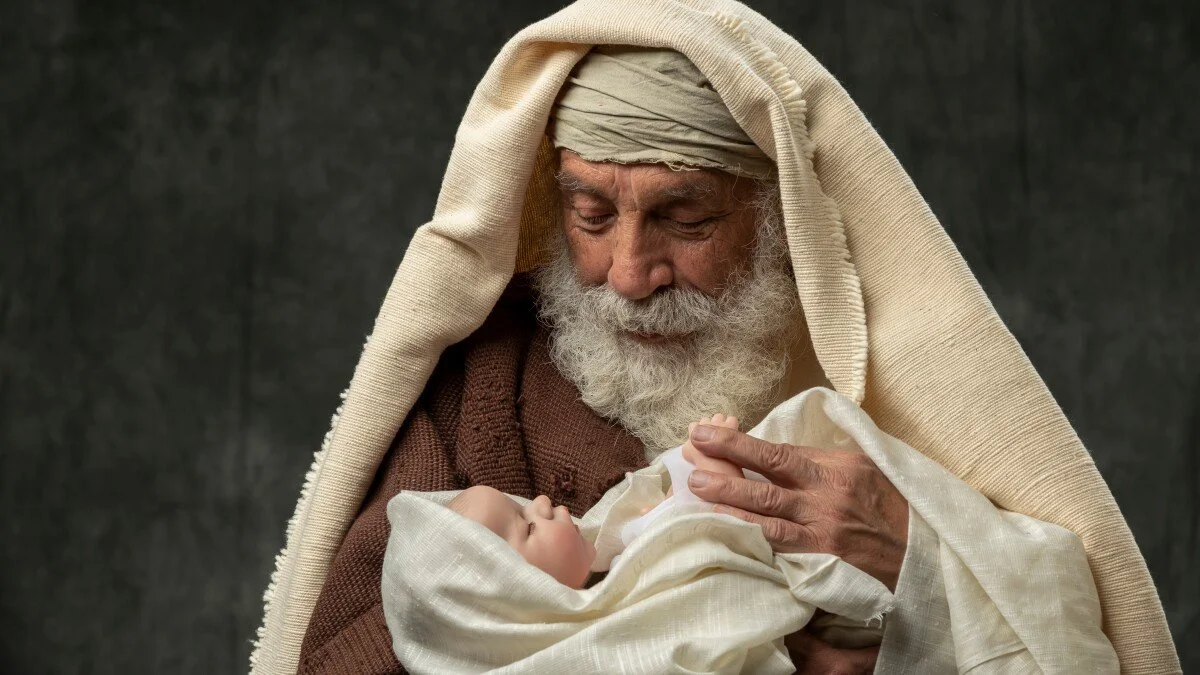
Luke 2:22-38. The Importance of Jesus
Over the years there has been much debate as to which of Christmas, Easter or Whitsun was the most important Christian festival. There is no doubt that today Christmas wins the popular vote.
Certainly it is still a popular even if odd season for many today. People love the idea of families and they love a new born baby. He is so unthreatening. It seems to be a lovely story that God entered his world as a cuddly baby. Most celebrate Christmas without any thought of Jesus or his importance, theirs is a cultural Christmas.
Some whit asked, ‘What is left if you take Christ out of Christmas?” He answered his own question. “M and S”, shops and materialism.
It has been pointed out that neither Mark nor John mention the nativity of Jesus. However this passage in Luke shows that all of the life of Christ, from his birth, his death, his resurrection and his ascension are all integrated in their meaning.
Luke is a fastidious historian. He includes this remarkable story of two elderly people, significantly a man and a woman, who both recognised that baby Jesus was very special indeed. They were both full of expectation, they were both looking for the fulfilment of the Old Testament prophecies about God’s Messiah entering his world.
1. Luke stresses that the Holy Spirit is powerful
They knew that the baby Jesus, who must have looked the same as any other baby, was highly significant. Had they heard of his genealogy and his birthplace that are prophesied in their Scriptures? Luke does tell us that God was working in an extraordinary way at this time.
“He was waiting for the consolation of Israel, and the Holy Spirit was on him.. It had been revealed to him, by the Holy Spirit, that he would not die before he had seen the Lord’s Messiah. Moved by the Spirit he went into the temple courts . . .” Luke 2:26-27
We are told that those featuring in this early story were filled with the Holy Spirit, the Spirit of God:
John the Baptist – Luke 1:17
Mary, Jesus’ mother - Luke 1:35
Elizabeth, John the Baptist’s mother – Luke 1:41
Zechariah, John the Baptist’s father – Luke 1:67
Simeon, the elderly priest – Luke 2:25
Are we as clear about the Holy Spirit’s role today?
Let’s see what else Luke wants us all to know from these short accounts.
2. Luke stresses that the Old Testament is fulfilled in Jesus
These stories about Simeon and Anna should alert those people, who doubt the inspiration of Scripture, to think again. It is the Old Testament Scripture that prophesies in great detail the future birth of God’s Messiah, the man who would be God’s Chosen King. They were both waiting for these prophecies to be fulfilled.
Simeon – “He was waiting for the consolation of Israel.” Luke 2:25
Anna – “She gave thanks to God and spoke about the child to all who were looking forward to the redemption of Jerusalem.” Luke 2:38
Joseph and Mary were also deeply committed to living according to God’s law and Luke clearly wants his readers to know this by mentioning it five times:
“When the time came for the purification rites required by the Law of Moses, Joseph and Mary took him to Jerusalem to present him to the Lord (as it is written in the Law of the Lord, “Every firstborn male is to be consecrated to the Lord”), and to offer a sacrifice in keeping with what is said in the Law of the Lord: “a pair of doves or two young pigeons.” Luke 2:22-24
“When Joseph and Mary had done everything required by the Law of the Lord, they returned to Galilee to their own town of Nazareth.” Luke 2:39
“When he was twelve years old, they went up to the festival, according to the custom.” Luke 2:42
Luke is telling us that the Christian story is rooted in the Old Testament. He is telling us that God always fulfils his promises. There is no conflict between the Law of the Old Testament and the message of the New Testament.
All God’s people must live in obedience to what God has told us in his Word.
In 2018 the Bible Society reported a very disturbing survey of Christian Millennials, those born between 1981 and 1996. They found that 51 per cent of people claiming to be Christians only engage with the Bible a few times a year or less!
Are we all reading our Bible’s every day and meditating on what it says?
3. Luke stresses that Jesus stands in our place to fulfil the Law
“(as it is written in the Law of the Lord, “Every firstborn male is to be consecrated to the Lord”).” Luke 2:23
This raises a natural question, ‘Why should this apply to Jesus if he was already God’s Son?’ The New Testament teaches that Jesus was the second Adam. The Law of Moses and the prophets all point us to the Messiah. Paul later stresses this:
“But when the set time had fully come, God sent his Son, born of a woman, born under the law,” Galatians 4:4
4. Luke stresses that Jesus would bring salvation
Both Joseph and Mary, a virgin, were specifically told of the coming supernatural birth and that he was to be called Jesus, which has a special meaning, ‘The Lord saves’. This Saviour would become the world’s eternal king. Mary was told:
“You will conceive and give birth to a son, and you are to call him Jesus. He will be great and will be called the Son of the Most High. The Lord God will give him the throne of his father David and he will reign over Jacob’s descendants forever; his kingdom will never end.” Luke 1:31-33
This is extraordinary. This child will be God’s king for eternity, for ever. The priest Zechariah, John the Baptist’s father, filled by the Holy Spirit, also recognised that his son would prepare the way for the Messiah who would come to save people:
“Praise be to the Lord, the God of Israel, because he has come to his people and redeemed them. He has raised up a horn of salvation for us in the house of his servant David (as he said through his holy prophets of long ago), salvation from our enemies . . . to rescue us from the hand of our enemies, and to enable us to serve him without fear in holiness and righteousness before him all our days.’ Luke 1:68-75
This is not talking about a military victory over the Romans or other nations, this is about personal victory over fear, temptation and sin. John the Baptist will be the Lord’s prophet who will prepare people for the coming of the Messiah. The role of both John and the Messiah, who will follow him, will be to teach people about the salvation that the Messiah alone can give to people. The baby John was told,
“And you, my child, will be called a prophet of the Most High; for you will go on before the Lord to prepare the way for him, to give his people the knowledge of salvation through the forgiveness of their sins, because of the tender mercy of our God.” Luke 1:75-78
This is the gospel in a nutshell. It is because of God’s grace for sinners that the Messiah came. People need to be taught about Jesus. We need to talk about Jesus. He is the only means of salvation as he alone is able to forgive our sin against God. This so much more than a political leader. The Christmas message is about salvation, about being put right with God and nothing less.
Jesus’ name leaves us in no doubt about what he had come to achieve; his name means ‘The Lord saves.”
Listen again to what this elderly priest, Simeon has to say about Jesus. This is widely called the Nunc Dimittis, which is Latin for ‘Now dismiss’.
Bishop J.C Ryle says this of Simeon and what he had to say:
“He speaks as one for whom death has lost its terrors and the world its charms.”
Can you feel the joy and confidence his statement exudes?
““Sovereign Lord, as you have promised, you may now dismiss your servant in peace. For my eyes have seen your salvation, which you have prepared in the sight of all nations: a light for revelation to the Gentiles, and the glory of your people Israel.” Luke 2:29-32
Simeon knew from his knowledge of Scripture that the Messiah would bring eternal salvation to people. What confidence this knowledge should give all of us. Like Simeon, we should love to joyfully share this understanding with people around us.
The very old Anna also understood the reason this child had been sent into the world. She:
“ . . .spoke about the child to all who were looking forward to the redemption of Jerusalem” Luke 2:38
Jerusalem here is shorthand for the Holy City of God’s chosen people and represents all of God’s people who would be redeemed or rescued from their sin because of the sacrifice of the Lord Jesus.
5. Luke stresses that this salvation is for all people
Simeon’s understanding is remarkable:
“ . . . my eyes have seen your salvation, which you have prepared in the sight of all nations: a light for revelation to the Gentiles.” Luke 2:30-32
This echoes what the angel said to the simple shepherds looking after the sheep near Bethlehem,
“I bring you good news of great joy that will be for all the people.” Luke 1:21
This is precisely what Isaiah said in his first ‘Servant Song’ about the coming Messiah,
“I, the Lord, have called you in righteousness; I will take hold of your hand, I will keep you and will make you to be a covenant for the people and a light for the Gentiles, to open eyes that are blind, to free captives from prison and to release from the dungeon those who sit in darkness.” Isaiah 42:5-7
This is also what God said to Abraham:
“ . . . and all peoples on earth will be blessed through you.”
This is exactly what Jesus said about God’s people, about you and me:
“Therefore go and make disciples of all nations . . .” Matthew 28:19
The gospel has never changed,
“For God so loved the world that he gave his one and only Son, that whoever believes in him shall not perish but have eternal life.” John 3:16
This salvation is therefore for individuals from every national background, Arab, Jew, Hindu, atheist, nominal Christian – we all need to know Jesus personally, if we are to be put right with God and empowered to live for him.
Also reminds us that Christians have been chosen by our Lord to share this good news with others. Is this a priority for our lives? God knows.
6. Luke stresses that Jesus would cause the ‘falling and rising of many’
When the Christian message is explained, people react in different ways. Some love the story of forgiveness and purpose and are ‘lifted up’, but others reject the story and ‘fall away’ After blessing the baby Jesus, Simeon says to Mary,
“This child is destined to cause the falling and rising of many in Israel, and to be a sign that will be spoken against, so that the thoughts of many hearts will be revealed.” Luke 2:34-35
It is how we think or react to Jesus that will affect our eternal destiny. If we are protected by the righteousness of Christ we will be lifted up to be with him but if we go on living without him, eventually, according to Jesus, we will fall away from all that the presence of God brings.
John reminds us of this fact at the beginning of his gospel; some Jews would reject Jesus but others would believe in him:
“He came to that which was his own, but his own did not receive him. Yet to all who did receive him, to those who believed in his name, he gave the right to become children of God.” John 1:11-12
The prophet Isaiah was given the same warning about the effect the Messiah would have:
“He will be a stone that causes people to stumble and a rock that makes them fall. And for the people of Jerusalem he will be a trap and a snare. Many of them will stumble; they will fall and be broken,” Isaiah 8:14-15
Both Paul (Romans 8:33) and Peter (1 Peter 2:6-8 were later to apply this verse from Isaiah to reactions people have to the message of Jesus. Peter adds:
“They stumble because they disobey the message . . .” 1 Peter 2:8
Some Gentiles would be saved but some Jews would be lost.
No-one need wait for the final judgment to know how we stand in God’s eyes. Reflect on how you respond to Jesus. Do you trust him, love him, live for him and obey him? If so God has promised that you have salvation. If you reject him or are sitting on the fence you will be condemned.
Some of you may know the word Mugwump from the Harry Potter films about Dumbledore’s early days. It was noted that he was the Supreme Mugwump. Mugwumps were decided upon by an ancient creature called the Qilin. The Qilin could see into the purity of a person’s soul and see the future, so they would wander around potential candidates and bow at the person they felt was most worthy.
Originally the name Mugwump came from a native American tribal chief who was renounced for sitting on the fence about most things. He would agree with his tribal council whenever they met and he would agree with the US Cavalry officers whenever he met them. However some wit described a Mugwump as a person who sits on the fence with his ‘mug on one side and his ‘wump’ on the other.’ Such people are most uncomfortable when they fall off! The point however is not to be a ‘mugwump’ when it comes to Jesus.
7. Luke stresses that Jesus would be spoken against
Simeon adds,
“. . . and to be a sign that will be spoken against.” Luke 2:34
Not only will some people privately reject Jesus, there will be others who will vociferously speak against him and what he stands for. If you talk about Jesus someone will be upset. This shouldn’t surprise us as whenever Jesus spoke about his Father he was maligned and threatened. Whenever the apostles spoke about Jesus they were accused of causing social disorder and were persecuted, abused, imprisoned and even martyred.
8. Luke infers that Jesus’ death would be significant
Simeon does not say this specifically but adds:
“And a sword will pierce your own soul too.” Luke 2:35
These must have been worrying words to Mary. Thirty years later Mary was to stand before her crucified son, watching him die and have a spear pierce his side whilst the mob ridiculing him. Yet even this deep sorrow was to turn Mary and his followers to joy when on the third day they saw him resurrected.
The Christmas story is never complete without the story of Good Friday and Easter Sunday.
9. Luke stresses that our decision about Jesus will eventually be obvious to all
Simeon added,
““. . . so that the thoughts of many hearts will be revealed.” Luke 2:34
Some people think that their decision about Jesus is private. That must not be the case for Christians. We are Christians because we both believe in our hearts and confess with our lips. Paul stressed this:
“If you declare with your mouth, “Jesus is Lord,” and believe in your heart that God raised him from the dead, you will be saved. For it is with your heart that you believe and are justified, and it is with your mouth that you profess your faith and are saved.” Romans 10:9-10
My wife arranged for a salesman of Cable Television to visit our home one Saturday morning. I was hard at work preparing for a mission and had my Bible and commentaries spread out on our small lounge table. He came and joined me and started to explain the benefits of cable television. But then, noticing the books, he said,
“I see that you are religious. Do you know that if you subscribe to cable television, you can have the God Channel for free.’
I managed to avoid telling what I thought of much of the God channel content but instead asked him,
“Are you interested in Christian things yourself?”
He answered,
“I would call myself a Christian but I think these things are private and personal!”
It appeared that he wasn’t happy to talk about the Christian faith so I tried a different tack,
“I can understand that, but I would guess that there is one problem with your approach.”
‘What’s that?” he naturally asked.
“Well it probably means that you don’t talk about it much with others to make sure you’ve understood it correctly.”
“That’s probably true,” he answered.
What an opportunity this offered.
“Would you mind if I briefly share a summary of what Jesus taught to make sure you have got it right?”
‘That would be interesting,’ came the reply.
For the next hour we had a great conversation about Jesus and the gospel and he took a copy of ‘Cure for Life’ away with him, promising to read it. There is a natural reticence to talk about Jesus.
The Christian message is very personal and therefore somewhat embarrassing. God knows what we really think about his rule. Most people are good at putting up fronts and often a pretence but behind this facade all people desperately need God’s salvation. No-one can be indifferent to the Jesus who entered this world in order to help them.
If this story about Jesus, that Simeon and Anna summarise, is untrue it is the most breathtaking fraud in history. The prophecies about Jesus have to be somehow explained away; his life, death and resurrection must be somehow refuted, Furthermore what caused those disciples to give up their lives to tell people about Jesus must be explained, as must the dramatic expansion of his church in the first century AD. The instincts in all people shouts that life does have a purpose, that values such as honesty, integrity and love are real and essential.
If the story about Jesus is true it is foolish not to glory in Jesus and the forgiveness he has won for us. We should all bow before him because he is worthy of our worship and praise.
This story is either life changing or will result in our rejecting it. God knows where each of us stands, where the members of our families and our friends stand. We need to ask ourselves and help others to ask,
“Where do I stand? Do I believe who he is?”
Luke keep pressing these questions,
“Do I love him, do I openly exalt him?”
The effect of allowing ourselves to come under Jesus’ control is completely life changing and this remains the churches message. Paul wrote later,
“For what we preach is not ourselves, but Jesus Christ as Lord, and ourselves as your servants for Jesus’ sake. For God, who said, “Let light shine out of darkness,” made his light shine in our hearts to give us the light of the knowledge of God’s glory displayed in the face of Christ.” 2 Corinthians 4:5-6
Simeon and Anna saw that face in the temple. They recognised that he really was God’s Messiah. Have we all here, have our families and friends grasped this? It is because of Jesus that we can all have total confidence in God’s promises, wonderful contentment in our Saviour and a total commitment to his calling. What a blessing it is to be chosen by God to be saved for his service.
BVP

Luke 11:29-36 Changing your mind

Why do people find it so hard to become Christians when there is so much evidence that it is true?
There is evidence from science that there has to have been a mind behind our creation. Who set the constants of the universe? Who designed the DNA system and code? How is it that our earth has exactly right properties that enable man to live on it? There is the evidence about Jesus and his life, teaching, miracles, his death and resurrection. There are the many Old Testament prophecies that are fulfilled in him. What changed those early disciples so radically that they turned the world upside down within a generation? Philosophically we know that if our arguments start with man we have nothing certain to live for or by but if we start with God we can find coherent answers. Furthermore all humans have inherent spiritual instincts. We instinctively recognise that love, kindness, honesty, beauty and duty are real values although they cannot be proved. If we came accidentally from primordial soup, such values are artificial but if we are created in the image of God they can be explained and are real. However in spite of such evidence, and there is much more than this, few people want to become Christians.
David McRaney, a psychologist, has written a fascinating book, ‘How Minds Change: The Surprising Science of Belief, Opinion, and Persuasion’. In this book he argues that people’s beliefs, whether political, economic or religious are seldom based on a cold evaluation of the facts, rather they are formed from the tribe we come from or the society we surround ourselves with. It seems that we are biologically hard-wired to keep believing whatever we already believe. He feels that facts rarely change people’s minds. He describes an experiment where they put E.E.G electrodes on people’s heads before they became engaged in a political discussion. When the arguments were going strongly against them they wouldn’t change their minds, they just mentally clammed up and stopped listening.
It seems we are biologically wired up to keep believing what we already believe. Yet the Christian gospel calls on people to change their minds radically. ‘Repent’ literally means to ‘re-think’, to rethink the direction of our lives. The Greek word for ‘repent’ is metanoia which literally means ‘a change of mind’.
What more is needed that will persuade people to recognise the significance of Jesus Christ so that lives are permanently changed? Will it be spell-binding rhetoric in our pulpits, the ambiance of packed meetings or even irrefutable apologetics, a brilliant disclosure of the evidence that the message about Jesus is true. Even if such methods may have short-term effects Christian conversion is something much deeper – it is utterly life changing. Christian conversion is much more than hearing and agreeing, it is the doing that keeps on being done that matters. Jesus said,
“Blessed are those who hear the word of God and obey it.” Luke 11:28
What a disaster it is when people, who say they believe, live in ways that deny their so-called faith.
Jesus was quite willing to state publicly why many people would not believe in him, he says it is because we all have stubborn sinful hearts. What stops our faith is not a lack of facts or information.
“As the crowds increased, Jesus said, “This is a wicked generation. It asks for a sign, but none will be given it except the sign of Jonah. For as Jonah was a sign to the Ninevites, so also will the Son of Man be to this generation. The Queen of the South will rise at the judgment with the people of this generation and condemn them, for she came from the ends of the earth to listen to Solomon’s wisdom; and now something greater than Solomon is here. The men of Nineveh will stand up at the judgment with this generation and condemn it, for they repented at the preaching of Jonah; and now something greater than Jonah is here.” Luke 11:29-32
The wicked will always want more evidence
In the original Greek the phrase, ‘It asks for a sign’ is in the present continuous tense so it literally means, ‘It keeps asking for a sign’. Up until this point in Luke’s record of the life of Jesus he has described some of the many miraculous signs that Jesus had performed. He had calmed the storm, showing he was Lord of the natural world, he had healed the deaf and lame, raised the dead and cast out demons, showing he was Lord over Satan. What more did his critics want. Even when he rose from the dead, as he had frequently foretold, many still would not believe in him.
Jesus encouraged people to look at the evidence supporting his claims, it is the abundance of this evidence that convinces us that his message is true. In John’s gospel there are three major sections where Jesus urges people to look at the evidence and these passages are worth studying (John 5:31-47, John 8:31-59 and John 10:22-42).
This crowd kept on asking for more and more evidence when the reality was standing there before them. How much evidence did they need? There is a Chinese proverb that says,
“Man stands long time with mouth wide open waiting for roast duck to fly in.”
The real reason they wouldn’t believe was because they recognised that faith would necessitate radical changes in lifestyle. It was their wickedness that controlled their thinking.
Aldous Huxley was an avowed atheist author who wrote the great twentieth century dystopian novel ‘Brave New World’. In his collection of essays, ‘Ends and Means’ he very honestly explained the rationale for his atheism.
““I had motives for not wanting the world to have a meaning; and consequently assumed that it had none, and was able without any difficulty to find satisfying reasons for this assumption. The philosopher who finds no meaning in the world is not concerned exclusively with a problem in pure metaphysics. He is also concerned to prove that there is no valid reason why he personally should not do as he wants to do. For myself, as no doubt for most of my friends, the philosophy of meaninglessness was essentially an instrument of liberation from a certain system of morality. We objected to the morality because it interfered with our sexual freedom. The supporters of this system claimed that it embodied the meaning - the Christian meaning, they insisted - of the world. There was one admirably simple method of confuting these people and justifying ourselves in our erotic revolt: we would deny that the world had any meaning whatever.”
Thomas Nagle, an American Professor of Law and Philosophy wrote a book in 1997 called, ‘The Last Word’. This is a philosophical defence of atheistic rationalism but it reveals that his motives are not basically rational. He wrote,
“I want atheism to be true and I am made uneasy by the fact that some of the most intelligent and well-informed people I know are religious believers. It isn’t just that I don’t believe in God, and naturally hope that I’m right in my belief. It is that I hope there is no God. I don’t want there to be a God. I don’t want the universe to be like that. My guess is that the cosmic authority problem is not a rare condition.”
This is precisely what Jesus said, it is our determination to live our lives as we want that controlled how we assess evidence. Aldous Huxley had an open marriage and many mistresses!
The Sign of Jonah
Here in Luke’s gospel the ‘Sign of Jonah’ was the fact that the evil city of Nineveh repented when they were challenged by Jonah’s preaching – they repented and turned back to God. In the British museum there are some carvings that portray the wickedness of the people of Nineveh. They would spear their enemies, chop off their legs, flay them alive and chop off their heads!
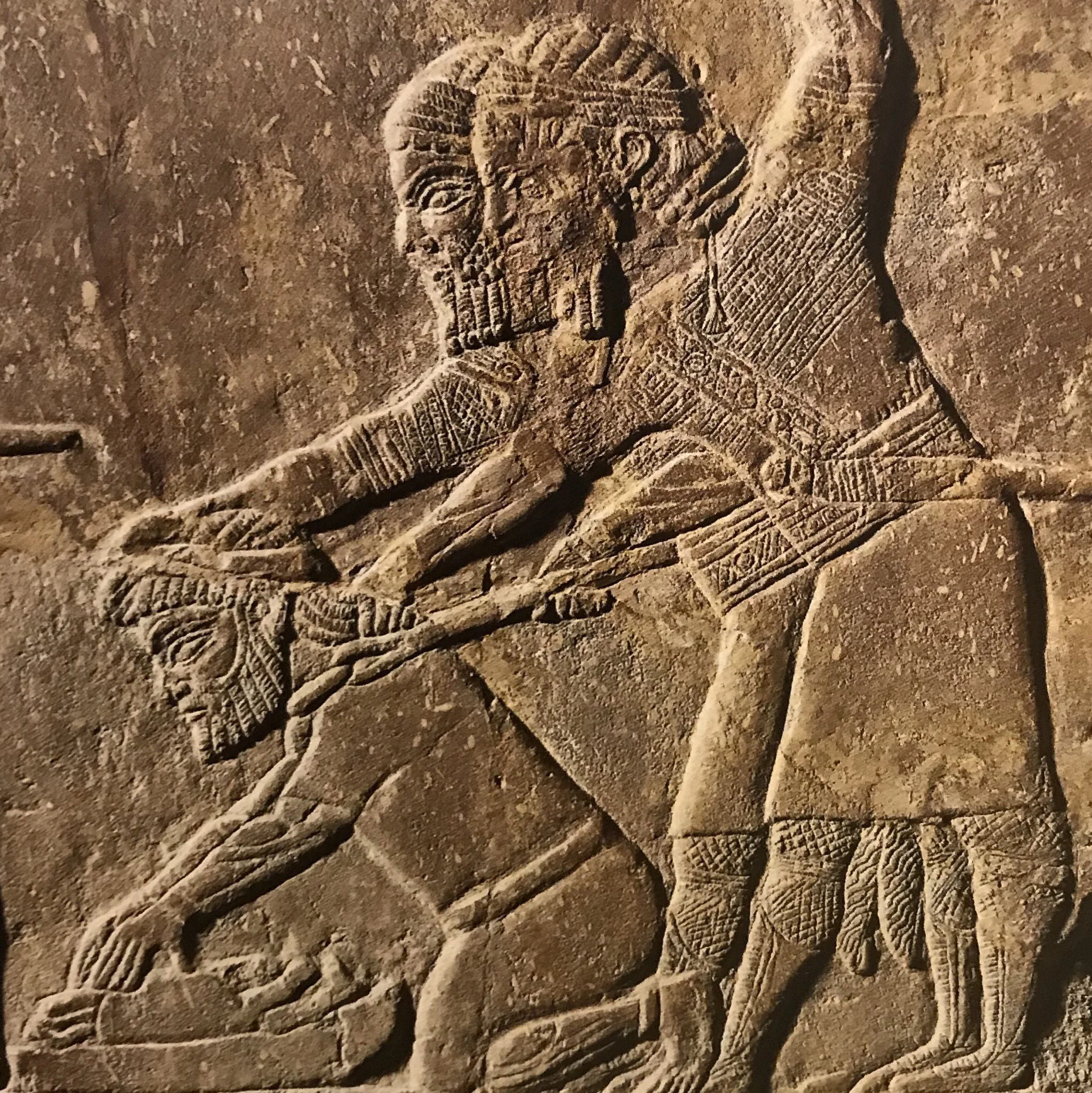
Two Assyrian soldiers forcing a Babylonian captive to grind bones of his family,
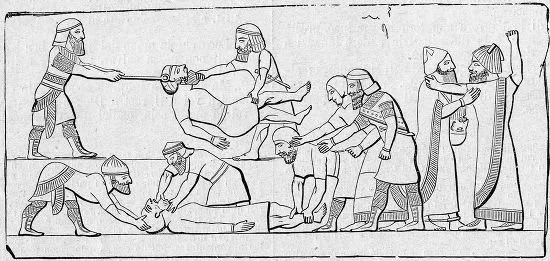
Ninevites torturing their captives (engravings from the British museum)
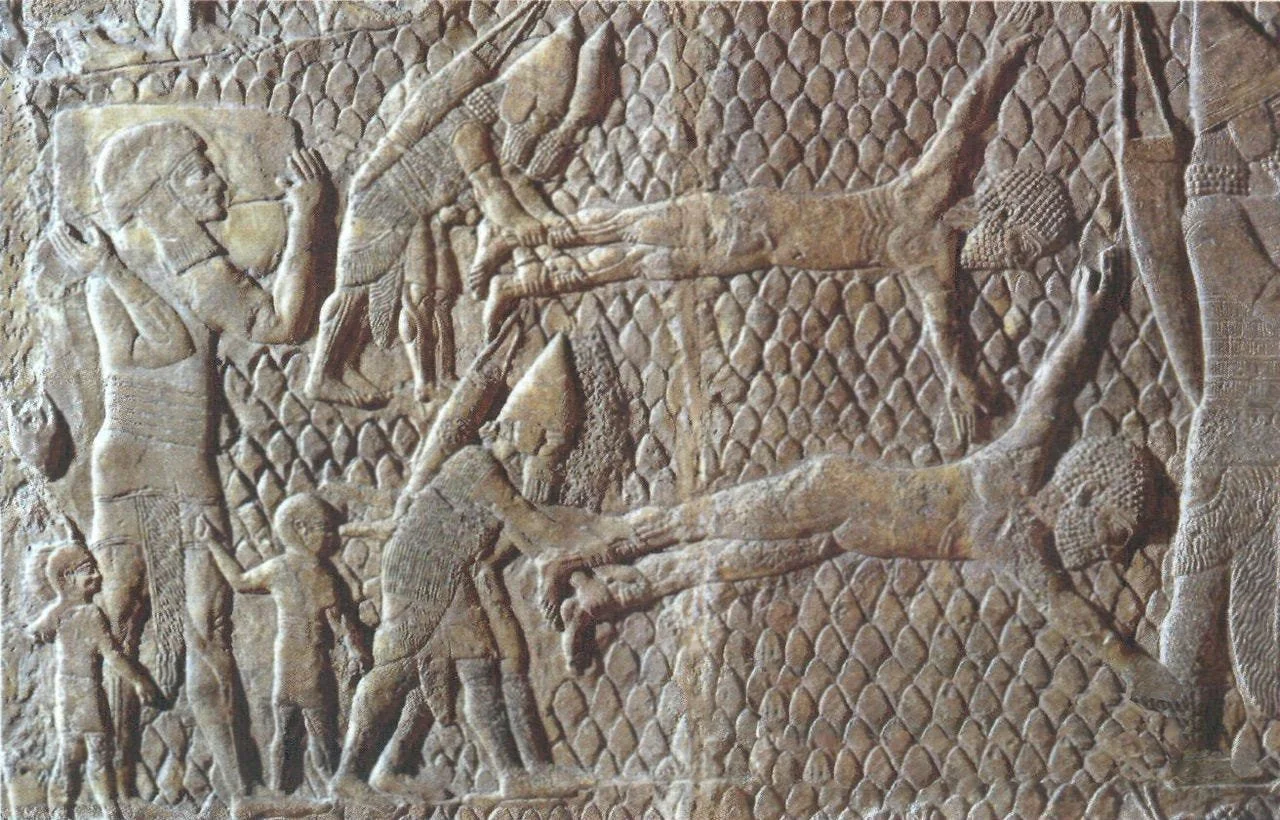
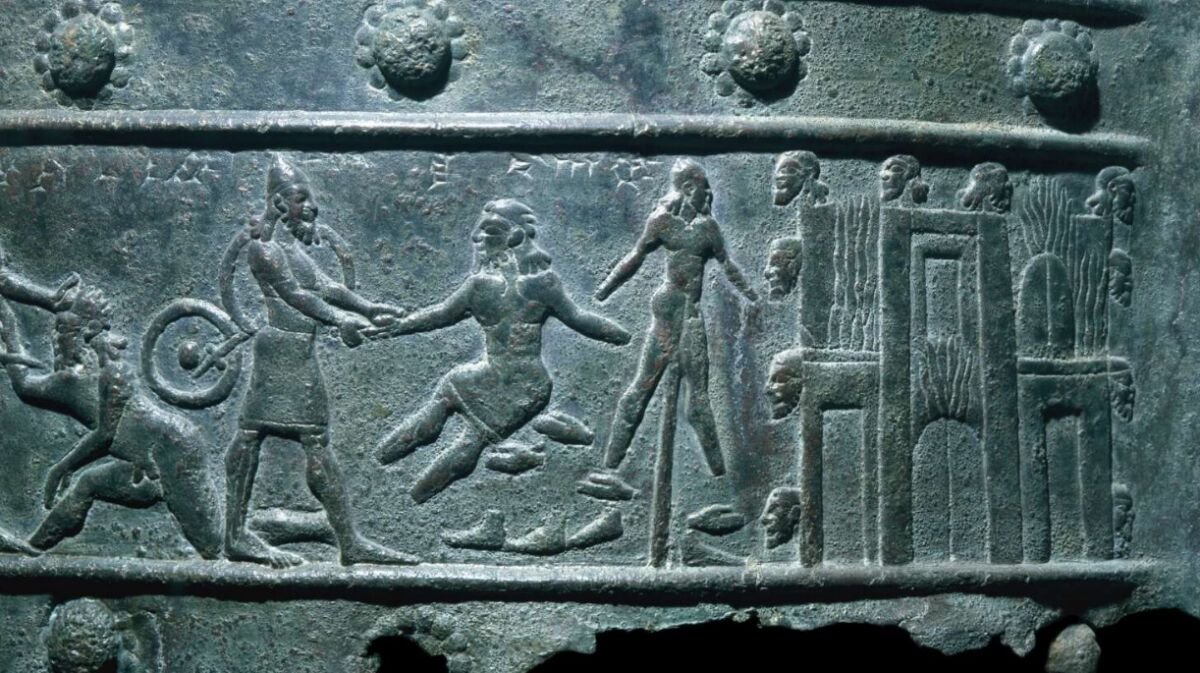
The Ninevites were certainly a pagan, cruel, and utterly evil people yet they could repent wholeheartedly at the message of judgment! Jesus says that these men of Nineveh will stand up at the final day of judgment and condemn the Jews for not believing in the need for repentance, for turning back to God.
Jesus frequently compares the behaviour of the Jews, God’s chosen people with that of outsiders and he then gave another example. If a foreigner, the Queen of Sheba, could recognise the wisdom of Solomon, could travel a very long way to ask him hard questions, could so learn about God, and could end up persuaded, then what is stopping the Jews, a more privileged people from discovering the truth. Sheba was the combined region of Yemen and Ethiopia so the journey would not be easy.
The message of Jesus remains the same today. Whatever our past anyone can start a new life as one of God’s people, empowered by His Spirit, to live lives for his glory. Jesus had already set his heart on going down to Jerusalem where he knew he would be arrested and killed by crucifixion. Yet he was determined to go through with all this so that he could be the Saviour of the world. He would be cut off from God so we could be reconciled with God – such love. He would rise from the dead to prove his claim to be the very Son of God.
We may not know everything but we all know enough especially about ourselves to know that we need to be forgiven by God if we are to have any future with him.
The light is not hidden
The wicked may claim that they do not have enough light to see the truth but Jesus rejects this claim.
“No one lights a lamp and puts it in a place where it will be hidden, or under a bowl. Instead they put it on its stand, so that those who come in may see the light. Your eye is the lamp of your body. When your eyes are healthy, your whole body also is full of light. But when they are unhealthy, your body also is full of darkness. See to it, then, that the light within you is not darkness. Therefore, if your whole body is full of light, and no part of it dark, it will be just as full of light as when a lamp shines its light on you.” Luke 11:33-36
Jesus repeatedly claimed to be the light of the world that is not hidden.
To be in he dark is a miserable state to be in. We lack knowledge, we are outsiders, we cannot see the right way to go. When I was speaking at a student conference in Denmark the organisers decided to take us all on a late night walk through a local forest. It was totally pitch black, we couldn’t see anything. The only way to move forwards was to hold onto the clothes of the person in front of you. It was eerie and most disorientating. When the military want to break a captive it is common practice to place them in a pitch black cell as this tends to separate people from reality.
Jesus says that this is our natural spiritual condition. We are vulnerable and are liable to take wrong paths. This light of God is not just for the religious, he is available to all. This is why he is repeatedly described as ‘a light to the Gentiles’ (Isaiah 42:6, 49:6, Luke 2:32 and Acts 13:27). Jesus did what the Jews kept failing to do – to bring god’s light to all people.
The suggestion that Jesus was hiding his light is bizarre. He deliberately went to Jerusalem so everyone could know about him and his sacrificial death. What is necessary is for people to go to where that light is,
“. . . so that those who come in may see the light.” Luke 11:33
Culpability for not seeing the light remains on those who refuse to go to the light. Didn’t Jesus say,
“Ask and it will be given to you; seek and you will find; knock and the door will be opened to you. For everyone who asks receives; the one who seeks finds; and to the one who knocks, the door will be opened.” Matthew 7:7-8
I have just been watching some videos on YouTube of blind people who have been able to see after modern surgery. The thrill on their faces was wonderful – they can see after living in the dark for years.
Why cannot everybody see how everything fits together in Jesus? The facts about him are clear. He explains why those innate instincts within all of us that life has a purpose, that there is right and wrong, that sin matters, that values such as honesty, courage and beauty are real. He gives those of us who are getting older both hope and security. It all makes sense but people do not want to see this.
At my medical school I had a friend who asked me why I was a Christian. We spent a long time going over the evidence that had convinced me and he had no answers to the arguments. However when I asked him whether he would be willing to commit himself to Christ he replied after a pause,
“No, I’m sorry , but I see that it would mean great changes to the way I enjoy living now.”
It was as if he had blinkers over his eyes, like a cart-horse and can only have a limited perspective.
The responsibility for seeking and obeying God’s truth is ours. Jesus said,
“Blessed are those who hear the word of God and obey it.” Luke 11:28
“See to it then to see that the light within you is not darkness.” Luke 11:35
If anyone wants to know whether what Jesus is saying about himself, they need to understand that the block is not in a lack of evidence about him, it is an unwillingness to obey what God has said. Elsewhere he said,
“Anyone who chooses to do the will of God will find out whether my teaching is of God.” John 7:17
What will persuade people about Jesus?
No matter how hard we try or how many arguments we present, ultimately only God can persuade a person that the Gospel is both true and for them. Jesus said, “No one can come to me unless the Father who sent me draws him” (John 6:44). People are spiritually blind. I became a Christian because I saw that the Christians around me had something different about them that was admirable. They had a purpose and a morality that I instinctively knew to be right. It was the light in them that led me to look at their Jesus. Without seeing that difference, the arguments would have had much less impact.
This is why the most important thing we can do for our neighbours is to pray for them. Right now, they doesn’t believe there is any need to have their sins forgiven – and therefore they doesn’t believe they need Christ. They may think that they are relatively ‘good’ – but cannot see that in God’s eyes they are rebel’s against his rule. Pray that they will face up to their own spiritual emptiness, and that God will convict them of their self-righteousness and need for Christ. The Bible says the Holy Spirit “will convict the world of guilt in regard to sin and righteousness and judgment” (John 16:8).
Christians need to ask God to help us be a witness to others by the way we live – including the way you react when things don’t go the way you wish they would. Anyone can be at peace when things are going well – but how do you react when things turn against you? The Bible says, “But the fruit of the Spirit is love, joy, peace, patience, kindness, goodness” (Galatians 5:22). It is these characteristics that make Jesus attractive and can lead them to respond to our invitations to investigate the truth of the claims of Christ, who alone can give hope for this life and the next.
Jesus wants all his people to be full of the light of the Spirit of Jesus in us. It is as if a spotlight is shining on us that others will see. Hidden sin in us will prevent this light shining. Jesus concluded,
“Therefore, if your whole body is full of light, and no part of it dark, it will be just as full of light as when a lamp shines its light on you.” Luke 11:33
A student wrote to his tutor,
“I’m not coming back next term. I’m taking time out to find myself. I feel I am the product of what my family, society and school want me to be, but I want to get to the core of my being and find myself.”
Such people seem to think they are like an onion and if only they can peel off the layers, the socially generated skins they will find themselves at the core. Such thinking suggests that all of us have a true self waiting to be found. This is not true self is something waiting to be created by what we commit ourselves to and live by.
This is why Jesus is both ‘the sign of Jonah’ and the ‘lamp of the body,’ he alone embodies both intellectual truth and can give us an experience of reality.
BVP
This article is based on a talk given by Andy Palmer at Christchurch Balham

Luke10:25-37 Is Meritocracy Christian?

In 1958 Michael Young wrote a novel ‘The Rise of Meritocracy’ which introduced the idea of ‘meritocracy’. His book is set in 2033 when democracy was abandoned and replaced not with aristocracy, not with rule by the financially successful, a plutocracy of wealth, but with government by a meritocracy of talent. Meritocracy is a social system, society, or organization in which people get success or power because of their abilities, not because of their money or social position. At first sight it seems to sound right.
This system has been advocated by many politicians such as Tony Blair and Theresa May. Barack Obama in his inaugural address in 2013 said,
“We are true to our creed when a little girl born into the bleakest poverty knows that she has the same chance to succeed as anybody else…”
Donald Trump in his inaugural address in 2017 also said,
“We must create a level playing field for American companies and workers.”
Michael Young was a sociologist and reformer who was a chief architect of Britain's postwar welfare state, but he was certainly not an advocate of this system at all, viewing it as dystopian and dangerous. He shows in this novel and in other writings that such a society quickly becomes merciless and those at the bottom are thought to be there because that is where they deserve to be, not because they are victims of circumstances, prejudice and unfairness. The difficulty is that so much in life is unfair and trying to make everything fair can remove what is good. Those raised in close, loving, motivated homes will always have a great advantage over those who were not. The former group will tend to have ambition, commitment and perseverance that unfortunately others may not. However much those coming from disadvantaged situations are encouraged, ‘level playing fields’ can never be created.
Although widely held, the belief that merit rather than luck determines success or failure in the world is demonstrably false. This is not least because merit itself, to a large part, is the result of luck. Talent and the capacity for determined effort, depend to a great deal on a person’s genetic makeup and upbringing. An article in the Guardian newspaper in 2002 pleaded with Tony Blair to stop using the word ‘meritocracy’ as a goal to be desired.
“If meritocrats believe . . . that their advancement comes from their own merits they will feel they deserve everything they have. They can be insufferably smug, even believing they have morality on their side.”
A growing body of research in psychology and neuroscience suggests that believing in meritocracy makes people more selfish, less self-critical and even more prone to acting in discriminatory ways.
Is the Kingdom of God a meritocracy?
So many people assume that it is how they live their lives that will make them acceptable to God. I well remember a patient with terminal cancer who, when asked how she would fare when she met God replied,
“I think I’ll be alright, I’ve never done any one any harm. I am better than most.”
Most people do think that living relatively moral, upright and religious lives is the key to receiving eternal life. The problem is that such people can so easily become smug because they believe in their own righteousness.
In the Bible, salvation is always described as being by grace, it has never been deserved. There can be not ‘meritocracy’ in God’s eyes as no-one merits his favour. Paul made this abundantly clear:
“But because of his great love for us, God, who is rich in mercy, made us alive with Christ even when we were dead in transgressions - it is by grace you have been saved. And God raised us up with Christ and seated us with him in the heavenly realms in Christ Jesus, in order that in the coming ages he might show the incomparable riches of his grace, expressed in his kindness to us in Christ Jesus. For it is by grace you have been saved, through faith—and this is not from yourselves, it is the gift of God - not by works, so that no one can boast. Ephesians 2:4-9
Self-righteousness is the belief that I can be righteous myself but tends to be associate with self-satisfaction. Neither are attractive but in god’s eyes they are downright lethal.
The Parable of the Good Samaritan
This is a much misunderstood parable. It is not saying that if anyone behaves selflessly, like the Samaritan did, that they will be saved, as that would go against the rest of the Bible’s teaching. What Jesus is saying is that the good news or gospel is for the broken, hurt, weak and lonely and that the self-righteous will miss out.
Note the context, Jesus was being tested by an expert in the law, one of the group opposed to Jesus. This was a trap. He asked, ‘What must I do to inherit eternal life?’ It sounds as if he thought that eternal life could be earned by being meritorious.
Jesus answers in his usual way by referring to what the Jewish Scriptures teach; they were always his authority.
“What is written in the Law?” he replied. “How do you read it?” Luke 10:26
“He answered, “‘Love the Lord your God with all your heart and with all your soul and with all your strength and with all your mind’; and, ‘Love your neighbour as yourself.’” Luke 10:27
We might expect Jesus would say, “Good works are what God expects to see in those who are saved but are not the means of being saved! Salvation is only given to those who follow me!’ However Jesus didn’t, instead he replied,
“Do this and you will live.” Luke 10:28
The difficulty that all people have is that no-one can or ever has fulfilled this command, ‘Love the Lord your God with all your heart and with all your soul and with all your strength and with all your mind.” Only one person, Jesus himself, has ever done this. The rest of us, if we are honest with ourselves, come nowhere near this standard. God cannot be bought off by our attempts at religion. Religion, which literally means trying to ‘tie ourselves back to God’ by what we do, can never satisfy a Holy God. Significantly this expert in the Law is still thinking in terms of meritocracy.
“But he wanted to justify himself,” Luke 10:29
How many people have tried to please God by being religious or by trying to be good!
The ‘Scala Sancta’ or ‘Holy Stairs’ were the twenty eight white marble stairs that lead up to the praetorium of Pontius Pilate in Jerusalem that Jesus Christ climbed up on the way to his trial. Medieval legends claim that Saint Helena, the mother of Emperor Constantine the Great, brought these Holy Stairs from Jerusalem to Rome circa AD 326. In the Middle Ages, they were known as "Scala Pilati" ("Stairs of Pilate"). It appears, from old plans, that they were placed to lead up to a corridor in the Lateran Palace. They became Roman Catholic relics. Climbing the Holy Stairs on one's knees became much in favour with pilgrims and the faithful. Popes gave faithful pilgrims indulgences, freedom from time in purgatory, if they completed this task.
In 1510 a young monk was on a pilgrimage to Rome. He climbed these steps on his knees, repeating the ‘Our Father’ on each step. It was said that, by doing this task, a person could ‘redeem their soul from purgatory.’ The young monk’s name was Martin Luther. When Luther arrived at the top of the stairs he could not suppress his doubt, “Who knows whether this is true?” He was beginning to question whether his religious devotion could ever merit the favour of Almighty God.
The expert in the Law does not continue to discuss whether he had complied with this impossible standard of loving God ‘with all your heart and with all your soul and with all your strength and with all your mind’, so he moves on to ask a tangential question.
“And who is my neighbour?” Luke 10:29
Those who try to please God by keeping his Laws are called ‘legalists’. They have three main problems. Firstly they can never be sure that their standards are high enough, and consequently there can never be that assurance of being right with God that the Bible talks about so much. This is the experience God wants his people to have. Secondly it blinds people to their own needs. Thirdly it makes people feel superior to others who haven’t reached their standard.
The American preacher, John Piper, has compared legalism with alcoholism:
“Legalism is a more dangerous disease than alcoholism because it does not look like one.
Alcoholism makes men fail, legalism helps them succeed in the world.
Alcoholism makes men depend on the bottle, legalism makes them self sufficient, depending on no-one.
Alcohol destroys moral resolve, legalism gives it strength.
Alcoholics don’t often feel welcome in the church, legalists love to hear their morality extolled in church.”
Jesus tells the parable of the Good Samaritan to explain that we all desperately need God’s mercy. The road between Jerusalem and Jericho passed between rocky hills and was considered very dangerous because robbers were common.
“A man was going down from Jerusalem to Jericho, when he was attacked by robbers. They stripped him of his clothes, beat him and went away, leaving him half dead. A priest happened to be going down the same road, and when he saw the man, he passed by on the other side. So too, a Levite, when he came to the place and saw him, passed by on the other side. But a Samaritan, as he traveled, came where the man was; and when he saw him, he took pity on him. He went to him and bandaged his wounds, pouring on oil and wine. Then he put the man on his own donkey, brought him to an inn and took care of him. The next day he took out two denarii and gave them to the innkeeper. ‘Look after him,’ he said, ‘and when I return, I will reimburse you for any extra expense you may have.’” Luke 10:30-35
The first religious man to come across the fallen victim of the robbers was a Priest (kohein), a descendant of Aaron. They were charged with performing various rites in the Temple in connection with its religious rituals and its sacrifices. They were considered a very special and holy group of people. This priest passed by the injured man, walking on the other side of the road. He was not going to be contaminated. Perhaps he had a religious meeting he had to get to.
The next person to travel down the road was a Levite. Their principal roles in the Temple included singing Psalms during Temple services, performing construction and maintenance for the Temple, serving as guards, and performing other services. Levites also served as teachers and judges, and maintained cities of refuge in biblical times. He also passed by the half-dead man.
Third major group within Judaism were the rabbis. They were the experts in the Old Testament and in Jewish law. They did not need to be Levites. The man speaking to Jesus was one of this group. Perhaps he expected the third person come across the fallen Samaritan would, like him, be a rabbi, but no, it was a Samaritan. Samaritans were very much looked down upon by orthodox Jews, yet his love was real,
“He went to him and bandaged his wounds, pouring on oil and wine. Then he put the man on his own donkey, brought him to an inn and took care of him. The next day he took out two denarii and gave them to the innkeeper. ‘Look after him,’ he said, ‘and when I return, I will reimburse you for any extra expense you may have.’
It is significant that the expert in the Law could not even say the word ‘Samaritan’. When asked ‘which of the three was a neighbour to the man who fell into the hands of robbers?’ he could only say,
“The one who had mercy on him” Luke 10:37
Jesus had not answered the expert’s question, ‘Who is my neighbour?’ but instead answered, ‘Who am I a neighbour to?’
Meaning of the Parable
Jesus wants his hearers to understand that we are each like the helpless man who was in dire need of mercy. His salvation did not come from religion but from an unexpected, rejected source – from grace. Jesus was rejected by the religious authorities, he was considered ‘outside the camp’ by the elite, yet it is he who is the neighbour, the aid to those in need. He is the God who has been rejected. He walked the dangerous road and it is he who is willing to help all those of us in need. He binds up our wounds, he paid the price for our salvation, he clothes us in his own righteousness. He continues to care for those who have turned to him.
To be saved is to accept the salvation, the forgiveness that Jesus alone can give us, but that is not the end. Faith without works is dead. No wonder Jesus then says to the expert in the Law,
“Go and do likewise.” Luke 10:37
We Christians must now continue his work of sharing the good news about Jesus Christ with others and acting in a way that honours God.
My son Andy was the minister at St John’s Hampstead and was about to take the funeral of David, a schizophrenic who occasionally came to the church. He had had a very difficult life with his schizophrenia and gambling. As the service was about to begin a friend of David turned up wearing bright blue dungarees and a small pink plastic guitar strapped to his back. He looked completely out of place. He asked Andy,
“Vicar can I say a few words about my friend David in the service?”
Andy din’t think this would be such a good idea so said, ‘Why don’t you ask the family and see what they think?’ In fact they agreed so after David’s brother had given an elegant eulogy this man Mike stood up at the back of the church and in a shouting voice and with red eyes he began,
“David’s life was a living hell, but now he is with Jesus for ever, and ever, and ever, and ever, and ever, and ever. I remember once when we were walking past a church up the road. Outside the church were a bunch of drunks. Everyone else was passing them by but David went to speak to them as if he had known them for years. He was able to show compassion for the suffering because he knew what it was like to suffer. He showed mercy to them because he had received mercy.”
The impact of that speech was dramatic – it was so real and moving.
Christianity is not a meritocracy for those who are religious and respectable, it is all about someone, Jesus, who cared enough that he came to die for us so that we could be forgiven our sin and be made right with God.
Accepting this truth is just the beginning of a new life. Once we belong to him, once have received mercy, we cannot be proud and elitist as we have nothing to be proud of, but we must go out and share what we have been given with others around us, people who so desperately need to learn about a Saviour so that they too might be saved.
BVP
This article is based on a talk given by Rev Andy Palmer at Christchurch Balham

Luke 12:1-12 Am I safe?

Thousands of people were following Jesus and listening to what he had to say. It was even becoming dangerous as they were beginning to trample on each other. It is interesting that this was the time that Jesus chose to say some home truths. He knew that some of them were not eternally safe, though they thought of themselves as being God’s people.
Warning against hypocrisy
Recently we watched millions of people pressing forward and joining 5 mile queues to see the coffin of the late Queen and pay their respects. How many knew the secret of her security? Jesus was constantly warning people against having a false sense of security, such as some religious people, like the Pharisees, can have,
“Be on your guard against the yeast of the Pharisees, which is hypocrisy.” Luke 12:1
Yeast is usually used in the New Testament as a symbol of sin and corruption. Just as a little yeast can affect a large amount of dough, so sin is contagious and permeates into all aspects of our lives, our families and our societies. Outward forms of religion without changed hearts is fatal. The Queen understood this well and every day she would spend time with the King she served. She longed to live as her Lord asked of her.
How can those of us who accept Christian doctrines and even go to church know for sure that we are safe in our relationship with God? Aren’t we all hypocrites to some degree? What more important question is there?
As Queen Victoria was leaving a service in St Paul’s Cathedral she asked one of her chaplains, “Can one be absolutely sure in this life of eternal safety?” Sadly the chaplain replied that he did not know any way in which one could be certain. The Court News published this conversation. An unknown evangelist read this and eventually wrote to the Queen:
“To her gracious Majesty, our beloved Queen Victoria, from one of her most humble subjects. With trembling hand but with heartfelt love and because I know that we can be absolutely sure now of our eternal life in the home that Jesus went to prepare, may I ask your Majesty to read the following passages of Scripture: John 3:16 and Romans 10:9-10? These passages prove that there is full assurance of salvation by faith in our Lord Jesus Christ, for those who believe and accept His finished work. I sign myself your servant for Jesus’ sake, John Townsend.”
Some weeks later he received a letter from the Queen,
“To John Townsend, Your letter of recent date I received, and in reply would state that I have carefully and prayerfully read the portions of Scripture referred to. I believe in the finished work of Christ for me and trust by God’s grace to meet you in that home of which He said, ‘I go to prepare a place for you. Victoria”
Jesus continues to remind us all that God knows what we really think and do.
“There is nothing concealed that will not be revealed, or hidden that will not be made known. What you have said in the dark will be heard in the daylight, and what you have whispered in the ear in the inner rooms will be proclaimed from the roofs.” Luke 12:2-3
Not only will there be no secrets but what we do and think will be made public! God’s justice will be obvious to all. What hope do any of us have? Without Christ becoming my Saviour, my substitute in taking responsibility for my sin, I would have no hope whatsoever. This is the Christian good news,
“God made him who had no sin to be sin for us, so that in him we might become the righteousness of God.” 2 Corinthians 5:17
The only hope anyone can have, whether King or pauper, is to enter a relationship with Christ, to become his friend. When we have entered into such a relationship we need fear nothing, not even death. Jesus continued,
“I tell you, my friends, do not be afraid of those who kill the body and after that can do no more.” Luke 12:4
Warning
Many clergy who take funerals or weddings attended by many who are not really committed to him are afraid to even mention the possibility that some of those present may still not be forgiven. Jesus knew that people needed to hear the bad news before the good news made sense. People must fear the God who will eventually be our judge.
“But I will show you whom you should fear: Fear him who, after the killing of the body, has power to throw you into hell. Yes, I tell you, fear him.” Luke 12:5
Comfort
But then he addresses his friends, his followers who believe in him. He reminds them that God loves those who are his, however little the world values them.
“Are not five sparrows sold for two pennies? Yet not one of them is forgotten by God. Indeed the very hairs of your head are all numbered. Do not be afraid; you are worth more than many sparrows.” Luke 12:6-7
The Test
Part of the evidence that we love Jesus and are his true followers will be seen in how we talk openly about him – those who don’t love him will fail to do so. Jesus, the Son of God emphasises who is now saying this:
“I tell you, whoever acknowledges me before men, the Son of Man will also acknowledge him before the angels of God. But he who disowns me before men will be disowned before the angels of God.” Matthew 10:32
This is a repeated theme in Scripture, we must make an open acknowledgement that Jesus is our Lord if we are to be saved. What a tragedy it is when so many, who call themselves Christians and even go to church, never talk about him to others.
We do have a problem today. We are not training young Christians how to speak about Jesus to non-Christians, as Jesus did. I had a patient who was church warden of her local village church. After the medical issues had been dealt with, I asked her how the church was going. She replied,
“It is getting very difficult. We are getting smaller and older.”
“Tell me,” I replied, “Do members of the church talk about the Lord Jesus with others in the village?”
“Oh good gracious me, no, we don’t even speak about him amongst ourselves!”
I could only think of one thing to say,
“If that is true, then your church must die.”
To speak about Jesus is essential but it does require training.
At the end of the book of Deuteronomy Moses reminds God’s people of this link that what is in our heart will be apparent by what we say:
“No, the word of God is very near you; it is in your mouth and in your heart so that you may obey it.” Deuteronomy 30:14
We are saved by faith, our heart felt convictions but this must be seen in the way we live and talk. Moses continued,
“See, I set before you today, life and prosperity, death and destruction. For I command you today to love the Lord your God, to walk in his ways, and to keep his commands, decrees and laws; then you will live and increase, and the Lord your God will bless you in the land you are going to possess.” Deuteronomy 30:16
Paul was equally clear, there is an indissoluble link between having a saving faith and the way we will talk about our Lord openly. He quotes the above verse from Deuteronomy and then explains it.
“But what does it say? ‘The word is near you; it is in your mouth and in your heart,’ that is, the word of faith we are proclaiming: That if you confess with your mouth, ‘Jesus is Lord,’ and believe in your heart that God raised him from the dead, you will be saved. For it is with your heart that you believe and are justified, and it is with your mouth that you confess and so are saved.” Romans 10:8-10
Is this not why Jesus wanted those who had turned to him in repentance and faith to be baptised straight away, as happened after Peter’s Pentecost sermon (Acts 2:37-39). Baptism is a fitting visual aid that when we repent and put our faith in Jesus our sin is washed away, we have died to our old life and have risen with Christ to start a new life. Such a public confession is not easy but it is very important.
Jesus emphasises in the next paragraph that speaking out in support of his claims is vital. Christians will inevitably come up against the authorities and some will be arrested because of their claims. Their emphasis that Jesus is the only way to God will not be popular. The stress is again on what the Christians will then say in response,
“When you are brought before the synagogues, rulers and authorities, do not worry about how you will defend yourselves or what you should say, for the Holy Spirit will teach you at that time what you should say..” Luke 12:11-12
Am I safe?
A student wrote to the minister of a church in his university city saying,
“I would appreciate prayer that I may truly know that my sins have been forgiven and that I am truly a member of the Christ’s kingdom. I do believe but for some reason it is not real for me.”
The minister wrote back,
“This is simple to resolve. Firstly, do you know that you are a sinner and that your sin has separated you from God? If the answer is yes, then the next question is whether Jesus and his apostles are telling the truth. Jesus said,
“But I want you to know that the Son of Man has authority on earth to forgive sins.” Mark 2:10
Note the tenses in the following quotes of Paul,
“In him we have redemption through his blood, the forgiveness of sins, in accordance with the riches of God’s grace that he lavished on us.” Ephesians 1:7-8
“But now he has reconciled you by Christ’s physical body through death, to present you holy in his sight, without blemish and free from accusation if you continue in your faith, established and firm, and do not move from the hope held out in the gospel.” Colossians 1:22-23
John also wrote confidently,
“And this is the testimony: God has given us eternal life, and this life is in his Son. Whoever has the Son has life; whoever does not have the Son does not have life.” 1 John 5:21-22
Our eternal salvation does not depend on our level of faith but on whether Jesus is able to save us. If you are committed to him as your Saviour and your Lord then you are saved. Jesus said,
“Yet to all who did receive him, to those who believed in his name, he gave the right to become children of God.” John 1:12
The answer to your question is therefore simple, if you have received Christ, you have the right to call yourself a child of God, a member of his kingdom.”
This was just what the student needed to hear. From that evening on he was rejoicing in his salvation.
Jesus longs for us all to know we are secure because we are relying on God’s promise that those who follow the Lord Jesus can be certain of their standing before God. Jesus promised us,
“I tell you the truth, whoever hears my word and believes him who sent me has eternal life and will not be condemned; he has crossed over from death to life.” John 5:24
What a great verse on assurance this is to learn by heart. It is this knowledge that we have been saved by the Lord Jesus that makes us as bold as lions. We are now living to please God, knowing that we will eventually meet him face to face.
Merielle was a patient of mine who had just become a Christian, she had asked the Lord to forgive her sin and to be her Lord. She had advanced cancer and was later moved to the local hospice where I visited her. She was still holding onto her Saviour even though she was sleepier from the drugs. We looked at Romans chapter 8 which is another great chapter on assurance. This starts,
“Therefore there is now no condemnation for those in Christ Jesus.” Romans 8:1
Note that this is again in the present tense – we are safe now. To illustrate this, I wrote her name on a sheet of paper and placed this inside the Bible and then closed it. I explained,
“Let this Bible represent the Lord Jesus. You have now committed your life to him. You are therefore utterly secure. When God looks at you, he does not see your sin but the righteousness of Jesus. Furthermore because Jesus has now returned to heaven and is living there with his Father and because you are now in him, you are guaranteed to be with him in heaven.”
The Bible keeps reassuring those who have made a personal commitment to follow Christ that they are safe. This word ‘safe’ has the same origin as the word ‘saved’. Paul confidently wrote, again using the present tense
“The Spirit himself testifies with our spirit that we are God’s children.” Romans 8:16
The evidence
When we commit our lives to Jesus we are given the Holy Spirit who begins to change us. We will be happy to talk about Jesus as our Lord. We have already seen that Paul wrote,
“If you declare with your mouth, ‘Jesus is Lord’ and believe in your heart that God raised him from the dead, you will be saved.” Romans 10:9
The Spirit will change our attitudes so that we want to become like him and not like the world.
“But the fruit of the Spirit is love, joy, peace, patience. kindness, goodness, gentleness, faithfulness and self control.” Galatians 5:22
Christians know that they are living under the authority of the Lord Jesus. The only official biography of our late Queen was titled, ‘The Servant Queen and the King She Serves’. She knew that since committing herself to Jesus as her Lord and Saviour she was living under his authority. In her Christmas broadcast in 2011 she said,
“Finding hope in adversity is one of the themes of Christmas. Jesus was born into a world full of fear. The angels came to frightened shepherds with hope in their voices, ‘Fear not,’ they urged, ‘we bring you tidings of great joy, which shall be to all people. For unto you is born this day, in the City of David, a Saviour who is Christ the Lord.’”
Although we are capable of great acts of kindness, history teaches us that we sometimes need saving from ourselves. - from our recklessness or our greed.
God sent into the world a unique person – neither a philosopher nor a General, important though they are, but a saviour with the power to forgive.
Forgiveness lies at the heart of the Christian faith. It can heal broken families, it can restore friendships and it can reconcile divided communities. It is in forgiveness that we can feel the power of God’s love.
In the last verse of this beautiful carol, there’s a prayer
O Little Town of Bethlehem,
Descend to us we pray.
Cast out our sin and enter in, Be born in us today.
It is my prayer that on this Christmas Day we might all find room in our lives for the message of the angels and for the love of God through Christ our Lord.”
It is this confidence, that the late Queen Elizabeth II had, that God wants us all to experience.
BVP

Luke 13:22-30 The Narrow Door to Heaven?

The speaker stood at the front of a group and lifted up a white board with a square hole cut out of the centre. On it was a notice, ‘The Gate of Heaven’. He then explained that this is the only door into heaven and so everyone must make their way through it if they are to spend eternity with God.
He then showed a metal ring which was obviously too large to pass through the gate. He explained that this represented all people as no-one can enter God’s heaven by the admirable way they live, no-one is good enough for God. There has to be a radical change, that Jesus called a new birth, if anyone is to be acceptable to God.
At this point the metal ring was held up and then it instantaneously changed into a square. This metal square now neatly fitted through the ‘gate of heaven’. The person was now acceptable to God. The point is that a radical change, a new birth , is necessary if anyone is to be admitted into God’s kingdom.
A young Muslim in Bandung, Indonesia, was discussing with a Christian the problem of Isis in the Middle East. He thoroughly disapproved of them, adding:
“There are seventy-two groups in Islam, and only one of those are going to be saved!”
He was then asked:
“Which group are you in?”
“Oh, I’m in the group that is going to be saved.”
So many people think like that. They think that because they are Roman Catholics or Anglicans or Methodists or Baptists or Evangelicals or Pentecostalists or some other organisation, that they are in the right group that will be saved. The Bible is clear however that God does not look at which group a person is in but at the individual themselves. God reminded Samuel:
“For the Lord sees not as man sees: man looks on the outward appearance, but the Lord looks on the heart.” 1 Samuel 16:7
Similarly he says to the church at Thyatira that God’s judgment awaits those members of that church who do not live as God wants.
“Then all the churches will know that I am he who searches hearts and minds, and I will repay you each according to your deeds.” Revelation 2:23
What is the essential Christian message.? Google was asked this question and this was its answer:
“All that's necessary to seal this salvation deal is to believe Jesus is the Son of God and that He died for our sins and rose again.”
Is that the message? Another site correctly points out the doctrines that Christians believe in:
“The essentials are the resurrection of Christ, the gospel, the deity of Christ, salvation by God’s grace, salvation through Jesus Christ alone, monotheism, and the Holy Trinity. These are the basic doctrinal elements that we should understand and believe.”
Surely there is something missing here. Can a person be doctrinally orthodox yet still not be a Christian? In the first century AD there were many orthodox religious people around, the Pharisees who were clearly not right with God. Jesus called them ‘whitewashed sepulchres’! What was missing? The eminent Pharisee Nicodemus was told by Jesus:
“You must be born again.”
It is possible for a person to be a member of God’s chosen people but still not acceptable to God.
John the Baptist’s message was:
"Repent, for the kingdom of heaven is at hand.” Matthew 3:2
His essential message was to introduce the Messiah, God’s chosen king, saying
“Look, the Lamb of God who takes away the sin of the world.” John 1:29
However this introduction to belief in Jesus was not enough for salvation. People must repent, change the direction of their life and become real followers of King Jesus if they are to be saved and accepted by God as members of his Kingdom.
It is no coincidence that when Jesus began his preaching ministry his core message was identical to that of John the Baptist:
““The time has come,” he said. “The kingdom of God has come near. Repent and believe the good news!” Mark 1:15
Note that their message was not just accept the teaching that Jesus is the Messiah but that an urgent response is demanded. Repentance is nothing less than a change of mind about who rules in my life, myself or the Lord Jesus. Nothing less than a personal continual submission to Jesus Christ as my Lord and Saviour is enough to be acceptable to God. That is what being ‘born again’ means. When Jesus was asked what is the central message of the Old Testament he replied:
“Love the Lord your God with all your heart and with all your soul and with all your mind.’ This is the first and greatest commandment. And the second is like it: ‘Love your neighbour as yourself.’’ Matthew 22:37
The Narrow Door
Jesus himself is the only doorway to heaven. He taught that he alone was the way to God.
“I am the gate; whoever enters through me will be saved. They will come in and go out, and find pasture.” John 10:9
Jesus used a similar illustration to explain that people will not be admitted into God’s kingdom because they just belong to any particular group but that all of us have a responsibility to enter God’s Kingdom individually.
23 Someone asked him, “Lord, are only a few people going to be saved?”
He said to them, 24 “Make every effort to enter through the narrow door, because many, I tell you, will try to enter and will not be able to. 25 Once the owner of the house gets up and closes the door, you will stand outside knocking and pleading, ‘Sir, open the door for us.’
“But he will answer, ‘I don’t know you or where you come from.’
26 “Then you will say, ‘We ate and drank with you, and you taught in our streets.’
27 “But he will reply, ‘I don’t know you or where you come from. Away from me, all you evildoers!’
28 “There will be weeping there, and gnashing of teeth, when you see Abraham, Isaac and Jacob and all the prophets in the kingdom of God, but you yourselves thrown out. 29 People will come from east and west and north and south, and will take their places at the feast in the kingdom of God. 30 Indeed there are those who are last who will be first, and first who will be last.” Luke 13:22-30
This was shocking news for sincere Jewish people. Twice here Jesus says that to be personally known by Jesus is essential for salvation. Those who refuse to come to him on his terms will have the gate of heaven slammed in their faces. It is not whether we think we know Jesus, it is whether he knows us that counts. Any genuine relationship with Jesus will inevitably result in a changed God-centred life. As James says,
“Faith without deeds is useless.” James 2:20
Faith in Jesus must be life-changing. Thus, if a person claims to be a follower of Jesus but is not willing to curb how they speak about others is in serious peril:
“Those who consider themselves religious and yet do not keep a tight rein on their tongues deceive themselves, and their religion is worthless.” James 1:26
Salvation is utterly dependant of what Jesus has done for us on that cross. What we do cannot contribute to our salvation in any way, but if Jesus is really our Lord then a person’s life will then inevitably change. This was succinctly explained by Paul:
“For it is by grace you have been saved, through faith—and this is not from yourselves, it is the gift of God - not by works, so that no one can boast.
For we are God’s handiwork, created in Christ Jesus to do good works, which God prepared in advance for us to do.” Ephesians 2:8-10
Jesus saved us so that we can be his people, his representatives in this dark world. When our service is done he has promised to take those he knows to be with him in eternity.
BVP