Nabeel Qureshi - A Muslim Seeking God, BUT Finding Jesus
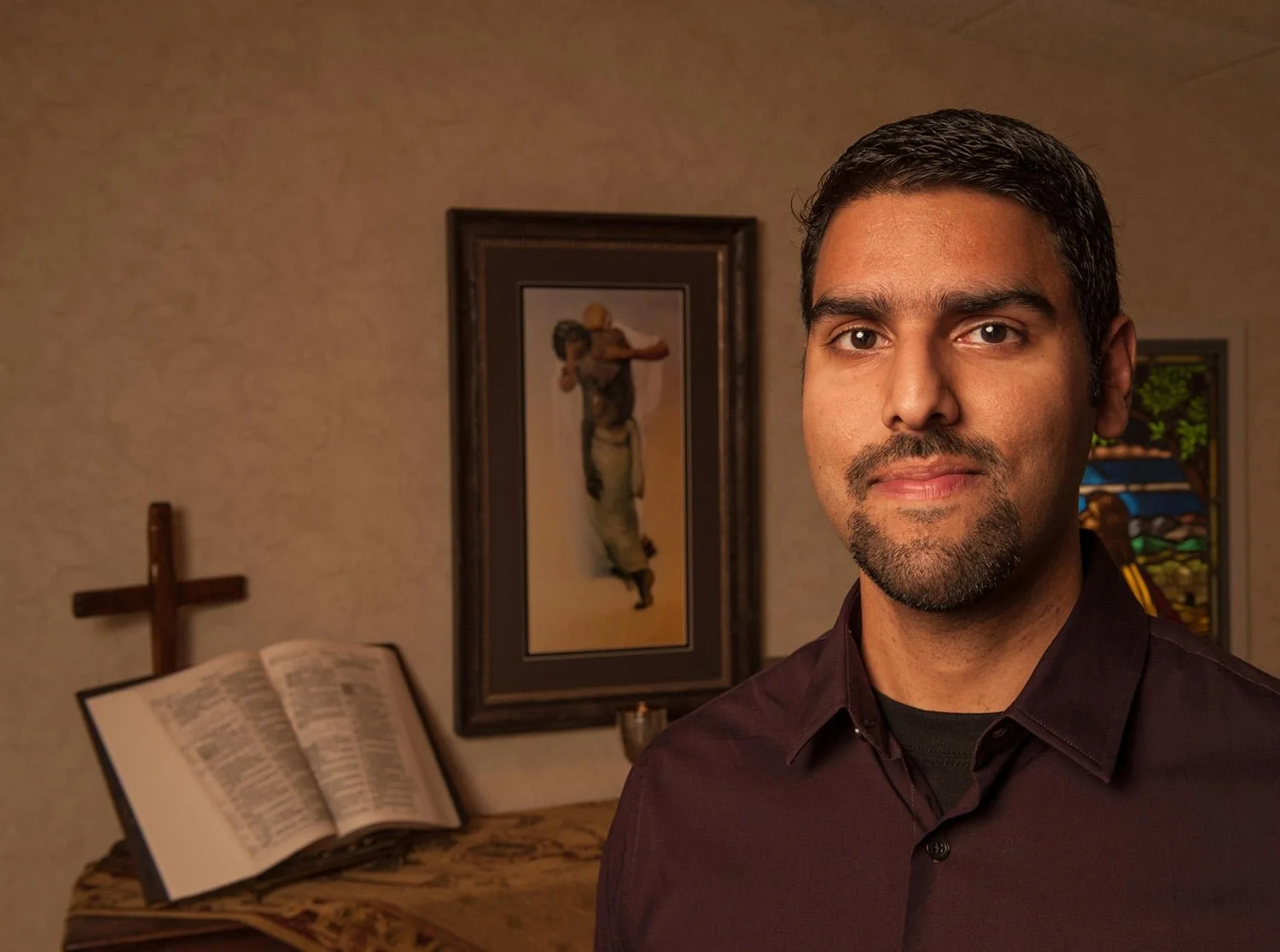
Nabeel Qureshi was a passionate Muslim, raised in a devout Ahmadi Muslim family. When a student he loved arguing with Christians , trying to dissuade them from their often superficial faith. One day he was sharing a room with a colleague, David Wood, who had become a Christian whilst in prison. He saw David reading his Bible and exclaimed:
“You know that the book you are reading is not trustworthy - it been corrupted over time.”
David looked up, closed his Bible and simply said,
“Go on’”
Nabeel then gave his standard argument that had floored many others:
“Jesus spoke in Aramaic. The church in Israel spoke Hebrew. The New Testament was written in Greek. Then it was translated into Latin, then German and finally into English. So what you have is a translation from a translation from a translation. There are now many versions so which one is the Word of God?”
Then David replied:
“Nabeel, let me ask you a question. A few minutes ago you spoke to your mother on the phone. When you told me in English what she told you. was that a corrupted translation? When you are multilingual you can take a message and relay that message into another language accurately.
That is what the disciples did. Whatever Jesus said in Aramaic, they wrote down in Greek. There are over 6,000 copies of New Testament manuscripts, 10,000 Latin, Coptic and Syriac translations of these early manuscripts. There are over 30,000 quotations in the writings of the early church Fathers, enough to reconstruct the whole of the New Testament. We know precisely what Jesus and his apostles taught.”
Nabeel was stunned, thinking that David must have made this up as it was so different to what he had been taught about the Scriptures having been corrupted.
Both Nabeel and David agreed that it is truth that matters and they continued to debate the evidence. A year later they had become very good friends. Nabeel came to accept that the New Testament is reliable and that it is not possible for it to have been corrupted - but he still did not accept the gospel message.
Is Jesus God?
Having been brought up as a Muslim this was one doctrine he could not accept. It is the major sticking point for Muslims. Although the Qur’an recognises Jesus to be a great man and a mighty prophet of God they totally reject the doctrine that he was God, that he was crucified and that he then rose from the dead. They teach that to say Jesus is God is the worst blasphemy any person can commit. The Qur’an teaches that if a person believes Jesus is God they will go to hell.:
“Believers! Always be on your guard against encounters.” Surah 4:71
“And surely they disbelieved when they said: 'Christ, the son of Mary, is indeed God'; whereas Christ had said: 'Children of Israel! Serve Allah, Who is your Lord and my Lord.' Allah has forbidden Paradise to those who associate anything with Him in His divinity and their refuge shall be the Fire. No one will be able to help such wrong-doers.” Surah 5:72
The Qur’an also describes a conversation said to be between Allah and Jesus:
“And imagine when thereafter Allah will say: 'Jesus, son of Mary, did you say to people: "Take me and my mother for gods beside Allah?" and he will answer: "Glory to You! It was not for me to say what I had no right to. Had I said so, You would surely have known it. You know all what is within my mind whereas I do not know what is within Yours. You, indeed You, know fully all that is beyond the reach of human perception.” Surah 5:116
When Nabeel discussed this with David, his response was to hand Nabeel a copy of the gospel of John and asked him to look at the first few verses. He read:
“In the beginning was the Word, and the Word was with God, and the Word was God. He was with God in the beginning. Through him all things were made; without him nothing was made that has been made.” John 1:1-3
This lead onto a discussion on who the Word is. He was asked to look on to verse 14:
“The Word became flesh and made his dwelling among us. We have seen his glory, the glory of the one and only Son, who came from the Father, full of grace and truth.” John 1:14
This gave Nabeel a real problem. He had accepted that the New Testament was unchanged and yet they taught that Jesus was God and the world’s creator. He thought hard for a way out.
“But this was written by John, the last of the apostles to write. Could this be his own development of doctrine?”
David, who knew the Scriptures well, asked him to look on to see what the Jews understood Jesus to be saying when he said:
“Though you do not know him, I know him. If I said I did not, I would be a liar like you, but I do know him and obey his word. Your father Abraham rejoiced at the thought of seeing my day; he saw it and was glad.”
“You are not yet fifty years old,” they said to him, “and you have seen Abraham!”
“Very truly I tell you,” Jesus answered, “before Abraham was born, I am!”
At this, they picked up stones to stone him, but Jesus hid himself, slipping away from the temple grounds.” John 8:55-80
The reason they tried to stone Jesus was because he claimed to be God, stoning was the recognised punishment for such a presumption. When Jesus claims the name ‘I am’ he is using the very name of God. When God met Moses, at the burning bush, he was commissioned to go back to Egypt and, with God’s help, to set the Jews free from slavery under the Egyptians:
“Moses said to God, “Suppose I go to the Israelites and say to them, ‘The God of your fathers has sent me to you,’ and they ask me, ‘What is his name?’ Then what shall I tell them?” God said to Moses, “I am who I am. This is what you are to say to the Israelites: ‘I am has sent me to you.’” Exodus 3:13-14
‘I am’ is the name of God and Jesus often applied this to himself. They countered by saying:
“You are not yet fifty years old,” they said to him, “and you have seen Abraham!” John 8:58
Jesus does claim to have existed before Abraham, ‘Before Abraham was, I am.’. He then uses the same name that God had told Moses he was called, ‘I am’. Jesus repeated used this name for himself.
Later Jesus said to the Jews:
“I and the Father are one.” John 10:30
Their response made it clear that they did understand what Jesus was claiming:
“Again the Jews picked up stones to stone him.”
Jesus then asked which of the miracles he had performed had upset them and they replied:
“We are not stoning you for any good work,” they replied, “but for blasphemy, because you, a mere man, claim to be God.” John 10:33
After the resurrection Jesus met up with his disciples a second time and on this occasion the doubtful Thomas was with them. He now saw the risen Jesus:
“Thomas said to him, “My Lord and my God!” John 20:28
This doctrine was clearly a problem for Nabeel who had accepted that the New Testament documents were reliable but rejected the divinity of Jesus. He suggested that it was just John’s gospel which had been modified from what Jesus actually said and that these passages were inserted as the doctrine of Jesus’ divinity developed.
David was up to this challenge and suggested that they look at Mark’s gospel which is widely accepted to be the first one written, perhaps only 20-30 years after the death of Jesus. At the trial of Jesus:
“Again the high priest asked him, “Are you the Messiah, the Son of the Blessed One?”
“I am,” said Jesus. “And you will see the Son of Man sitting at the right hand of the Mighty One and coming on the clouds of heaven.”
The high priest tore his clothes. “Why do we need any more witnesses?” he asked. “You have heard the blasphemy. What do you think?”
They all condemned him as worthy of death.” Mark 14:61-64
So Peter, who was behind Mark’s gospel, clearly taught that Jesus claimed to be God. This is the very opposite of what the Qur’an teaches.
David continued to show that this was the teaching of all the New Testament. Paul wrote:
“If you declare with your mouth, “Jesus is Lord,” and believe in your heart that God raised him from the dead, you will be saved.” Romans 10:9
Note these three doctrines that are essential to be accepted, Jesus is the Lord God, he was crucified and he was raised from death. Furthermore these doctrines must be spoken about publicly
Jesus said something similar:
“Whoever acknowledges me before others, I will also acknowledge before my Father in heaven. But whoever disowns me before others, I will disown before my Father in heaven.” Matthew 10:32-33
This is the very opposite of what the Qur’an teaches and what he had been taught. They deny the crucifixion, resurrection and the divinity of Jesus.
Could Jesus have been deluded or mad? Some psychiatric patients do claim to be God but there are always other indications to show they are deeply disturbed people. Jesus was clearly sane and well balanced yet he said these extraordinary statements about himself. The question is ‘Why did he do so’
After Peter had recognised that Jesus was the Messiah, Jesus made it clear what this word meant. He had not come as a victorious General to defeat the Romans but as a Saviour who had come to defeat the power of sin. He was going to killed as the ultimate sacrifice for sin but would then rise again. This was to be the absolute proof, on top of all the other miracles that he had done, that his claim to be God were true.
“He then began to teach them that the Son of Man must suffer many things and be rejected by the elders, the chief priests and the teachers of the law, and that he must be killed and after three days rise again.” Mark 8:31
He kept repeating this prophecy that he would rise from the dead:
“He said to them, “The Son of Man is going to be delivered into the hands of men. They will kill him, and after three days he will rise.” But they did not understand what he meant and were afraid to ask him about it.” Mark 9:31-32
“We are going up to Jerusalem,” he said, “and the Son of Man will be delivered over to the chief priests and the teachers of the law. They will condemn him to death and will hand him over to the Gentiles, who will mock him and spit on him, flog him and kill him. Three days later he will rise.” Mark 10:33-34
The resurrection is the vindication of Jesus’ claim. That he died by crucifixion is not in doubt. Even sceptics like Bart Ehrman, John Dominic Crossan, and Gerd Lüdemann acknowledge the crucifixion of Jesus as a historical fact, citing non-Christian sources like the Roman historian Tacitus and the Jewish historian Josephus, along with the early Christian creedal material and non-Christian contemporary accounts from the Talmud and the Greek satirist Lucian. These skeptical scholars argue that the crucifixion is as certain as any historical event can be.
Similarly the case for the resurrection is extremely strong, any independent jury would be convinced by the evidence. There are several prominent historical and modern figures who began as sceptics and later became convinced of Jesus' resurrection. These include early figures mentioned in the New Testament:
Paul the Apostle: Before his conversion, Paul (then known as Saul) was a Pharisee who violently persecuted early Christians. He experienced a radical transformation after what he described as an appearance of the resurrected Jesus. This account is considered especially compelling by Christian apologists because it came from a dedicated opponent of the faith.
James, the brother of Jesus: During Jesus' ministry, his own family, including his brother James, did not believe he was the Messiah. Early historical sources indicate that James was converted after a resurrection appearance and later became a prominent leader of the Jerusalem church, eventually suffering martyrdom for his faith.
Thomas the Apostle: The Gospel of John describes the apostle Thomas as initially unwilling to believe that Jesus had risen from the dead unless he could personally see and touch his wounds. After Jesus appeared to him, he made one of the most direct confessions of faith in the New Testament, stating, "My Lord and my God".
There are many more recent sceptics who looked at the evidence and became convinced such as:
Lee Strobel: A former investigative journalist for the Chicago Tribune and a self-proclaimed atheistic Jew, Strobel set out to use his journalistic skills to disprove the claims of Christianity. After extensive research and interviews with scholars, he became convinced by the evidence for the resurrection and converted to Christianity. He documented his journey in the book The Case for Christ.
Frank Morison: A British lawyer, Morison began writing a book intended to debunk the resurrection. As he meticulously examined the evidence, he was forced by the historical data to change his mind. He instead wrote Who Moved the Stone?, with its first chapter titled "The Book That Refused to Be Written," detailing why he became convinced of the resurrection.
Antony Flew: A well-known atheist philosopher for decades, Flew eventually converted to deism (the belief in a god based on reason, not revelation) after re-evaluating scientific and philosophical evidence. In a debate with Christian apologist William Lane Craig, Flew is cited as affirming that ‘the evidence for the resurrection is better than for claimed miracles in any other religion’. While Flew did not become a Christian, his dramatic shift away from atheism shocked many in the atheist community.
Lew Wallace: A Union general and lawyer, Wallace also set out to write a book that would disprove Christianity and the resurrection. However, his research had the opposite effect. He ended up defending the faith in his famous novel Ben-Hur, which became one of the most influential books of the 19th century.
An excellent and convincing overview of this evidence can be found in the book by Gary Habermas and Michael R. Licona, ‘The Case for the Resurrection’.
By now Nabeel was in a quandary. He had accepted the validity of the Christian Scriptures, which the Qur’an also affirmed. He was sure from the evidence that Jesus had been crucified and that he had risen but his belief in Islam was so deeply ingrained in him that he could not change and commit himself to Christ.
His friend David Wood then challenged him to test the Qur’an as vigorously as he had tested the validity and teaching of the New Testament, using the same level of scepticism and search for historical truth.
This search disturbed him as he discovered many problems when the Qur’an was examined critically. Muhammad had died in 632 AD, so why are there no contemporary references to him. Why are there no early manuscripts of the Qur’an? Why weren’t he direction of the Qiblas of early mosques pointing towards Mecca. Why was the Qur’an written in Nabatean Arabic and not Sabaic, the text used around Mecca. Why is there no mention of Mecca in the 7th century and how could thousands live there where there was no water? Why do coins of the 7th century have crosses on them? Why does the Qur’an speak so much about Jesus? In the Quran, Jesus, known as `Īsā, is referred to by name 25 times but the total number of references to him is much higher when his various titles and descriptions are included. Some analyses suggest he is mentioned over 100 times indirectly. Islam corroborates that Jesus was born to a virgin, was sinless, performed miracles, and was superior to other prophets. It teaches that the Christian Scriptures are the word of God. Yet, Islam also teaches that Jesus was no more than a prophet. It denies the central message of Christianity by denying Jesus’ divinity, crucifixion, and resurrection. Thus the Qur’an itself causes many problems.
The Qur’an is taught to be the exact unchanging word of God but Nabeel discovered that that could not be true. He concluded,
“When you apply the same level of scepticism to any other world religion, Christianity comes out top every time.”
The problem of shame and punishment
Having been raised in a close Muslim family, Nabeel felt a great loyalty to his family and their traditions so found it very hard indeed to ‘come out’ as a Christian. On top of that there is the law of apostasy in Islam. All four schools in traditional Sunni Islam and all three major schools in Shj’a Islam teach that if you leave Islam you should, in certain circumstances, be killed. Islamic scholar, Abu’ala Maududi declares:
“To everyone acquainted with Islamic law it is no secret that according to Islam the punishment for a Muslim who turns to kufr (infidelity, blasphemy) is execution.”
Islamic law stipulates that:
“When a person who has reached puberty and is sane voluntarily apostasies from Islam, he deserved to be killed … There is no indemnity [expiation] for killing an apostate”.
Why should apostates be killed? Another Islamic scholar answers:
“Those Muslims who are weak in faith and others who are against Islam may think that the apostate has only left Islam because of what he has found out about its real nature.. So they learn from him all the doubt, lies and fabrications which are aimed at extinguishing the light of Islam and putting people off from it. In this case, executing the apostate is obligatory, in order to protect [Islam]…”
In other words, all opposition must be squashed by whatever means, even by killing. What is significant is that the penalties are not being carried out by God himself, which he is well able to do, but Islam teaches that this responsibility has been delegated to men, which is surprising as God is all-powerful.
No wonder Nabeel was in a quandary. If he came out as a Christian, his family life and social life would be irreparably damaged and his life would be at risk. What should he do?
In Islam even prophets don’t communicate with God, they communicate via angels as intermediaries. One way that Muslims expect to hear from God is through visions and dreams.
One day Nabeel prayed for God’s help:
“Tell me who you are! If you are Allah, show me how to believe in you. If you are Jesus, tell me! Whoever you are, I will follow you, no matter the cost”.
He requested a vision or dream to show him whether Christianity was really true. He did have a vision of crosses but dismissed this as a trick of his mind. He then asked for a dream that would confirm the vision, stating,
“If the dream corroborates the vision, I will become Christian”.
He subsequently had three meaningful dreams. In the second dream he was standing outside a narrow arched doorway, just wide and tall enough for him to pass through. This archway was 5 to 7 feet deep. On the far side were several round tables all prepared for a feast, with people sitting around the food. Everyone was in fine clothes and they were waiting for the owner to enter. That room was definitely heaven. Then he saw his friend David was blocking the way in, he couldn’t get past him.
“I thought we were going to eat together’
“You haven’t responded” David replied.
Nabeel just knew that he had not responded to Jesus’ invitation. He then woke up. He called David and told him the dream, asking what it meant. David replied:
“This dream is so clear. I don’t need to interpret it for you. Just go to Luke 13:23-25.”
There Nabeel read these words, words he had never read before:
“Someone asked him (Jesus), “Lord, are only a few people going to be saved?”
He said to them, “Make every effort to enter through the narrow door, because many, I tell you, will try to enter and will not be able to. Once the owner of the house gets up and closes the door, you will stand outside knocking and pleading, ‘Sir, open the door for us.’“But he will answer, ‘I don’t know you or where you come from.’”
He knew this message was from God, God had told him plainly where he stood. Nabeel responded - but only by asking for another dream!
A little later, when driving his car when he prayed,
“God, I know what I need to do but I need time to mourn.”
He went back to his apartment, took out both his Qur’an and his Bible and asked God to comfort him. When he opened the Qur’an, looking for something to comfort him, he realised that there was not a single verse in the Qur’an designed to help a hurting man - not one. He concluded,
“This book does not apply to my life”
He then took up the Bible he had been given and stated to read the New Testament, starting at Matthew chapter 1. That was a genealogy so he skipped that. He came to Matthew chapter 5 and read:
“Blessed are those who mourn, for they shall be comforted.”
This phrase jumped of the page, Nabeel realised he said that for him. Then he read on till he came to Matthew 10 where he read:
“Whoever acknowledges me before others, I will also acknowledge before my Father in heaven. But whoever disowns me before others, I will disown before my Father in heaven.” Matthew 10:32-33
By this time Nabeel knew that the good news about Jesus was true but he had never openly acknowledged his commitment to Jesus. But then the thought came to him:
“If I do this I will have to give up my family.”
He then read the next verses:
“Do not suppose that I have come to bring peace to the earth. I did not come to bring peace, but a sword. For I have come to turn ‘a man against his father, a daughter against her mother, a daughter-in-law against her mother-in-law - a man’s enemies will be the members of his own household.’
“Anyone who loves their father or mother more than me is not worthy of me; anyone who loves their son or daughter more than me is not worthy of me. Matthew 10:34-37
He then realised that he would put at risk not only his relationship with his family but also his whole life. He read on:
“Whoever does not take up their cross and follow me is not worthy of me. Whoever finds their life will lose it, and whoever loses their life for my sake will find it.” Matthew 10:38-39
He knew this was true, so he got on his knees and prayed
“Lord, I believe you are Jesus. I thank you for taking my sins when you died on that cross and that you rose from the dead. I want to follow you with my life.”
From that time on his life changed. He began to see the world as Jesus did. When he saw someone walking across the road he realised:
“That is someone Jesus was willing to die for.”
As a Muslim he had imagined God to be sitting on his distant throne. This God would never deign to enter the world. He was its judge. But in contrast the Bible says that God was willing to enter into this world, live as a poor carpenter, live with people who would to betray him, was willing to go to his death nailed to a cross, to suffer and die for the sake of us sinners. Such love!
Nabeel understood that the God who created this universe was willing to die for you and me. He said:
“As I have loved you, so you must love one another.” John 13:34
The gospel is not something you just hear and believe. If it doesn’t change your life it hasn’t hit you yet.
Nabeel came to realise:
“This God is worth everything. This story is worth sharing with our lives. If we die today, serving our Lord, we will be taken care of.”
Nabeel went on to become a great advocate for his Lord. His story is written in his book, ‘Seeking Allah, Finding Jesus.’
BVP