The ‘Word of God’, both Jesus and Scripture
In the Bible, the term ‘Word’ (logos or rhema in Greek, dabar in Hebrew) frequently means a message, proclamation, or communication from God rather than just a single spoken word. It commonly refers to the divine message, the gospel, or the total message of God's will and purpose. It is a concept thought the Old and New Testaments, often used in a personal or embodied way. The Word is also a title of Jesus.
John’s use of ‘The Word’
In the Bible, the title ‘the Word’ is used to describe Jesus Christ. It is a unique designation used by the Apostles to describe Jesus' divine identity, his role in creation, and his function as the ultimate ‘communication’ of God to humanity. He was the embodiment of the eternal God:
"In the beginning was the Word, and the Word was with God, and the Word was God.” John 1:1:
This specifically says the Word was with God as a distinct person and yet was God, he had the same nature as God. Jesus was also fully human:
“The Word became flesh and made his dwelling among us.” John 1:14
John refers to Jesus as being the means by which people can receive eternal life. Elsewhere John describes him as:
“The Word of life.” 1 John 1:1
He also describes a vision concerning Jesus’ future return to rule the earth. Jesus, the Word of God won eternal life for his people by becoming the ultimate sacrifice for our sin.
“He is dressed in a robe dipped in blood, and his name is the Word of God.” Revelation 19:13
In the original Greek, the word used in these passages is Logos. In the ancient world, this term carried deep meaning for both Jewish and Greek audiences:
For Jewish and Christian readers, ‘the word of the Lord’ was how God created the universe
“And God said, 'Let there be light’”
The phrase ‘God said’ comes ten times in Genesis chapter 1.
Calling Jesus ‘the Word’ identifies him as the actual power and person through whom God brought everything into existence. The New Testament identifies Jesus as the agent of creation, stating that all things were made by him and for him.
“For in him all things were created: things in heaven and on earth, visible and invisible, whether thrones or powers or rulers or authorities; all things have been created through him and for him.” Colossians 1:16
“Through him all things were made; without him nothing was made that has been made.” John 1:3
“. . . but in these last days he has spoken to us by his Son, whom he appointed heir of all things, and through whom also he made the universe.” Hebrews 1:2
“You are worthy, our Lord and God, to receive glory and honour and power, for you created all things, and by your will they were created and have their being.” Revelation 4:11
These verses emphasise that Jesus (the Word) was not a created being, but the divine agent through whom God brought the universe into existence.
A ‘word’ is how we express our inner thoughts to others. By calling Jesus the Word, John is saying that if you want to know who God is and what He is like, look at Jesus. He is God ‘speaking’ to us in a way we can understand.
‘The Word’ is also the ‘mediator’. Just as words bridge the gap between two people's minds, so Jesus bridges the gap between a transcendent, invisible God and us as humans.
The Bible is also called ‘the Word of God’ because it contains God's message about Jesus to all people. However, in the context of John 1, ‘The Word’ is Jesus, not a book. The Bible is the written word that testifies about the Living Word.
The Word is also Scripture
‘The word’ refers to Scripture as the inspired message of God in several New Testament passages, emphasising its authority and truth. Here are specific references where "the word" relates to Scripture:
Jesus
Jesus taught:
“Now the parable is this: The seed is the word of God”. Luke 8:11
This could mean both Jesus himself or the spoken/written message of Scripture.
Jesus also said,
“Man does not live by bread alone but by every word that comes from the mouth of God”. Matthew 4:4
Jesus explains, towards the end of the Sermon on the Mount, how people can be secure in life and in eternity. He uses the picture of building the house of our lives on the rock and not on shifting sands:
“Therefore everyone who hears these words of mine and puts them into practice is like a wise man who built his house on the rock. The rain came down, the streams rose, and the winds blew and beat against that house; yet it did not fall, because it had its foundation on the rock.” Matthew 7:24-25
Jesus is saying that the only rock is himself and what he teaches. A commitment to obey what Jesus teaches is vital. The word used in this verse for ‘word’ is Logos!
Paul
Paul thanks the Thessalonians for receiving his message as ‘the word of God’.
“. . . not as the word of men, but as it is in truth, the word of God”. 1 Thessalonians 2:13
When he writes to the Colossian church he calls the Scriptures, ‘The Word’:
“. . . the faith and love that spring from the hope stored up for you in heaven and about which you have already heard in the true message of the gospel.” Colossians 1:5
In the original Greek this reads ‘in the word (logos) of the truth’. A little later he adds:
“Let the message of Christ dwell among you richly as you teach and admonish one another with all wisdom. . .” Colossians 3:16
Here again the original Greek word translated message is ‘logos’
He then goes on to make clear what the priority of a Christian leader is - to teach ‘the Word’, the true message about Jesus that is found in Scripture. Here ‘the Word’ is associated with the doctrine of the apostles and the rest of Scripture:
“Preach the word; be prepared in season and out of season; correct, rebuke and encourage—with great patience and careful instruction. For the time will come when people will not put up with sound doctrine. Instead, to suit their own desires, they will gather around them a great number of teachers to say what their itching ears want to hear. They will turn their ears away from the truth and turn aside to myths.” 2 Timothy 4:2-4
Hebrews
The writer of the book of ‘Hebrews’ is clear that the Word of God is Scripture:
”For the word of God is living and active, sharper than any two-edged sword...". Hebrews 4:12
Peter
Peter refers to Paul's letters, grouping them with
“. . . the rest of the Scriptures”. 2 Peter 3:16
Additionally, the term graphe (writing/scripture) is used 50 times in the New Testament, generally referring to the Old Testament as the holy, authoritative writings. Paul wrote:
“All Scripture is God-breathed and is useful for teaching, rebuking, correcting and training in righteousness.” 2 Timothy 3:16
Peter also recognises this double meaning of ‘the Word’. He wrote,
“Now that you have purified yourselves by obeying the truth so that you have sincere love for each other, love one another deeply, from the heart. For you have been born again, not of perishable seed, but of imperishable, through the living and enduring word of God. For,
“All people are like grass, and all their glory is like the flowers of the field; the grass withers and the flowers fall, but the word of the Lord endures forever.”
And this is the word that was preached to you.” 1 Peter 1:22-25
Luke
Luke also calls Jesus ‘the Word’ but then goes on to say that we know about him through the written word.
“Many have undertaken to draw up an account of the things that have been fulfilled among us, just as they were handed down to us by those who from the first were eyewitnesses and servants of the word. With this in mind, since I myself have carefully investigated everything from the beginning, I too decided to write an orderly account for you, most excellent Theophilus, so that you may know the certainty of the things you have been taught.” Luke 1:1-4
The New Testament is clear that Jesus is the Word of God but so is the message from God. There is no contradiction, a person committed to following the Jesus taught by his apostles must also be obedient to the written ‘Word of God’.
In Acts, believers
“. . . received the word with all eagerness, examining the Scriptures daily”. Acts 17:11
Greek understanding of Logos
For the Greeks, Logos referred to the divine reason or logic that kept the universe in order. John used this familiar concept to explain that this "universal logic" isn't an abstract force, but a person - Jesus. For the Greeks, Logos was not just a "word" you speak; it was the logic of the universe.
Heraclitus (6th Century BC) was the first to use Logos to describe the ‘fundamental law’ of the cosmos. He believed everything was in flux, but the Logos was the unchanging reason that kept the universe from falling into chaos.
The Stoics viewed the Logos as a ‘divine spark’ or ‘world-soul’ that permeated all matter. To live a good life, a person had to align their own human reason with this universal Logos.
Philo of Alexandria: (c.20 BC to 50 AD) was a Jewish philosopher who was born about 15–20 years before Jesus and died about 15–20 years after the Crucifixion. He described the Logos as God’s intermediary - the ‘first-born son of God’ through whom the world was created. He saw the Logos as the bridge between a perfect, distant God and the messy, physical world. And describes the Word as a mediator that stands between the Creator and the created world.
"To his Word (Logos), the chief messenger and most august, the Father of all has given the special gift, that he should stand as a boundary and separate the creature from the Creator... he is neither unbegotten like God, nor begotten like you (humans), but is between the two extremes, serving as a hostage to both.” Who is the Heir of Divine Things? (1.205-206)
He used the analogy of an architect to explain how God used the Logos to design the universe.
"The Logos is the shadow of God, which he used as an instrument when he was making the world. This shadow, and, as it were, model, is the archetype of other things... for the Word is the image of God, by which all the world was fashioned." Allegorical Interpretation (3.96)
In one of his most famous (and controversial) passages, Philo uses a specific Greek phrasing to distinguish the supreme God from His Word. This suggests that Philo knew something of Christian teaching
"Why is it that (Scripture) says, 'In the image of God I made man,' as if he were speaking of another God, and not of himself? ... For nothing mortal can be made in the likeness of the Most High God... but only in the likeness of the Second God, who is the Logos.” Questions and Answers on Genesis (2.62)
Jesus taught his disciples that he personified all these concepts. John subsequently declared that the Logos isn't just a force or a philosophy; it is a man who lived among us. Jesus is not only our creator and sustainer but is also the only way for humanity to become reconciled with God.
The Connection between Logos and ‘Wisdom’
In the Old Testament, God's Wisdom (Sophia in Greek) is often personified as a person who was present at creation. Wisdom said:
“The Lord brought me forth as the first of his works... I was there when he set the heavens in place.” Proverbs 8:22–31
Just as the ‘Word’ created all things in John 1:3, Proverbs says that God:
“. . . by wisdom founded the earth” Proverbs 3:19
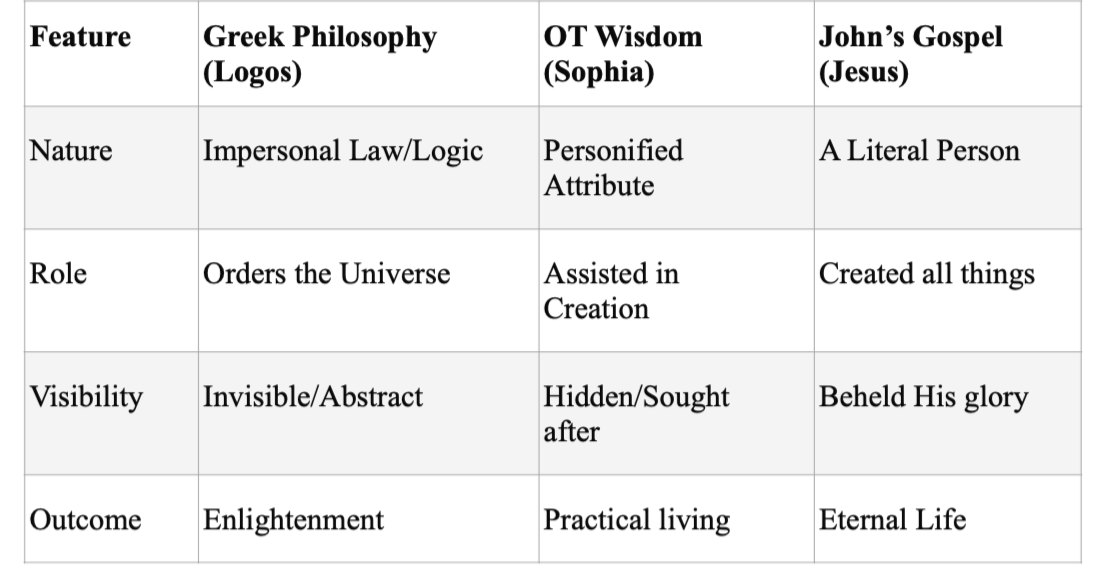
By using the title "The Word," John was telling his readers that the same Wisdom that designed and built the world was the same Presence that walked with Adam and is actually Jesus.
The ‘Word’ in the Old Testament
The Word as Creator
The most famous example is the creation narrative where God does not use tools; He uses His Word.
“And God said, 'Let there be light,' and there was light.” Genesis 1:3
“By the word of the Lord the heavens were made, their starry host by the breath of his mouth.” Psalm 33:6
“He sends his command to the earth; his word runs swiftly.” Psalm 147:15
The Word as a "Person" (Theophany)
In several passages, the "Word" appears to prophets in a way that suggests a visible or tangible presence, rather than just a voice in their heads.
“After this, the word of the Lord came to Abram in a vision: 'Do not be afraid, Abram…’”. Genesis 15:1
The text says the Word came to him, and later Abram replies to the Word as if it were God Himself).
“The Lord continued to appear at Shiloh, and there he revealed himself to Samuel through his word.” 1 Samuel 3:21
The Word as an Active Power
The Word is often described as someone or something sent out to perform a specific task, almost like an arrow or a messenger.
“So is my word that goes out from my mouth: It will not return to me empty, but will accomplish what I desire and achieve the purpose for which I sent it.” Isaiah 55:11
“He sent out his word and healed them; he rescued them from the grave." Psalm 107:20
The ‘Memra’ in the Targums
In the Aramaic translations of the Old Testament (Targums) used in John's day, they used the term Memra, meaning ‘Word’ to avoid describing God in human terms. Instead of saying ‘God walked in the garden,’ they would say ‘The Memra of the Lord walked in the garden.’
In Genesis 3:8: Instead of "They heard the sound of the Lord God walking," the Targum says, "They heard the sound of the Memra of the Lord."
In Exodus 25:22: Where God says, "I will meet with you," the Targum says, "My Memra will meet with you.”
So in the Old Testament the ‘Word’ could mean a person who had power and authority and who created the world.
The ‘Word’ in Isaiah 40
In Isaiah 40, the "Word" serves as the eternal, unshakable foundation of reality, contrasted against the frailty of human life. Isaiah has a message of hope for God’s people who were to be exiled in Babylon. God gives him a message to share.
The Word is eternal and unchanging:
“A voice says, ‘Cry out.’ And I said, What shall I cry?’
“All people are like grass, and all their faithfulness is like the flowers of the field.
The grass withers and the flowers fall, because the breath of the Lord blows on them.
Surely the people are grass. The grass withers and the flowers fall, but the word of our God endures forever.” Isaiah 40:6-8
This passage establishes that while the physical world is temporary, God's Word is permanent.
In Hebrew, ‘word’ (davar) implies more than just a spoken sentence; it refers to God's decree and purpose. Humans are like grass - vulnerable, seasonal, and fleeting, whereas God’s Word is the only thing in the universe that never loses its power or relevance. The word of God is personified as an eternal being, in contrast to finite humanity.
The Voice in the Wilderness
This section in Isaiah 40 is crucial because it links the "Word" of Isaiah to ‘the Word’ in the Gospel of John. It links God’s message with the person of god’s Messiah.
“A voice of one calling: ‘In the wilderness prepare the way for the Lord; make straight in the desert a highway for our God. Every valley shall be raised up, every mountain and hill made low; the rough ground shall become level, the rugged places a plain.
And the glory of the Lord will be revealed, and all people will see it together. For the mouth of the Lord has spoken.” Isaiah 40:3–5
When John the Baptist appears in the New Testament, he identifies himself as this ‘Voice’. If John the Baptist is the ‘Voice’ (the sound), then Jesus is the ‘Word’ (the message). The Voice exists only to announce the arrival of the Word.
The Word as Divine Reliability (Isaiah 40:1–11)
Isaiah 40 uses the "Word" to comfort a people in exile. It is God’s promise to bring His people home. Verses 10-11 describes God coming with power, yet tending his flock like a shepherd.
In his New Testament letter, Peter quotes Isaiah 40:6–8 (see above)) and explicitly says,
“For you have been born again, not of perishable seed, but of imperishable, through the living and enduring word of God. For,
“All people are like grass, and all their glory is like the flowers of the field; the grass withers and the flowers fall, but the word of the Lord endures forever.”
And this is the word that was preached to you.” 1 Peter 1:24–25
He connects the eternal decree of Isaiah 40 directly to the person of Jesus.
Isaiah 40 teaches that unlike human promises, God’s Word, cannot fail. The Word has the power to level mountains and straighten crooked paths (v. 4). The Word is the means by which "all people will see" the glory of God (v. 5).
This chapter is where the famous phrase “Hope in the Lord" comes from:
“. . . but those who hope in the Lord will renew their strength. They will soar on wings like eagles; they will run and not grow weary, they will walk and not be faint.” Isaiah 40:31
It implies that those who trust in the Word - the eternal decree mentioned in verse 8 and the person of the Messiah - will have their strength renewed.
For anyone to be saved and right with God they must bow before both the ‘living Word’, the Lord Jesus and follow what he teaches in his ‘written word’. Both are vital. We can test ourselves whether we do this by noticing how much we pray to the Lord and how much we study his written word.
BVP