Matthew 7:13-14 The Broad and Narrow Ways
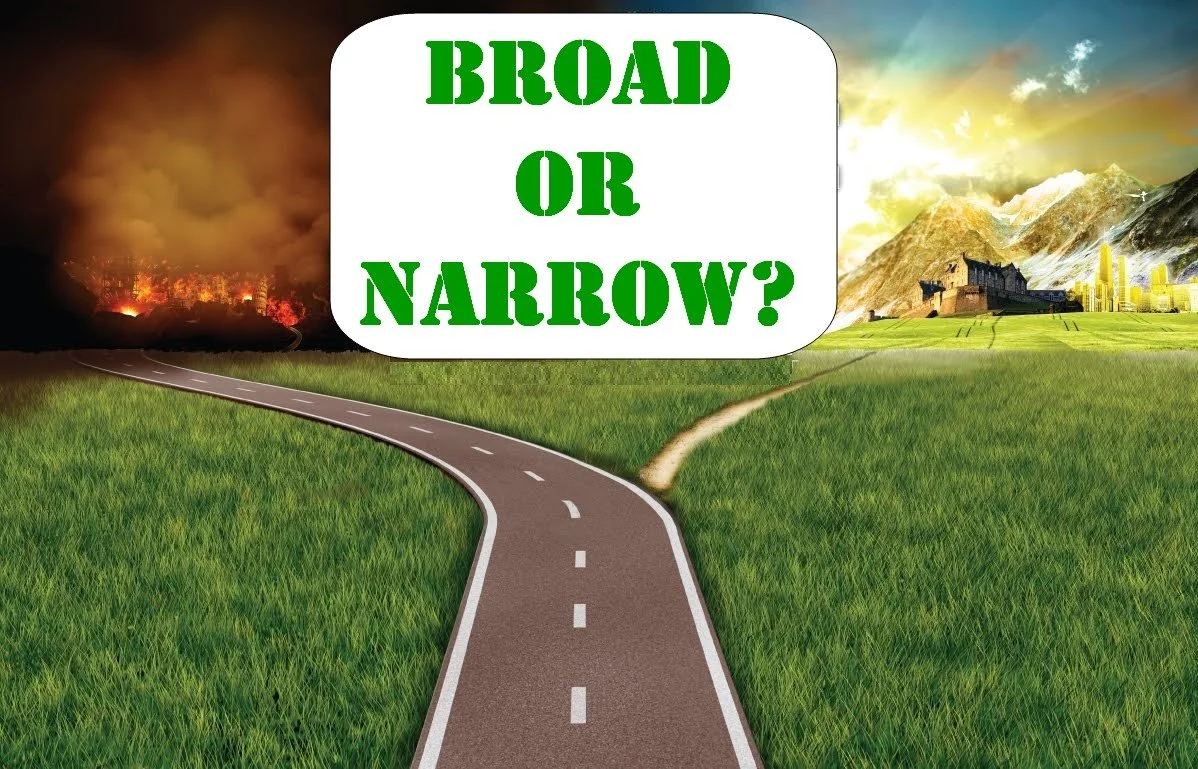
In this final section of the Sermon on the mount Jesus calls his hearers to make a decision about him. He is saying that we must all decide:
“Enter through the narrow gate. For wide is the gate and broad is the road that leads to destruction, and many enter through it. But small is the gate and narrow the road that leads to life, and only a few find it.” Matthew 7:13-14
This follows on from that epic statement that summarises the central section of his teaching:
“So in everything, do to others what you would have them do to you, for this sums up the Law and the Prophets.” Matthew 7:12
The ‘others’ here includes God as well as our neighbours. When Jesus was asked later what were the most important of the Lord’s commandments he summarised it in similar terms, by quoting from the book of Deuteronomy, part of the Torah:
“Jesus replied: ‘Love the Lord your God with all your heart and with all your soul and with all your mind.’ This is the first and greatest commandment. And the second is like it: ‘Love your neighbour as yourself.’ All the Law and the Prophets hang on these two commandments.” Matthew 22:37-40
Jesus now comes to his conclusion, he drives home his message and calls on all of us to make a response. He does this by contrasting the two possible roads that people take.
Two Gates
The first gate is very wide and is easy to get through. Indeed it is so broad that it is easy to pass through it without realising it is there.
The other gate is small and might even seem to be insignificant. It is certainly ignored by many. It is tight and not easy to get through. It reminds me of my visits to Spurs football ground. To get in to have to pass through a very narrow turnstiles - I could only squeeze through.
Jesus is talking about entering his Kingdom, starting out on the Christian life. At the beginning of the Sermon, Jesus taught the Beatitudes, where he describes the mindset of those who are to be blessed by God. To realise how spiritually poor we are, to be poor in spirit, to mourn over our sinfulness, to be meek (not weak) before God and others, to hunger and thirst for righteousness. He then acknowledges that such people will not have an easy life:
“Blessed are those who are persecuted because of righteousness, for theirs is the kingdom of heaven. ‘Blessed are you when people insult you, persecute you and falsely say all kinds of evil against you because of me. Rejoice and be glad, because great is your reward in heaven, for in the same way they persecuted the prophets who were before you.” Matthew 5:10-12
Jesus keeps repeating that our eyes should always be on the next life. To be blessed by God gives us an assured hope of life with him in eternity. It is a large claim. As in the rest of the sermon, those who are looking for an easy life will not notice the narrow gate or find it at all attractive. If we do, it is a sign that God is calling us to himself. Remember what Jesus said in the centre of the sermon:
“‘Do not store up for yourselves treasures on earth, where moths and vermin destroy, and where thieves break in and steal. But store up for yourselves treasures in heaven, where moths and vermin do not destroy, and where thieves do not break in and steal. For where your treasure is, there your heart will be also. . . ‘No one can serve two masters. Either you will hate the one and love the other, or you will be devoted to the one and despise the other. You cannot serve both God and Money.” Matthew 6:19-24
The Greek word for ‘money’ used is mamōnas or ‘mammon’. This is a transliteration of an Aramaic word meaning wealth, property, or money or any worldly values. Jesus is saying we cannot serve God and worldliness at the same time.
To pass through the narrow gate means that much that we value, that we would naturally want to hold tightly onto, has to be left behind if we are going to pass through the narrow gate. It could be called the ‘narrow gate of repentance’. We realise that all we have, has been given to us by God and now our lives and all we have are to be used for his glory. This is a repeated theme of Jesus. Later he reminded his disciples:
“Whoever wants to be my disciple must deny themselves and take up their cross and follow me.” Matthew 16:24
Jesus is saying that those who turn to him as a cheat ‘eternal life insurance policy’ have missed the point. He wants people who will serve him and live for God. He calls us to leave our self-interest behind.
Two Ways
The contrast between the two paths is clear:
“ . . . broad is the road”, is very different to “ . . . narrow is the road.”
The broad road is easy to rush along, there is plenty of room for everyone. You can live as you want, rest when you feel like it. You make the decisions as it is you who is in charge. A person like this could be described as
“A self-made man who worships his creator"
This witty remark - often attributed to John Bright regarding Benjamin Disraeli, implies that a person is arrogant, or proud of their own accomplishments that they effectively worship themselves.
The narrow road is very different. It is bumpy and hard going. Again this is a picture to remind people that members of God’s kingdom are not free to choose their own way, their decisions are now guided by the mind of God.
It is important to stress that those who decide to pass through the narrow gate and travel on the narrow way will never be alone. At first sight it seems to be a very tough decision. The writer to the Hebrews recognised this but he reminds his readers of one vital fact:
“Keep your lives free from the love of money and be content with what you have, because God has said,“Never will I leave you; never will I forsake you.” Hebrews 13:5
What a wonderful promise God gives to all who follow him. It keeps being repeated in Scripture. When Joshua was commissioned to lead the children of Israel into the Promised land and defeat the Canaanites he was told this path would not be easy, he was to live as God teaches in his Word, but again God gave him a promise:
“Keep this Book of the Law always on your lips; meditate on it day and night, so that you may be careful to do everything written in it. Then you will be prosperous and successful. Have I not commanded you? Be strong and courageous. Do not be afraid; do not be discouraged, for the Lord your God will be with you wherever you go.” Joshua 1:8-9
To those on the broad road, looking across at those on the narrow way they can only see the restrictions, they do not see the joy of walking in step with our creator. Earlier in this sermon Jesus is very clear that we still have to make this decision even though we are also concerned about all the normal worries of life. Can we trust God? Jesus says:
“ But seek first his kingdom and his righteousness, and all these things will be given to you as well.” Matthew 6:33
What is so attractive about Jesus is that he makes the costs and benefits absolutely clear. He is not like so many politicians who say what they think their voters want to hear. Jesus is straight. There are just two gates and two roads.
Two Groups
Those who enter through the wide gate and travel along the broad road are many. This is not surprising as the road is apparently easy to progress along. I remain at the centre so it naturally appeals. Being in a crowd is so reassuring. Surely we can’t all be wrong - can we? Could the minority be in the right?
The other group, on the narrow way are fewer in numbers, though still significant.
“. . . and only a few find it.” Matthew 7:14
Jesus used a significant verb. Those on this way have had to ‘find’ it, they were looking for salvation. Jesus had said a little earlier:
“‘Ask and it will be given to you; seek and you will find; knock and the door will be opened to you.” Matthew 7:7
There are people who say that they are interested but are waiting for God to do something to pull them over the line of commitment to him. There is a Chinese saying:
“Man stand long time, with mouth wide open, waiting for roast duck to fly in.”
Our consciences may be pricked and our desire for purpose clear but then it is up to us to determine who Jesus is and whether what he says, that does resonate with our consciences, is really true.
What is it then that draws people to go through the narrow gate and travel on this harder road? Jesus said later to his followers:
“‘Whoever wants to be my disciple must deny themselves and take up their cross and follow me.” Matthew 16:24
Jesus is not the smooth-talking salesman, he honestly longs that people with travel with him. That is the secret - the God of this universe has promised to accompany us through life and give us real joy and satisfaction in our service of him. The Lord himself promises to be always close to us.
Two destinations
This is fundamental. Just as students have to work hard if they are going to do well in the exams, or sportsman have to train hard if they are to succeed, so putting God first in life will lead to the ultimate reward. There are many satisfactions in this life that in themselves make following Christ worthwhile, but it is the destination that is crucial.
“For wide is the gate and broad is the road that leads to destruction, and many enter through it.” Mathew 7:13
For those who do not seek to satisfy God the ending could not be worse. They will end up outside God’s Kingdom, rejected by the God who entered this world to save us. The Jews expected that God would accept them simply because they were born as Jews. Jesus teaches that the chosen people, the descendants of Abraham, are those people who have a similar personal faith in the Lord as Abraham had. People of all nationalities will become followers of God’s Messiah and so will be saved. Jesus said later,
“I say to you that many will come from the east and the west, and will take their places at the feast with Abraham, Isaac and Jacob in the kingdom of heaven. But the subjects of the kingdom will be thrown outside, into the darkness, where there will be weeping and gnashing of teeth.” Matthew 8:11-12
At the final judgment there will be much unhappiness when, too late, people realise they have not sought out the salvation that Jesus alone can give us.
Jesus is encouraging us all, in that while the journey may be arduous, the destination will make all our dedicated hard work so worthwhile. All that makes life hard will pale into insignificance when we finally meet Jesus and be with him.
Two choices
Although there are two gates, two roads, and two groups Jesus wants everyone to understand these truths, not so that we are just better informed but so that we may act and make a wise decision. There are only two possible destinations:
“Whoever believes in the Son has eternal life, but whoever rejects the Son will not see life, for God’s wrath remains on them.” John 3:36
We all decide one way or the other. Yet there are people who do not want to make a decision. They want to wait until they understand more or are more convinced. In practice the vast majority of those who don’t want to make a decision do so because they do not want God to be their God. In practice they have already decided. To say, “I am not going to choose” is to say that I am not taking Jesus seriously. Not to decide to follow Christ is to say I want to stay as I am, on the easy path where I am in control.
By default we are all on the broad way and we have to make a positive decision to leave that road and pass though the narrow gate onto the narrow road. Jesus message keeps being repeated.
“Turn off the broad road, repent and come, follow me.”
A decision is made
Imagine the crowd travelling along the broad road. They have passed through the broad gate and taken no notice of the signpost their that says:
“To Destruction”
They are happily travelling along. Everyone has a rucksack on their back. Some rucksacks are large others smaller but everyone has one. They represent their sin, their innate rebellion against God’s rule and the actions that result from this.
Then one person, going with the crowd notices the small gate going off at the side. It has a signpost that says:
“To Life”
Something draws him to investigate. It all makes such sense. The person knows instinctively that he has not lived as God wants and when he hears that he can be forgiven and given a power to live a different, God-centred life he feels drawn to this. As a result he starts going in the opposite direction to the crowd.
“What’s up with you. Are you thinking of joining the God-squad?’
Those around mockingly ask suck questions. What better reply could be give than:
“I know I am a sinner before God and I want to end up in heaven and not hell. Doesn’t truth matter to you any more?”
When this person tries to pass through the narrow gate of repentance they find that the rucksack on their back is preventing them passing through. Sin is a major impediment. However at this point someone says:
“Can I take that burden of sin from you?”
It is Jesus, who then takes that burden and placers it at the foot of his cross. That person is then free to pass through the narrow gate and starts travelling along this new route. The difference is that there is someone else constantly travelling alongside. It is the Spirit of God himself. The problems and hurdles are real, but now there is real help at hand that enables us to overcome all difficulties. This road ends at eternal life.
To reject Jesus is to reject God. To reject ‘life’ will inevitably result in ‘destruction’.
If we believe Jesus is who he claimed to be, proved by fulfilling those 330 Old Testament prophecies about the Messiah, doing extraordinary miracles, rising from the dead after three days and teaching what surely resonates with our inner consciences, then the choice we have to make is straight forward. Jesus lays down stark realities and demands that each of us makes a response. He says:
“Follow me, accept my forgiveness and empowerment and receive life or reject me, go your own way and face the eternal awful consequences.”
To teach us about this choice is why Jesus came to his earth, he longs that we turn to him. He pleads with and commands us to repent, to rethink the direction of our lives.
About 1250 BC Joshua was coming to the end of his life. He had made this decision to follow the Lord but he realised that many of those who were formally God’s people had still not made a personal commitment to follow the Lord. He called all the people together and said to them:
“Now fear the Lord and serve him with all faithfulness. Throw away the gods your ancestors worshipped beyond the River Euphrates and in Egypt, and serve the Lord. But if serving the Lord seems undesirable to you, then choose for yourselves this day whom you will serve, whether the gods your ancestors served beyond the Euphrates, or the gods of the Amorites, in whose land you are living. But as for me and my household, we will serve the Lord.” Joshua 24:14-15
John’s gospel has the same message about the privilege of receiving Jesus as our Saviour and Lord:
“Yet to all who did receive him, to those who believed in his name, he gave the right to become children of God – children born not of natural descent, nor of human decision or a husband’s will, but born of God.” John 1:12-13
What a privilege.
BVP