What is Saving Faith?

What a vital question this is.
After a church meeting a senior member of a church approached me and asked,
“Why do you make being a Christian so hard? Why not soften the pill a bit and so make it easier for people to join the church?”
This is a common approach today. ‘Let us offer people the grand mystique of cathedral worship, perhaps, if they admire that, they will join us regularly in worshipping God.’ ‘Let us cater for people’s social and personal needs, run food banks and the like, and perhaps some will see our love for them and want to join us in caring for others as God wants.’
Such views have all misunderstood what a Christian is. Christians have been saved, born again as a result of recognising that Jesus is their divine Saviour and therefore their Lord and Master and are deeply grateful to him. To be attracted by magnificent musical ‘worship’ or by the care that people show to others is all very well but it is not the way to become right with God. Everything centres on a relationship with Jesus which results in obedience to him.
Today there is a widespread error in churches that assume that because people believe in Christian doctrines and do their part in helping others they must be acceptable to God. This is not a new error. It was recently suggested to me by a senior church member:
“Surely a Christian is someone who accepts Christian doctrine, has been admitted into the church by baptism and tries to live according to the ethics of the New Testament.”
No, no, no! Such an attitude is that of the religious who deep down are trying to ‘re-ligate’ themselves to God by the way they live. Christian faith is a dependance on the Lord Jesus who has entered his world to save people and those people will inevitably be filled with a deep gratitude for the privilege they have been given.
John Glas and Robert Sandeman
The year 2017 was the hundred and fiftieth anniversary of the death of the great scientist Michael Faraday. He belonged to a church group that followed John Glas and Robert Sanderman. Glas was a minister in the Church of Scotland who disliked the Westminster Confession. His understanding of Scripture was that belief in Christ to be willing for your life to be governed by the rule of Scripture was enough for salvation. He taught that anything else was just the word of men but he was very selective in what he saw as relevant in Scripture. His unorthodox views caused him to be expelled from the Church of Scotland and he became an Independent. His daughter married Robert Sanderman, a more aggressive character, who propagated these views actively. They presented a complete system of church government which included the teaching that the possessions of church members should be at the disposal of the church leaders and that ministers should not be paid. In this respect they were fore-runners of the Exclusive Brethren. They also believed in very strict church discipline which meant that elders had great control. In this respect they introduced ‘heavy-shepherding’. They also re-introduced ‘the holy kiss’, ritual foot-washing as well as a weekly communion.
This teaching caused a reaction from orthodox Christian leaders, who insisted that repentance is a change of heart for Christ, a love for him and the decision to live for him as Lord, They insisted that this is the essence of Christian belief as taught by Jesus and his apostles.
The major question that needs answering is what Jesus and his apostles teach is the true nature of believing faith. Sanderman attacked the views of orthodox Christians such as John Wesley and George Whitefield and their friend James Hervey, saying that cerebral belief, church membership, submission to church discipline and a determination to live a moral life is the way of salvation. He wrote:
“. . . the sole requisite to justification or acceptance with God, in opposition to those who while they openly avow only one meritorious cause of justification, do yet need the guilty to seek after some inward motion, feelings or desires, as some way requisite in order to acceptance with God”.
He despised the teachings of John Wesley who he considered to be one of the most dangerous men in the church. He stressed:
“. . . the work finished by Christ in his death, proved by his resurrection to be all sufficient to justify the guilty.”
He continues:
“. . . that the whole benefit of this event is conveyed to men only by the Apostolic report concerning it, that everyone who understands this report to be true, or is persuaded that the event actually happened as testified by the Apostles, is justified and finds relief to his guilty conscience. That he is relieved not by finding any favourable symptoms about his own heart, but by finding their report to be true.”
This view prioritises orthodox doctrine but lessens the impact that these doctrines must have in a believers heart and so change their whole life. A Christian is someone who loves the Lord their God with all their heart, mind and soul. It is this love for Christ that leads Christians to serve him as the priority of our lives and to want to obey him above all else. If a person has not seen the utter glory of God in Christ they are little more than Pharisaical christians, with a small ‘c’.
Such doctrines appear to be held by many Roman Catholics and Anglicans who think they have been saved because they believe in Christian doctrine, are members of the church and try to live moral lives as taught by the church. Repentance then means turning to join the church and follow its teachings. The New Testament is adamant that repentance is turning to Christ and accepting him as my personal Lord and Saviour. That relationship with Christ will result in a Christian joining God’s people in his church as there is no such thing as a solitary Christian. We need to be in a team of fellow believers if we are to serve the Lord Jesus effectively. However what saves a person is their turning to Christ for forgiveness. If a surgeon diagnoses and then removes a patients cancer it would be most strange if there was not a deep feeling of gratefulness in the heart of a patient. How much more will a person feel grateful to the Lord who came and died for them so that they could be saved and changed. Surely an emotional attachment to Jesus is inevitable if someone has grasped who Jesus is and what he has done for them. If we love Jesus we will surely obey what he wants from then on. Jesus himself linked love for him with obedience:
“If you love me, you will keep my commands.” John 14:15
“Whoever has my commands and keeps them is the one who loves me. The one who loves me will be loved by my Father, and I too will love them and show myself to them.” John 14:21
“Anyone who loves me will obey my teaching. My Father will love them, and we will come to them and make our home with them. Anyone who does not love me will not obey my teaching. These words you hear are not my own; they belong to the Father who sent me.” John 14:23-24
The Greek word used in all these verses is derived from the Greek verb ‘agapan’, which means ‘to greet with affection’, ‘to be fond of’, or ‘to love’. There is nothing ‘cold’ about this love!
This attitude was partly a reaction to the emotional preaching of the Wesleys and Whitefield and their travelling preachers which so often resultied in outward emotional responses. They were concerned that these preachers were going beyond what the Scriptures mean by faith but in doing so they accepted what falls far short of the Bible’s meaning of faith and on top of that they added in their own church rules.
There was a widespread reaction against this teaching, called Sandemanianism, based on bible teaching. The great Welsh preacher and hymn writer William Williams answered this issue in several books. The Bible commentator Thomas Scott addressed it in his book ‘The Warrant and Nature of Faith in Christ’. Such men argued that Abraham and David were saved by their faith and not by anything they did. They trusted what God had said and turned penitently to God:
“However, to the one who does not work but trusts God who justifies the ungodly, their faith is credited as righteousness.” Romans 4:5
“Yet he did not waver through unbelief regarding the promise of God, but was strengthened in his faith and gave glory to God.” Romans 4:20
A person with genuine faith will always ‘give glory to God’ in their hearts and this will inevitably overflow in various ways.
When Paul wrote to the Ephesian church he repeatedly emphasised the effect that true faith has. Christians will live for ‘the glory of God’. This life of praise will accompany a real understanding of what the grace of God for each of us cost Jesus:
“. . . he predestined us for adoption to sonship through Jesus Christ, in accordance with his pleasure and will - to the praise of his glorious grace, which he has freely given us in the One he loves.” Ephesians 1:5-6
“. . . we, who were the first to put our hope in Christ, might be for the praise of his glory.” Ephesians 1:12
To live for the glory of our Saviour is a mark of the Holy Spirit’s presence:
“When you believed, you were marked in him with a seal, the promised Holy Spirit, who is a deposit guaranteeing our inheritance until the redemption of those who are God’s possession - to the praise of his glory.” Ephesians 1:13-14
Throughout the Bible, God’s true people always have a grateful personal relationship with their Lord and Saviour which causes them to live for the glory of God and not their own glory.
Similarly in John chapter 5, Jesus discusses the nature of true faith with some Pharisees. He had just healed a lame man on the Sabbath. They believed in God, had been circumcised and did their best to keep his laws, at least outwardly yet Jesus warned them:
“ . . that all may honour the Son just as they honour the Father. Whoever does not honour the Son does not honour the Father, who sent him.” John 5:23
The Pharisees did not glory in their Saviour, they did not honour Jesus, although they were deeply religious and consequently they were still outside God’s Kingdom.
In John chapter 8 Jesus again puts the relationship with himself right at the centre of what saving faith means:
“When Jesus spoke again to the people, he said, “I am the light of the world. Whoever follows me will never walk in darkness, but will have the light of life.” John 8:12
Many Jews believed in Jesus in some way but Jesus is saying that that acknowledgement needed to be followed up by teaching. Jesus clearly recognised that there was indeed such a thing as spurious faith:
“If you hold to my teaching, you are really my disciples. Then you will know the truth, and the truth will set you free.” John 8:31-32
The pious Jews thought they were saved because they tried to keep God’s laws but they were not really God’s disciples:
“We are Abraham’s descendants and have never been slaves of anyone. How can you say that we shall be set free?” John 8:33
Jesus then reminds them what characterises true faith
“ Jesus said to them, “If God were your Father, you would love me, for I have come here from God.” John 8:42
In the Sermon on the Mount Jesus gave a stark warning to religious leaders:
“Not everyone who says to me, ‘Lord, Lord,’ will enter the kingdom of heaven, but only the one who does the will of my Father who is in heaven. Many will say to me on that day, ‘Lord, Lord, did we not prophesy in your name and in your name drive out demons and in your name perform many miracles?’ Then I will tell them plainly, ‘I never knew you. Away from me, you evildoers!’” Matthew 7:21-23
Jesus is teaching that even church leaders who preach in his name may not have a personal relationship with Jesus and so will be excluded from heaven.
Jesus alone is the rock, hearing him and obeying him are evidence of a personal relationship with him, of being known by him
“Therefore everyone who hears these words of mine and puts them into practice is like a wise man who built his house on the rock.” Matthew 7:24
John Berridge
John Berridge became the Vicar of Everton in Bedfordshire between 1755-1793. He also was a sincere man but he had not understood the Bible’s message.
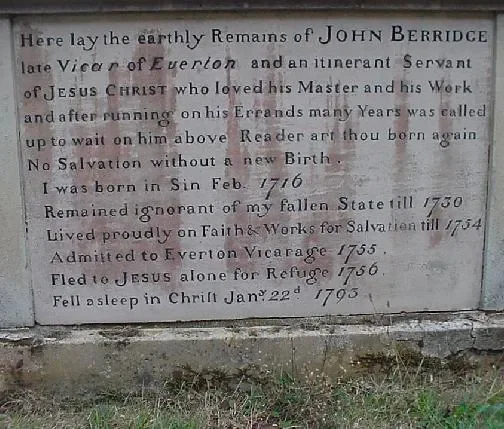
His tombstone in the Everton churchyard carries the epitaph that he himself wrote:
The story goes that Berridge had spent 8 years labouring in church ministry in various places and was totally ineffective yet still somehow managed to rely “proudly on faith and works for salvation”. At that time he thought that human merit and virtue was adequate to obtain salvation and his lively sermons exhorted his congregations to a life of good works. This is what he later wrote:
“ It was a doctrine every man will naturally hold while he continues in an unregenerate state, viz, that we are to be justified partly by faith and partly by works of our own. . . . It was some secret reliance on my own works for salvation.”
It wasn’t until he was 50 years old that he understood what the apostles taught, that it is Jesus alone who has won salvation for us. He now understood,
“For it is by grace you have been saved, through faith—and this is not from yourselves, it is the gift of God - not by works, so that no one can boast. For we are God’s handiwork, created in Christ Jesus to do good works, which God prepared in advance for us to do.” Ephesians 2:8-10
“He saved us, not because of works done by us in righteousness, but according to his own mercy, by the washing of regeneration and renewal of the Holy Spirit.” Titus 3:5
This doctrine that we can only be put right with God if he gives us the gift of being righteous is throughout Scripture:
“For in the gospel the righteousness of God is revealed - a righteousness that is by faith from first to last, just as it is written: “The righteous will live by faith.” Romans 1:17
The religious people in Jesus day, the Pharisees, also thought that God was satisfied firstly by their being admitted to Judaism through circumcision and then, by their keeping God’s laws. They thought is was by a combination of being admitted to God’s people by rite and then by trying to keep God’s rules that a person becomes acceptable to God.
This is very similar to much churchmanship today. Jesus however totally rejected this. The thief on the cross was saved simply because he believed in Jesus. Salvation is only given to those who have a personal faith in Jesus, to those who are committed to Jesus as their Lord and Saviour. It is this personal relationship with Jesus that is the door to being given the status of being righteous as a free gift.
Today it is possible to be a very intelligent theologian who knows much about Jesus and the Bible yet remain outside God’s kingdom. John Stott was a great Bible teacher who helped many come to faith in Jesus. He attended a conference at which there was radical theologian who disagreed with what the Bible teaches. As they were walking to breakfast together John wanted to get to the root issue so he asked the theologian a simple but far reaching question,
“May I ask you, do you worship Jesus.”
BVP