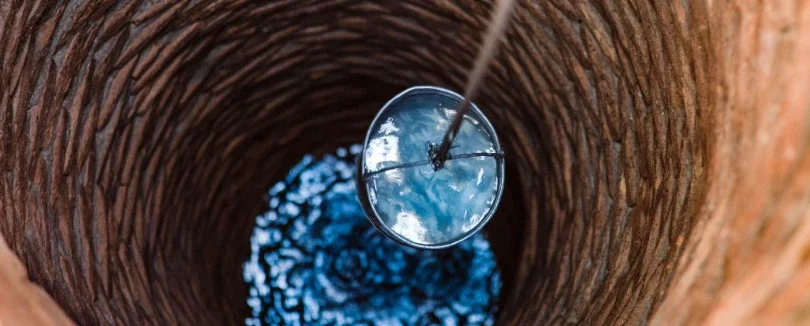
In the Bible, fresh, running water (referred to as ‘living water’ in Hebrew and Greek) is a rich and consistently positive symbol representing God's provision of spiritual life, cleansing, renewal, and the coming of the Holy Spirit. Its flowing, dynamic quality contrasts sharply with stagnant, collected water, which is often associated with fruitlessness or abandonment of God.
Water represents God giving life to his people
The most immediate significance flowing water in the arid Near East was that it gives life. In Genesis, when Hagar and Ishmael were perishing in the desert, God opened her eyes to see a well, thus saving their lives.
God’s miraculous provision of water for His people in the wilderness. is a powerful illustration of His care. God provided running water from a rock in the wilderness (Exodus 17:6, Numbers 20:11) demonstrating His loving care for His people.
Other than streams and rivers, wells were the main source of fresh water. Wells were also a place to meet people. Abraham's servant found Rebekah at a well (Genesis 24:13), an event orchestrated by God that led to her marriage to Isaac. Similarly, Jacob met Rachel at a well (Genesis 29:9-12).
The Promised Land was described as:
“. . . a land with streams and pools of water, with springs flowing in the valleys and hills” Deuteronomy 8:7
This symbolised God's abundant blessing that would come on his people as they followed Him.
Water, especially running water, was required for various ritual purifications under the Mosaic Law, representing the removal of impurity and sin. Priests were required to wash at a bronze basin before approaching the altar (Exodus 30:18-21), and specific rites for cleansing from skin diseases or bodily discharges mandated the use of running water. These acts symbolised the need for holiness and preparation to enter God's presence. Clearly water cannot wash away people’s sins, the water represents Jesus who alone can forgive us.
Institutional religion is often contrasted with the ‘living water’ of a personal faith. Water serves as a powerful metaphor for humanity's deep need for God and the satisfaction found in Him. God is described in Jeremiah as ‘the fountain of living water,’ contrasting with the ‘broken cisterns that can hold no water’ which the people had hewn out for themselves.
“My people have committed two sins: They have forsaken me, the spring of living water, and have dug their own cisterns, broken cisterns that cannot hold water.” Jeremiah 2:13
In the Old Testament, the imagery of flowing water and wells is rich with both literal and spiritual significance, symbolising divine provision, life, blessing, and spiritual renewal. Flowing or "living" water is consistently portrayed as pure and dynamic, contrasting with stagnant water in a cistern.
In the life of a believer, spiritual wells can be understood as the practices and disciplines that draw one closer to God. Prayer, meditation on Scripture, worship, and fellowship with other believers are ways to access the living water that Christ offers. These practices help maintain a vibrant spiritual life, ensuring that believers remain connected to the source of all spiritual nourishment.
In summary, spiritual wells in the Bible serve as powerful symbols of God's provision, guidance, and the eternal life offered through Jesus Christ. They remind believers of the importance of seeking God as the ultimate source of spiritual sustenance and the joy found in His salvation.
The waters of Judgment
In contrast to ‘living water’, wild, uncontrolled or deep water in the Bible is used as a symbol of chaos, destruction, and represents God’s judgment.
In the story of Noah, water was the means of God’s judgment, wiping away human corruption to purify the earth.
For the Egyptians, the Red Sea was an instrument of death and defeat, demonstrating God's ultimate power over any forces that oppose him.
In ancient Near Eastern thought, deep water housed monsters and symbolised the terrifying forces opposed to God.
Today churches need to remind people that God is not just a God of love but also one of judgment. He opposes those who, in reality, do do love his Son, the Lord Jesus. When visiting a cathedral in Paris recently I picked up a leafltet titled, "‘The Gosdpel of the Heart of Jesus’. It consisted of selected verses about the love of God but omitted any warning about the danger of rejecting him.
When I was at school we would sing from Psalm 95, the Venite, which starts:
“Come, let us sing for joy to the Lord; let us shout aloud to the Rock of our salvation. . . “
Hoever we always stopped at verse 6. I now understand why. The subsequent verses are a warning that we must listen and obey the Lord. If any do not the Psalm finishes,
“So I declared in my anger, ‘They shall never enter my rest.’” Psalm 95:11
Jesus’ use of fresh running water
This theme of using water as a form of parable is repeatedly used in the New Testament.
The first miracle described in John’s gospel is the turning of six large jars of water used for ceremonial religious washing, into the best wine available (John 2:1-11). This is the first of many teachings in John’s gospel where it is taught that the rituals of Judaism were being replaced by a new wine in which the Spirit of Jesus Christ is foundational.
Nicodemus
The next chapter describes the meeting of an upright religious leader, Nicodemus, with Jesus. He was a Pharisee who believed his sins had been forgiven because he was regularly involved in the sacrifice of animals in the temple and he tried to keep God’s laws. He had missed the point that our only hope of salvation is if God can forgive us. Jesus was to become the ultimate sacrifice for sin that all the animal sacrifices modelled. Without a personal relationship with Jesus no-one can be saved. Jesus said to Nicodemus:
“Very truly I tell you, no one can see the kingdom of God unless they are born again.”
Nicodemus didn’t understand. He thought that as he was one of God’s people and had been regularly involved in the temple sacrifices, his sin had been forgiven. Jesus rejects this view and says:
“Very truly I tell you, no one can enter the kingdom of God unless they are born of water and the Spirit. Flesh gives birth to flesh, but the Spirit gives birth to spirit.” John 3:5-6
Jesus was referring back to what the Prophet Ezekiel had said. This Old Testament passage was one that Nicodemus, as a teacher of Israel, would have known well. Jesus is emphasising both aspects of the gospel, forgiveness and empowerment to live a new life, that he alone can give to individuals. Both our sins are washed away and our hearts are washed so we can live a very different life. He will bring a people together, will wash them of their sins and then put a new heart, a new spirit into them: Ezekiel was shown what the coming of Jesus would result in.
“I will gather you from all the countries and bring you back into your own land. I will sprinkle clean water on you, and you will be clean; I will cleanse you from all your impurities and from all your idols. I will give you a new heart and put a new spirit in you; I will remove from you your heart of stone and give you a heart of flesh. And I will put my Spirit in you and move you to follow my decrees and be careful to keep my laws.” Ezekiel 36:24-27
Ezekiel was written during the captivity in Babylon but he uses the future tense. This prophecy was fulfilled by Jesus. This meeting of a respected, moral, religious man is shred with us to teach that all people, including men such as Nicodemus, need to have their sin washed away and turn round to follow the Son of God.
This spiritual transformation, sins forgiven and forgotten, our sinful hearts modified so we can chose to go God’s way, a new heart, and a new spirit in us to keep motivating us to be godly is the essence of what is called being ‘born again’. The general principle that sinful humanity needs divine intervention to be put into a right relationship with God is a foundational Old and New Testament concept. The only hope for a spiritually dead person is to be made alive by God, which is the core idea of the ‘new birth’.
The woman at Samaria
Jesus' conversation with the Samaritan woman at Jacob's well in John chapter 4 is a very good illustration. They meet significantly at the fresh-water well in Sychar that had been dug by the Patriarch Jacob. Jesus offers her something very different:
“If you knew the gift of God and who it is that asks you for a drink, you would have asked him and he would have given you living water.” John 4:10
She misunderstands this idiom but Jesus explains that he is talking about spiritual life:
“Everyone who drinks this water will be thirsty again,but whoever drinks the water I give them will never thirst. Indeed, the water I give them will become in them a spring of water welling up to eternal life.” John 4:13-14
He then demonstrates that God knows all about her and more than that that he himself is God’s Messiah.
““I know that Messiah” (called Christ) “is coming. When he comes, he will explain everything to us.” Then Jesus declared, “I, the one speaking to you—I am he.” John 4:25-26
This passage agin teaches that only a relationship with God, obtainable only through Jesus the Christ, can truly satisfy humanity's deepest spiritual needs - an answer to the coming judgment before God and a power to live in a way that pleases God. It highlights the transition from a physical well to the spiritual wellspring that can be found in Christ, offering us eternal sustenance and fulfilment.
The Feast of Tabernacles
Each morning during the Feast of Tabernacles a priest would fill a golden pitcher with water from the Pool of Siloam and would then lead a joyful procession up to the Temple, often accompanied by trumpets and singing. The water was poured into a silver basin at the base of the altar, while a similar basin containing wine was poured out at the same time. The ceremony represented prayers for a good harvest in the coming year. It also held a spiritual meaning, connecting to prophecies of an outpouring of the Holy Spirit, or ‘living water’. Jesus clarifies that this ‘living water’ refers to.
“On the last and greatest day of the festival, Jesus stood and said in a loud voice, ‘Let anyone who is thirsty come to me and drink. Whoever believes in me, as Scripture has said, rivers of living water will flow from within them.’ By this he meant the Spirit, whom those who believed in him were later to receive. Up to that time the Spirit had not been given, since Jesus had not yet been glorified.” John 7:37-39
The Spirit provides constant spiritual nourishment, guidance, and the power to live a new life aligned with God's will. The imagery of ‘rivers’ of living water flowing from within the believer (John 7:38) suggests an abundant, inexhaustible supply. This spiritual overflow is meant not just for personal benefit but to be a channel of blessing, hope, and life to others in the world.
The Old Testament prophets often use water imagery to speak of future hope and restoration. Thus Ezekiel had a vision of a river flowing from the temple that brings life to the Dead Sea (Ezekiel 47:1-12) This image is taken up in the New Testament with the ‘river of the water of life’ in Revelation 22:1-2 flowing from the throne of God in the New Jerusalem. This symbolises the ultimate renewal of creation and eternal fellowship with God.
In essence, the Biblical emphasis on fresh, running water underscores its dynamic, life-sustaining, and transformative power, serving as a powerful metaphor for God's active, inexhaustible grace and presence in the lives of believers in Jesus.
The Last Supper
During the Last Supper, fresh water served two primary functional and ritual purposes: washing the feet of the disciples and diluting the ritual wine.
1. Washing the Disciples' Feet
At the Last Supper Jesus poured fresh water into a basin (John 13:5). He wrapped a towel around his waist and personally washed the dust off the feet of his twelve disciples. In first-century Judea, people wore sandals on dusty, unpaved roads. Washing a guest's feet upon entry was a standard act of hospitality, typically performed by the lowest-ranking household servant. By using water to wash their feet himself, Jesus upended social hierarchies to demonstrate firstly the humility needed in servant leadership. However there was probably more to this as Jesus said that they would not understand the significance of what he was doing at the time. Feet were highly significant in the Bible and represent God’s people going out with the gospel. Jesus is preparing his disciples to embark on a ministry of sharing the gospel with others. There is an article on this website called ‘Feet’ that goes into this in much more detail.
2. Diluting the Ritual Wine
Historically, it was standard practice in ancient Mediterranean and Jewish cultures to mix fresh water into wine before drinking it. Pure wine of that era was concentrated and heavy. For a formal multi-cup ritual like the Passover Seder (which the Last Supper is traditionally understood to be), the wine was intentionally tempered with water to make it more palatable, refreshing, and less intoxicating over a long evening.
This specific first-century practice is the direct historical reason why some Christian denominations today (such as the Roman Catholic and Eastern Orthodox churches) still mix a few drops of water into the chalice during Holy Communion.
3. Preparing for the Last Supper
Fresh water also served as a secret signal to find the location of the room itself. In the Gospels of Mark and Luke, Jesus sent two disciples into Jerusalem ahead of time, telling them they would find the Upper Room by looking for ‘a man carrying a jar of water’. Because fetching water from public fountains was almost exclusively women's work at the time, a man carrying a heavy water jug stood out immediately in the crowded Passover traffic
The Death of Jesus
According to the Gospel of John (John 19:34), a Roman soldier pierced Jesus' side with a spear to confirm his death, resulting in an immediate flow of "blood and water". Medical professionals attribute this "water" to the separation of stagnation blood into plasma and red cells and in Jesus this probably came from a collection of blood around the pericardium. This feature proved the humanity of Jesus, In the late first century, a heresy known as Docetism (an early form of Gnosticism) argued that Jesus was a purely spiritual being who only appeared to be human and did not actually possess physical flesh or suffer physically. The sudden flow of blood and water served as undeniable, eyewitness proof of Jesus' true humanity. It proved he had a physical body that experienced literal biological death, validating that the crucifixion was a real historical and physical event.
Theologians have drawn a direct structural parallel between the crucifixion and the creation account in Genesis. While Adam slept, God opened his side and took a rib to fashion Eve, his bride. While Jesus slept the ‘sleep of death’ on the cross, his side was opened and the ‘bride of Christ’ was born.
The Fulfilment of the Temple Prophecies
In ancient Judaism, the Temple in Jerusalem was the place where God's presence dwelt, and where animals were sacrificed. During major festivals like Passover, massive amounts of water were used to wash away the blood of thousands of sacrificed lambs. This mixture of blood and water literally flowed out from the side of the Temple mount through drainage channels into the Kidron Valley.
By showing blood and water flowing from Jesus, John explicitly identifies Jesus' body as the ‘New Temple’. He is the ultimate Passover Lamb whose sacrifice replaces the old temple system.
“Jesus answered them, ‘Destroy this temple, and I will raise it again in three days.’ They replied, ‘It has taken forty-six years to build this temple, and you are going to raise it in three days?’ But the temple he had spoken of was his body.” John 2:19-21
Today, all people must beware of the danger that we can place our church, our cathdrals, our rituals as substitute for an obedient faith in the Lord Jesus