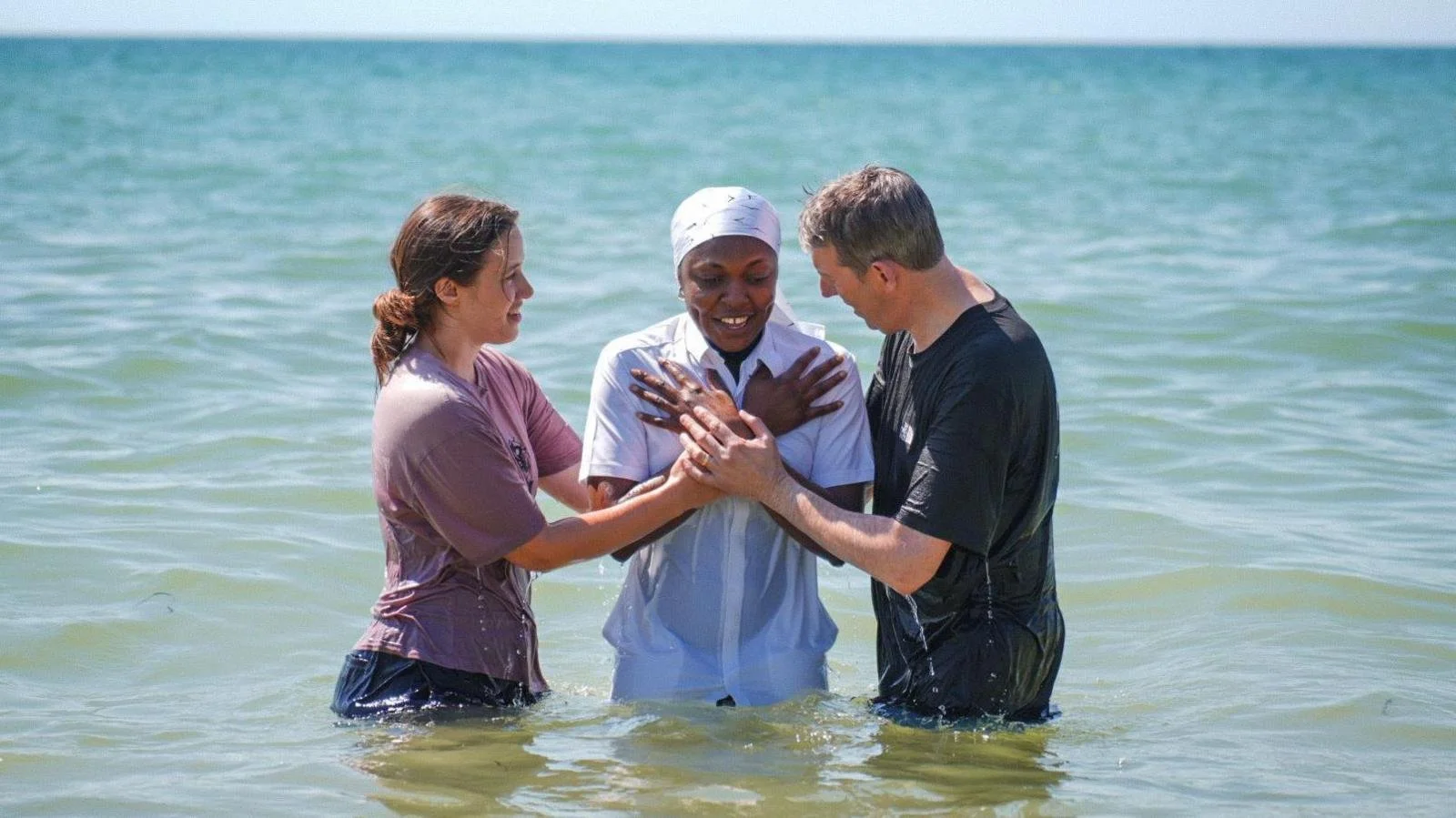
Early Church Fathers, including Augustine and John Chrysostom, interpreted the two fluids of ‘blood and water’ that flowed when Jesus corpse was pierced with a spear as the foundational elements of Christian symbolic life. They thought the water represented the Sacrament of Baptism symbolising the washing away of sins, spiritual cleansing, and rebirth into the family of God. They thought the blood represented the sacrament of the Holy Communion, which reminds people that it is only through the sacrificial death of Jesus that our sin can be forgiven and that we can be acceptable to the one holy God. This privilege of becoming members of God’s Kingdom is only given to those who have truly submitted to be followers of the Lord Jesus.
The Fountain of Living Water
In earlier chapters of John's Gospel, Jesus makes two bold promises; he said to the Samaritan woman he met at a well,
“. . . but whoever drinks the water I give them will never thirst. Indeed, the water I give them will become in them a spring of water welling up to eternal life.” John 4:14
“Whoever believes in me, as Scripture has said, rivers of living water will flow from within them.” John 7:38
In both cases he is talking about the life that the Spirit gives to those who follow Jesus.
The piercing of Jesus’ side is the physical, climactic fulfilment of those promises. The ‘fountain’ is opened at the exact moment his sacrificial work was completed and this can be the experience of any person who submits to follow the Lord Jesus and his teaching..
Early Christian symbols
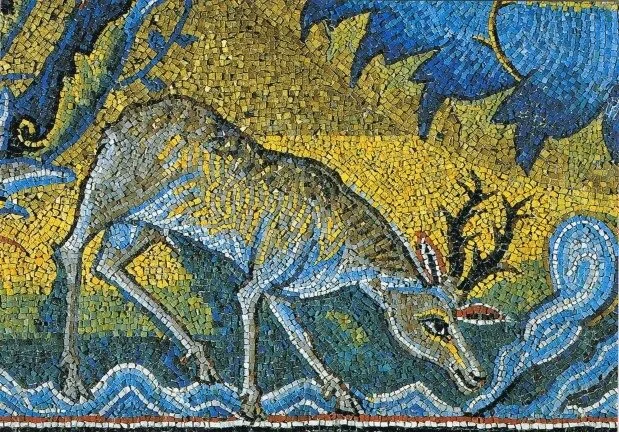
Psalm 42 starts,
‘As the deer pants for streams of water . . .’,
This inspired many artists making mosaics and relief sculptures who frequently depicted stags drinking from rivers or streams in paradise. This symbolised the soul's desperate longing for God and the refreshing grace found in a relationship with him and his people.
Mosaics on baptistery walls and church apses often depicted the four rivers of paradise, Gihon, Pishon, Tigris, and Euphrates, mentioned in Genesis as flowing through Eden, flowing out from the base of the cross. This visually taught people that Christ's crucifixion was the fountainhead of the ‘living water’ that restores creation and can restore people into a relationship with God.
The fish was one of the earliest secret Christian symbols. In ancient Greek, the word for fish is Ichthys (ΙΧΘΥΣ). Early Christians used this word as an acrostic, a clever way to spell out a profound statement of faith using the first letter of five Greek words: [
Iota (Iēsous) = Jesus
Xi (Christos) = Christ
Theta (Theou) = God's
Ypsilon (Huios) = Son
Sigma (Sōtēr) = Savior
Tertullian, an early Church Father, explicitly linked this to baptism, writing:
"We, little fishes, after the image of our Ichthys, Jesus Christ, are born in the water."
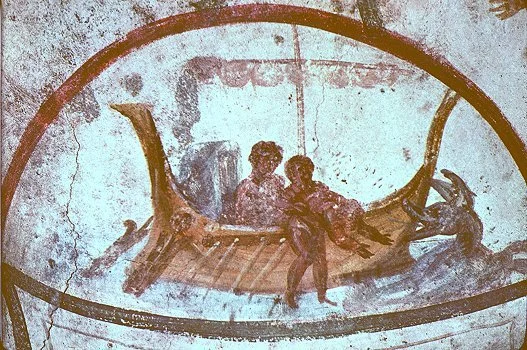
Catacomb frescoes frequently illustrated Noah in the ark or Jonah being thrown into the sea. These water-heavy stories were artistic shorthand for surviving the destructive ‘waters of judgment’ through divine rescue.
Does water baptism save people?
Many denominations teach that rituals such as baptism, confirmation and ordination automatically confer God’s blessing but what does these rites really mean? It cannot be that a child will for ever be acceptable to God because a genuine ‘faith in Jesus’ is the only means of salvation. There are many who think that because they are members of a church, have been baptised or have submitted to some religious ritual they are acceptable to God. Yesterday I was speaking with a friend in my sports club and asked him if he was a Christian.
“I’m a baptised Greek Orthodox” he replied.
I smiled and asked again:
“But are you a Christian, who is committed to living for Christ.”
“No I am not!”
In the Old Testament, God states that he despises empty religious rituals when they are not accompanied by genuine love for him. Through prophets like Isaiah and Amos, God says he cannot stand hollow practices, Isaiah chapter 1 is a graphic example of this. He emphasises that he desires justice, mercy, and humility over empty sacrifices and solemn assemblies. True worship involves an internal transformation and righteous actions that are more pleasing to God than external performances alone.
God rejects rituals that are disconnected from true devotion.
“The multitude of your sacrifices - what are they to me?” says the Lord. “I have more than enough of burnt offerings, of rams and the fat of fattened animals; I have no pleasure in the blood of bulls and lambs and goats.When you come to appear before me, who has asked this of you, this trampling of my courts? Stop bringing meaningless offerings! Your incense is detestable to me. New Moons, Sabbaths and convocations - I cannot bear your worthless assemblies.Your New Moon feasts and your appointed festivals I hate with all my being. They have become a burden to me; I am weary of bearing them.” Isaiah 1:11-14
“The Lord says:“These people come near to me with their mouth and honour me with their lips, but their hearts are far from me. Their worship of me is based on merely human rules they have been taught.” Isaiah 29:13
“I hate, I despise your feasts! I cannot stand the stench of your solemn assemblies” Amos 5:21
God prioritises righteousness and justice, he makes it clear what he truly wants from his people, faith shown in how we live, and this is much more than an outward show.
"He has shown you, O mortal, what is good. And what does the LORD require of you? To act justly and to love mercy and to walk humbly with your God" Micah 6:8
Amos contrasts ritual with godly actions. Significantly he describes justice and righteousness as a construal flow of water.
"But let justice roll on like a river, and righteousness like an ever-flowing stream" Amos 5:24
God desires a change of heart, God's message points to a need for an internal transformation rather than just an external one. This is what Jesus meant when he said to the upright religious Nicodemus,
“You must be ‘born again”. John 3:3
The prophets repeatedly highlight that God desires sincere worship throughout the weeks and years, that reflects a true and righteous heart, not just the performance of outward acts.
The righteous person is likened to:
“ . . . a tree planted by streams of water, that yields its fruit in its season.” Psalm 1:3
Constant spiritual nourishment is derived from a relationship with God. Isaiah joyfully proclaimed,
“With joy you will draw water from the springs of salvation.” Isaiah 12:3
Throughout Scripture, wells are not only physical sources of water but also carry deep spiritual significance, representing God's provision, blessing, and the sustenance of life both physically and spiritually.
In the Old Testament, wells are frequently mentioned in the narratives of the patriarchs. For instance, in Genesis 21:19, God opens Hagar's eyes to see a well of water in the desert, providing life-saving water for her and her son Ishmael. This act of divine provision underscores the well as a symbol of God's care and intervention in times of need.
“Then God opened her eyes and she saw a well of water. So she went and filled the skin with water and gave the boy a drink.” Genesis 21:19
Wells are often a picture in the Bible to represent the Word of God. The water in the well is often Christ as the source of refreshment to the thirsty soul. Remember how the Lord said to the woman of Samaria as she came down to the well,
“The water I give him will become in him a spring of water welling up to eternal life.” John 4:14b
What does 1 Peter 3:21 mean?
Peter writes:
“. . . this water symbolises baptism that now saves you . . .”
The context is important, the full verse reads:
“To those who were disobedient long ago when God waited patiently in the days of Noah while the ark was being built. In it only a few people, eight in all, were saved through water, and this water symbolises baptism that now saves you also—not the removal of dirt from the body but the pledge of a clear conscience toward God.[a] It saves you by the resurrection of Jesus Christ” 1 Peter 3:20-21
There are some who say that water baptism is necessary for salvation. That clearly cannot be right as Jesus said to the repentant thief on the cross:
“Today you will be with me in paradise.” Luke 23:43b
Some teach that ‘baptism doesn’t save us’, whereas here Peter seems to says it does! How can this be reconciled with the clear teaching of the rest of Scripture that syas that people are only saved by faith and that rituals and our works cannot contribute to our salvation?
In any answer, we should never deride the sacraments that are given to remind us of what God has done to save us. What God demands is a wholehearted response to his love, a genuine faith. All symbolic acts are to remind us that they represent what Jesus has done for us and nothing more. The blessing comes from our commitment, our faith, in who he is and what he had won for us.
The Roman Catholic Church officially teach something different. It says that God’s saving grace comes to people essentially through the physical acts of the sacraments administered appropriately by a human priest or his authorised representative. They teach ‘baptismal regeneration’, that a person is born again into a right relationship with God by means of the act of baptism. Similarly they teach that the bread and wine actually become, get transubstantiated into, the physical body and blood of Christ, during the Eucharist. The bread really becomes the physical body of Christ and the cup of wine becomes the physical blood of Jesus. They teach that through these physical means Gods grace is preserved and shared with people. So in baptism, the priest or his representative applies the water to the infant. And by that ecclesiastical and sacramentally physical act, the child is said to be saved. These are the very words of the Roman Catholic Catechism:
“Holy Baptism is the basis of the whole Christian life, the gateway to life in the Spirit, and the door which gives access to the other sacraments. Through Baptism we are freed from sin and reborn as sons of God; we become members of Christ, are incorporated into the Church and made sharers in her mission: ‘Baptism is the sacrament of regeneration through water in the word.’” Roman Catholic Catechism part 2, section 2, chapter 1, article 1, paragraph 1213
Protestant evangelicals would protest against such teaching. The name ‘Protestant’ means ‘we protest’. No, rituals do not free from sin, they do not cause a person to be reborn. They do not unite to Christ in a saving way. Salvation is only given through faith. When a person has a personal relationship with Jesus all acts of obedience confirm that faith, and confirm that a person has a new birth, and confirm forgiveness of sins, and confirm membership in Christ. Without such a faith religious acts are meaningless to god. Paul writes,
“We also have believed in Christ Jesus, in order to be justified by faith in Christ and not by works of the law, because by works of the law no one will be justified” Galatians 2:16
The context of Paul’s letter had to do with whether circumcision was effective for justification, a was a similar question to whether baptism was effective for justification.
If the first act of true saving faith, when we turn to Christ for salvation from our sins, is the point at which justification happens, then there is nothing we can add to faith to make it happen. You can’t add circumcision — and by implication, you can’t add baptism. The decisive act of justification and adoption and new birth are performed by God through that first act of saving faith. Therefore, no other acts can make those divine acts happen.
How are we to understand baptism then? There are two passages, where baptism is described as an act signifying the new birth, of burying the old self and rising from the water with the new self.
“In [Christ] also you were circumcised with a circumcision made without hands, by putting off the body of flesh, by the circumcision of Christ” Colossians 2:11
This is a picture of the new birth, described as a kind of spiritual circumcision. The old, unbelieving, blind, rebellious self is cut away, and a new person comes into being, a new creation. Paul goes on in the next verse to say,
“. . . having been buried with him in baptism, in which you were also raised with him through faith in the powerful working of God, who raised him from the dead” Colossians 2:12
So, baptism is here described as an act signifying the new birth, of burying the old self and rising from the water with the new self.
We were raised with Christ through a personal faith in him. Paul wants christians to understand that we must not picture the physical act of baptism as the decisive cause of this new birth. It’s an acted-out picture of what is happening, and the spiritual effect of what is happening is through faith.
1 Peter 3:21 should be understood in the same way. Peter has just referred to Noah’s flood and the rescue of eight people in the ark. And then he says,
“Baptism, which corresponds to this, now saves you , not as a removal of dirt from the body but as an appeal to God for a good conscience, through the resurrection of Jesus Christ” 1 Peter 3:21
In other words, the waters of baptism are like the waters of Noah’s flood. We are saved from that judgment. Peter clarifies what he means unless we think it’s the actual physical enactment of passing through the water that saves. He says salvation happens
“. . . not as a removal of dirt from the body, but as an appeal to God for a good conscience”. 1 Peter 3:21
This appeal is an act of the heart looking away from itself and from all human means and calling on God, for grace to save.
This appeal is the heart’s cry of faith. That, Peter says, is the instrument that receives the saving grace of God. The physical act of baptism is the parable, it’s the drama, it’s the emblem, but the reality of new birth is not physical and is not received by physical acts. It’s received by faith and faith alone. Then baptism follows as a beautiful, obedient enactment of the effects of faith.
The Place of Rituals
When I was teaching at a student conference in Poland a lovely young doctor took me on a sight-seeing visit to the local town and we entered the church. My guide immediately went and dipped her hand in some holy water by the door and made a sign of the cross. Then she went to the aisle of the church and genuflected towards the altar. I asked her why she did this and she replied:
“This is how we are saved.”
In the subsequent discussion it was clear that what was originally intended to be an aid to help people remember Jesus and the gospel had become the means of salvation. This is not that uncommon. There are many who think that because they have been baptised, confirmed and regularly follow church directives that they are saved. there is nothing wrong with having rituals but people must be taught that sacraments save nobody, they can only be an aid to having a saving faith.
Infant Baptism
Since very early days of the church babies were admitted into the church community through infant baptism. This meant that the parents, God parents and the local congregation committed themselves to bring the child up to know about and love the Lord Jesus. Whilst they are in those formative years the children are accepted as part of a family of faith. However they then have to make up their minds who they will serve. There is no salvation for those who reject the Lord Jesus’ rule over them and fail to continue living in him. Paul wrote about this:
“But now he has reconciled you by Christ’s physical bodythrough death to present you holy in his sight, without blemish and free from accusation - if you continue in your faith, established and firm, and do not move from the hope held out in the gospel.” Colossians 1:22-23
With this understanding, there is no problem with having a child baptised so long as the parents are committed to following the Lord and genuinely intend to raise the child to love the Lord Jesus and the Scriptures. What is a tragedy is that many think they are Christians because they were baptised as a baby.
The difference bewteen infant baptism and dedication in a believing family is simply that in baptism water is sprinkled on the child as a sign that the only hope we can have is to be washed of our sin by following the Christ who died to take responsibility for our sin. In dedication the meaning is the same but the sign is omitted. The Christian parents may or may not like the symbolism of the water but what matters is the faith of the family. Both the infant baptisers and the dedicaters acknowledge that this faith in Jesus must be personally adopted by the child when they become an adult, hence the need for formal ‘confrmation of the baptismal vows’ or an ‘adult baptism’. We have all seen people who were baptised as adults but who have gone away from following Jesus. The sign is only valid if it helps lead to a continued faith.
When I was a student I ‘inked in’ the commitment made to Jesus that I had ‘pencilled in’ as a child. I then wanted to be a full member of my Bible teaching church so went forwards for ‘Confirmation’. At the service the Bishop announced that by the laying on of his hands I would receive the gift of the Holy Spirit. I almost walked out as I knew that I already had received the Spirit, I loved Jesus and wanted to follow him. The Bible is clear when we receive the Spirit of God, it is when we turn to Christ for salvation.:
“ I would like to learn just one thing from you: Did you receive the Spirit by the works of the law, or by believing what you heard?” Galatians 3:2
It is never the ritual that is important, the Bible emphasises that it is only a genuine faith that saves us.
This important subject is discussed further in the article ‘Once saved, always saved?’ on this website (https://www.bvpalmer.com/bible-teaching-1/once-saved-always-saved-1?rq=once%20saved)
We must therefore all do all we can to keep helping people, including our families and friends, to remember what the Lord Jesus has done for us and to be eternally grateful. It is faith that matters, not rituals.