Repentance and Faith
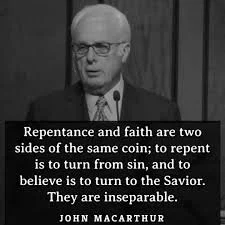
In his book ‘I Surrender’, Patrick Morley writes that the church has an integrity problem and that this lies in a misconception:
“. . . that we can add Christ to our lives, but not subtract sin. It is a change in belief without a change in behaviour.”
He goes on to say,
“It is revival without reformation, without repentance.”
The Bible consistently teaches that both “repentance” and “belief” in Jesus are necessary for salvation. Sadly today many people emphasize “believe” while downplaying “repent”. Often this is because they do not understand what the Biblical word ‘believe’ means.
The meaning of “belief” has shifted significantly over the last 200 years. Originally, belief was not just intellectual agreement but a deep, relational trust - especially in the context of faith.
The English word “belief” comes from the Old English ‘geleafa’, which means “to hold dear” or “to love”. It involved a personal trust in someone, faithfulness and loyalty to them and commitment to follow a person or way of life. Thus the commitment of ‘marriage’ is a form of ‘belief’ With this understanding, “to believe in Christ” meant to trust, love, and obey Him - not just to agree with facts about Him.
Over the last 200 years this meaning has changed. With the rise of rationalism during the Enlightenment era (1700s -1800s) belief became more about mental agreement rather than relational trust. With modern secular thinking (1800s - Present) faith and belief have been separated, with belief seen as accepting certain propositions rather than following a person.
Today, “belief” is often reduced to “accepting something as true”, rather than a deep commitment of trust and love.
In the Bible the word ‘belief’ (Greek: pisteuo) certainly means trusting, loving, and following a person, it does not just mean accepting an idea as true.
In John 3:16 we read “Whoever believes in Him . . . has eternal life” and this clearly means trusting and following Him. This is not the same sort of belief as when we say “I believe in gravity”. Martin Luther, the 16th century church reformer emphasized the importance of personal faith in Jesus Christ. He wrote:
“Should anyone knock at my heart and say, ‘Who lives here?’ I should reply, ‘Not Martin Luther, but the Lord Jesus Christ.’”
In the same vein he said,
“Many say Jesus is Lord but only the Christian says ‘Jesus is my Lord’.”
Luther recognised that genuine saving faith involves a personal relationship with Christ, not merely acknowledging Him as God in a theoretical sense. The apostle James wrote similarly:
“Even demons believe - and shudder!” James 2:19
Mere intellectual belief is not enough for anyone to be acceptable to God.
Many today reduce faith to just agreeing with doctrine, rather than trusting and following Jesus. Jesus teaches that true belief involves obedience:
“If you love me, keep my commands.”. John 14:15
Repentance and discipleship always have been part of believing in Christ. There is no saving faith without love, loyalty, and commitment to him. True Biblical faith is relational—it means trusting, loving, and following the Lord Jesus Christ. In contrast modern ‘belief’ is often just intellectual agreement.
Repentance & Faith Go Together
A repeated theme throughout the Bible is that saving faith must be combined with rethinking about who will control my life. Repentance involves allowing God to take over the control that previously had been in my own hands. To be able to enter God’s eternal kingdom a person must individually repent. This was an emphasis both of Jesus and his apostles
Unfortunately there are some who have not understood this and omit to emphasise the need for repentance. Why do some do this? Saying “just believe” sounds easier and more appealing than calling people to turn from sin. Some think repentance means “earning” salvation, but the Bible teaches that repentance is simply turning away from sin and turning toward God in response to who Jesus is and what he has done tobear the consequences of our sin.
There has been a cultural shift by some preachers today to emphasise the need for self-confidence and self-affirmation. Many modern churches avoid messages about sin and judgment, fearing that such doctrines are divisive and so they focus on God’s love and acceptance of all. However this is to deny the apostolic message which is only possible by the selective use of Scripture.
The German theologian, Dietrich Bonhoeffer, who was hanged by the Nazis just before the end of the Second World War, famously wrote against those who advocated what he called ‘cheap grace’. He reminded us that God hates sin. Every sinful thought would be enough to send Jesus to the cross – is that what we want? There are today some, even in churches that are trying to move the goal posts about sexual morality, they do not think that repentance is vital, but to do so they have to undermine the validity of Scripture. Paul goes on to say:
“Let no one deceive you with empty words, for because of such things God’s wrath comes on those who are disobedient.” Ephesians 5:6
People have a choice, do we listen and follow what the Word of God says or do we follow empty words. Remember what Paul passed on to Timothy (and us) just before he was beheaded,
“Preach the word . . . For the time will come when people will not put up with sound doctrine. Instead, to suit their own desires, they will gather around them a great number of teachers to say what their itching ears want to hear. They will turn their ears away from the truth and turn aside to myths.” 2 Timothy 4:2-4
We can contribute nothing to our salvation, only Christ can give us eternal life because only he has taken our sin on himself. However true belief in Jesus includes repentance - a heart that turns away from sin, a rejection of Christ’s rule. Repentance is not just about feeling sorry but about real change that continues. Jesus says to his followers:
“Produce fruit in keeping with repentance.” Luke 3:8
Faith without repentance is inadequate, just as repentance without faith in Jesus is meaningless.
Jesus’ teaching – repentance and faith in him are both essential
At the start of his teaching ministry Jesus emphasised how people could become members of God’s kingdom.
“The time has come,” Jesus said. “The kingdom of God has come near. Repent and believe the good news!” Mark 1:15
Both repentance (turning from sin) and belief (trusting in Him) are vital for salvation.
“Unless you repent, you too will all perish.” Luke 13:3
Jesus made it clear that repentance is necessary for salvation. Just before he ascended into heaven Jesus told his disciples:
“Go and make disciples of all nations, baptising them in the name of the Father and of the Son and of the Holy Spirit, and teaching them to obey everything I have commanded you.” Matthew 28:19-20
Luke expands this by adding that new followers will be made by preaching about the need for repentance and the promise of forgiveness of sins for those who turn to Christ.
“He told them, “This is what is written: The Messiah will suffer and rise from the dead on the third day, and repentance for the forgiveness of sins will be preached in his name to all nations, beginning at Jerusalem.” Luke 24:46-47
2. Peter’s Preaching: Repentance First, Then Faith
At Peter’s first sermon he emphasised the same truth:
“Peter replied, ‘Repent and be baptized, every one of you, in the name of Jesus Christ for the forgiveness of your sins.’” Acts 2:38
Sin is essentially the rejection of the Lordship of God and his son Jesus. This results in our succumbing to the many temptations to sin that come our way. Peter emphasized repentance as the response to the gospel about who Jesus is and what he has done for us.
In Peter’s next sermon he emphasised the same message:
“Repent, then, and turn to God, so that your sins may be wiped out.” Acts 3:19
Turning away from sin is an essential part of salvation.
3. Paul’s Preaching: Repentance & Faith Together
Paul told the church leaders of Ephesus that this had also been the basis of the gospel he taught:
“I have declared to both Jews and Greeks that they must turn to God in repentance and have faith in our Lord Jesus.” Acts 20:21
Paul clearly linked repentance and saving faith as being inseparable. Paul, on trial before King Agrippa testified:
“First to those in Damascus, then to those in Jerusalem and in all Judea, and then to the Gentiles, I preached that they should repent and turn to God and demonstrate their repentance by their deeds.” Acts 26:20
Paul insisted that true repentance will result in a transformed life. Faith is trusting in Christ for my eternal forgiveness and salvation and repentance is a change of heart and mind to live as Jesus wants. Both together are the response God wants to see in us when we recognise who Jesus really is. Jesus and his apostles taught both boldly.
Paul explained that our salvation has been won by Christ and is a gift, but the evidence of this gift will be a life committed to living asJesus wants:
“For it is by grace you have been saved, through faith - and this is not from yourselves, it is the gift of God - not by works, so that no one can boast. For we are God’s handiwork, created in Christ Jesus to do good works, which God prepared in advance for us to do.” Ephesians 2:8-10
The reformer Martin Luther has said,
“Paul does not say that faith is without its characteristic works, but that it justifies without the works of the law. Therefore justification does not require the works of the law; but it does require a living faith, which performs its works.”
We have been chosen by God for a purpose – to life with and for him.
The Message of the Early Church
After the apostles, the early church fathers and Christian leaders continued teaching that repentance and faith were both necessary for salvation. Here are some examples:
1. Clement of Rome (c. 96 AD)
“Let us fix our gaze on the blood of Christ and understand how precious it is to His Father, because it was poured out for our salvation and brought the grace of repentance to the whole world.” 1 Clement 7:4
Clement, a disciple of the apostles, taught that repentance is a gift from God through Christ.
2. Ignatius of Antioch (c. 110 AD)
“He who is truly possessed by the Word of Jesus can also hear His silence, that he may be perfect; so that he may act through what he speaks, and be known by his silence. Nothing is hidden from the Lord, but even our secrets are close to Him. Let us then do all things in the knowledge that He dwells within us, that we may be His temple, and He may be in us our God—which indeed He is, and will manifest Himself before our faces. Therefore, let us love Him in sincerity of heart, and not corrupt His commandments through hypocrisy.” Letter to the Trallians 9:1
Ignatius emphasized that true faith leads to obedience and a changed life—not just belief without transformation.
3. Justin Martyr (c. 150 AD)
“We have learned from the prophets, and we hold it as true, that punishments and chastisements and good rewards are rendered according to the merit of each man’s actions. Since if it were not so, nothing would be left to free choice. But since our own actions bring about judgment, we learn that we must turn from our wicked ways, and through faith in Christ obtain salvation.” First Apology 61
Justin affirmed that both repentance and faith are required for salvation.
4. Irenaeus of Lyons (c. 180 AD)
“But how shall they be saved unless it be through the Son? And how shall they receive adoption unless they remain in His light? Those who do these things do not repent, but despise Him and reject His teaching, and thus cast themselves away from life.” Against Heresies 4.27.2
Irenaeus taught that those who refuse to repent remain in darkness, while those who repent and believe receive salvation.
The early church fathers continued the apostolic teaching that salvation requires both repentance and faith in Jesus. True belief leads to transformation—a life that turns away from sin. The idea of “just believe” without repentance is a modern distortion of the teaching of Jesus and his apostles.
J. Bridges in his book ‘The Pursuit of Holiness’ has summarised the Bible’s teaching,
“Faith and holiness are inextricably linked. Obeying the commands of God usually involves believing the promises of God.”
BVP