Ishtar, Aphrodite, Venus and Mary
Throughout history there have always been female divine figures that people venerate or worship.
Ishtar was a goddess in ancient Mesopotamia, who had a complex and varied character. Her associations included love, sensuality, fertility and war, giving her the extraordinary ability to both create life, and to take it away. Because of these powerful gifts, she was the most famous and revered of all goddesses worshipped in ancient Mesopotamian society, and remained so for thousands of years. Ishtar is pronounced as ‘east-er’ and many think this is where our word ‘Easter’ is derived from. Her symbols included an egg and a rabbit. It is likely that she is the origin of what we know as the ‘Easter egg’.
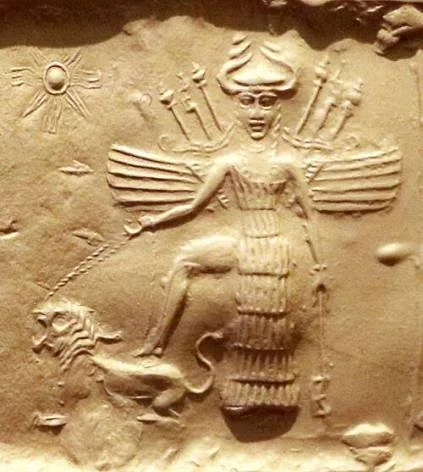
Goddess Ishtar on an Akkadian seal, 2350–2150 BC
The ancient Egyptians had their female goddess called Isis. She was worshipped as a goddess or magic, motherhood, healing and fertiltiy.
As Mesopotamian culture influenced the Levant, Ishtar became Astarte and her popularity spread to the Mediterranean. The cult of Astarte reached Greece (likely via Cyprus), where she was adapted into Aphrodite. While the Greeks kept her beauty and sexuality, they largely stripped away her ‘warrior’ status, except in places like Sparta.
The Romans later identified Venus, their local goddess of gardens and fertility with Aphrodite, adopting all her myths and Greek traits to create the Venus we know today.
Despite their different names, they share several core ‘features’ that reveal their common origin:
The Planet Venus: All three goddesses are personifications of the planet Venus. In Mesopotamia, Ishtar was the "Morning and Evening Star". This association was passed down to Aphrodite and finally gave the planet its modern name in Rome.
They all share specific animal and plant symbols:
Doves: Both Ishtar and Aphrodite were closely associated with doves; the Greek word for dove, peristerá, may even derive from "bird of Ishtar".
Roses: Legend says the goddesses created the rose, imbuing it with their power over life and desire.
Eight-Pointed Star: Ishtar's primary symbol, represented her planetary form. It specifically represents the planet Venus which returns to the same position in the sky every eight years. The ancients observed this cycle and encoded into this eight-rayed symbol. As the ‘Morning Star’ and ‘Evening Star,’ it reflected Ishtar’s dual roles as the goddess of both love/fertility and war.
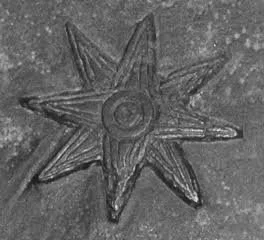
Ishtar’s eight-pointed star
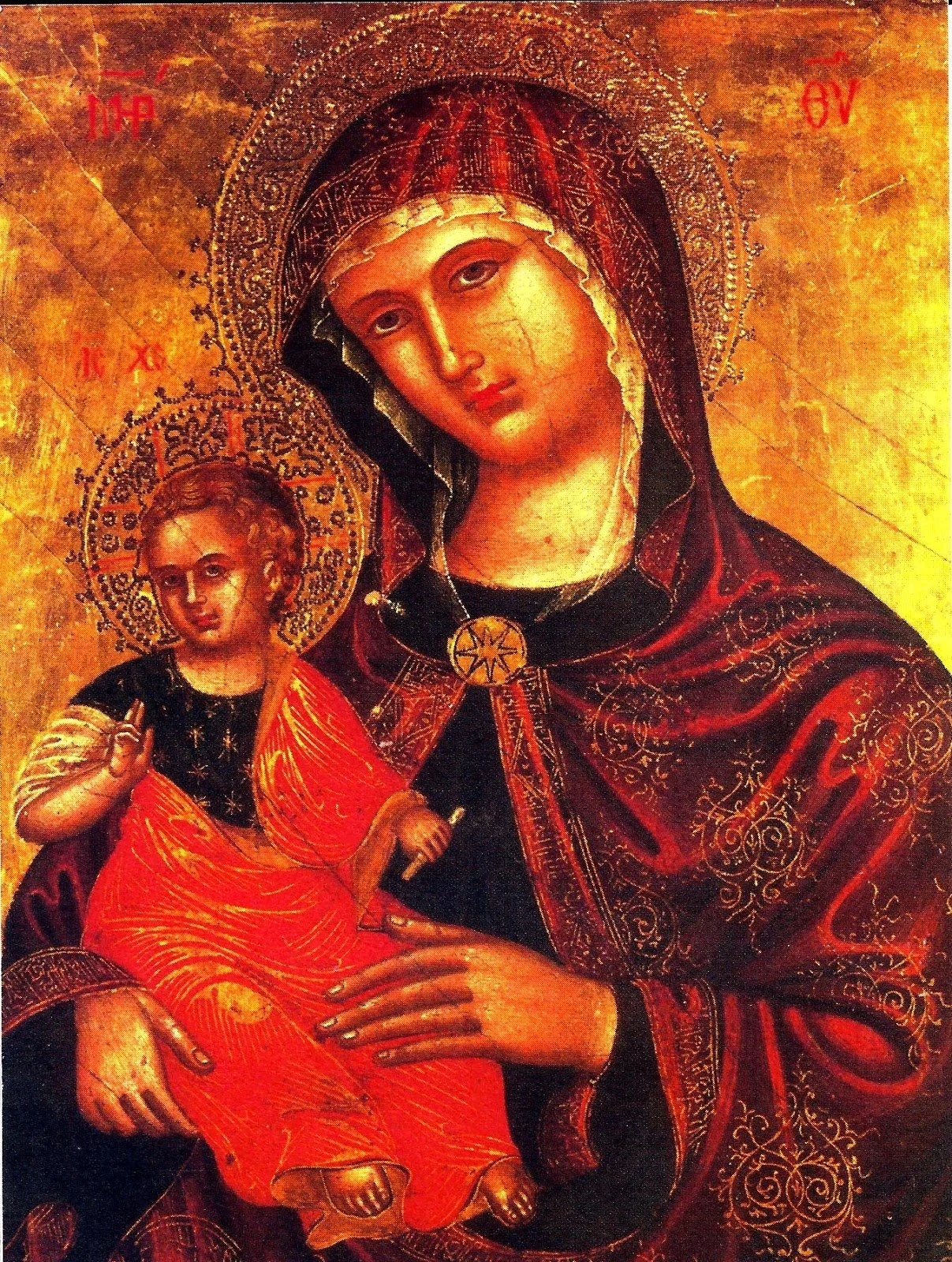
In the Christian tradition, many symbols of the ancient ‘Queen of Heaven’ were adapted to honour the Virgin Mary. Mary is often titled Stella Maris (Star of the Sea), and the eight-pointed star frequently appears on her mantle or in iconography to denote her divine guidance and purity. You can still see this star used prominently in Catholic art and architecture.
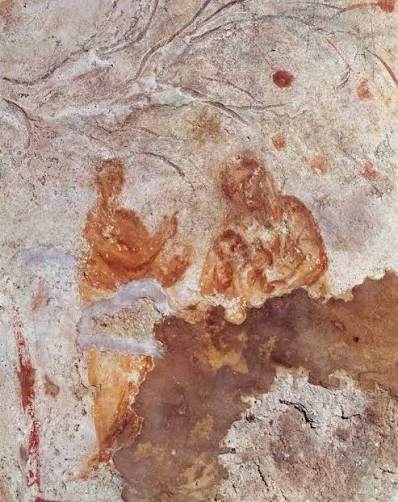
Earliest picture of Mary, note the eight pointed star. Picture in the catacomb of Priscilla
Mary (the Virgin Mary) is frequently linked to Aphrodite and Venus. As Christianity spread, many attributes of Mediterranean love and fertility goddesses (Isis, Aphrodite, Venus) were adapted into Mary’s role as the idealised Queen of Heaven and the ultimate divine mother figure.
Venus/Aphrodite (goddesses of love/beauty) were replaced by Mary (embodiment of chaste/maternal virtue), taking on the role of the ultimate female template in Western culture.
Mary has been given the title of ‘Queen of Heaven,’ which was previously applied to ancient goddesses like Inanna, Isis, Astarte, and Juno.
Aphrodite/Venus were often depicted as arising from the sea (often on a scallop shell), and later Mary was frequently depicted in similar iconic poses or settings during the Renaissance.
Symbols such as the dove, often associated with goddesses like Venus, Aphrodite, and others, were transitioned to represent the Holy Spirit in relation to Mary. The eight pointed star is often used to represent Mary in art. See the eight-pointed star in the picture of Mary in the catacomb of Priscilla shown below.
In ancient contexts, the word ‘virgin’ often referred to an independent woman not owned by a man, a title shared by Aphrodite, Venus, and other goddesses long before it was applied to Mary.
In some interpretations, Mary Magdalene is also linked to Venus as a figure representing romantic love, while the Virgin Mary represents maternal/divine love.
While Catholic theologians emphasise that Mary is not a goddess, scholars in art and history argue that Mary's cult inherited the cultural roles, imagery, and devotion formerly dedicated to Venus and Aphrodite. In practice, in many Roman Catholic churches she is treated as if she were divine, with many praying to her and asking her for miraculous interventions. Although the theologians recognise this problem, few are loathe to speak up against this widespread deviation away from a christ centred apostolic faith.
Development of Mary’s pre-eminence
The veneration of Mary began developing in the 3rd and 4th centuries, with the earliest known prayer, Sub tuum praesidium, dating to around 250 AD. Public veneration was formally solidified at the Council of Ephesus in 431 AD when she was declared to be Theotokos (Mother of God). There is a suggestion of earlier, unofficial veneration as she is prominent in second century catacomb paintings. Much of the developed doctrines about Mary are not found in the Bible, many of the ideas were codified at much later dates. The doctrines of Mary’s 'Immaculate Conception' and 'Assumption' were not declared dogma until the nineteenth and twentieth centuries.
In the 2nd century AD the earliest archaeological evidence appears in Roman catacombs, such as paintings of Mary with the Christ Child in the Catacomb of Priscilla. Note the eight pointed star over her head. Since then the vast majority of these paintings,, and there are very many, depict a helpless child in the hands of a capable mother. When we visited the Ufizzi museum in Florence we were amazed that the vast majority of religious pictures there depict Mary with a helpless baby Jesus.
In the 3rd - 4th century AD people began praying to Mary much as they used to pray to Aphrodite and Venus, asking for her help. The ‘Sub tuum præsidium’ (Latin for ‘under your protection') is an ancient hymn and prayer addressed to the Virgin Mary. At this time there was also a growing popularity for using the title ‘Mother of God’ when talking of Mary. This gives her a very different status ti being known as ‘the mother of Jesus’.
In 431 AD the Council of Ephesus officially confirmed the title Theotokos (God-bearer), leading to a significant increase in public devotion to Mary, particularly in the East of the Roman Empire.
From the 6th century AD formal liturgical feasts, such as ‘the Nativity of Mary’ were introduced and devotion to her expanded into the Western division of the Roman Church.
The danger of tradition
Problems arise when people follow traditions instead of the Word of God. Man-made traditions can easily become idols, nullifying God's commands and leading to superficial worship. When tradition is elevated to the same or higher authority than Scripture, it often results in hypocrisy, legalism, and division, shifting the focus from internal transformation to external appearance.
The Pharisees were a very devout and religious group but their thinking and teaching angered Jesus.
“So the Pharisees and teachers of the law asked Jesus, “Why don’t your disciples live according to the tradition of the elders instead of eating their food with defiled hands?”
He replied, “Isaiah was right when he prophesied about you hypocrites; as it is written:“ ‘These people honour me with their lips, but their hearts are far from me. They worship me in vain; their teachings are merely human rules.’
You have let go of the commands of God and are holding on to human traditions.” Matthew 7:5-8
Jesus affirms that Scripture must always have precedence over tradition. Traditions can so easily become more important over divine commandments, rendering Scripture ineffective in a person's life and their worship meaningless. People may appear righteous outwardly through strict adherence to customs (such as special fasts, dress codes, or rituals), but their hearts remain far from God.
This story also illustrates how human traditions often create unnecessary rules that burden believers, fostering a culture of judgment rather than grace and can often lead to ignoring weightier matters such as love, mercy, and justice.
The problem is not with all traditions, but specifically 'traditions of men’ that contradict, overrule, or distract from the Bible. Traditions that encourage devotion to the Lord Jesus are often good, but when tradition replaces the truth, it leads to spiritual dryness and error.
Current teaching of the Roman Catholic Church about Mary
The perpetual virginity of Mary
The Roman Catholic Church now teaches that Mary was a virgin her whole life; not only when Jesus was conceived by the Holy Spirit, but even through his birth, her virginity remained physically intact; and that following Jesus’s birth she never engaged in sexual relations. The tradition goes that though married to Joseph, she never bore any other children. Mary’s womb, having borne the Son of God, was sacred. It is as if virginity is somehow regarded as godly. There is a major problem with this view. Furthermore the gospels all teach that Jesus had brothers and sisters.
"While Jesus was still talking to the crowd, his mother and brothers stood outside, wanting to speak to him.” Matthew 12:46
“Isn’t this the carpenter’s son? Isn’t his mother’s name Mary, and aren’t his brothers James, Joseph, Simon and Judas?” Matthew 13:55
“Then Jesus’ mother and brothers arrived. Standing outside, they sent someone in to call him. A crowd was sitting around him, and they told him, ‘Your mother and brothers are outside looking for you.’” Mark 3:31-32
“Isn’t this the carpenter? Isn’t this Mary’s son and the brother of James, Joseph, Judas and Simon? Aren’t his sisters here with us?” And they took offence at him.” Mark 6:3
“After this he went down to Capernaum with his mother and brothers and his disciples.” John 2:12
These passages make it clear that Jesus was the oldest of a large family. Jesus brother James later became the leader of the church in Jerusalem.
The Immaculate Conception of Mary
Many people (even some Catholics) think this refers to the Virgin Birth of Christ, but this doctrine relates to her own status before God. In order for Mary to be born without the stain of original sin, she had to be immaculately conceived. Although she was conceived naturally by her parents (who tradition holds were St. Joachim and St. Anne), the church teaches that she was shielded by the Holy Spirit from from inheriting original sin.
The Assumption of Mary
Tradition holds that Mary, at the end of her earthly life, was taken physically into Heaven to be with her Son. The Sacred Tradition of Eastern Orthodox Christianity teaches that the Virgin Mary died a natural death, like any human being; but that her body was resurrected on the third day after her death, at which time she was taken up, soul and body, into heaven in anticipation of the general resurrection. Her tomb, according to this teaching, was found empty on the third day. Roman Catholic dogma leaves open the question of whether she first died, but the idea is that this was her last moment on this earth.
Mary, the Queen of Heaven
This title was originally given to goddesses such Inanna, Isis, Astarte, and Juno and has been passed on to Mary because of her honoured status as the Mother of Jesus.
Mary, the Mother of God
The title arises as a translation of the title originally given to her in the Eastern Roman Empire, Theotokos, which means, the God-bearer or Mother of God. The apostles affirmed that Christ was fully God as well as fully man but later some introduced the doctrine that Jesus was merely a great prophet of God. This teaching spread and later evolved into Islam. In the first Christian centuries, when Christological questions and heresies raged about the true nature of Christ, His earthly origins were of the utmost importance and concern. Nestorius of Constantinople had rejected the title Theotokos for the mother of the incarnated Word, Jesus. He insisted that Mary, as a human being, could give birth only to a human being, and not to God. He persisted in calling the Virgin Mary Christotokos. This teaching, which demeaned who Jesus claimed to be, jeopardised the salvation of the human race. It was similar to the teaching of Arius that Jesus was not fully God, a teaching that has evolved into what the Watchtower, the ruling body of Jehovah’s Witnesses, teach today. Cyril of Alexandria disproved of this error and supported the reason why the mother of God should be called Theotokos. The Scriptures are clear that Jesus is fully divine but it has also led to the status of Mary being, in practice, almost deified.
Mary as Mediatrix
Scripture is clear:
“For there is one God and one mediator between God and mankind, the man Christ Jesus”. 1 Timothy 2:5
However Roman Catholics are taught that that doesn’t preclude the idea that there can’t be other mediators between us and Christ so people can ask Mary and the saints to intercede for them. The problem with this view is that in the Scriptures prayers are all addressed to God directly. There are no prayers addressed to people who have died. Furthermore there is only ‘one mediator between God and mankind’, not many!
Statues to Mary
In many Roman Catholic Churches Mary is given great prominence. There are a multitude of statues and pictures depicting her, often carrying helpless baby. In some churches, especially in countries such as Spain, Italy and Poland, Mary seems to hold a more prominent position than Jesus, with her statue being larger, more centrally located, or more adorned. This gives the strong impression that Mary is on a ‘pedestal higher than Christ’. Although the claim is that these are not to be worshipped but just are aids to devotion, the problem is that that devotion then centres more on Mary or a Saint. This consequently detracts from the Lord and Saviour of the world. It elevates a human being excessively, violates the command in Scripture against making ‘graven images’ and disrupts the Christians worship of Jesus. Kneeling, bowing, or praying in front of a statue is essentially an act of worshiping a ‘graven image’ or idol, which Scripture argues should be restricted to God alone.
“You shall not make for yourself a graven image . . . you shall not bow down to them or serve them”. Exodus 20:4-5
Some Catholics seem to treat statues with superstitious reverence, and act as though the statue itself possesses miraculous power. One such report from a Roman Catholic Church in Buenos Aires describes the way that a statue to Mary was the focus of people’s worship.
“At the centre of the sanctuary, near the altar, stood a statue of the Blessed Virgin Mary, about four feet tall. She was carved of plaster but painted lovingly: her robe in sky blue, her veil in white, her eyes downcast in serenity. The folds of her mantle seemed to ripple like fabric, though they were stone. Generations had prayed at her feet. Couples left flowers at her base on their wedding day. Mothers brought their infants for baptism, whispering prayers for their futures. Old men sat in the back pews, staring at her folded hands, remembering wars and losses and hoping that a mother’s intercession still reached heaven.”
Such beliefs in the power of the statue of Mary have been encouraged by officials through stories of the statues of Mary weeping blood, though many of these when investigated have been found to be fraudulent..
Who was Mary?
Mary was a young woman, a direct descendant of king David, who God chose to be the mother of Jesus. She was a normal sinful girl. Mary the mother of Jesus was described by God as ‘highly favoured’ (Luke 1:28). This phrase comes from a single Greek word, which essentially means ‘much grace.’ Mary received God’s grace. Grace is a blessing we receive despite the fact that we do not deserve it. Mary needed grace from God and a Saviour, just as the rest of us do. Mary herself understood this fact, as she herself declared:
“My spirit rejoices in God my Saviour.” Luke 1:47
Mary, by God’s grace, recognised that she needed the Savior. To recognise how far short we fall from God’s standard is always the way to begin being blessed by God. The Bible never says that Mary was anyone but an ordinary human whom God chose to use in an extraordinary way. Mary was a sinful human being who needed Jesus Christ as her Saviour, just like everyone else. Mary was not without sin. The Bible is clear:
“ . . .for all have sinned and fall short of the glory of God, and all are justified freely by his grace through the redemption that came by Christ Jesus.” Romans 3:23-24
There is nothing in the Bible to suggest that Mary was an exception to this rule. The apostle John wrote,
“If we claim to be without sin, we deceive ourselves and the truth is not in us. If we confess our sins, he is faithful and just and will forgive us our sins and purify us from all unrighteousness. If we claim we have not sinned, we make him out to be a liar and his word is not in us.” 1 John 1:8-10
The virgin Mary did not have an ‘immaculate conception.’ The Bible doesn’t suggest Mary’s birth was anything but a normal human birth.
Mary was a virgin when she gave birth to Jesus (Luke 1:34–38), but she was not a virgin permanently. The idea of the perpetual virginity of Mary is unbiblical. The gospels say that Joseph
“ . . . did not consummate their marriage until she gave birth to a son.” Matthew 1:25
The word ‘until’ indicates that Joseph and Mary did have normal sexual relations after Jesus was born. Mary remained a virgin until the Saviour’s birth, but later Joseph and Mary had several children together.
What does the Bible teach about worship?
The Bible is clear that we are only to worship the one Almighty God. Even angels refuse to be worshipped. The apostle John got this wrong when he had a vision of an angel:
“At this I fell at his feet to worship him. But he said to me, ‘Don’t do that! I am a fellow servant with you and with your brothers and sisters who hold to the testimony of Jesus. Worship God!” Revelation 19:10
“I fell down to worship at the feet of the angel who had been showing them to me. But he said to me, ‘Don’t do that! I am a fellow servant with you and with your fellow prophets and with all who keep the words of this scroll. Worship God!’” Revelation 22:8-9
To fall at the feet of a person or statue is worship.
The apostles themselves refused to be worshipped:
“As Peter entered the house, Cornelius met him and fell at his feet in reverence. But Peter made him get up. ‘Stand up,’ he said, ‘I am only a man myself.’” Acts 10:25-26
At Lystra, Paul and Barnabus were revered as gods:
“The priest of Zeus, whose temple was just outside the city, brought bulls and wreaths to the city gates because he and the crowd wanted to offer sacrifices to them. But when the apostles Barnabas and Paul heard of this, they tore their clothes and rushed out into the crowd, shouting: ‘Friends, why are you doing this? We too are only human, like you. We are bringing you good news, telling you to turn from these worthless things to the living God, who made the heavens and the earth and the sea and everything in them.” Acts 14: 13-15
Roman Catholic authorities attempt to “bypass” these clear Scriptural principles by claiming they do not ‘worship’ Mary or saints, but rather that they only 'venerate' them. Using a different word does not change the essence of what is being done. A definition of ‘venerate’ is “‘o regard with respect or reverence.’ Nowhere in the Bible are we told to revere anyone but God alone. There is nothing wrong with respecting and learning from those faithful Christians who have gone before us as Hebrews chapter 11 demonstrates. There is nothing wrong with honouring Mary as the earthly mother of Jesus. The Bible describes Mary as “highly favoured” by God (Luke 1:28). However there is no instruction in the Bible to revere those who have gone to heaven. We are to follow their example, yes, but worship, revere, or venerate, never! It is only the one true God and his Son that we may and must worship.
Many Catholics use images of Mary and/or the saints as ‘good luck charms.’ Any cursory reading of the Bible will reveal this practice as blatant idolatry. It has always been a tendency of people to make images to worship but this is always condemned.
“You shall not make for yourself an image in the form of anything in heaven above or on the earth beneath or in the waters below. You shall not bow down to them or worship them; for I, the Lord your God, am a jealous God.” Exodus 20:4-6
“You know that when you were pagans, somehow or other you were influenced and led astray to dumb idols.” 1 Corinthians 12:2
“Dear children, keep yourselves from idols.” 1 John 5:21
The terminology is not the issue. Whether the practice is described as “worship” or “veneration” or any other term, the problem is the same. Any time we ascribe something that belongs to God to someone else or something, it is idolatry. The Bible nowhere instructs us to revere, pray to, rely on, or “idolise” anyone other than God. We are to worship God alone. Glory, praise, and honour belong to our heavenly Father and his Son alone. Only God is worthy to be worshipped. Nehemiah understood this:
“You alone are the Lord. You made the heavens, even the highest heavens, and all their starry host, the earth and all that is on it, the seas and all that is in them. You give life to everything, and the multitudes of heaven worship you.” Nehemiah 9:6
The apostle John recognised that worship must be given to the God who had entered his world as Jesus, the Messiah:
“‘You are worthy, our Lord and God, to receive glory and honour and power, for you created all things, and by your will they were created and have their being.’ Revelation 4:11
“Who will not fear you, Lord, and bring glory to your name? For you alone are holy.
All nations will come and worship before you, for your righteous acts have been revealed.” Revelation 15:4
What is really happening in this world?
Satan has always been attempting to seduce God’s people away from truly worshipping him in the way he wants, ’in spirit and in truth’.
This picture is depicted in Revelation chapter 12 where John describes a woman in labour. But a red dragon is standing there ready to catch the child as it is born. He wants to devour the child. The child is obviously the Lord Jesus as he is described in vivid terms:
“She gave birth to a son, a male child, who ‘will rule all the nations with an iron sceptre.’ And her child was snatched up to God and to his throne.” Revelation 12:5
This is a quotation from the Psalm 2 which describes the relationship between God the Father and his Son:
“He said to me, ‘You are my son; today I have become your father. Ask me, and I will make the nations your inheritance, the ends of the earth your possession.You will break them with a rod of iron; you will dash them to pieces like pottery.’” Psalm 2:7-9
So Jesus was born, lives, dies, rises again and ascended into heaven. But who is the woman? The book of Revelation is full of symbolism. This mother who gave birth to the Messiah is taken into the desert where she is looked after for 1,260 days. In the book of Revelation, this period of time, sometimes called 42 months, sometimes three and a half years, represents the last days, the gospel period which continues until the Messiah returns to rule in glory. It cannot therefore be Mary as she has not lived that long.
This woman must represent the nation of Israel from whom the Messiah was to come. Yet she is then pursued by Satan into the desert and there is protected by God:
“The woman fled into the wilderness to a place prepared for her by God, where she might be taken care of for 1,260 days.” Revelation 12:6
So this woman represents the chosen people who are now the followers of Christ. She is a glorious woman:
“. . . a woman clothed with the sun, with the moon under her feet and a crown of twelve stars on her head.” Revelation 12:1
God sees his church as being glorious. The moon is under her feet and a crown of twelve stars is on her head. He does not see our sin but as a people clothed with the sun. The number 12 in Revelation is always symbolic and refers to the whole of God’s church.
There have been some writers who have tried to suggest that this woman is Mary and therefore it is acceptable to refer to her in such glorious terms but such thinking is far from what the book of Revelation is teaching. The church will have a tough time but in God’s eyes those who persevere in living for the Lamb will be given great glory in heaven.
Jesus told the Samaritan woman what true worship involves:
“Yet a time is coming and has now come when the true worshippers will worship the Father in the Spirit and in truth, for they are the kind of worshippers the Father seeks. God is spirit, and his worshippers must worship in the Spirit and in truth.’” John 4:23-24
To say that we must worship God ‘in spirit’ must mean that it originates from the heart; it must be sincere, motivated by our love for the Lord Jesus and gratitude for all he is and has done. Worship cannot be mechanical or formalistic. God is not concerned whether our ‘worship’ is effervescent or formal and liturgical but it does demand that all symbolic actions must be infused with heartfelt commitment and faith and love and zeal for God and a determination to serve and obey the Lord Jesus as revealed in Scripture.
The apostle Paul was very concerned that the troubled church at Corinth was drifting away from apostolic doctrines because they were listening to other voices. His advice is clear:
“. . . so that you may learn from us the meaning of the saying, “Do not go beyond what is written.” Then you will not be puffed up in being a follower of one of us over against the other.” 1 Corinthians 4:6
To move away from what the apostles taught is clearly against what God wants for his church.
Any worship or veneration that sidelines Jesus is clearly wrong. He is our hope, he is our salvation, he is the answer to our problems and we can pray to him directly. It is the Spirit of God who interprets our prayers to our heavenly Father, we do not need human intermediaries or even dead human intermediaries.
“In the same way, the Spirit helps us in our weakness. We do not know what we ought to pray for, but the Spirit himself intercedes for us through wordless groans.” Romans 8:26
What a privileged position we Christians are in we have a Father in heaven who loves us more than we can ever know. This love is seen in the way Jesus came to teach, to suffer and to die for our sin so that we, his followers, could be members of his kingdom. Jude, probably the brother of Jesus, finished his short letter with these words:
“To him who is able to keep you from stumbling and to present you before his glorious presence without fault and with great joy - to the only God our Saviour be glory, majesty, power and authority, through Jesus Christ our Lord, before all ages, now and forevermore! Amen.” Jude 24-25
BVP