God can use many means to achieve his ends
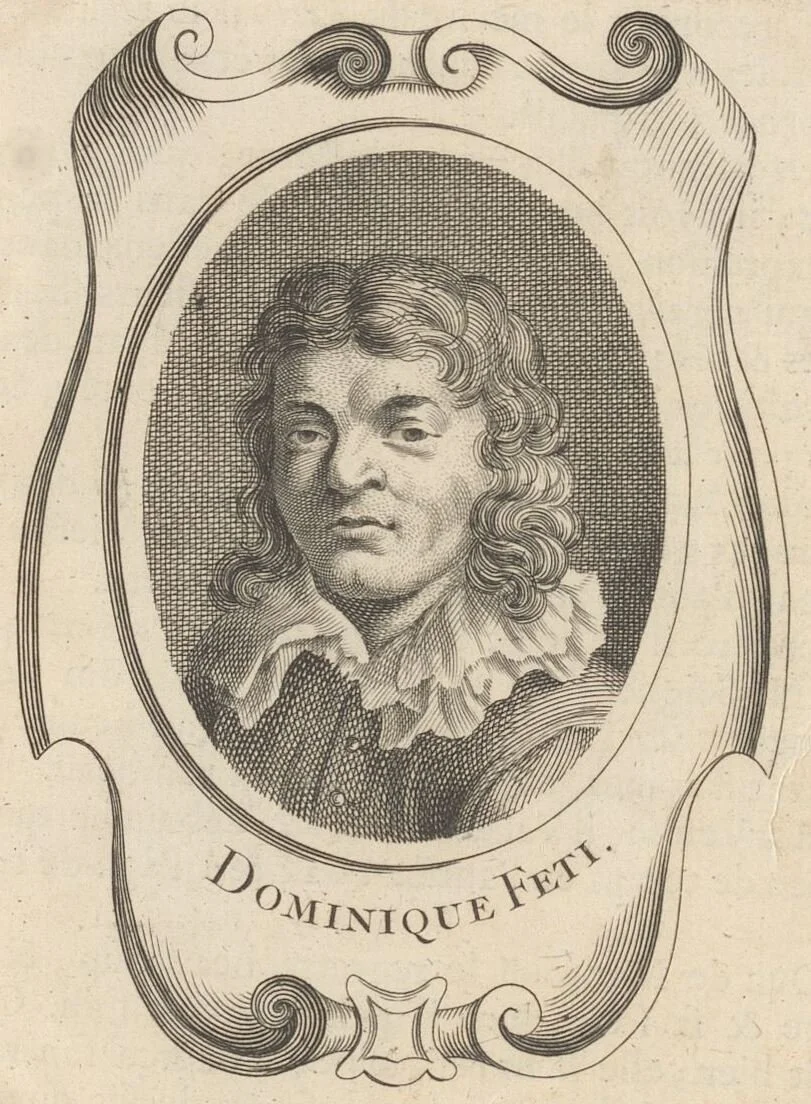
Domenico Fetti (c. 1589–1623) was an Italian Baroque painter born in Rome. He was highly talented but notoriously turbulent, often getting into legal trouble and public brawls. As a hot-tempered and competitive artist, his main troubles stemmed from intense professional jealousy, a violent confrontation with a prominent religious figure, and self-destructive lifestyle choices. Fetti was a ‘foreigner’ (originally from Rome) brought in by Duke Ferdinando Gonzaga to be the elite court painter. In Mantua his life was highly stressful due to intense professional hostility from local artists. The native Mantuan painters deeply resented his rapid rise, his high salary, and his intimate access to the Duke. They subjected Fetti to years of constant backstabbing, professional sabotage, and bitter feuds, which left him feeling isolated, paranoid, and miserable.
Fetti's most defining scandal occurred in August 1622. While attending a calcio storico (a violent, early 17th-century form of soccer) match in Mantua, Fetti got into a heated verbal argument with a cleric from a powerful, aristocratic Mantuan family. The argument escalated into a violent street fight. Because he had physically assaulted an influential religious official with deep political ties, Fetti faced immediate, severe legal retaliation. Terrified of being imprisoned or worse, he abruptly abandoned his prestigious court position and fled Mantua in fear of his life, seeking asylum in Venice.
Even after the Duke forgave Fetti for the street brawl and begged him to return, Fetti flatly refused because he could not bear facing the ‘constant hostility’ of his Mantuan rivals.
Though Fetti was a shrewd businessman, his success brought its own severe pressures. The extreme demand for his ‘Gospel Parable’ series created a high-stress environment. To cash in on his popularity, he was forced to turn his studio into a relentless mass-production assembly line. He spent his final years under immense physical strain, frantically churning out copies of his own artwork to keep up with competitive market demands in Venice and Mantua. Fetti is most famous for his pioneering series on the Gospel Parables, commissioned for the Duke of Mantua. Instead of painting distant, idealised figures, Fetti set Christ's parables inside the gritty, ordinary world of 17th-century contemporary life. He went out of his way to highlight human vulnerability and divine mercy, inviting viewers into an intimate, personal dialogue with the text.
Once Fetti escaped his contract in Mantua and settled into the more relaxed, libertine atmosphere of Venice, his personal life appears to have unraveled. Early Baroque biographers note that he succumbed to a chaotic lifestyle of ‘debauchery’ and reckless living. This sudden lack of discipline, combined with the physical exhaustion of running his studio, reportedly broke down his immune system—making him entirely defenceless when he contracted the "malignant fever" that killed him at just 33 years old.
During his brief career, he realized that "Ecce Homo" ("Behold the Man") was an incredibly lucrative subject matter so Fetti and his studio actively mass-produced variations of this exact image because it sold so well to churches and wealthy collectors across Europe. Today, different original versions of Fetti's ‘Ecce Homo’ hang in various galleries, including the Uffizi Gallery in Florence and the Bayerische Staatsgemäldesammlungen (Alte Pinakothek) in Munich.
Although he was a committed Roman Catholic his lifestyle betrayed what really mattered to him. His sister, who was also an artist became a nun.
The painting ‘Ecce home’ is a somber, deeply emotional portrait of Jesus Christ wearing the crown of thorns. ‘Ecce Homo’, is a Latin translation of ‘Behold the Man’ and comes from the phrase Pontius Pilate used when introducing Jesus to the Jewish crowd. Attached to the frame of this specific painting in Germany was an inscription that read:
“"Ego pro te haec passus sum. Tu vero quid fecisti pro me.”
This means:
”This I have done for you; what are you doing for me?”
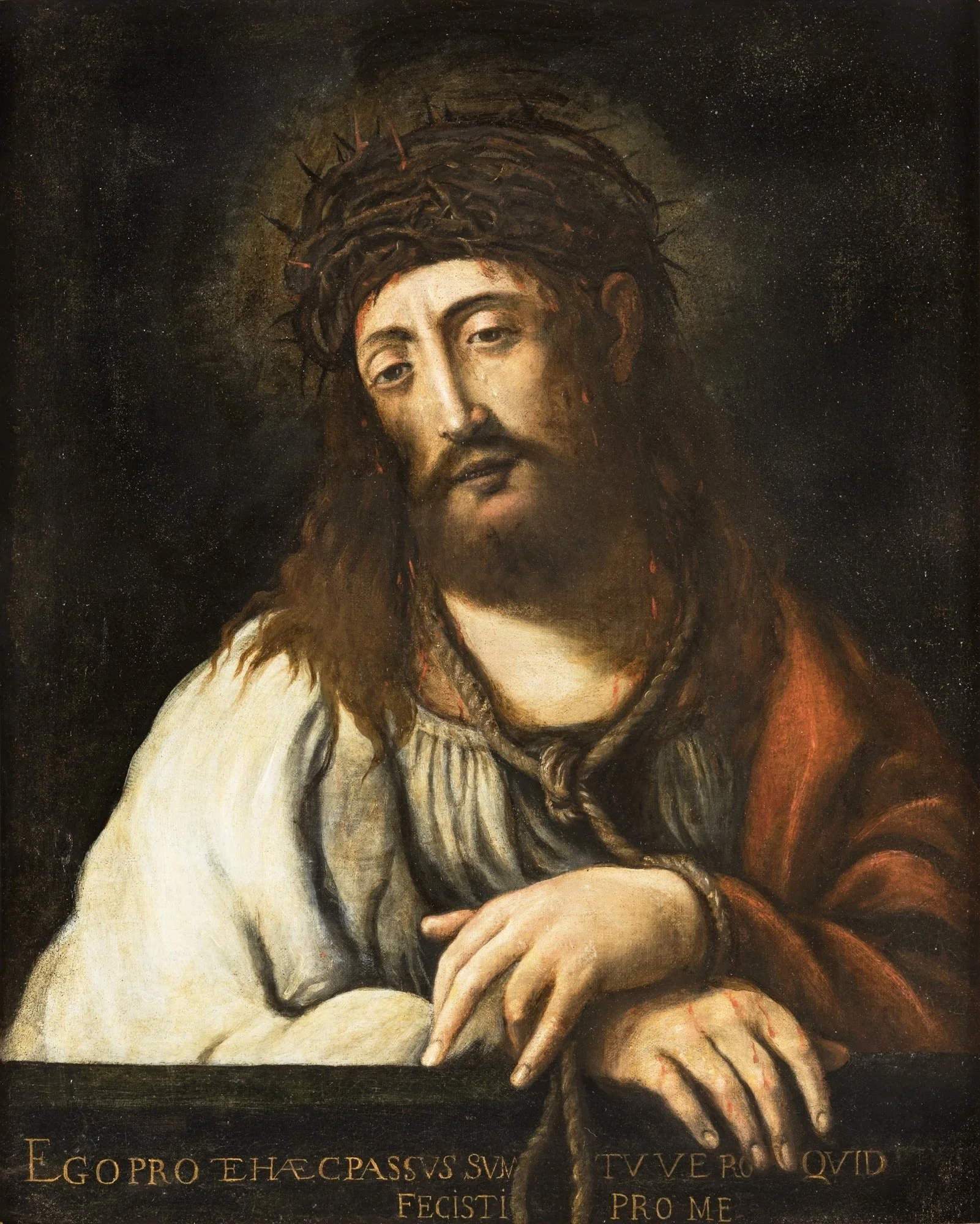
The influence of this painting
Count von Zinzendorf
In 1719, a 19 year old German nobleman, Count von Zinzendorf, saw this painting in the Düsseldorf museum. The image and its inscription profoundly changed his life. He went on to revitalise the Moravian Church, launching the modern Protestant missionary movement. He made a vow:
”From now on I will do whatever He leads me to do”
Zinzendorf transformed from a wealthy young aristocrat into the pioneer of the modern Protestant global missionary movement. Because he was a nobleman, Zinzendorf's family strictly forbade him from becoming a theologian or preacher and he was obliged to fulfil his familial duties. He completed his Grand Tour of Europe and accepted a position in October 1721 as the King’s Judicial Counselor in Dresden. However, he treated his prestigious government job as secondary; his apartment in Dresden immediately became a weekly hub for informal prayer, Bible study, and religious reform meetings.
In 1722, wanting a dedicated space to put his faith into practice, Zinzendorf purchased a large plot of land from his grandmother in Berthelsdorf, Saxony. He originally envisioned this estate as a model Christian community for local peasants.
However that same year, a group of heavily persecuted, German-speaking Protestant refugees from Moravia and Bohemia arrived at his estate seeking asylum. Zinzendorf gladly took them in, granting them land to build a village. They named this settlement Herrnhut, which translates to ‘The Lord’s Watchful Care’.
As hundreds of religious refugees from different theological backgrounds flocked to Herrnhut, bitter arguments broke out over doctrine. Zinzendorf left his government job, moved to Herrnhut full-time, and physically went from house to house to resolve grievances. His efforts culminated on 13 August 1727, when the community experienced a profound spiritual revival during a communion service. The divided refugees united, officially renewing the Moravian Church under Zinzendorf's leadership. Zinzendorf turned the Moravians into a global missionary force. In 1732, he personally commissioned the first two Protestant missionaries to go to the Caribbean island of St. Thomas to minister to enslaved populations. Over the next few decades, Zinzendorf sent Moravian missionaries all over the world—including to Greenland, Africa, North America, and England, where they would eventually cross paths with, and deeply influenced John and Charles Wesley.
In 1735, John Wesley and his brother Charles sailed to Georgia as Anglican missionaries. During a terrifying Atlantic storm that panicked the English passengers, a group of Moravian families remained completely calm, singing hymns peacefully.
When John Wesley asked if they were afraid, they replied that they did not fear death. This starkly exposed Wesley's own spiritual anxieties and ignited his deep desire for their level of serene, unshakeable faith.
Upon returning to England, John Wesley was mentored by Moravian leader Peter Böhler, who taught him about the nature of saving faith and the necessity of personal conversion to follow Jesus Christ. This directly led to the defining spiritual moments for both brothers in May 1738. Charles Wesley submitted to Christ alone for salvation on 21 May 1738. John Wesley attended a meeting at Aldersgate Street on 24 May 1738 where someone was reading Martin Luther’s preface to the Romans. There, John experienced his famous conversion, noting that his heart felt "strangely warmed" and that he finally felt an assurance of personal salvation.
The Moravian Church profoundly shaped early Methodism by providing the theological framework for what a personal faith means, the possibility of assurance of salvation, and offering models for discipleship training and global missions. The Moravian practice of dividing congregations into small, localized sub-groups for intensive discipleship and confession heavily inspired Wesley’s famous Methodist ‘class meetings’ and ‘bands. The Methodists adopted the Moravian practice of the "Lovefeast" (a communal meal of fellowship, testimonies, and prayer). Furthermore, Moravian vibrant hymn-singing deeply influenced Charles Wesley's prolific career as a hymn writer. Their emphasis was on a ‘heart-centered’ relationship with Jesus as Lord and Saviour and this became the bedrock of Methodist identity.
Before establishing independent Methodist societies, the Wesleys functioned within the Fetter Lane Society, a joint Anglican-Moravian group used for deep spiritual accountability. Despite this profound influence, John Wesley officially broke from the Moravians in 1740. He strongly opposed a teaching introduced by Moravian Philip Molther called ‘stillness’. This was so different to the nominal faith of Fetti.
Frances Havergal
In 1858 the American hymn-writer, Frances Havergal (1836 – 1879), also encountered the ‘Ecce Homo’ painting during a trip to Germany. Like Zinzendorf, she was moved by both the painting itself and the motto
”This I have done for you; what are you doing for me?”
She scribbled a hymn verse, ‘I Gave My Life For Thee’ on a scrap of paper. Whether she was aware of Zinzendorf’s experience with the painting is uncertain, but it is possible since she had extensive contact with the Moravians in England.
At first unsatisfied with the verse, she found that others were very moved by it and it was published in a leaflet in 1859 and later in Good Words in 1860 and The Ministry in Song in 1869 to a tune written by her father, Baca. Philip Bliss later wrote the tune familiar in America, Kenosis.
The 1918 WWI German propaganda poster purposefully hijacked this deeply ingrained, religious German phrase to induce guilt in citizens, swapping the sacrifice of Christ for the sacrifice of a wounded frontline soldier - what a difference.
God can still use this message today, when there is so much nominal Christianity around, where a faith in Jesus is far from life changing. Yet Jesus still says to us all:
“This I have done for you; what are you doing for me?”
BVP