Whose is the Promised Land?
Introduction
The conflicts over who should have ownership of Jerusalem and the land of Israel/Palestine has been continuing for over 3000 years. How can ownership be determined. Great Britain used to own America until the American War of Independence when sovereignty was taken away by the rebellious Americans. Does Britain still have a claim to ownership on the grounds that they established the country?
Ownership of the Falkland Islands could be determined by the will of the majority living there although Argentina felt that they had historic rights to the islands. The question was resolved, at least for the time by military force.
Israel did not officially exist till 1948 when the United Nations decided that the Jews should have a homeland and that Israel was not only historically theirs but there were already many Jews who had settled there since the latter part of the nineteenth century when many fled to what was then part of the Ottoman Empire because of persecutions in mainly eastern Europe and Russia. The land was at first divided into a Jewish area and a Palestinian area but neighbouring Arab countries did not approve and immediately Syria, Egypt Lebanon, Jordan and started a war that the Israelites not only won but they captured further land. This conflict has continued ever since. The BBC made a fascinating series of programmes they called ‘The 50 Year War”. This book shows that the conflicts have been going on much longer than that. Whose is the Promised Land?
God’s promises
When God first called Abram to be the foundation of his chosen people around 2000 BC, he promised three things:
“I will make you into a great nation, and I will bless you; I will make your name great, and you will be a blessing. I will bless those who bless you, and whoever curses you I will curse; and all peoples on earth will be blessed through you.” Genesis 12:2-3
A nation who would be blessed by God and who would be a blessing to all peoples on the earth. ‘How was this to come about?’ is the question that has been debated since
In Genesis we repeatedly read of these promises. Many years later the promise about his descendents was repeated and a promise about the land was included;
“The Lord said to Abram after Lot had parted from him, “Look around from where you are, to the north and south, to the east and west. All the land that you see I will give to you and your offspring for ever. I will make your offspring like the dust of the earth, so that if anyone could count the dust, then your offspring could be counted. Go walk through the length and breadth of the land, for I am giving it to you” Genesis 13:14-17
Some time later the Lord told Abraham, who had no children, that he would not only have a son but again the land was promised:
“ ‘Look up at the heavens and count the stars – if indeed you can count them.’ Then he said to him, ‘So shall your offspring be.’ Abraham believed the LORD, and he credited it to him as righteousness. He also said to him, ‘I am the Lord, who brought you out of Ur of the Chaldeans to give you this land to take possession of it.’” Genesis 15:5-7
Abram was understandably sceptical and asked,
“How can I know that I shall gain possession of it?” Genesis 15:8
God then gave him a sign. Abraham was told to cut a heifer, a goat, a ram, a dove and a young pigeon in half and arrange the halves in two rows. He had to fight off birds of prey - this probablyly symbolised fighting his doubts. Then he fell into a deep sleep and during this he saw:
“. . . a smoking brazier and a blazing torch appeared and passed between the pieces. On that day the Lord made a covenant with Abram and said, ‘To your descendants I give this land, from the river of Egypt to the great river, the Euphrates . . .” Genesis 15:17-18
In the Old Testament, the burning lamp signified the presence of the Shekinah Glory of God. God was binding Himself, unconditionally, by a blood covenant to Abram and his descendants forever, saying,
“To your descendants I give this land.” Genesis 15:18
When Abram was ninety-nine years old the Lord again appeared to him and repeated his covenant:
“As for me, this is my covenant with you: ‘You will be the father of many nations. No longer will you be called Abram; your name will be Abraham, for I have made you a father of many nations. I will make you very fruitful; I will make nations of you, and kings will come from you. I will establish my covenant as an everlasting covenant between me and you and your descendants after you for the generations to come, to be your God and the God of your descendants after you. The whole land of Canaan, where you now reside as a foreigner, I will give as an everlasting possession to you and your descendants after you; and I will be their God.” Genesis 17:4-8
Then God said to Abraham:
“You must keep my covenant, you and your descendents after you for generations to come. . . ” Genesis 17:9
This reminder, that there are two sides to a covenant, keeps being repeated in Scripture as we shall see.
Being promised a land is not the same as immediately claiming it as your right. Although God had promised Abraham the land of Canaan he did not assume it all belonged to him. When Abraham’s wife Sarah died he needed somewhere to bury her and this he had to buy. He said,
“I am a foreigner and stranger among you. Sell me some property for a burial site here so I can bury my dead.” Genesis 23: 4
The Hittites responded, “You are a mighty prince among us. Bury your dead in the choicest of our tombs” and “choose whatever site you please and take it for free.”
Abraham rejected this kindness and insisted on paying the full price for the field. He did not infringe the rights of others.
The Lord gave the very same promises, about his descendants and the land, to Jacob, after he fled from cheating Esau. He then had a dream of a ladder coming down from heaven:
“There above it stood the Lord, and he said: “I am the Lord, the God of your father Abraham and the God of Isaac. I will give you and your descendants the land on which you are lying. Your descendants will be like the dust of the earth, and you will spread out to the west and to the east, to the north and to the south. All peoples on earth will be blessed through you and your offspring. I am with you and will watch over you wherever you go, and I will bring you back to this land. I will not leave you until I have done what I have promised you.” Genesis 28:13-15
On this occasion all three aspects of God’s promise are repeated, his descendents would be a multitude, the land of Canaan would be theirs and the promise that his descendents would be a great blessing to others.
When Jacob was old and living in Egypt,
“Jacob said to Joseph, “God Almighty appeared to me at Luz in the land of Canaan, and there he blessed me and said to me, ‘I am going to make you fruitful and increase your numbers. I will make you a community of peoples, and I will give this land as an everlasting possession to your descendants after you.’” Genesis 48:3-4
Here Jacob reminds his family of the double nature of the promise, that their descendants would multiply and that they would be given the land of Canaan and their understanding was that this promise was everlasting. Interestingly he omitted the promise that they would be a blessing to all people on earth.
The patriarchs understood that the repeated promises of God about their descendants and the land were utterly reliable but not immediate. It was not until 400 years later that they entered the promised land but was that the fulfilment of the promise? When Joseph was about to die he said to his brothers:
“But God will surely come to your aid and take you up out of this land to the land he promised on oath to Abraham, Isaac and Jacob.” Genesis 50:24
God’s eternal promises were unconditional
Confirmation that the promise to Abraham, Jacob and to their offspring was unconditional is emphasised in Psalms where God says,
“If his sons forsake my law and do not follow my statutes, if they violate my decrees and fail to keep my commands, I will punish their sin with the rod, and their iniquity with flogging, but I will not take my love from him, nor will I ever betray my faithfulness.” Psalm 89:30-33
This is such an important lesson, God’s promises can never be broken but we must be very careful how and when we apply them. Was this prophecy fulfilled when the Jews returned to the land of Canaan under Joshua but if so how is the promise an eternal one?
God’s people felt as if God had forgotten them but Isaiah reminded them and us of God’s love for his people. At least part of the promise was still valid in the late 7th century BC:
“Can a mother forget the baby at her breast and have no compassion on the child she has borne? Though she may forget, I will not forget you!” Isaiah 49:15
God is repeatedly saying that He will never break His covenant but how have these oaths been fulfilled? The increase in the numbers of Jews is obvious - they are everywhere.
Louis XIV asked the Christian philosopher and mathematician, Louis Pasteur,
“Is there any evidence for God?”
“Yes, my Lord, the Jews!”
It is remarkable that other tribes existing when Abraham and his descendants first appeared no longer exist. Where are the Hittites, Perrizites, Rephaites, Amorites and the Canaanites except in history books? The Assyrians, Babylonians and their like have similarly all disappeared - but not the Jews. This is in spite of the multitude of persecutions, pogroms and other attempts to annihilate them as a people. Hitler’s holocaust was only one in a chain of such attempts.
The book of Genesis could not be clearer: Israel was to be God’s chosen nation, and the land of Canaan its land. However the third aspect of this promise is often overlooked:
“All peoples on earth will be blessed through you and your offspring.”
In the Psalms this covenant of God with regard to the land is also an eternal one:
“He remembers his covenant forever, the promise he made, for a thousand generations, the covenant he made with Abraham, the oath he swore to Isaac. He confirmed it to Jacob as a decree, to Israel as an everlasting covenant: ‘To you I will give the land of Canaan as the portion you will inherit.’” Psalm 105:8-11
This psalm ends:
“For he remembered his holy promise given to his servant Abraham. He brought out his people with rejoicing, his chosen ones with shouts of joy; he gave them the lands of the nations, and they fell heir to what others had toiled for - that they might keep his precepts and observe his laws. Praise the Lord.” Psalm 105:42-45
Has this been fulfilled? When it says ‘he gave’ did that mean that the promise was fulfilled. A major question that should be in the mind of Christians is how we are to understand these promises?
The apple of His eye
Israel is often called ‘the apple of God’s eye.’ For example:
“For the Lord’s portion is his people, Jacob his allotted inheritance. In a desert land he found him, in a barren and howling waste. He shielded him and cared for him; he guarded him as the apple of his eye . . .” Deuteronomy 32:9-10
The Hebrew phrase literally reads ‘little man of the eye’. Israel is the ‘little man of the eye’. He may be small in comparison to God but he is still deeply loved.
The next time we read this phrase is in the Psalms where David prays:
“Keep me as the apple of your eye; hide me in the shadow of your wings.” Psalm 17:8
This literally reads as ‘little daughter of the eye’. Just as a young daughter is deeply loved by her father, so David longs for such a close relationship with his Lord.
In Zechariah we are given a picture of the heavenly Jerusalem:
“For this is what the Lord Almighty says: “After the Glorious One has sent me against the nations that have plundered you - for whoever touches you touches the apple of his eye . . .” Zechariah 2:8
Literally this reads ‘the gate of the eye’. They all have the meaning that to damage Israel is to ‘poke God in the eye’!
Again, in the light of the teaching of Jesus and his apostles we need to know who are ‘Israel’?
Warning
Repeatedly in Scripture we are reminded that there are two sides to a covenant. If God’s people are disobedient and unfaithful God’s wrath can descend on them, yet the eternal promise remains
There is also a repeated warning what God expects from his people:
“‘Do not defile yourselves in any of these ways, because this is how the nations that I am going to drive out before you became defiled. Even the land was defiled; so I punished it for its sin, and the land vomited out its inhabitants. But you must keep my decrees and my laws. The native-born and the foreigners residing among you must not do any of these detestable things, for all these things were done by the people who lived in the land before you, and the land became defiled. And if you defile the land, it will vomit you out as it vomited out the nations that were before you.” Leviticus 18:24-28
This is not an unconditional promise. This promise is only true ‘if you do not defile the land. But if you defile the land, it will vomit you out.’
God did punish the Canaanite and other nations as a result of their evil deeds at the time of Joshua, He repeatedly says that he will punish his people if they do not live in holiness before Him. Evil always results in God’s judgment.
“Woe to those who plan iniquity, to those who plot evil on their beds! At morning’s light they carry it out because it is in their power to do it. They covet fields and seize them, and houses, and take them. They defraud people of their homes, they rob them of their inheritance.” Micah 2:1-2
“Therefore, the Lord says: “I am planning disaster against this people, from which you cannot save yourselves. You will no longer walk proudly, for it will be a time of calamity.” Micah 2:3
It is possible for God’s blessing to become a curse if God’s people do not obey God’s voice. There are two sides to a covenant. Part of the covenant is how God’s people should treat their neighbours and those living in their land.
Repeatedly this condition about God’s promises about the land and the people is repeated:
“The LORD will bless you in the land he is giving you. The Lord will establish you as his holy people, as he promised you on oath, if you keep the commands of the Lord your God and walk in obedience to him. Then all the peoples on earth will see that you are called by the name of the Lord, and they will fear you.” Deuteronomy 28:8-9
One of God’s commands concerns the way that foreigners living in the land are to be treated. Does this have relevance to the way Palestinians have been treated recently or have the Arabs brought this on themselves because of their actions?
“When a foreigner resides among you in your land, do not mistreat them. The foreigner residing among you must be treated as your native-born. Love them as yourself, for you were foreigners in Egypt. I am the LORD your God.” Leviticus 19:33-34
‘Love your neighbour as yourself’ has always been what God demands. If we fail to live as God asks of his people, he has repeatedly said he will turn his back on us. Yet his promise to his people is still eternal, he will bring his people to their eternal destiny.
Divorced
One of the ways in which God assures His people of His love for them is to describe Himself as their husband. The prophet says to Judah,
“Your Maker is your husband—the Lord Almighty is his name—the Holy One of Israel is your Redeemer; he is called the God of all the earth” Isaiah 54:5; cf. Jeremiah 3:14; 31:32
Yet Israel often proved to be an unfaithful spouse, committing spiritual adultery by worshiping false gods and forsaking the Lord. In fact, it was due to idolatry that God spoke this word:
“I gave faithless Israel her certificate of divorce and sent her away because of all her adulteries. . . . Because Israel’s immorality mattered so little to her, she defiled the land and committed adultery with stone and wood. In spite of all this, her unfaithful sister Judah did not return to me with all her heart, but only in pretence.” Jeremiah 3:8–10
In this passage, God warns Judah against making the same mistakes that Israel, their neighbours to the north, had made. In their idolatry, Israel had polluted the land and broken their covenant with God. Due to the enormity of their sin, God punished Israel, and He illustrates that punishment like this: He “divorced” Israel and sent them away—a reference to the Assyrian invasion, which resulted in Israel’s removal from their homeland (see 2 Kings 17:5–7). Even given the example of Israel’s “divorce,” Judah still remained unfaithful.
Having just cause, God, the faithful Husband, “divorced” Israel, His unfaithful wife. To make matters worse, God had asked,
“If a man divorces his wife and she leaves him and marries another man, should he return to her again?” Jeremiah 3:1
The answer, according to the Mosaic Law, was “No”; a man who had divorced his wife could not later remarry her (Deuteronomy 24:1–4). According to God’s metaphor, Israel seems to be in a hopeless situation: she has been divorced by God, and, according to the law, she can never be accepted back.
But then comes a surprising twist: God’s mercy intervenes:
“‘Return, faithless Israel,’ declares the Lord, ‘I will frown on you no longer, for I am faithful,’ declares the Lord, ‘I will not be angry forever’” Jeremiah 3:12
In the same passage in which God sets up a scenario of hopelessness for Israel, He invites His people to “return” to Him and promises that His anger will end. Could it be that God’s love is stronger than His people’s rebellion? The Lord doubles down on His invitation:
“‘Return, faithless people,’ declares the Lord, ‘for I am your husband. I will choose you . . . and bring you to Zion.” Jeremiah 3:14
God promises to do what the Mosaic Law could never do: restore the broken “marriage.” It was unthinkable that a human husband would take back his unfaithful wife, but God is greater than that; He can and will forgive His wayward people when they repent of their sin and seek Him again (Jeremiah 3:13).
God used the shocking illustration of a “divorce” of Israel to stress their guilt before Him. But God never cut Israel off completely for all time. He only asked that they return to Him and experience His goodness. In fact, after God says that He “divorced” Israel, He commands them three times to “return” (Jeremiah 3:12, 14, 22).
As we shall see later the apostle Paul explains,
“Did God reject his people? By no means! . . . God did not reject his people, whom he foreknew. . . . At the present time there is a remnant chosen by grace. And if by grace, then it cannot be based on works; if it were, grace would no longer be grace. . . . Again I ask: Did they stumble so as to fall beyond recovery? Not at all! . . . And if they do not persist in unbelief, they will be grafted in, for God is able to graft them in again” Romans 11:1–6, 11, 23
God will always have a remnant of people who remain faithful to him and glory in him and His Son. Another illustration of God’s amazing goodness is found in the story of the prophet Hosea. God actually commanded Hosea to marry a prostitute (Hosea 1:2). She did not remain faithful to Hosea. Then, while his wife was living in immorality, the Lord commanded Hosea to find her and buy her back. God’s purpose was to show the greatness of His grace:
“Love her as the Lord loves the Israelites, though they turn to other gods” Hosea 3:1
Hosea’s grace toward his unfaithful wife is a model of God’s grace toward His unfaithful people. Israel had been chosen and loved by God, yet they were unfaithful to Him by way of idolatry. In Jeremiah 3, God gives them a “bill of divorcement,” but then He pleads with them to come back. In Hosea, God pursues and redeems His estranged “wife” and seeks to continue His relationship with her. Both stories provide an unforgettable picture of God’s strong, unending love for His covenant people.
How can a divorced wife return and be restored? The law forbade it, but “mercy triumphs over judgment” (James 2:13), and God still has a plan for Israel. God’s grace in the New Covenant provided restoration for all who would believe in Christ.
Once, the incredulous disciples asked Jesus, “Who can be saved?” Jesus assured them that salvation is based on God’s power and grace, not man’s efforts:
“What is impossible with man is possible with God” Luke 18:27
Individual members of God’s people can reject God and will personally be rejected by God but his promise to his people remains, there will always be a remnant to whom he is very close.
The meaning of the prophecies about the land
God gave Abraham the prophecy about possessing the land of the Canaanites around 2000 BC. As we have noted there was a massive delay until this was first fulfilled. Two generations later, Jacob, his sons and their families all moved down to Egypt when Joseph was the Chancellor to the Pharaoh and there was a famine in Canaan. It was 430 years before they entered the land again under Joshua,
In one respect these promises were fulfilled when the children of Israel returned and conquered the Land of Canaan. However the occupation was fraught with problems. David had to fight many battles to establish his kingdom. It was only in Solomon’s time that peace reigned in an established kingdom. There has certainly been little history of peace or blessing in that land since then.
Clearly God’s promise about the land had only been partially fulfilled. The land suffered a multitude of wars with the Midianites, the Philistines, the Edomites, the Assyrians and the Babylonians, the Syrians and the Romans, to mention but a few. In 721 BC the northern ten tribes were defeated and exiled by the Assyrians from which they never returned, leaving Judah and the small tribe of Benjamin in the land. It is from the word Judah that we have the name Jew. Judah just survived the Assyrian invasion but troubles came to them later.
The book of Joshua states,
“The Lord gave Israel all the land he had sworn to give their forefathers, and they took possession of it and settled there. The Lord gave them rest on every side, just as he had sworn to their ancestors. Not one of their enemies withstood them; the Lord gave all their enemies into their hands. Not one of all the Lord’s good promises to Israel failed; every one was fulfilled.” Joshua 21:43
As Joshua was dying, he reminded the children of Israel that the Lord had been faithful to His promises:
“You know with all your heart and soul that not one of all the good promises the Lord your God gave you has failed. Every promise has been fulfilled; not one has failed.” Joshua 23:14
Both these passages suggest that the Lord’s promises had all been fulfilled. Solomon, was equally clear:
“Not one word has failed of all the good promises [the Lord] gave through his servant Moses” 1 Kings 8:56
At the height of the Solomon’s reign (970-931 BC) we read,
“The people of Judah and Israel were as numerous as the sand on the seashore; they ate, they drank and they were happy. And Solomon ruled over all the kingdoms from the Euphrates River to the land of the Philistines, as far as the border of Egypt.” 1 Kings 4:20–21
Yet the promise to Abraham also gave a timespan:
“All the land that you see I will give to you and your offspring forever.”
Where is this eternal country? Is it by the Mediterranean Sea or somewhere else?
The prophet Ezekiel had been exiled to Babylon in an early wave of deportation, probably around 597BC. Many Jews remained in Israel but the leadership there were increasingly ungodly. Ezekiel warns them in chapters 10 to 11 that God was going to act by leaving his temple and the city. His message is that he wants devoted, obedient followers, he is not so interested in land or power. However the leaders remaining in Israel continued to think that God’s promise of the land gave them security. They thought that God lived in the land so the exiles must be far from God!
“Son of man, the people of Jerusalem have said of your fellow exiles and all the other Israelites, ‘They are far away from the Lord; this land was given to us as our possession.’” Ezekiel 11:15
What presumption, God’s covenant was much more than land! The land of Israel symbolises the presence of God but the relationship with him was what God desires. He corrects the thinking of the leaders in Jerusalem by saying:
“‘This is what the Sovereign Lord says: I will gather you from the nations and bring you back from the countries where you have been scattered, and I will give you back the land of Israel again.’
“They will return to it and remove all its vile images and detestable idols. I will give them an undivided heart and put a new spirit in them; I will remove from them their heart of stone and give them a heart of flesh. Then they will follow my decrees and be careful to keep my laws. They will be my people, and I will be their God. But as for those whose hearts are devoted to their vile images and detestable idols, I will bring down on their own heads what they have done, declares the Sovereign Lord.” Ezekiel 11:17-21
God’s concern for his people is always a close relationship with himself which will be shown by a determined obedience to what he has told us. This is just as true today for Christians as it was for Jews back then.
The writer Peter T. Forsythe was right when he said,
“The first duty of every soul is to find not its freedom but its Master”.
I love the story told by John Kenneth Galbraith, the Canadian-American diplomat and economist. In his autobiography, ‘A Life in Our Times,’ he illustrates what commitment means by describing the devotion of Emily Gloria Wilson, his family's housekeeper: After a very tiring day, Galbraith asked Emily to hold all telephone calls whilst he had a nap. Shortly thereafter the phone rang. The President of the United States, Lyndon Johnson, was calling from the White House.
“Get me Ken Galbraith. This is Lyndon Johnson.”
“He is sleeping, Mr. President. He said not to disturb him.”
“Well, wake him up. I want to talk to him.”
“No, Mr. President. I work for him, not you.”
When Galbraith called the President back, he could scarcely control his pleasure. “Tell that woman I want her here in the White House.” Oh that more of God’s people had this attitude.
Whose land really is it?
This is a vital question. The Bible contains a very important message about the land:
“The land must not be sold permanently, because the land is mine.” Leviticus 25:23
The Lord owns the land! He is the King who says to his people, “You reside in my land as foreigners and strangers.” Whoever we are, we are all temporary occupants of God’s land because He owns everything. He asks us to trust him and live by faith in obedience to him.
Can we trust God?
We are all too prone to forget God and to rely on our own strength and abilities. This is true both for us as individuals and as nations. One illustration of this was when Satan incited David to take a census of the people of Israel, with the purpose of knowing how many soldiers he could rely on. This was a sign that David was relying on the power of his army and not on the power of his Lord. David failed that test and as a result God sent a plague on the Israelites. David then realized that he had sinned. He witnessed an angel in the sky with a sword drawn and extended over Jerusalem and he fell facedown, begging the Lord for mercy. So, the Lord told him to build an altar for Him on the threshing floor of Araunah the Jebusite, a foreigner living among the people of Israel. The Bible says that when Araunah found out that God had asked for his threshing floor, and that David wanted to build an altar there for the Lord, he said,
“Take it! Let my lord the king do whatever pleases him. Look, I will give the oxen for the burnt offerings, the threshing sledges for the wood, and the wheat for the grain offering. I will give all this.” 1 Chronicles 21:23
But David’s replied:
“No, I insist on paying the full price. I will not take for the LORD what is yours, or sacrifice a burnt offering that costs me nothing.” 1 Chronicles 21:24
This is the right spirit! Where was David? He was in Jerusalem. And who is David? He is the king! And who is Araunah – few know of him? Yet, the Bible says that David insisted on paying Araunah full price for a piece of the land. David was declaring,
“I will not take your land for free, because I do not violate or infringe upon the rights of anyone. This is your land; it is your right. Even if I am taking it for the Lord, I will pay you the full price.” 1 Chronicles 21
A brief history of Judaism and Israel
The land and people of Israel have seldom been at peace since their creation.
Jerusalem has been the central city of Judaism since 1000 BC when King David conquered this small, remote, hilltop Canaanite town. Since the building of the Temple by King Solomon, the city has become the focus of three pilgrimages each year for thousands of celebrating Jews, in keeping with the command in the Torah:
“Three times a year all your men must appear before the Lord your God at the place he will choose: at the Festival of Unleavened Bread, the Festival of Weeks and the Festival of Tabernacles.” Deuteronomy 16:16
The question about who should lay claim to the land of Israel has been debated for centuries. How can it be answered? Does it belong to those who have lived there in recent generations? That can be changed by mass deportation, expulsions and immigration. Are historic treatises inviolable? It is clear from history that they are not, military might can overcome treatises. A new government can readily change past agreements.
Have these promises been fulfilled and do they have any validity in the decisions made by modern politicians - if so how should they be understood? The following pages give a summary of all that has happened to the Jews and their land.
The early history of the land of Israel
Troubles in the land kept recurring since the relatively peaceful days of Solomon. After the Battle of Carchemish in 605 BC, the Babylonian king, Nebuchadnezzar II, besieged Jerusalem, which resulted in tribute being paid by the Judean king Jehoiakim. In the fourth year of Nebuchadnezzar II's reign, Jehoiakim refused to pay further tribute, which led to another siege of the city in Nebuchadnezzar II's seventh year (598/597 BC). This culminated in the death of Jehoiakim and the exile to Babylonia of his successor Jeconiah with his court, and many others. Jeconiah's successor Zedekiah rebelled so Nebuchadnezzar II destroyed Jerusalem in his 18th year (587 BC) and exiled Zedekiah and more nobles. A later deportation occurred in Nebuchadnezzar II's 23rd year (582 BC). However, the exact dates, numbers of deportations, and numbers of deportees vary in the several biblical accounts.
After the fall of the Neo-Babylonian Empire to the Persian Empire at the Battle of Opis in 539 BC, King Cyrus allowed the exiled Judeans to return to Judah. The construction of the Second Temple in Jerusalem began c. 537 BC.
Was the promise of ‘forever’ broken here or was there another meaning? ‘Forever’ implies an eternal resolution! The history of the land of Israel has seldom been peaceful since!
Alexander the Great rapidly conquered much of the Middle East but his early death in 323 BC led to the breakup of the Greek empire as three of his generals fought for supremacy and divided the Middle East among themselves. Ptolemy secured control of Egypt and the Land of Israel. Seleucus grabbed Syria and Asia Minor, and Antigonus took Greece.
The Land of Israel was thus sandwiched between two of the rivals and, for the next 125 years, Seleucids and Ptolemies battled for this land. The Seleucids finally won in 198 BC when Antiochus III defeated the Egyptians and incorporated Judea into his empire. Initially he allowed the Jews to have their own autonomy, but after a stinging defeat at the hands of the Romans he began a program of Hellenization that threatened to force the Jews to abandon their monotheism for the Greeks' paganism. Antiochus backed down in the face of Jewish opposition to his attempts to introduce idols in their temple, but his son, Antiochus IV, who inherited the throne in 176 BC resumed his father's original policy of Hellenisation without accepting the Jews. A brief Jewish rebellion only hardened his views and led him to outlaw central tenets of Judaism such as the Sabbath and circumcision, and he defiled the Temple by erecting an altar to the god Zeus, by allowing the sacrifice of pigs, and opening the shrine to non-Jews.
Though many Jews had been seduced by the virtues of Hellenism, the extreme measures adopted by Antiochus helped unite the people. When a Greek official tried to force a priest named Mattathias to sacrifice to a pagan god, the Jew murdered the official. Predictably, Antiochus began reprisals, but in 167 BC the Jews rose up behind Mattathias and his five sons and they fought for their liberation.
The family of Mattathias became known as the Maccabees, from the Hebrew word for "hammer," because they were said to strike hammer blows against their enemies. Jews refer to the Maccabees, but the family is more commonly known as the Hasmoneans.
Like other rulers before him, Antiochus underestimated the will and strength of his Jewish adversaries and sent a small force to put down the rebellion. When that was annihilated, he led a more powerful army into battle only to be defeated. In 164 BC, Jerusalem was recaptured by the Maccabees and the Temple purified, an event that gave birth to the holiday of Hanukah.
The Roman general Pompey had conquered Jerusalem and its surrounding lands by 63 BC. The Romans deposed the ruling Hasmonean dynasty of Judaea and the Roman Senate declared Herod the Great "King of the Jews" in c. 40 BC.
The Jews revolted against Roman rule resulting in the first Jewish–Roman War (66–73 AD). The destruction of Jerusalem and the Second Temple occurred in 70 CE, and finally the fall of Masada in 73 CE.
Roman rule in Judea was not well-received among the Jewish population, especially after the destruction of the Second Temple during the Roman siege of Jerusalem in 70. The Romans had also continued to maintain a large military presence across the province; pushed unpopular changes in administrative and economic life. The Bar Kokhba revolt 132-136 AD) was a large-scale armed rebellion initiated by the Jews of Judea, led by Simon bar Kokhba but again the Jews were totally defeated.
The forced exile of Jews from Israel after the second major revolt against Roman occupation included many Jewish Christians, so the church in Jerusalem became largely led by Gentiles and the Jewishness of the church was further diluted.
It is important to understand the basis of much orthodox Jewish thought today as it was firmly established at this time.
The Tannaim
The Tannaim, like the majority of Jews in the first and second centuries AD, lived in the land of Israel. They had faced the destruction of Jerusalem in 70 AD and the dismal failure of the Bar Kokhba Revolt against Roman rule in 132 AD. Israel was their home, and they fought to maintain its Jewish character and population in spite of much opposition. The Sanhedrin (Jewish High Court) still functioned, but Jewish society was in turmoil because of the ongoing conflict with the Romans. At the same time, the Diaspora, was growing with each crisis in the Land.
Because of this exodus of Jews, the Tannaim discouraged this emigration from Israel and encouraged all Jews to settle in the land by legislating and teaching about the unique beauty of the Land and its centrality in Jewish life. For instance, the Mishnah, the premiere work of Tannitic literature, declared:
“The Land of Israel is Holier than all other lands” Kelim 1
The Tannaim teach that the only place where one can fully observe the Torah is in the Land of Israel. This statement is supported by the fact that more than half of the Torah’s commandments can be observed only in the Land. Festivals in Jerusalem, tithes, first fruits, the sabbatical year, and the leaving of a corner of the field for the poor were part of everyday life only in the Land of Israel.
To these rabbis, the sanctity of the Land enriches all aspects of life, such as Torah study:
“There is no Torah like the Torah of the Land of Israel” Sifrei Parshat Ekev
Even death and burial is elevated in Israel: One who is buried there is forgiven of all their sins, as if he or she were :
“. . . buried under the altar of the Temple itself” Ketubot 111a
This holiness is such that even a person who is living outside of Israel, must, during prayer:
“. . . direct his heart to the Land of Israel” Tosefta Berakhot
The Tannaitic rabbis do not mince words when it comes to the importance of living in Israel:
“Our Rabbis taught: One should always live in the Land of Israel, even in a city with a population that is primarily non-Jewish, rather than in a city outside of the Land in which there is a majority of Jews. Whoever lives outside the Land of Israel is as one who does not have God.” Babylonian Talmud , Ketubot 110b
Not only is the value of living in Israel more important than living in a vibrant Jewish community, it is also more important than family. The Mishnah states that a wife who wants to move to Israel can force her husband to divorce her if he refuses to join her (and vice versa). In the same vein, leaving the Land is also grounds for divorce.
The Tannaim set the foundation upon which rabbinic Judaism stands today.
In 312AD the Roman Emperor Constantine became a Christian and churches became recognised, often taking over temples of the Roman and Greek gods with their altars and religious garb of the leaders. Constantine was concerned about the diversity of beliefs in the church at that time and called together the Council of Nicea in 325AD to clarify what the apostolic faith really was. Constantine established a new capital for the Roman Empire at Byzantium on the Bosphorus straits between the Black Sea and the Mediterranean Sea. This city was renamed Constantinople after him. Eventually the church separated into two division, the Roman Catholic church that remained based in Rome and the Eastern Orthodox church based in Byzantium.
In 638 AD, the expanding Arab armies occupied Israel. It was not until around 692 AD that the religion of Islam became established. The Qur’an was only then quoted from and Muhammed was only then talked about. The new Islamic doctrines were very different to those of the Bible even though, presumably for political reasons, it recognised ‘people of the book’, the Jews and Christians, as being Godly. The Dome of the Rock was built on the temple mount in Jerusalem and this had anti-Christian writing on its walls. Two major streams of Islam developed, the Sunnis, centred in Arabia (Saudi Arabia today) and the Shi’ites centred in Persia, modern day Iran and these have been in conflict since the early days of Islam.
In the late 11th century Turkish Muslims made life for Christians living in Israel intolerable and, in response, the Roman Catholic church called for a crusade to take the land back from Islam. The Crusaders were formed and they captured Jerusalem in 1099AD. The horrendous wars resulted in the death not only of many Muslims but also of many Jews. Much barbarity occurred and the effect of these un-Christlike wars has tarnished relationships ever since..
The Muslim Mamelukes from Egypt eventually defeated the Crusaders in 1291AD. Later another Islamic empire, the Ottoman Turks came on the scene. They captured Constantinople in 1493AD and Jerusalem in 1517AD.
It is significant that the great reformer Martin Luther was amongst those who opposed the Jews. He published a book in 1543AD entitled ‘The Jews and their Lies’. At this time the Renaissance movement began in Europe where the role of the church began to be spoken against and ‘secularism’ became established.
The Ottoman Turks with their control of the Middle East controlled the trade routes and prices increased. Trade, particularly with India became lucrative and many nations wanted to be involved. In 1798 Napoleon sent a large army to try to take India from the British. This large force landed in Egypt with the intention of its sailing on to India. The British fleet under Admiral Nelson then destroyed the French fleet at the Battle of the Nile and subsequently the French army had to return home.
In 1832-33 Egyptians rebelled against the Turks and ousted them from Israel. This change in sovereignty enabled some Christians to return to the land. The British sent a Consul to Jerusalem in 1838 with directions to ‘protect the Jews generally’. An official letter sent by the British Consul in 1839 stated,
“… the Jew in Jerusalem is not estimated in value much above a dog - and scarcely a day passes that I do not hear of some act of tyranny and oppression against Jew - chiefly by the soldiers . . . If a Jew were to attempt to pass the door of the Church of the Holy Sepulchre, it would in all probability cost him his life - this is not very Christian like, considering Christ himself was a Jew.”
In 1840 the British government first proposed that Jewish people should be returned to Israel but the Turks were opposed to this idea. Jews were also not ready to migrate at that time but their interest gradually grew. With the increase of nationalism and anti-Semitism in Europe from 1860 Jews felt increasingly isolated and the desire for a homeland increased. In 1881 there were some despicable pogroms against Jews in Russia and many Russian Jews fled to Turkish occupied Palestine which was then underdeveloped. Further pogroms against Jews in Russia in 1905 resulted in more Jewish settlers coming to Palestine.
The Suez Canal was built by a French Consortium in 1869 and this, together with the discovery of oil in Arabia increased international interest in the Middle East.
From the 1860’s and following the Crimean War, Russia developed a keen interest in Israel. The rationale was that it had once belonged to the Byzantine empire and Russia viewed itself as the custodian of all that once belonged to Byzantium. It is such historic thinking that still dominates the thinking of modern Russia! However the land still remained a rather impoverished region within the Ottoman empire. There was little or no national identity as the immigrants tended to remain loyal to their clan or their ethnic groups, such as Sunni or Shi’ite.
Many missionary schools were established particularly by Americans and an Arab identity gradually became established especially among the Christian Arabs. They increasingly desired to be treated as equals which could not occur under Islam. If the region could be an Arab state instead of Islamic, then equality could be possible. This movement, called ‘Pan-Arabism’ began in the 1860s.
The desire for a Jewish state grew when Theodor Hertzl founded the Zionist Movement in 1897. The German Kaiser Wilhelm II visited the Turkish Empire in 1898 and he was asked to support this idea but he refused as he had no desire to upset the Ottoman Turks.
Then World War I began and the Ottoman Turks sided with the Germans. There was much fighting in Palestine. T. E. Lawrence, Lawrence of Arabia, obtained the support of the Arab nationalist movement but the Jewish legion also played their part. In December 1917 General Allenby captured Jerusalem. After the Turks were defeated the Ottoman Empire was broken up and the desire to establish a Jewish State increased.
Recent history of Israel
This part of history has been well portrayed in the BBC series ‘The Fifty Years War:I srael and the Arabs’ and these are well worth watching.
The Balfour Declaration was a public statement issued by the British Government in 1917 during the First World War announcing its support for the establishment of a “national home for the Jewish people” in Palestine, then an Ottoman region with a small minority Jewish population. After this war, in 1922, Britain was officially granted control of Palestine by a League of Nations mandate, in what became known as Mandatory Palestine, to prepare for local sovereignty. The League of Nations recognised the historic association of the land of Israel with the Jewish people and this endorsement became enshrined in international law. The British government publicly committed itself to the creation of a Jewish homeland. Arab nationalism opposed this plan, asserting Arab rights over the former Ottoman territories and seeking to prevent Jewish migration. The idea of a two nation state was rejected by the Arabs. As a result, Arab–Jewish tensions grew in the succeeding decades of British administration.
Eventually the vast area of Arabic captured lands were divided to form Iraq, Syria, Lebanon and Jordan. These all became Islamic areas, leaving a relatively small area for a Jewish home, though a considerable number of non-Jews lived there. Many of the non Jewish residents, both Muslim and local Christians also opposed this plan and they were encouraged by the neighbouring Muslim states to make their feeling felt. Local Arab-speaking leaders openly opposed the plan and violence began to occur against the Jewish residents in Palestine. Tensions grew further.
The Nazi party in Germany began to persecute Jews and from 1933 many thousands emigrated to Palestine and yet again Arabic speaking leaders initiated violence against this immigration. As a result the British proposed a partition of Mandate Palestine into a small Jewish State and a much larger Arab State. The Arab leaders rejected this offer outright. This appears to be the root of the problem, the Arab leaders cannot tolerate the establishment of a Jewish State at all, arguing that is is all part of the historic Islamic State.
Jews were then not permitted to leave Germany and in 1939, after the Nazis invaded Poland the second World War began. In 1941 the mass murder of Jews in Axis occupied countries began. In 1942 the Nazi leaders decreed at a Conference in Wannsee near Berlin to complete the extermination of eleven million jews in Europe and surrounding regions which included those living in the Middle East. Local collaborators in Palestine would be used. This part of the holocaust plan never occurred largely because of the defeat of the Germans by General Montgomery’s troops at the Battle of El Alamein in 1942. However some 6 million Jews were murdered at this time and most Jews lost relatives.
After World War II hundreds of thousands of Jews were desperate to move to Palestine but the British closed the doors to try and reduce tensions. However conflicts then broke out between Jewish, Arab and British forces. The British administrative headquarters for Mandatory Palestine, housed in the southern wing of the King David Hotel in Jerusalem, were bombed in a terrorist attack on July 22, 1946, by the militant right-wing Zionist underground organization the Irgun during the Jewish insurgency. 91 people of various nationalities were killed, including Arabs, Britons and Jews, and 46 were injured.
In November 1947 the United Nations Assembly voted to support the establishment of both Arab and Jewish States. The Jewish leadership accepted the offer but the Arab leadership, both in the British Mandate Palestine and in the Arab league, refused to accept this solution. Arab and Palestinian militias fought the embryonic Jewish state.
The British were due to withdraw from Palestine at midnight on 14th May 1948 Prior to this Palestinian militia forces were active and even came close to cutting off Jewish supply routes to West Jerusalem and other areas of Jewish settlement and many atrocities were committed . After members of a rightwing Zionist militia, Etzel, threw grenades into a Palestinian crowd near an oil refinery in Haifa in December 1947, the crowd turned on nearby Jewish workers, killing 39 of them. In April of 1948, after Zionist forces killed more than 100 unarmed Palestinians in the village of Deir Yassin, Palestinian militiamen burned dozens of Jewish civilians to death in buses on the road to Jerusalem. In May of that year, Arab fighters vowing revenge for Deir Yassin killed 129 members of the kibbutz of Kfar Etzion, even though they were flying white flags.
When the British withdrew Israel immediately declared its independence, and then the fighting intensified. Five surrounding Arab nations, Egypt, Syria, Jordan, Lebanon and Iraq all declared war on Israel and invaded the Jewish State. That evening, May 14,, the Arabs launched an air attack on Tel Aviv, which the Israelis resisted. Saudi Arabia also sent a formation that fought under the Egyptian command. British trained forces from Transjordan eventually intervened in the conflict, but only in areas that had been designated as part of the Arab state under the United Nations Partition Plan.. After tense early fighting, Israeli forces, now under joint command, were able to gain the offensive.
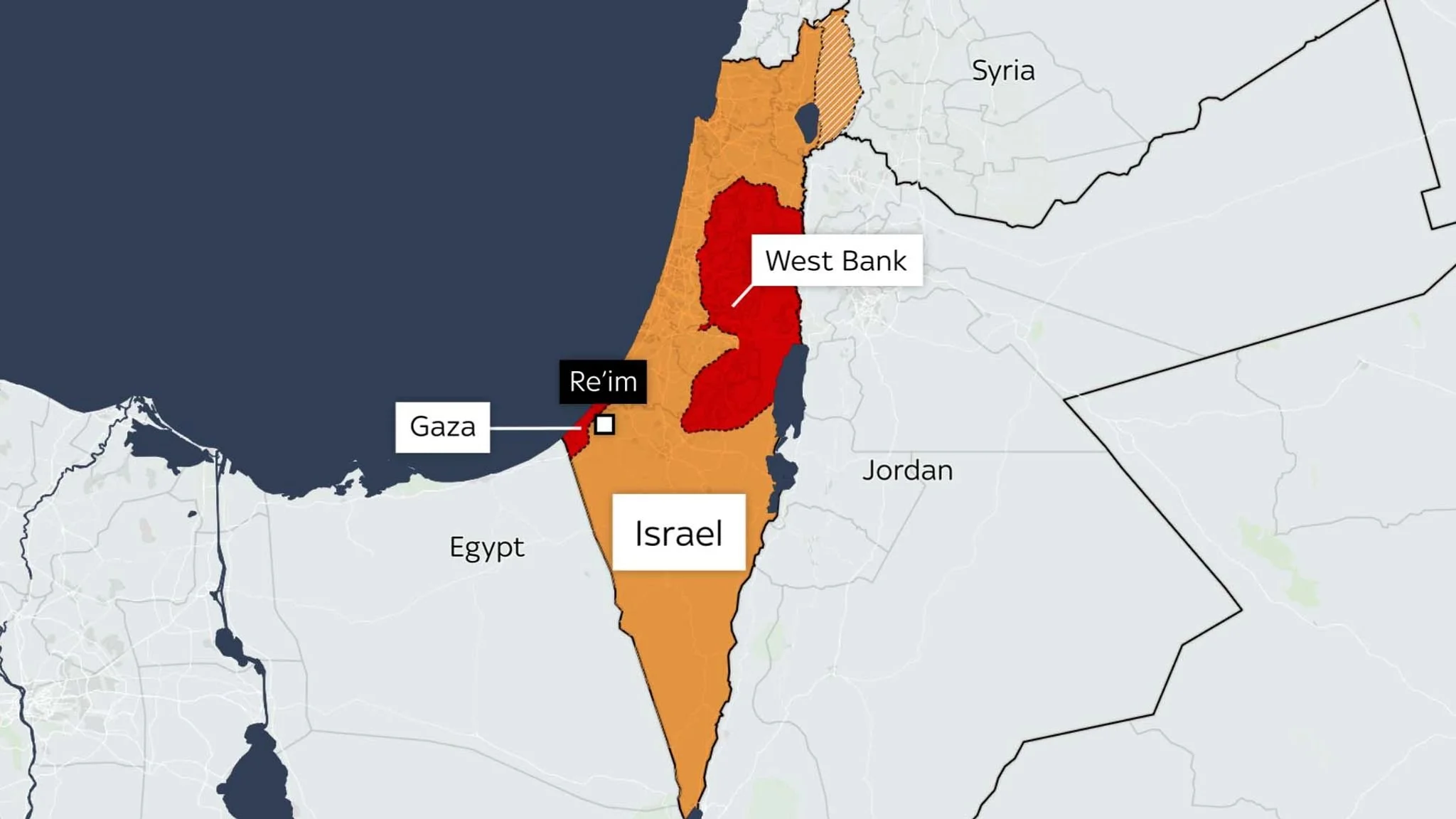
Though the United Nations brokered two cease-fires during the conflict, fighting continued into 1949. Israel and the Arab states did not reach any formal armistice agreements until February. Under separate agreements between Israel and the neighbouring states of Egypt, Lebanon, Transjordan, and Syria, these bordering nations agreed to formal armistice lines. Israel gained some territory formerly granted to Palestinian Arabs under the United Nations resolution in 1947. Egypt and Jordan retained control over the Gaza Strip and the West Bank respectively.
In 1964, when further war seemed imminent, Israel again defeated the armies of Egypt, Syria and Jordan, gaining control of Sinai, Gaza, the West Bank and the Golan Heights from Syria. Israel called this the War of Independence but Arabs call it ‘Al Naqba’, ‘the Catastrophy’ as it resulted in the mass exodus of many Arabs from Israel. Their Arab leaders told them that they could return after the Jews had been ‘driven into the sea’! More than 500,000 Arab speaking people became refugees. Many moved to refugee camps in Gaza which was taken over by Egypt. Jordan took control of of much of Biblical Judea and Samaria including the Old City of Jerusalem. Later Jordan annexed this area but they did not permit the establishment of an independent Arab state, as voted for by the United Nations. Almost the same number of Jewish people were forced to leave surrounding Muslim countries and most of these were absorbed into Israel. It is significant that the Jewish refugees were assimilated into Israel but the Arab refugees were not accepted by the surrounding Arab countries. By keeping them in refugee camps they became political pawns against the existence of Israel.
The American Anti-Defamation League has argued:
“Zionist leaders accepted the partition plan despite its less-than-ideal solution, it was the Arab nations who refused … Had the Arabs accepted the plan in 1947 there would today be an Arab state alongside the Jewish State of Israel and the heartache and bloodshed that have characterised the Arab-Israeli conflict would have been avoided.”
There were subsequently many border infiltrations and clashes that have continued to the present day and these have always met with very strong Israeli responses. In 1964 the Palestine Liberation Organisation was formed, mainly made up of young men from the refugee camps who longed to redeem the lands from which they had been forced to leave. The PLO was not homogeneous, but was composed of several groups, the largest of which was ‘Fatah’ whose leader was Yasser Arafat.
The PLO was first based in Jordan but were then expelled to Lebanon and were then based in tnisia before making Gaza their home. Although Egypt and other antagonistic Arab nations were predominantly Muslim, they were not governed by Islamic or ‘sharia’ law. However the humiliations caused by Israel successes led to the establishment of a fundamentalist Islamic group in Egypt called the Muslim Brotherhood.
By June 1967 Egypt, Syria and Jordan were preparing to attack Israel. Israel learned of this and her airforce made pre-emptive strikes causing much destruction of the opposing forces. As a result of fierce fighting Israel took control of of many additional areas including Sinai, Judea, Samaria, the Golan Heights, Gaza and Jerusalem. This war, planned by the Arab States, again had the effect of creating many more refugees. Most of the occupied areas contained a majority of Arabs and Israel had somehow to govern these lands. This would have been an ideal time to create an Arab State as decreed by the United Nations in 1947 but again the Arab countries refused. The Arab League met in Khartoum, Sudan, on September 1st 1967, shortly after the war and there the eight member nations stated categorically:
“No peace with Israel, no recognition of Israel, and no negotiations with Israel.”
In November 1967 the United Nations issued Resolution 242 which called for the withdrawal of Israeli forces from the captured areas. It was from theses areas that Syria, Jordan and Egypt had planned their assaults so returning the lands without a change of attitude would open the door for further problems. The Charter of the PLO called for the destruction of the State of Israel and this has not been rescinded.
In 1973 the Syrians and Egyptians attacked Israel again, starting on Yom Kippur, the Day of Atonement. They almost succeeded but the timely intervention of the United States and the passing of Resolutions 338 and 339 finally resulted in the cessation of fighting.
There were further attempts to bring peace. In 1978 President Jimmy Carter invited the Israeli Prime Minister Menachem Begin and Egyptian President Anwar Sadat to meet with him at his retreat at Camp David and the agreements became known as the Camp David Accords, officially titled the “Framework for Peace in the Middle East,” Sadat and Begin were awarded the Nobel Prize for Peace in 1978 for their contributions to the agreements. This led, in the following year to a peace treaty between Egypt and Israel, the first such treaty between Israel and any of its Arab neighbours. The price of peace was the surrendering of Sinai to Egypt and the dismantling of settlements. This treaty was signed by the two Prime Ministers and the effect was quite successful – at first there was quite a lot of goodwill. Tens of thousands of people would enter Israel every day from Gaza and the West Bank for work and living conditions in these areas improved dramatically. Life in Gaza became mush better than it had been when administered by Egypt.
All this changed in 1987 with the first Intifada, an outbreak of Arab led violence. Israel Defence forces had killed four Palestinian refugees and this was the reason given for a violent uprising led by the PLO. As a result Arabs were refused entry into Israel. Israel then needed labourers and so they welcomed immigration with many especially from Rumania and from the Philippines entered the country. This outbreak of violence led to the formation of Hamas, which is an acronym for ‘Islamic Resistance Movement’. Its founder, Sheik Ahmed Yassim, had previously been involved in the Muslim Brotherhood movement. Hamas was ideologically dedicated to the destruction of the State of Israel and the return of the land to Islamic control. Another similar organisation, ‘Islamic Jihad’ was formed about this time.
Again the need for a lasting peace through a political solution was obvious. In 1993 the Oslo Accords were signed. In this various degrees of autonomy were granted to local Arab leaders. Arafat became the leader of a large part of the Israeli administered Palestinian areas that was designated as the Palestinian Authority. Jordan relinquished its claim to the so-called ‘West Bank’ and this resulted in a peace agreement between Israel and Jordan in 1994.
Israel even armed the police force of the Palestinian Authority and for a time peace did follow. However attacks against Israeli civilians started up again, much of it instigated by Hamas and Jihad. Terrorists again crossed into Israel and started to bomb buses and murder Israeli civilians. Some Israelis did react privately such as the Israeli who entered a mosque in Hebron and killed 29 defenceless worshippers – a strange way to be a blessing to the nations!.
To try and stop the cycle of Palestinian attacks, which were inevitably followed by harsh Israeli responses, President Clinton invited Yasser Arafat of the PLO and Ehud Barak, Prime Minister of Israel to Camp David for talks in 2000. Significant concessions were offered by Israel but pressure was put on them to give much more than they felt safe to give, including part of Jerusalem., the problems being the status of Jerusalem, the rights of refugees and the increased Jewish settlements in Jewish lands. Later that year Ariel Sharon, who would become Israel’s Prime minister visited the Al Aqsa mosque in Jerusalem, an act that many Palestinians found offensive. During the following 5 years violent attacks, bombings and suicide attacks took place and this was called the Second Intifada. It marked the end of any peace that the Oslo Accords hoped for. the violence ended in 2005 when Israel withdrew from Gaza. This second Intifada resulted in terrible consequences for both the attacked Israelis and then for the Arabs as a result of harsh Israeli responses. The violent incursions became so severe that in 2002 Israel built a security fence to try and prevent attackers entering the country.
In 2005 a meeting was held at Sharm el-Sheik in Sinai which was attended by many regional leaders, including Ariel Sharon, Prime Minister of Israel. Israel unilaterally passed a law calling for the withdrawal of Israeli settlements from Gaza, hoping that this sign of good faith would be sufficient to bring peace. Unfortunately the effect was that even more rockets were sent into Israel from Gaza.
In 2006 there was a fateful election. The vote took place in the aftermath of a turbulent series of events: the fiery years of the second Intifada, the death of longtime Palestinian leader Yasser Arafat, and the 2005 Israeli withdrawal of troops and settlers from the Gaza Strip. Hamas, a radical movement committed to the destruction of Jerusalem, won the election. There have been no further elections since. In 2007 Hamas gained political control of Gaza and subsequently defeated Fatah militarily. Since then the tensions with Israel have worsened.
In 2017 Hamas called for the establishment of a Palestinian State based on the 1967 borders but it would not recognise Israel so Israel did not accept. As more Jews emigrate to Israel they have been settled in new buildings in the West Bank.
Recently Israel has entered into diplomatic relations with several Arab countries, the so-called Abraham Accords, and was even beginning to forge closer ties with Saudi Arabia. Such a move could further isolate Iran which has close ties with and is a strong supporter of Hamas. Another political factor could be the Russian invasion of Ukraine. Russia has close ties with Iran and a diversion of press coverage and finance into another trouble spot would be most welcome to the Russians.
Despite efforts to finalize a peace agreement, the conflict continues to play a major role in Israeli and international political, social, and economic life. Following the recent massacre of 1,300 Israelis by the Hamas attack it is said that the Palestinian Authority gave financial rewards amounting to $2,789,430 to the families of Hamas terrorists who were killed, a disturbing use of money given by other countries to support the people of Gaza.
One thing is clear, the history of Israel has been a real mess. It is a strange way for God to have blessed his people. Could we be looking in the wrong place for this blessing of God on his people?
Who does the land of Israel belong to now?
This is a difficult question. Legally the United Nations has decreed that part of it belongs to Israel but then the Arabs lost much more land in the wars they embarked on. Many Palestinians feel deeply aggrieved that they have lost their properties and are particularly concerned that their traditional enemies, the Jews, now have this.
Like the Jews, Arabs are also descended from Abraham, not through Sarah but through Hagar, Abraham’s concubine,, whose son was Ishmail. God had told Abraham that He would establish his covenant through Isaac, Sarah’s son. When Hagar was pregnant with Ishmael God said?
“The angel of the Lord also said to her: ‘You are now pregnant and you will give birth to a son. You shall name him Ishmael, for the Lord has heard of your misery. He will be a wild donkey of a man; his hand will be against everyone and everyone’s hand against him, and he will live in hostility towards all his brothers.’ Genesis 16:11-12
This was written around 2000BC. These four more prophecies about Hagar’s son are striking. First, Ishmael would be a “wild donkey of a man.” A wild donkey is a stubborn animal who lives isolated from other animals. As this relates to Ishmael, it points to his character as an independent, self-reliant man. He became a Bedouin, roaming the countryside. Second, “his hand will be against everyone” means that he would be in conflict with all those around him. As a result, “the hand of everyone will be against him” is a logical third trait for Ishmael. Ultimately, he would “live to the east of all his brothers”—outside the boundaries of his kinfolk, Ishmael would live separately from all Abram’s promised seed. He would live in “defiance” of his relatives. Genesis 25:12-18 tells us that Ishmael became the father of twelve tribes who lived in the south near Egypt. A simple summary of his descendents is given,
“And they lived in hostility to all their brothers.” Genesis 25:18
Arabs look back to the days of the early Arab conquests in the 7th century AD and the subsequent Islamic Empires. The Ottoman Empire, also known as the Turkish Empire, was a Muslim empire that controlled much of Southeast Europe, West Asia, and North Africa between the 14th and early 20th centuries. The empire also controlled parts of southeastern Central Europe from the early 16th to the early 18th century. They lost control of much of their lands after their defeat in theWorld War I.
The Qur’an bases its claim on the Israʾ ("Night Journey") when Muhammad is said to have travelled on the back of Buraq (a winged horse-like animal) to Al-Aqsa which is on the Temple Mount in Jerusalem. There he is said to have led other prophets including Abraham, Moses and Jesus in prayer. He then purportedly ascended into heaven during the Miʿraj (Ascension), where he individually greeted the prophets, and later spoke to God, who agreed to lower the number of required ṣalāt (ritual prayers) from fifty a day to only five.
It is on the veracity and the meaning of these ancient writings that so much depends.
There is now much evidence to show that the Qur’an was composed around 692AD, much later that the death of Muhammed, which was said to be in 632AD. The coins of the Arab rulers in the British Museum show their faces, forbidden in the Qur’an and even have crosses embossed, up until 692AD. The direction of the quibla (direction of prayer) of mosques was not firmly established to Mecca until around 725AD. The court documents of the Caliphs in Damascus make no mention of Islam or Muhammed until after 692AD. The stones engraved by people on tribal hajj’s in the sixteenth century make no mention Muhammed or quote from the Qur’an. All this is most strange if, as has been said, Muhammed and the Qur’an controlled Arab life before Muhammed’s death in 632AD.
The understanding of the Biblical prophecies also determines the differences between Judaism and Christianity. The Jewish Scriptures repeatedly stress that God hates what is only outward religion, what he longs for is for people to love and obey him and his Son.
“Serve the LORD with fear and rejoice with trembling. Kiss the Son, lest he be angry and you be destroyed in your way.” Psalm 2:11-12
Isaiah 53 is an extraordinary chapter that describes what the coming servant king would achieve. He would die for people’s sins and would then rise from the dead. There are 330 prophecies about the world’s Messiah in the Jewish Scriptures. Some of these are examined in my book, ‘Cure for Life’. Orthodox Jews are naturally opposed to the idea that a man can be God, they consider that any such claim is blasphemous even though Daniel describes just such a person who God accepts as being divine.
“In my vision at night I looked, and there before me was one like a son of man, coming with the clouds of heaven. He approached the Ancient of Days and was led into his presence. He was given authority, glory and sovereign power; all nations and peoples of every language worshiped him. His dominion is an everlasting dominion that will not pass away, and his kingdom is one that will never be destroyed.” Daniel 7:13-14
It is surely no coincidence that Jesus often used the title ‘Son of Man’ for himself. John the Baptist, Jesus and his disciples often talked about the Kingdom of God, but this was now used about those who acknowledge Jesus as the Messiah, God’s chosen King. Christianity teaches that salvation is a gift of God that is given to those who repent and follow God’s only Son, the Lord Jesus. It teaches that the Jewish Scriptures look forward to the coming of a Messiah who would save the world. His followers are promised an eternal future in a promised land with a heavenly Jerusalem. ‘Your Kingdom come’ is how Jesus taught his followers to pray.
Judaism, on the other hand overlooks the relevance of Jesus and places its hopes on the return of all Jews to the land of Israel, which it still regards as its Promised Land, and looks to the restoration of the Temple and its liturgical rites. The Jewish prayer book shows how deeply this belief is held. A core element of Jewish eschatology is that the holy city of Jerusalem will one day be rebuilt and the throne of David re-established there. A famous Jewish blessing reads
“Have mercy and return to Jerusalem, Your city. May Your presence dwell there as You have promised. Build it now, in our days and for all time. Re-establish there the majesty of David, Your servant. Praise are You Adonai, who builds Jerusalem.
Cause the offspring of Your servant David to flourish, and hasten the coming of Your deliverance. We hope continually in Your redemption. Praise are Your Adonai, who assures our redemption.y embedded these hopes are in the Jewish soul.”
Today, approximately 43 percent of the global Jewish population resides in Israel. Yet we must continue to ask, ‘Is God’s Kingdom a geographical or a spiritual one?”
New Testament teaching about the land and the people
The teaching of Jesus and his apostles gives a radical new way of understanding the meaning of the Old Testament prophecies. Paul understood the promise to Abraham as being much more than occupying a small strip of land in Israel. He recognised that those who had the faith of Abraham would inherit the world.
“It was not through the law that Abraham and his offspring received the promise that he would be heir of the world, but through the righteousness that comes by faith.” Romans 4:13
The descendents of Abraham are those who share the faith of Abraham, not just his physical descendents.
Jesus and his apostles repeatedly spoke of the Kingdom of God, not as a geographical area but within people’s hearts,
“The Kingdom of God is at hand, repent and believe in the gospel.” Mark 1:15
It is true that throughout the world, in all nations there are now followers of Jesus Christ.
The book to the Hebrews, written primarily to Jewish Christians, refers to the promise given to Abraham:
“God made his promise to Abraham . . . saying, ‘I will surely bless you and give you many descendants.’ And so, after waiting patiently, Abraham received what was promised” Hebrews 6:13-15
Later in the book the writer does refer to the promised land, but uses the picture given in the Old Testament in a spiritual sense:
“But you have come to Mount Zion, to the heavenly Jerusalem, the city of the living God.” Hebrews 12:22
This is also the understanding of the apostle John.
God’s people have always been looking forwards to a heavenly kingdom and a heavenly Jerusalem. The Bible is clear that the only people who will be there will be those who genuinely love God and his Son and are set on obeying him.
“Whoever believes in the Son has eternal life, but whoever rejects the Son will not see life, for God’s wrath remains on them.” John 3:36
A remnant of Israel will be saved but they are those who worship the Lamb.
“There is neither Jew nor Gentile, neither slave nor free, nor is there male and female, for you are all one in Christ Jesus.” Galatians 3:28
God has always wanted a people for himself who are increasingly becoming and behaving like Jesus, his Son. Surely we must keep our eyes on our heavenly kingdom and keep talking about this and who will be there and so get our temporary earthly tensions in perspective. God has always promised that he will give us a land and even death cannot prevent his people from seeing this fulfilled.
Jesus teaching
During Jesus’ trial before Pontius Pilate, the Roman governor asked him,
“Are you the king of the Jews?” John 18:33
Jesus answered,
“My kingdom is not of this world. If it were, my servants would fight to prevent my arrest by the Jewish leaders. But now my kingdom is from another place.” John 18:36
As Roman governor in Judea, Pilate’s primary responsibility was to maintain peace and order. The Jewish high council wanted to put Jesus to death, so they sent Him to Pilate because he alone held the power to pronounce a death sentence . The high priest Caiaphas had to convince Pilate that Jesus was a troublemaker and a threat to Roman stability. He accused Christ of claiming to be a king—a charge that would insinuate Jesus in the crime of recruiting rebel forces to launch a revolution against Roman authority.
“And they began to accuse him, saying, “We have found this man subverting our nation. He opposes payment of taxes to Caesar and claims to be Messiah, a king.” So Pilate asked Jesus,
“Are you the king of the Jews?”
“You have said so,” Jesus replied.
Then Pilate announced to the chief priests and the crowd,
“I find no basis for a charge against this man.”
But they insisted, “He stirs up the people all over Judea by his teaching. He started in Galilee and has come all the way here.” Luke 23:2–5
Caiaphas hoped that, by suggesting that Jesus was trying to start a rebellion, Pilate would put Jesus to death.
When Jesus answered,
“My kingdom is not of this world,”
he was, in essence, telling Pilate that He needed no earthly defence because His kingdom wasn’t from the world. Christ admitted He was head of an empire, but not one that Rome needed to fear as a political rival. If His kingdom were of this world, His servants would have been fighting to defend Him. But Jesus had restrained His disciples from preventing His arrest, war and aggression have no place in His kingdom.
“Then Simon Peter, who had a sword, drew it and struck the high priest’s servant, cutting off his right ear. (The servant’s name was Malchus.) Jesus commanded Peter, “Put your sword away! Shall I not drink the cup the Father has given me?” John 18:10–11
Pilate realized that Jesus had no interest in stirring up a rebellion. He posed no direct threat to Rome. Directly following this conversation, Pilate told the Jewish leaders,
“I find no basis for a charge against him” John 18:38
“My kingdom” refers to a spiritual kingdom of truth where Jesus reigns as Lord over the lives of His people. Jesus told Pilate,
“You are a king, then!” said Pilate.
Jesus answered,
“You say that I am a king. In fact, the reason I was born and came into the world is to testify to the truth. Everyone on the side of truth listens to me.” John 18:37
Jesus did not come to earth to rule over a mortal empire. He came to bear witness to the truth of who He is—the Messiah, Saviour of the world. Everyone who loves and recognizes this truth is a citizen of Christ’s kingdom.
The Jewish high council wanted Pilate to condemn Jesus under the pretence that He was raising a rebellion against Rome and proclaiming Himself “king of the Jews.” But that scenario was inaccurate, and Jesus cleared up the distortion, saying, “My kingdom is not of this world.” The Lord hit on the word truth as if to say,
“The real truth is this, Pilate: they want me dead because they are horrified by the truth of my claim—that I am ‘I Am,’ the promised Jewish Messiah.”
Jesus offers the truth of intimate fellowship with the only true God. He was born into this world for this purpose:
“Now this is eternal life: that they know you, the only true God, and Jesus Christ, whom you have sent.” John 17:3
His kingdom presents the opportunity to know the truth that sets us free from sin and death (Romans 8:2; John 8:32). Only those who are born again can see Christ’s kingdom (John 3:3).
Once, Jesus told the Pharisees,
“You are from below; I am from above. You are of this world; I am not of this world” John 8:23
The kingdom of God is an eternal kingdom, not a geographical one, it starts now in peoples’ hearts and will be fully experienced in the next permanent world. It is this kingdom we fight for, but with weapons of truth and persuasion empowered by the Spirit of God himself.
The statement, “My kingdom is not of this world,” relates to the origin and nature of Christ’s kingdom, not the location. The authority and power of Christ’s kingdom are drawn from a source outside of this world—from God, our heavenly Father. Christ’s headship is not of human origin but divine.
Christ’s kingdom is unlike any on this earth:
“For the kingdom of God is not a matter of eating and drinking, but of righteousness, peace and joy in the Holy Spirit” Romans 14:17
Other kingdoms are rooted in the realm of this world, but Christ’s is unique. His kingship is spiritual.
While not of this world, the Lord’s kingdom is most certainly in this world, exercising authority over this world and impacting this world. Jesus Christ and all of His disciples take orders from above, not from below. We are to:
“Set your minds on things above, not on earthly things.” Colossians 3:2
Christians are subjects of Christ’s kingdom. This world is not our home:
“For here we do not have an enduring city, but we are looking for the city that is to come.” Hebrews 13:14 “But our citizenship is in heaven. And we eagerly await a Saviour from there, the Lord Jesus Christ.” Philippians 3:20
“Do not love the world or anything in the world. If anyone loves the world, love for the Father is not in them. For everything in the world—the lust of the flesh, the lust of the eyes, and the pride of life—comes not from the Father but from the world. The world and its desires pass away, but whoever does the will of God lives forever.” 1 John 2:15–17
We are citizens of heaven, and we owe our highest allegiance to our ultimate authority - King Jesus. Just as He declared, we, too, can say,
“My kingdom is not of this world.”
So let us get earthly wars and factions in their right perspective.
Who is Israel today and what is its purpose?
Does God regard the physical descendants of Abraham, Isaac and Jacob as his people today or are they those who love Him and his Son?

or

In recent weeks the reaction of Israel to the invasion by Hamas troops from Palestine and the wanton killing of 1,500 Jews has caused much anger and heated debate. Is it right for the Israelis to react in such a violent way against Hamas with the widespread destruction of Gaza and the killing of so many people? Are Israel still God’s people?
The gift of righteousness
In Paul’s letter to the Romans he reminds them that Gentile Christians have been grafted into the people of God and that those born as Jews will be excluded if they reject the fulfilment of God’s plan that involves God’s Son, the Lord Jesus, who is the only hope of the world. Paul argues that physical circumcision, the formal sign of belonging to God’s people, saves nobody:
“A man is not a Jew if he is only one outwardly, nor is circumcision merely outward and physical. No, a Jew is a Jew if he is one inwardly; and circumcision is circumcision of the heart, by the Spirit, not by the written code. Such a man’s praise is not from men, but from God.” Romans 2:28-29
Paul follows this statement by asking a pertinent question:
“What advantage, then, is there in being a Jew, or what value is there in circumcision?
He answers this in a very positive manner
“Much in every way! They have been entrusted with the very words of God.” Romans 3:1-2
To know the gospel message and have the opportunity to respond to its message is an immense advantage, but without the response that God requires, Jews gain nothing.
Paul goes on to emphasise that there is no-one, Jew or Gentile, who is naturally right with God. Quoting Psalm 14 he writes,
“There is no-one righteous, not even one; there is no-one who understands, no-one who seeks God. All have turned away, they have together become worthless.” Romans 3:10-12
“There is no difference (between Jew and Gentile), for all have sinned and fall short of the glory of God.” Romans 3:23
Paul does not leave his readers in this helpless state as there is one hope, the gift from God of the status of righteousness that the Old Testament also speaks of:
“But now a righteousness from God, apart from the law, has been made known, to which the Law and the Prophets testify. This righteousness from God comes through faith in Jesus Christ to all who believe.. . .” Romans 3:21-22
All people are sinful in God’s eyes, but Paul then reminds his readers that there is good news:
“ . . . and are justified freely by his grace through the redemption that came by Christ Jesus.” Romans 3:24
This free gift of the status of righteousness is what the book of Romans is all about. Early in the book he explains the meaning of Habakuk 2:4
“For in the gospel a righteousness from God is revealed, a righteousness that is by faith from first to last, just as it is written ‘the righteous will live by faith’.” Romans 1:17
Who are God’s people?
God’s people are those who have a personal relationship with God in that they honour both him and his Son and live as he directs; such people are given the status of being ‘righteous’. This is illustrated from the Old Testament in story of Abraham, who was saved, not because he lived an upright life but because God chose him to have a special relationship with himself. This relationship was subsequently reflected in the way he obeyed what God told him.
Paul knew that the Scriptures are the Word of God for all people and so everyone needs to learn the lessons it contains:
“What does the Scripture say? ‘Abraham believed God, and it was credited to him as righteousness.’” Romans 4:3
This is further explained,
“However to the man who does not work but trusts God who justifies the wicked, his faith is credited a righteousness. David says the same thing when he speaks of the blessedness of the man to whom God credits righteousness apart from works: ‘Blessed are they whose transgressions are forgiven, whose sins are covered. Blessed is the man whose sin the Lord will never count against him.’” Romans 4:5-8
This is the Christian message,
“We have been saying that Abraham’s faith was credited to him as righteousness.” Romans 4:9
The central point is that salvation can only come as a gift. Abraham is the model of all of God’s people:
“He is our father in the sight of God, in whom he believed – the God who gives life to the dead and calls things that are not as though they were.” Romans 4:17
We cannot become righteous by the good way we live. God’s righteousness is infinitely greater than any standard we can achieve and to live in his family we have to be deemed by God as being as righteous as Jesus; this standing can only be found as a gift. John put this very succinctly:
“Yet to all who received him, to those who believed in his name, he gave the right to become children of God - children born not of natural descent nor of human decision or a husband’s will, but born of God.” John 1:12-13
Paul again emphasises this in his letter to the Romans:
“But God demonstrates his own love for us in this: While we were still sinners, Christ died for us.” Romans 5:8
The obedience of ‘the righteous’
Paul now emphasises that those who have been given the status of being righteous have an obligation to live as God has directed us. A commitment to obey the Lord Jesus is major evidence that we are truly God’s people.
“In the same way, count yourselves dead to sin but alive to God in Christ Jesus. Therefore do not let sin reign in your mortal body so that you obey its evil desires.” Romans 6:11-12
God’s ‘Chosen People’, the descendants of Abraham, are those who have a personal relationship with God and his Son, the Lord Jesus, and this will be demonstrated in the way we live.
“Don't you know that when you offer yourselves to someone to obey him as slaves, you are slaves to the one whom you obey - whether you are slaves to sin, which leads to death or to obedience which leads to righteousness.” Romans 6:16
There are only two eternal destinations, spiritual death, an eternal separation from God or living in the presence of God and his righteousness. Obedience to what God has disclosed to us in Scripture is a major evidence that we have been ‘born again’.
“But thanks be to God that though you used to be slaves to sin, you wholeheartedly obeyed the form of teaching to which you were entrusted. You have been set free from sin and have become slaves to righteousness..” Romans 6:17-18
The confidence of ‘the righteous’
Paul now moves on to the confidence those who have accepted the Lord Jesus as their Lord and Saviour should understand. This is the message of Romans 8 which begins:
“Therefore, there is now no condemnation for those who are in Christ Jesus.” Romans 8:1
The proof that we have been saved will be that we are becoming like the Lord Jesus, His Spirit is obviously in us. The gift of righteousness will always change us into obeying the Lord and so becoming more like him.
“And if anyone does not have the Spirit of Christ, he does not belong to Christ. But if Christ is in you, your body is dead because of sin, yet your spirit is alive because of righteousness” Romans 8:9-10
Life will not be easy when we become followers of Jesus, but our prize will be in eternity.
“I consider our present sufferings are not worth comparing with the glory that will be revealed in us. The creation waits in eager expectation for the sons of God to be revealed.” Romans 8:18-19
God has always called a group of people to be his Chosen People. The whole of the Old Testament looks forwards to the coming of God’s Messiah who will call people from every nation to follow him. He says that he loves and cares for his people and in eternity we will experience this love in a new way.
“And we know that in all things God works for the good of those who love him, who have been called according to his purpose. For those God foreknew he also predestined to be conformed to the likeness of his Son, that he might be the firstborn among many brothers.” Romans 8:28-29
Just as God chose the descendants of Abraham to be his chosen people, now God has extended his kingdom so people from every nation can belong to him. Essentially, for anyone to be a member of God’s people, God must first put it in our hearts to want to be with him.
“And those he predestined, he also called; those he called, he also justified; those he justified, he also glorified.” Romans 8:30
What a privilege it is to be chosen to be one of God’s people. Paul reminds us of the security those who remain in Christ have been given:
“For I am convinced that neither death nor life, neither angels nor demons, neither the present nor the future, nor any powers, now the height no depth nor anything else in all creation, will be able to separate us from the love of God that is in Christ Jesus our Lord.” Romans 8:38-39
Who are God’s Chosen People?
Now the ex-Pharisee, Paul, makes a major statement, he longs that his fellow Jews can come to see that in Jesus Christ, the Messiah, their faith is fulfilled and their symbolic animal sacrifices have been completed by the death of their Messiah to pay for their sin. He says of the people of Israel,
“Theirs is the adoption as sons; theirs is the divine glory, the covenants, the receiving of the law, the temple worship and the promises. Theirs are the patriarchs, and from them is traced the human ancestry of Christ, who is God overall, for ever praised! Amen.” Romans 9:4-5
What privileges the Jews have, all that God was going to do through His Messiah is foretold in the Jewish Scriptures, our Old Testament, together with the Jewish symbolism of their services and feasts. Does the rejection of their Messiah by many Jews invalidate the Jewish Scriptures? Certainly not!
“It is not as though God’s word had failed. For not all who are descended from Israel are Israel. Nor because they are his descendants are they all Abrahams children.” Romans 9:6
Paul summarises this situation:
“What then shall we say? That the Gentiles, who did not pursue righteousness, have obtained it, a righteousness that is by faith; but Israel, who pursued a law of righteousness, has not attained it. Why not? Because they pursued it not by faith but as it were by works. They stumbled over the "stumbling-stone”. Romans 9:30-32
The ‘stumbling-stone’ is their Messiah, the Lord Jesus.
Today there are religious people who still think that, because of their relatively good lives and even their religious affiliation, they will be acceptable to God. The Bible is clear that the way we live can never satisfy God. The apostle Paul longed that his fellow Jews could understand this:
“Brothers, my hearts desire and prayer to God for the Israelites is that they may be saved.
But I can testify about them that they are zealous for God, but their zeal is not based on knowledge. Since they did not know the righteousness that comes from God and sought to establish their own, they did not submit to Gods righteousness. Christ is the end of the law, so that there may be righteousness for everyone who believes.” Romans 10:1-4
Anyone can be put right with God if their faith, their dependance, is on God’s Messiah. This must be an open allegiance:
“But if you confess with your mouth, "Jesus is Lord," and believe in your heart that God raised him from the dead, you will be saved. For with your heart that you believe and are justified and it is with your mouth that you confess and are saved. As the Scripture says, ‘Anyone who trusts in him will never be put to shame’. Four there is no difference between Jew and Gentile - the same Lord is Lord of all and richly blesses all who: him, for, "everyone who calls on the name of the Lord will be saved.” Romans 10:9-13
This is the message that the church is committed to pass on to all people, Jew and Gentile alike. Our message is not primarily social or political, it is about the salvation of those who commit themselves to Jesus Christ.
“How, then, can they call on the one they have not believed in? And how can they believe in the one of whom they have not heard? And how can they hear without someone preaching to them? And how can anyone preach unless they are sent? As it is written: “How beautiful are the feet of those who bring good news!” Romans 10:14-15
The greatest need of members of apostolic, Bible teaching churches is to return to the apostles’ message and then to teach this widely to all people of the world. Commitment to the Lord Jesus is the way to peace, personal, social and international peace.
Has God rejected the Jews then?
Paul returns to this theme with characteristic clarity:
“I ask then, has God rejected his people? By no means.” Romans 11:1
Paul gives himself as an example of a disobedient Jew who found forgiveness in Christ. The message of the Old Testament is that God will always keep a remnant who remain faithful to himself:
“So too, at the present time there is a remnant chosen by grace. And if by grace it is no longer by works; if it were, grace would no longer be grace. What then? What Israel sought so earnestly it did not obtain, but the elect did. The others were hardened . . .” Romans 11:5-7
The tree of God’s people has many branches but some are broken off because they refused to believe and follow God’s revealed way. Their place has been taken by believing Gentiles:
“If some of the branches have been broken off, and you, though a wild olive shoot have been grafted in among the others and share in the nourishing sap from the olive root, do not boast over those branches.” Romans 11:17-18
There is no place for smugness
There are some who say that once a person has committed themselves to Christ they are saved for eternity. Paul rejects such naivety. Our salvation depends on us being in Christ, outside of him there is no salvation:
“You will say then, “Branches were broken off so that I could be grafted in.” Granted. But they were broken off because of unbelief, and you stand by faith. Do not be arrogant, but tremble. For if God did not spare the natural branches, he will not spare you either.
Consider therefore the kindness and sternness of God: sternness to those who fell, but kindness to you, provided that you continue in his kindness. Otherwise, you also will be cut off. And if they do not persist in unbelief, they will be grafted in, for God is able to graft them in again. After all, if you were cut out of an olive tree that is wild by nature, and contrary to nature were grafted into a cultivated olive tree, how much more readily will these, the natural branches, be grafted into their own olive tree! Romans 11:19-24
God’s covenants still stand
There are so many promises in the Old Testament that God will always remain faithful to his promises given to his chosen people, the Jews. Even if many turn away from God and his ways he will always keep a remnant for himself to achieve his ends. The Saviour of the world will come from his people. The message of the Old Testament is summarised:
“The deliverer will come from Zion: he will turn godlessness away from Jacob. And this is my covenant with them when I take away their sins.” Romans 11:26-27
Some Christians had come to see the Jews as their enemies but Paul wants us to understand that God’s word is utterly reliable:
“As far as the gospel is concerned, they are enemies on your account; but as far as election is concerned, they are loved on account of the patriarchs, for God’s gifts and his call is irrevocable.” Romans 11:28-29
Paul is so thrilled by this love of God for people that he bursts out in praise:
“Oh, the depth of the riches of the wisdom and knowledge of God! How unsearchable his judgments, and his paths beyond tracing out! “Who has known the mind of the Lord? Or who has been his counsellor?” “Who has ever given to God, that God should repay them?” For from him and through him and for him are all things. To him be the glory forever! Amen.” Romans 11:33-36
The obligations for the righteous
The final four chapters of the book of Romans contain practical directions about how Christians should live as we, like the Jews, have been chosen by God for a purpose. We should be wholeheartedly committed to living for the glory and reputation of our Lord:
“Therefore, I urge you, brothers and sisters, in view of God’s mercy, to offer your bodies as a living sacrifice, holy and pleasing to God—this is your true and proper worship. Do not conform to the pattern of this world, but be transformed by the renewing of your mind. Then you will be able to test and approve what God’s will is—his good, pleasing and perfect will.” Romans 12:1-2
All the apostles similarly urged Christians to be single-minded in our commitment to living for the reputation of the Lord Jesus. John wrote:
“Do not love the world or anything in the world. If anyone loves the world, love for the Father is not in them. For everything in the world—the lust of the flesh, the lust of the eyes, and the pride of life—comes not from the Father but from the world. The world and its desires pass away, but whoever does the will of God lives forever.” 1 John 2:15-17
James wrote bluntly, affirming the validity of Scripture, urging people to be single-minded,
“You adulterous people, don’t you know that friendship with the world means enmity against God? Therefore, anyone who chooses to be a friend of the world becomes an enemy of God. Or do you think Scripture says without reason that he jealously longs for the spirit he has caused to dwell in us? But he gives us more grace. That is why Scripture says: “God opposes the proud but shows favour to the humble.”
Submit yourselves, then, to God. Resist the devil, and he will flee from you. Come near to God and he will come near to you. Wash your hands, you sinners, and purify your hearts, you double-minded.” James 4:4-8
Paul finishes his book, just as he started it, with a reminder of how a holy people are characterised The book starts:
“Through him we received grace and apostleship to call all the Gentiles to the obedience that comes from faith for his name’s sake. And you also are among those Gentiles who are called to belong to Jesus Christ.” Romans 1:5-6
The book ends:
“ Now to him who is able to establish you in accordance with my gospel, the message I proclaim about Jesus Christ, in keeping with the revelation of the mystery hidden for long ages past, but now revealed and made known through the prophetic writings by the command of the eternal God, so that all the Gentiles might come to the obedience that comes from faith - to the only wise God be glory forever through Jesus Christ! Amen.” Romans 16:25-27
Recently I have asked many Christians, ‘Why did you become a Christian’? Nearly all answer with the reasons why they became Christians, such as ‘My parents were’, ‘I felt a need for forgiveness’, ‘The evidence about Jesus is overwhelming’, ‘I needed a purpose in life that was true’ and the like. However the question ‘Why?’ has another meaning, ‘What is the purpose?” The Bible puts much more emphasis on this meaning. Christians have been chosen by God to believe in the Lord Jesus so that we may live for his glory,
“ . . .so that all the Gentiles might come to the obedience that comes from faith - to the only wise God be glory forever through Jesus Christ!” Romans 16:26-27
All Christians should ask ourselves whether we are being effective in fulfilling this purpose we have been chosen for!
The Kingdom of God Today
The Old Testament tells the story of the people chosen by God to be his representatives in his world. It also teaches that God’s Messiah will enter his world as a descendant of King David and his coming will initiate a new covenant.
“Behold, the days are coming, declares the Lord, when I will make a new covenant with the house of Israel and the house of Judah, not like the covenant that I made with their fathers on the day when I took them by the hand to bring them out of the land of Egypt, my covenant that they broke, though I was their husband, declares the Lord. For this is the covenant that I will make with the house of Israel after those days, declares the Lord: I will put my law within them, and I will write it on their hearts. And I will be their God, and they shall be my people. And no longer shall each one teach his neighbour and each his brother, saying, ‘Know the Lord,’ for they shall all know me, from the least of them to the greatest, declares the Lord. For I will forgive their iniquity, and I will remember their sin no more.” Jeremiah 33:31-34
This new covenant will not be a rejection of the previous covenants God made with Adam, Noah, Abraham, Isaac, Jacob and Moses but will build on them. The purpose is the same, to have a chosen people who will represent him in a sinful world. This new covenant will be with individuals who will have all their sin forgiven and who will have a personal relationship with God himself.
The Kingdom of God
In the Old Testament the Kingdom of God was a physical kingdom made up of Jews and based in the land of Canaan with Jerusalem as its capital.
The John the Baptist came on the scene to prepare people for the coming of the Messiah and his kingdom. He taught that God’s kingdom, a spiritual kingdom was imminent:
“Repent, for the kingdom of heaven has come near.” Matthew 3:2
When Jesus, who claimed to be God’s Messiah, came he taught that God’s Kingdom had arrived. At the beginning of his ministry he taught,
“From that time on Jesus began to preach, ‘Repent, for the kingdom of heaven has come near.’” Matthew 4:17
As Jesus continued his ministry his message was the same:
“Jesus went throughout Galilee, teaching in their synagogues, proclaiming the good news of the kingdom, and healing every disease and illness among the people.” Matthew 4:23
Jesus power to heal substantiated his claim as well as fulfilled the Old Testament prophecies that the Messiah would be a healer.
Mark says something similar:
““The time has come,” he said. “The kingdom of God has come near. Repent and believe the good news!” Mark 1:15
Jesus’ kingdom has himself as its king. This kingdom is now open to all who repent of living outside his rule but now accept him as their King. It is an eternal spiritual kingdom, not a geographical or political one. The kingdom of God is the realm where god and his Son are loved and followed, where his will is done on earth as in heaven.
When his disciples asked Jesus to teach them to pray he replied:
“This, then, is how you should pray: ‘Our Father in heaven, hallowed be your name, your kingdom come, your will be done, on earth as it is in heaven.’” Matthew 6:9-10
God’s kingdom is clearly a spiritual kingdom that is composed of all sorts of people of different nationalities, sex and social class who have come under the rule of Jesus. Some of its citizens are in heaven and some still on earth. It is not an earthly geographical kingdom. The Greek word for ‘kingdom’ is basileia which means ‘the rule’ or ‘realm’ of the king. Jesus teaches that God’s kingdom is where God’s will is done.
At a school annual speech day, a headmaster told his pupils,
“The point of life is to discover the point of life and then to make this the point of your life.”
Jesus said something similar to his followers:
“But seek first his kingdom and his righteousness, and all these things will be given to you as well.” Matthew 6:33
At his trial he said to Pilate:
“My kingdom is not of this world. If it were, my servants would fight to prevent my arrest by the Jewish leaders. But now my kingdom is from another place.” John 18:36
God’s or Christ’s kingdom is ‘not of this world’. Jesus is claiming that he is the fulfilment of the Old Testament story of Israel. His is now the universal king of God’s kingdom. These stories were ‘types’ that illustrated his coming rule.
In his Great Commission to the church, at the end of his earthly ministry, Jesus explains how his kingdom will grow. It is not in terms of territory but of people who return to live under his authority:
“Therefore go and make disciples of all nations, baptising them in the name of the Father and of the Son and of the Holy Spirit, and teaching them to obey everything I have commanded you. And surely I am with you always, to the very end of the age.” Matthew 28:19-20
The writer of the book of Hebrews was very clear about where the Christians hope lies – it is not on this earth:
“All these people were still living by faith when they died. They did not receive the things promised; they only saw them and welcomed them from a distance, admitting that they were foreigners and strangers on earth. People who say such things show that they are looking for a country of their own. If they had been thinking of the country they had left, they would have had opportunity to return. Instead, they were longing for a better country—a heavenly one. Therefore God is not ashamed to be called their God, for he has prepared a city for them.” Hebrews 11:13-16
God’s kingdom is not on this earth. At first many followers expected him to establish an earthly kingdom with Jesus as its King. He repeatedly rejected such an idea:
“Then Nathanael declared, ‘Rabbi, you are the Son of God; you are the king of Israel.’” John 1:49
“Jesus, knowing that they intended to come and make him king by force, withdrew again to a mountain by himself.” John 6:15
Paul’s letter to the Philippians shows that he had abandoned any idea of an earthly kingdom where the Messiah would reign on earth. He looked forwards to being with Christ after his resurrection:
“I press on towards the goal to win the prize for which God has called me heavenwards in Christ Jesus.” Philippians 3:14
“Their mind is on earthly things. But our citizenship is in heaven.” Philippians 3:19-20
John and Peter were also looking forwards to a heavenly kingdom and not one on this earth:
“Then I saw ‘a new heaven and a new earth,’ for the first heaven and the first earth had passed away, and there was no longer any sea. I saw the Holy City, the new Jerusalem, coming down out of heaven from God, prepared as a bride beautifully dressed for her husband.” Revelation 21:1-2
“But in keeping with his promise we are looking forward to a new heaven and a new earth, where righteousness dwells.” 2 Peter 3:13
There has been an erroneous teaching called ‘Premillennialism’ which says that there is an earthly kingdom to look forwards to. In this theory Christ will return to rule in this kingdom for one thousand years. Another erroneous teaching is ‘dispensationalism’ which suggests that God’s salvation comes in two ways, one is through the church and the other through the nation of Israel. It teaches that there are two peoples of God. As we have seen this is not what Jesus or his apostles taught. They saw that Israel is now fulfilled in christ, the Messiah the Old Testament talks so much about.
“The promises were spoken to Abraham and to his seed. Scripture does not say ‘and to seeds’, meaning many people, but ‘and to your seed’, meaning one person, who is Christ.” Galatians 3:16
Rejecting the Son of God is the same as rejecting God himself. Jesus had many harsh words to say to those Pharisees who did just that. The Bible is clear, there is no salvation away from Jesus Christ. Christians are the spiritual offspring of Abraham because they are also people with a personal faith in the living God.
“So in Christ Jesus you are all children of God through faith, for all of you who were baptised into Christ have clothed yourselves with Christ. There is neither Jew nor Gentile, neither slave nor free, nor is there male and female, for you are all one in Christ Jesus. If you belong to Christ, then you are Abraham’s seed, and heirs according to the promise.” Galatians 3:26-29
Perhaps today we should be saying that in God’s eyes there is neither Jew nor Arab, all are lost without a personal commitment to the one living God and his Son. This is the only way to be righteous in God’s eyes, it cannot be earned by good behaviour or by being religious, it can only be obtained as a gift. It was God’s gift to Abraham who was ‘credited with righteousness’.
“So then, he is the father of all who believe but have not been circumcised, in order that righteousness might be credited to them. And he is then also the father of the circumcised who not only are circumcised but who also follow in the footsteps of the faith that our father Abraham had before he was circumcised.” Romans 4:11-12
What a disaster it is for people who call themselves Christians to be unclear about these things. The conflicts in Israel and the Arabs are therefore not that dissimilar to the conflicts between Russia and Ukraine, the IRA and the British or the Crusades. They have nothing to do with winning people for Christ’s eternal spiritual kingdom, becoming godly or Christlike.
Paul summarises his concern for those whose focus is on earthly matters:
“For, as I have often told you before and now tell you again even with tears, many live as enemies of the cross of Christ. Their destiny is destruction, their god is their stomach, and their glory is in their shame. Their mind is set on earthly things. But our citizenship is in heaven. And we eagerly await a Saviour from there, the Lord Jesus Christ, who, by the power that enables him to bring everything under his control, will transform our lowly bodies so that they will be like his glorious body.” Philippians 3:18-21
Christ’s return will be associated with his judgment and the taking to glory of those who belong to him.
It can therefore be concluded that wars on earth reflect the evil in man. God wants people to expect ‘wars and rumours of wars’ until he returns in judgment and only then will there be real peace. Arabs rely on the Qur’an, that appears to have only existed since the end of the seventh century, sixty years after Muhammed was said to have died. Recent scholarship has raised major problems with the dating and teaching of the Qur’an. The Jews rely on a literal understanding of the promises in Scripture, promises that Jesus and his apostles explained should be interpreted spiritually.
Where is the peace and blessing that God’s people are to bring to the world? Have the Jews brought this or has Christ’s church? Have Muslims brought this? Has Communism?
Any decision about the right and wrong of these wars ultimately depends on who Jesus is. Did he claim to be divine, does his teaching resonate with what we instinctively know to be the truth, did he did rise from the dead, did he did perform those extraordinary miracles and did he fulfil the many Messianic prophecies?
Some responsibility must lie with the United Nations Organisation who, recognising the animosity there was against the Jews after World War II gave them a country sited amidst of antagonistic Arab nations. They knew the problems the new state of Israel would have to face before making their decision so they have a responsibility to back up their decision both politically and militarily - which unfortunately they failed to do strongly.
However the root problem is the way we humans tend to act selfishly, not recognising that we will all have to give an account for the decisions we have made to Almighty God. Seeing ourselves as God sees us will radically influence how we live the few years we have been given on earth.
The Kingdom God is primarily concerned about in both the Old and the NewTestaments is undoubtedly a spiritual kingdom. We have to see all the evils of the conflicts in the Middle East over nearly a hundred years in the light of this.
BVP