"I will not let you go unless you bless me"
Introduction
There is a hunger woven into the human heart — a longing not merely for comfort or success, but for God's own favour. The Old Testament calls this "blessing," and it is one of the great threads running from Genesis to Malachi. To be blessed is not simply to receive good things; it is to be brought into the orbit of God's presence, purpose, and pleasure. The story of Scripture suggests that this desire — far from being selfish or small — is one that God himself planted in us, and one he delights to satisfy.
Let's trace this longing through four scenes.
1. The Blessing That Started Everything — Abraham (Genesis 12:1–3)
The very first thing God says to Abram is a promise of blessing, repeated five times in three verses:
"I will bless you... and you will be a blessing... I will bless those who bless you... and all peoples on earth will be blessed through you."
Notice what's happening here. Abram has done nothing to earn this. He hasn't built an altar yet, hasn't offered a sacrifice, hasn't proven his faith. God's blessing comes first — as a gift, an initiative from heaven downward. And yet Abram still has to receive it: he has to leave Ur, walk by faith into the unknown, and trust that the blessing is real.
Think of a father who tells his young son, "Everything I have will one day be yours." The inheritance is settled — but the son still has to grow up believing it, living in light of it, and eventually stepping into it. Abram's whole life becomes a walk toward a blessing he was promised but had not yet fully seen. That is the shape of blessing throughout the Old Testament: promised, believed, and pursued.
2. The Blessing You Wrestle For — Jacob at the Jabbok (Genesis 32:22–32)
If Abraham shows us blessing freely given, Jacob shows us blessing desperately sought.
The night before he must face his estranged brother Esau, Jacob is alone by the river Jabbok. A mysterious man wrestles with him until daybreak. When the stranger asks to be released, Jacob refuses:
"I will not let you go unless you bless me."
This is remarkable. Jacob is a man who has spent his whole life taking — he took his brother's birthright, took his father's blessing through deception, took advantage of his uncle Laban. But here, for the first time, he doesn't take a blessing — he begs for one, clinging to God through a long, painful night, even after his hip is wrenched out of joint.
And God gives it. Jacob leaves limping — but he leaves renamed. "Israel" — one who has struggled with God and with man and has overcome.
Picture someone who has spent years chasing success, approval, and control — always maneuvring, always managing outcomes — until one crisis strips all of that away and leaves them with nothing to hold onto but God himself. Jacob's wrestling match is what it looks like when the desire to be blessed finally becomes more important than the desire to control everything else. He walks away limping, but he walks away changed — and that limp becomes the visible mark that the blessing was real.
3. The Blessing You Dare to Ask For — Jabez (1 Chronicles 4:9–10)
Tucked into a long genealogy — the kind of passage most readers skim past — sits one of the boldest prayers in the Old Testament:
"Jabez cried out to the God of Israel, 'Oh, that you would bless me and enlarge my territory! Let your hand be with me, and keep me from harm so that I will be free from pain.' And God granted his request."
Jabez's name means "pain" — his mother named him for the suffering of his birth. He could have lived defined by that name. Instead, he prays past his circumstances and asks God directly for enlargement, presence, and protection.
Imagine someone born into a family history of hardship, given a name (literal or figurative) that seems to predict a limited, painful life. The remarkable thing about Jabez isn't that his life was hard — it's that he refused to let the label define the outcome. He simply asked. Four short verses in a genealogy remind us: sometimes the desire to be blessed doesn't need an elaborate wrestling match or a decades-long journey. Sometimes it just needs the courage to ask.
4. The Blessing Spoken Over You — the Priestly Blessing (Numbers 6:24–26)
Finally, the Old Testament shows that blessing isn't only something individuals chase — it's something God institutes as a regular gift to his people. God gives Aaron and his sons specific words to speak over Israel:
"The Lord bless you and keep you; the Lord make his face shine on you and be gracious to you; the Lord turn his face toward you and give you peace."
This is blessing as relationship, not merely as prosperity. Notice the language: keeping, shining face, graciousness, turned attention, peace. This is the language of a parent bending down to look their child in the eye. The desire to be blessed, at its root, is a desire to be seen, known, and favoured by God — not simply to receive things from him.
A child doesn't just want gifts from a parent — they want the parent's face turned toward them, attention given, delight expressed. A birthday present handed over by a distracted parent who never looks up means far less than a small gift given while looking the child in the eyes. The Aaronic blessing tells us that this is exactly what God offers his people — his face, not just his hand.
Bringing It Together
Across these four scenes, a pattern emerges:
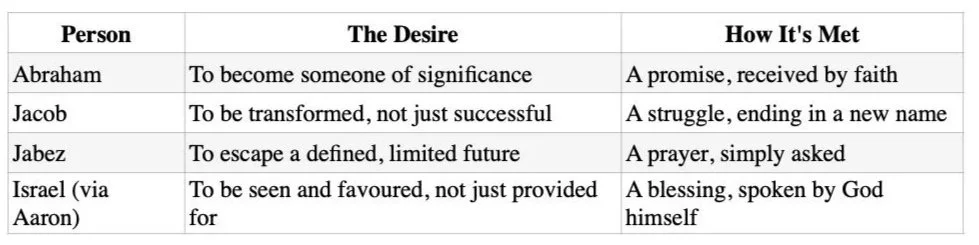
The Old Testament never treats this desire as something to be ashamed of or suppressed. It treats it as right — placed in the human heart by the God who made us for relationship with himself. The question each of these figures had to answer wasn't "should I want God's blessing?" but "will I actually pursue it, wrestle for it, ask for it, and receive it, even when it costs something?"
Perhaps the deepest lesson is this: the desire to be blessed is ultimately the desire for God himself. Abraham didn't just want land — he wanted to walk with God. Jacob didn't just want safety from Esau — he wanted to know he hadn't been abandoned by the God of his fathers. Jabez didn't just want more territory — he wanted God's hand with him. And Israel didn't just want prosperity — they wanted God's face turned toward them.
That is still the invitation today: not simply to chase blessings, but to hold on — like Jacob at the Jabbok — until we find the One who gives the blessing.
Terms for blessing occur over 600 times in the Old Testament in most English translations. But that total is really an umbrella over a few distinct Hebrew words:
The main word, meaning ‘to bless’ is the Hebrew ‘barak’ which is literally connected to kneeling, since a person would kneel to receive a blessing.
This word appears 289 times in the Old Testament.
A related word meaning "happy" or "blessed" in the sense of a state of flourishing is ‘esher’ , as in "Blessed is the man who..." This appears 42 times.
BVP
If you would like to discuss further please get in touch with me on - berniepalmer1@sky.com
The website www.bvpalmer.com contains many interesting articles on a variety of important subjects, as well as videos and details of my books. This article is part of a series on Matthew’s Gospel.
‘Christchurch Baldock’ meets at 10.30 am every Sunday in Knights Templar School, Baldock.