Let my people go!
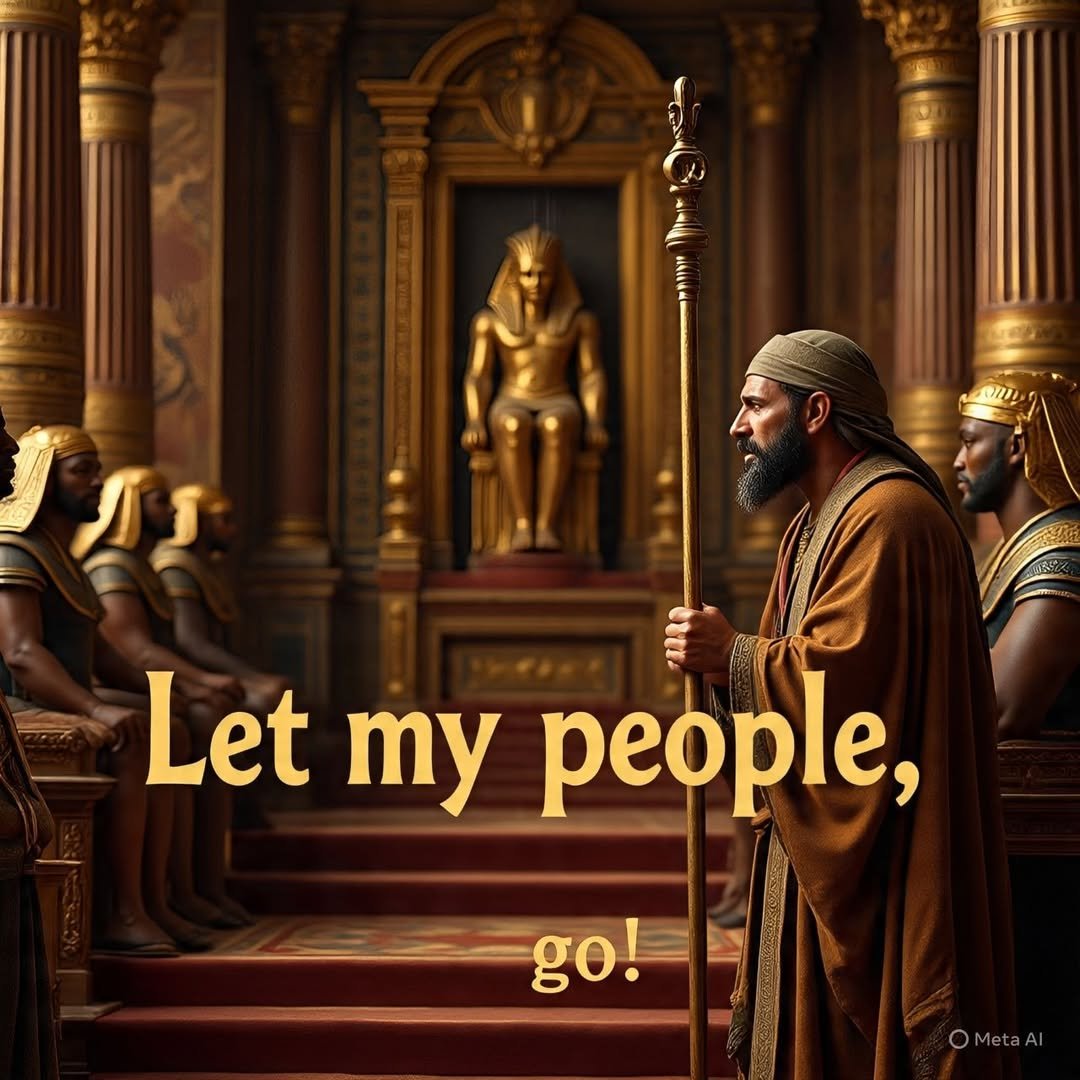
The imperative, ‘Let my people go’ is a recurrent phrase that recurs 10 times throughout chapters 5-10 of Exodus. (5:1; 7:16; 8:1; 8:8; 8:20; 8:21; 9:1; 9:13; 9:17; 10:3; 10:4).
The enslaved Africans in the American plantations recognised that this story about the enslaved Israelites in Egypt in the 13th century BC paralleled their problems. They were also enslaved and longed for freedom. The scriptural refrain, “Let my people go,” struck them as very relevant to their problem. Their spiritual song “Go Down, Moses” distills of their understanding of this text – a lyrical and forceful sung sermon.
This song spread rapidly, it was well known before its first publication in sheet music form submitted by a Virginia chaplain to the escaped slaves who had noted down this song from the fugitive slaves as early as 1853. These fugitives, known as the “contraband of war,” escaped by the thousands to fight with the Union Army.
Why is this story is in the Bible? Is it just an interesting historical record of God’s supernatural power? Is this about ‘liberation theology’ saying that God hates slavery and wants political freedom for people or is there something deeper? Let’s examine the passage.
1. Drawn out - to serve
This story centres on Moses who had been born to an Israelite family who for many generations had been slaves in Egypt. You will remember that the numbers of the Jews were growing fast so the Pharaoh was worried. His first remedy was to make life even harder for them with slave labour being strictly enforced.
“So they put slave masters over them to oppress them with forced labor, and they built Pithom and Rameses as store cities for Pharaoh. But the more they were oppressed, the more they multiplied and spread; so the Egyptians came to dread the Israelites and worked them ruthlessly. They made their lives bitter with harsh labour in brick and mortar and with all kinds of work in the fields; in all their harsh labor the Egyptians worked them ruthlessly.” Exodus 1:11-14
The next remedy was to order the midwives Shiphrah and Puah to kill all boys as soon as they were born.
“The midwives, however, feared God and did not do what the king of Egypt had told them to do; they let the boys live.” Exodus 1:17
As that plan didn’t work either Pharaoh ordered all new-born boys to be drowned in the river Nile. You know the rest of the story. A baby boy was born and when he was three months old his mother made a papyrus basket, covered this with tar, put the baby in it and placed the basket amongst the reeds. Pharaoh’s daughter saw the child and adopted him. He was allowed to live for a while with his own mother, Jochebed, but was later raised in Pharaoh’s palace. The princess gave him the name Moses as this means ‘drawn out’.
When 40 years old he saw a fellow Jew in a work party being beaten; he attacked the Egyptian guard and killed him. Moses then fled to the land of Midian where he became a shepherd. He was there for 40 years having married a Midianite woman.
Then came the time when God himself was to ‘draw out’ Moses for the purpose he planned for him, he wanted him to deliver his people out of slavery.
An interesting choice. Moses was a murderer. He had been rejected by the Jews because of his privileged upbringing and had been an exile from his people for 40 years. Yet Moses had had great educational advantages. He could read and write and think. Many privileged young men in Egypt went to the Royal University of Heliopolis where students learned to speak five languages, read eight textbooks, one of which was about medicine. This helps us understand how Moses could edit the Pentateuch, the first five books of the Bible.
There is an interesting parallel with Saul who became the apostle Paul in the New Testament. He was also a murderer who was deeply hated by God’s new people but he had also received an excellent education. There are some religious groups, such as Jehovah’s Witnesses, who spurn education. God’s churches need people today who can seek out and apply the truth to our world’s problems. True faith must be reasonable and evidence based.
God meets Moses at the burning bush when he was working as a shepherd in the land of Midian, which was at the east side at the top end of the Red Sea.
God speaks
We read,
“There the angel of the Lord appeared to him in flames of fire from within a bush.” Exodus 3:2
But then verse 4 says
“God called to him from within the bush, “Moses! Moses!”” Exodus 3:4
Note that from there on it is God himself who talks with Moses. People can allow themselves to get distracted with such differences. Clearly Moses knew what he was writing when he edited the book. It is easy to miss the point that after 400 years of seeming silence, God can step into history and speak to a man he was calling for a specific purpose.
Thus Jesus was not only God who came to save his people by dying for us but he also acted as the messenger of God who came to teach us. This awesome God who created the universe and created you and me wants to save his people. What a wonderful God. But note he is a holy God. Moses was reminded that even the ground in his presence becomes holy. He is the God who has always chosen people to be his representatives,:
“I am the God of your Father, the God of Abraham, the God of Isaac, and the God of Jacob. At this, Moses hid his face, because he was afraid to look at God.” Exodus 3:6
One thing is obvious, Moses still fears God. What a tragedy it is for people who lose this fear, this awe of God. The Lord then reminds Moses that he is not an inactive God. He may not be visible but he remains very active.
v. 7 “I have indeed seen the misery of my people . . .”
God sees and knows all about what is happening to all of us.
v. 7 “I am concerned about all their suffering.”
He not only sees but he cares about what is happening to all of us.
v. 8 “So I have come down to rescue them . . .”
Our God not only sees and cares but he actively intervenes at times
v. 10 “So now I am sending you . . .’
Please can everyone see this point. God rescues people through spirit-filled individuals that he has chosen for the task
v. 12 “I will be with you . . .”
Moses was being commissioned for a task but the God of miracles will go with him as we shall see.”
v. 20. “So I will stretch out my hand and strike the Egyptians with all the wonders that I will perform among them.”
Our God can do the miraculous, though he does this when it pleases him and not when it pleases us.
v. 21 “I will make the Egyptians favourably disposed toward this people, so that when you leave you will not go empty-handed”.
In v. 21 of the next chapter God can harden people’s hearts. Our God can even change how people think, he is all powerful.
Can everyone see the parallels here with what Jesus teaches in the New Testament. God has seen the problems people have, he cares and he has come down to rescue us. He is sending us out to help save others and yet he will remain with us.
In the Old Testament God gave his Spirit to just a few notable people, to Abraham, Moses and the prophets to enable them to fulfil his purposes. Today God gives his Spirit to every follower of the Lord Jesus so that we also can be his witnesses and fulfil his purposes. The Lord has always longed that people around us, people of all nations, can be freed from the slavery to sin that they are trapped in. The gospel we have today has never changed because our God is unchanging.
“Jesus Christ is the same yesterday and today and forever.” Hebrews 13:8
It is worth emphasising that God’s kingdom has always really been an internal, spiritual kingdom. If any one doubts this read the last sermons of both Moses at the end of Deuteronomy and Joshua as well as what Jesus and his apostles teach.
Remember the name Moses was given him by Pharaoh’s daughter and means ‘drawn out’. She called him this because he was ‘drawn out’ of the river Nile. However God continued to use this name because now he was to be ‘drawn out’ of oblivion in the Land of Midian to be the means of freeing his people, of ‘drawing them out’ of activity in Egypt.
God sends - ‘Go’
Did you notice the repeated use of the word ‘Go’ in chapter 3-4. I have counted that it comes 17 times. This frequent use of “go” underscores the urgency and importance of God’s call. Moses is being sent to serve God, and that theme is central. The repetition drives home that God’s plan requires movement, obedience, and mission.
In the Old Testament, God delivered His people from physical slavery in Egypt. In the New Testament, through Jesus, He delivers people from spiritual slavery—to sin, todeath, and to the Old Testament law.
This introduces one of the most powerful themes in the New Testament - the sending of God’s people into the world. “Go” becomes a key word in Jesus’ final command and in the Church’s mission.
“Go therefore and make disciples of all nations, baptising them… teaching them to observe all that I have commanded you.” Matthew 28:19–20
This is often called The Great Commission. There are several other key“Go” moments in the New Testament:
“Go into all the world and proclaim the gospel to the whole creation.” Mark 16:15
“Go your way; behold, I am sending you out as lambs in the midst of wolves.” Luke 10:3
“You will be my witnesses in Jerusalem and in all Judea and Samaria, and to the end of the earth.” Acts 1:8
Paul asks,
“How are they to hear without someone preaching? And how are they to preach unless they are sent?” Romans 10:14–15
“Go” in the New Testament isn’t just about movement—it’s about mission. The people of God are not meant to be sedate. They are sent—into the world, into culture, to individuals - with the message of forgiveness, acceptance, freedom and life.
“Go” is the heartbeat of the New Testament Church. Yes, now God’s people are all being sent on the difficult task of freeing people from the power of darkness, from Satan’s rule.
2. Doubts - keep recurring
Moses was told what God wanted him to do but he was naturally afraid. He keeps coming up with excuses, just as many do today. Let us look briefly at these excuses as they are relevant today:
1. “Who am I?” (Exodus 3:11)
Moses has been an insignificant person in exile for 40 years. He knows that he had been rejected by the Jews after he had killed an Egyptian guard and had fled. He naturally felt that there must be someone better equipped and he doubts his ability:
“Who am I that I should go to Pharaoh and bring the Israelites out of Egypt?”
2. “What authority do I have?” (Exodus 3:13)
He worries the Israelites will question his authority:
“What is his name? What shall I say to them?”
3. “What if the Jews don’t accept me?” (Exodus 4:1)
Moses fears rejection:
“They will not believe me or listen to my voice.”
4. “I am not eloquent.” (Exodus 4:10)
He claims he’s not a good speaker:
“I am slow of speech and of tongue.”
How often Christians today claim that they are not good at speaking about Christian things
5. “Please send someone else.” (Exodus 4:13)
Finally, he just tries to avoid the task: “Oh, my Lord, please send someone else.”
Each time, God responds with reassurance, signs, or solutions—culminating in appointing Aaron, Moses’ brother, to help him speak.
Isn’t chapter 4:10 typical today of many who do not think they are able to help others come to Christ:
“Pardon your servant, Lord. I have never been eloquent, neither in the past nor since you have spoken to your servant. I am slow of speech and tongue.”
The Lord said to him,
“Who gave human beings their mouths? Who makes them deaf or mute? Who gives them sight or makes them blind? Is it not I, the Lord? Now go; I will help you speak and will teach you what to say.” Exodus 4:11-12
3. Decision - Moses goes
In spite of all Moses’ reservations, God continues patiently to persuade him. He has to do what God wants. He gives him evidence to persuade him. His staff becomes a snake. I was interested to see that the Lord told him to pick it up by the tail. That is dangerous as the head can whip round and bite the hand so it is usual to grab a snake by its neck. Moses has now learned that he can trust God. Then he is told to put his hand within his cloak and it became leprous, as white as snow. When he obeyed the Lord and put this arm back inside his cloak it became normal again. Leprosy is often used as a symbol for sin. Out God always wants to forgive the sin that separates us all from God.
Christ redeemed people from the slavery of sin. The Passover, the last of the ten plagues foresees the fulfilment of Calvary. Blood was the painted on the doorposts of the Israelites homes to avoid the death of their first-born sons. This looked forward to when Christ shed his blood on the cross, so that we can be free from slavery to sin.
Moses makes a decision:
“Then Moses went back to Jethro his father-in-law and said to him, “Let me go back to my own people in Egypt to see if any of them are still alive.” Jethro said, “Go, and I wish you well.” Exodus 4:18
We have all been called to live for the Lord Jesus and to find ways to introduce others to him. Let’s be very careful not to be satisfied with excuses as to why we need not be involved. Remember the Lord is with us and if we ask him he longs to help us. We do this in teams where everyone’s gifts together make a powerful group.
God remains with us
Rashid and Ahmad had been driving up a mountain road. They were Christians living in a strongly Islamic land but were unsure where they were going. Suddenly the car spluttered and died and they just couldn’t get it to start so it was pushed to the side of the road. They sat inside wondering what to do next.
Just then an elderly man with a beard approached them and knocked on the car window. Rashid and Ahmad were unsure whether it was safe to undo the window. The truth was that the two had something to hide. Their boot contained forbidden material. The old man didn’t look like the police but you can never be sure. Ahmad took a deep breath and wound down the window.
The old man gave the standard greeting,
“Hello. How are you?”
But then he said,
“Where are the books?”
The two men shot each other puzzled looks. Was he confused? Was this a trap? Finally they said,
“Why don’t you get in and we’ll give you a lift to the your village and figure what is going on.”
They forgot that the car wouldn’t start but on turning the key the engine fired perfectly. The old man directed them to his village. There they were introduced to the village chief. The chief just blurted out,
“Where are the books.?”
“What do you mean?” replied Rashid and Ahmad.
The chief started to tell them an unbelievable story:
“Last night the entire village had a dream of a man in white who came to each of them in their own separate houses. He had said, ‘ Tomorrow, there will be two men in a car who will bring you the books.”
Rashid and Ahmad now understood that God was at work. They went to the car, opened the boot and inside was their forbidden cargo, a box full of Bibles. The two Christians spent the night reading portions of the Scriptures to an eager crowd, starting with the stories of Jesus. After a few hours Rashid and Ahmad did something that could cost them their lives. Ahmad stopped reading and said to the chief,
“Do you understand what I’m reading to you?”
The chief replied,
“Oh yes, the man in white told us all about it. We were just waiting for you to come with the books. The man in white said that this book would tell them all about him”
Ahmad was astonished. No longer afraid he smiled,
“Let us tell you how you can know this man in white for yourselves.”
That whole village of one hundred people decided to become followers of Jesus.
The Lord is surely calling all of us, his people to go out for him today, praying that we shall see his Spirit at work through each of us to set people free.
What risks are we willing to take that the Lord Jesus is honoured. Moses, after much hesitation went, the early church obeyed and went, now it is up to us.
“Go” becomes a key word in Jesus’ final command and in the Church’s mission. Go has always been the heartbeat of the faithful Christian churches.
BVP