Joshua 22-24 and the Gospel
The emphasis, throughout the Bible, is that faith must be a personal surrender to the rule of Jesus Christ. This discussion aims to show that this close relationship of love for God has always been what God requires of his people, even in Old Testament times.
Old Testament teaching
Someone may reasonably object that in the Old Testament a person was saved by keeping the law. Rubbish. This has never been the case. God has always wanted his people to have a personal relationship with him. It is this relationship that will be apparent through members of God’s kingdom wanting to live as God has taught.
The prophet Joel wrote:
“And rend your hearts and not your garments.” Return to the Lord your God, for he is gracious and merciful, slow to anger, and abounding in steadfast love; and he relents over disaster.” Joel 2:13
In ancient Israel, tearing one’s clothes (rending garments) was a traditional sign of grief, repentance, or mourning. But in this verse, God is calling for genuine inner repentance, not just outward religious display. He’s saying:
“Don’t just look repentant—be repentant.”
It’s a powerful call to heartfelt, sincere turning to God, not just symbolic gestures.
At the end of their lives both Moses and Joshua urged God’s people to become dependent on the grace of God and to show this dependance by the way they lived.
Joshua and the gospel
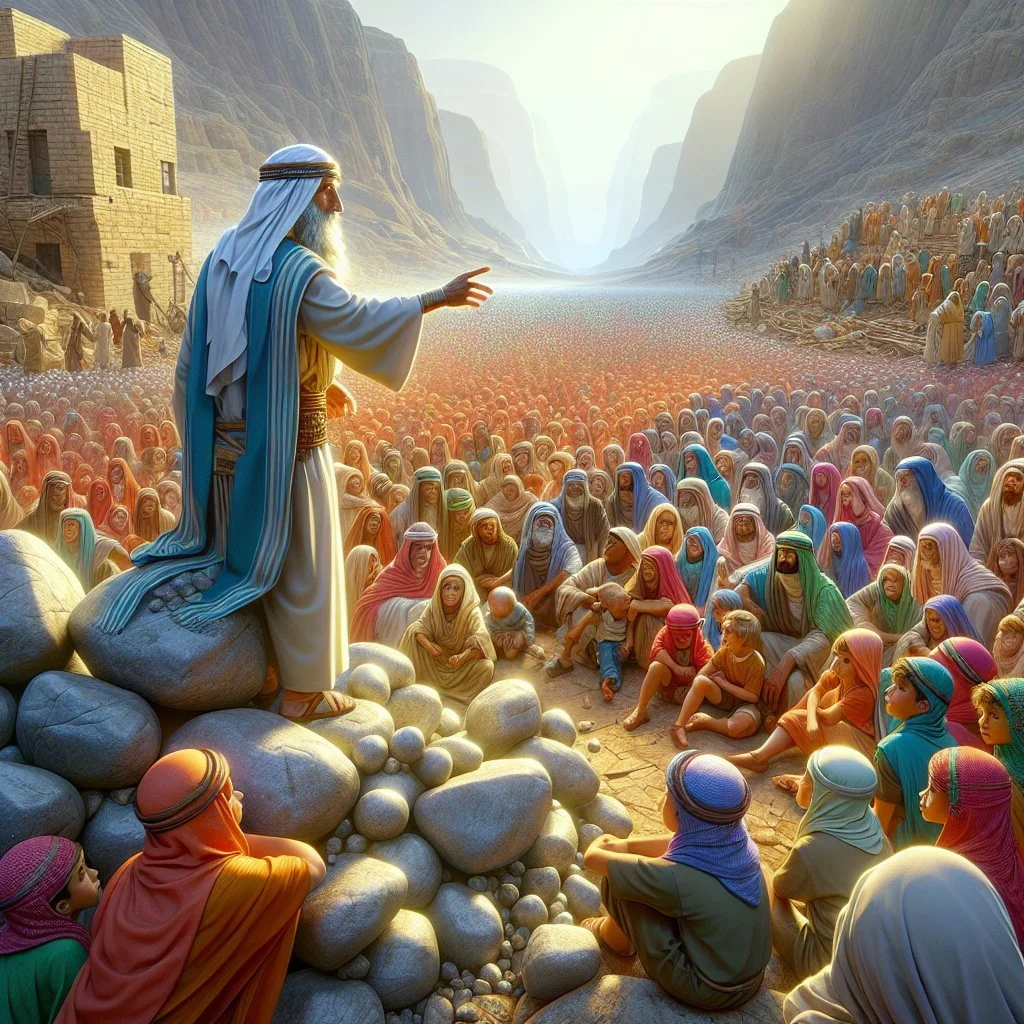
Towards the end of his life Joshua summonsed the Israelites together on three occasions.
1. In Joshua 22 he summonsed the tribes who had been given land to the East of the Jordan. He reminded them what God required from them, it was much more than an outward obedience to rules!
“But be very careful to keep the commandment and the law that Moses the servant of the Lord gave you: to love the Lord your God, to walk in obedience to him, to keep his commands, to hold fast to him and to serve him with all your heart and with all your soul.” Joshua 22:5
Love for the Lord was vital, this is a total commitment to him. Who or what we worship can be seen in who or what we serve. My priorities reveal who I serve.
2. In Joshua 23, when life had become much easier all I Israel was summonsed to hear what Joshua had to say. He again reminds them that all they have is because of God’s choosing them them to be his people. This must mean that the people will continue resolutely to keep living as God had taught them:
““Be very strong; be careful to obey all that is written in the Book of the Law of Moses, without turning aside to the right or to the left.” Joshua 23:6
They will only live this God-centred life if they have a deep personal relationship with the Lord themselves.
“But you are to hold fast to the Lord your God, as you have until now.” Joshua 23:8
Joshua summarised what the foundation of this relationship was:
“So be very careful to love the Lord your God.” Joshua 23:11
Love for the Lord has always been foundational.
3. In Joshua 24, Joshua assembled all the Israelites at Shechem, together with their leaders. Moses recognised that even God’s chosen people remain inherently sinful. None of us is good. What Moses said to God’s Chosen people is true today:
“After the Lord your God has driven them out before you, do not say to yourself, “The Lord has brought me here to take possession of this land because of my righteousness.” No, it is on account of the wickedness of these nations that the Lord is going to drive them out before you. It is not because of your righteousness or your integrity that you are going in to take possession of their land; but on account of the wickedness of these nations, the Lord your God will drive them out before you, to accomplish what he swore to your fathers, to Abraham, Isaac and Jacob.Understand, then, that it is not because of your righteousness that the Lord your God is giving you this good land to possess, for you are a stiff-necked people.” Deuteronomy 9:4-6
Three times in this short section God’s people are reminded that our righteousness is a gift from God. Righteousness in the Bible is not primarily how we live to obtain God’s favour, it is his gift because we love him.
Isaiah similarly taught that the level of righteousness we can achieve is pathetic when compared to the righteousness we need to stand in his presence. He describes our efforts at being good as ‘filthy rags’.
“All of us have become like one who is unclean, and all our righteous acts are like filthy rags; we all shrivel up like a leaf, and like the wind our sins sweep us away.” Isaiah 64:6
Even our best efforts at righteousness are stained by sin and cannot make us right with God. It reflects human inability to earn salvation and points to our need for God’s mercy and grace.
At the end of his life Joshua, after conquering the land, Joshua again gathered all the tribes at Shechem for a massive covenant renewal ceremony. He reminded them that the Lord wants people’s hearts which will result in obedience and service.
He reminded God’s people that everything they had was the result of what God had done for them (Joshua 23:1-7). Joshua later recounted the story of their redemption (Joshua 24:1–13), emphasising again that it was all God’s work. It was God’s power that had achieved their salvation and freedom, not theirs.
To have such a personal relationship involves a deep ongoing choice, just as a good marriage does. He therefore goes on to say:
“Choose this day whom you will serve… But as for me and my house, we will serve the Lord.” Joshua 24:15
Real faith has always been a personal commitment to live gratefully as one of the Lord’s own people out of gratefulness for all God has done. A stone of witness was set up under a great oak by the sanctuary of the Lord.
He then called them to make a personal commitment that they would follow their Lord:
“Now therefore fear the Lord and serve him in sincerity and faithfulness.”
“Choose this day whom you will serve…”
“As for me and my house, we will serve the Lord.” Joshua 24:14–15
He reminds them that there is no place for half-hearted faith because
God is holy and jealous and he will not tolerate divided hearts.
“Joshua said to the people, “You are not able to serve the Lord. He is a holy God; he is a jealous God. He will not forgive your rebellion and your sins. If you forsake the Lord and serve foreign Gods, he will turn and bring disaster on you and make an end of you, after he has been good to you.”. Joshua 24:19–20
The people make a decision and publicly commit themselves to the Lord:
“We will serve the Lord our God and obey him.” Joshua 24:24
Joshua then set up a large stone of witness as a public reminder. This is surely why public acts such as baptism or confirmation should be permanent reminders of the promise to God we have made.
The core message is that faithfulness of God must be responded to with a personal, total, and enduring faithfulness on our behalf.
We must remember what God has done and determine to love him with all our heart. We must reject false idols, keep His Word, and choose daily to serve Him.
Possible Questions based on Joshua’s last two talks
1. God is the one who saves and establishes his people. What is our role in continuing what he has done? Joshua 23:6-7. Is love for God essential? Joshua 22:5b, 23:6, 23:11
2. Note how often the word ‘serve’ and its derivatives are mentioned in Joshua 24:14-24 - at least 12 times. Is real ‘worship’ the same as ‘service’?
3. How important is a close relationship with the Lord? What is the secret of maintaining an obedient and steadfast life? Joshua 23:8,11
4. What usually results when we drift and become cold towards the Lord. Joshua 23:12-13, Joshua 24:20 Hebrews 10:35-39
5. How can we help each other keep our primary commitment to love and obey him?