Matthew 9:27-34 Responses to Jesus
Chapters 8 and 9 of Matthew are largely about describing the astonishing authority Jesus had..He healed a leper and a paralytic was restored, a storm quelled, demons cast out and then he raises a dead person. All of this is extraordinary.
This leaves us with a puzzle. Why does Matthew then tell us about the two blind and the mute men? We have already learned that Jesus could heal such people of their disease. The dead girl was blind and mute and much more, and Jesus could deal with that problem.
These stories are written in a very brief way, few details are given. We are just told this happened. Why does Matthew do this?
We do learn one detail, the way they addressed Jesus.
“As Jesus went on from there, two blind men followed him, calling out, “Have mercy on us, Son of David!” Matthew 9:27
It is easy to miss this. Matthew wants us to note this stunning declaration. Do you remember how he began his record of the gospel about Jesus?
“This is the genealogy of Jesus the Messiah, the son of David, the son of Abraham.” Matthew 1:1
My wife happens to have in her genealogy Alfred the Great, William the Conqueror, Henry 1, Henry II, Henry III, Edward I, Edward II, Edward III, John o’Gaunt’. John o’Gaunt died in 1399 and since then there have been 15 generations, of outwardly less significant people, except for the Guinness’ in Ireland. There must be thousands of people who could claim such a lineage but who are now not notable in the public eye. My wife can therefore only be called a descendant of royalty. However Jesus claim, that we saw in Matthew chapter 1, includes the great King David and many kings after, but note he doesn’t say ‘a descendant of David’, but ‘the Son of David’, the one prophesied about throughout the Jewish Scriptures.
David lived around 1000 years BC and he was told that one of his descendants would come to the throne of God’s people and rule for ever. Under David, Israel was united, strong and secure – free from other nations. Rival nations always wanted to conquer Israel. David knew that he couldn’t rule forever. But here promises him a descendant who would rule forever. The prophet Nathan said to King David:
“When your days are over and you rest with your ancestors, I will raise up your offspring to succeed you, your own flesh and blood, and I will establish his kingdom. He is the one who will build a house for my Name, and I will establish the throne of his kingdom for ever. I will be his father, and he shall be my son. When he does wrong, I will punish him with a rod wielded by men, with floggings inflicted by human hands. But my love will never be taken away from him, as I took it away from Saul, whom I removed from before you. Your house and your kingdom shall endure for ever before me; your throne shall be established for ever.”’ 2 Samuel 7:12-16
This does refer to Solomon, David’s son with Bathsheba but it seems to say much more. Solomon did build a temple which was destroyed by the Babylonians. Jesus also claimed to be the temple and said that his people would be the made into the temple of God. Solomon’s dynasty died out but that of Jesus continues to grow.
There are many other prophecies that declare that the Messiah would be a direct descendant of King David. There was a special interest in the Messiah who come in the name of David as Israel was occupied by the Romans and they longed for this who would lead them to freedom. The problem was that they had misunderstood the sort of Kingdom the Messiah would have.
So these two blind men cried out to Jesus calling him ‘Son of David’. Were they right? If you look a little later in Matthew’s record we read:
“ When John, who was in prison, heard about the deeds of the Messiah, he sent his disciples to ask him, “Are you the one who is to come, or should we expect someone else?”
Jesus replied, “Go back and report to John what you hear and see: The blind receive sight, the lame walk, those who have leprosy are cleansed, the deaf hear, the dead are raised, and the good news is proclaimed to the poor.” Matthew 11:2-5
Jesus is listing what he has done, but there is more to his reply than first seems. His hearers would know the Old Testament and the prophecies about what would happen when God’s King, the Messiah appeared.
Isaiah 35 is a prophecy about the Messiah, and includes this section:
“. . . they will see the glory of the Lord, the splendour of our God. Strengthen the feeble hands, steady the knees that give way; say to those with fearful hearts, “Be strong, do not fear; your God will come, he will come with vengeance; with divine retribution he will come to save you.”
Then will the eyes of the blind be opened and the ears of the deaf unstopped. Then will the lame leap like a deer, and the mute tongue shout for joy.” Isaiah 35:2-6
This prophecy is abundantly clear. God will come to earth to save his people. The evidence will be healing miracles.
Another prophecy in Isaiah explains that the Lord will raise the dead:
“But your dead will live, Lord; their bodies will rise - let those who dwell in the dust wake up and shout for joy - your dew is like the dew of the morning; the earth will give birth to her dead.” Isaiah 26:19
We are also told that he will not associate with the rich and privileged but will bring God’s message to the poor. In the Sermon on the Mount Jesus explains that it is the ‘poor in spirit’ who God blesses.
“The Spirit of the Sovereign Lord is on me, because the Lord has anointed me
to proclaim good news to the poor. He has sent me to bind up the brokenhearted, to proclaim freedom for the captive, and release from darkness for the prisoners . . .” Isaiah 61:1
The reaction of the people listening to Jesus and seeing what he was doing was that they were bowled over:
“The crowd was amazed and said, “Nothing like this has ever been seen in Israel.” Matthew 9:33
Now the chosen Son of David has appeared. This is the moment the world has been waiting for. Our creator has intervened in an unmistakable way and has kept his promises.
We have many powerful leaders in our world today, Trump, Putin, Xi Jinping and others, but such people are powerless when faced with death. They cannot offer anyone eternal salvation. They are certainly not God even though they may think so at times! Look what happened to Alexander the Great, Julius Caesar, Hitler, Stalin and Churchill!
How do people respond to the coming of Jesus? Matthew gives us three options.
Belief
“When he had gone indoors, the blind men came to him, and he asked them, “Do you believe that I am able to do this?” “Yes, Lord,” they replied.” Matthew 9:28
Matthew wants everyone to see that it is a trust in Jesus and that there is nothing less that God desires everyone to have.
“Then he touched their eyes and said, “According to your faith let it be done to you”; and their sight was restored.” Matthew 9:29-30
To be a follower of Jesus is God’s way to eternal life.
There is a misunderstanding that some have after reading this verse. Some think that Jesus heals in proportion to someones faith in his healing power. As a result some healers do all they can to whip up peoples credibility in their ability to heal.
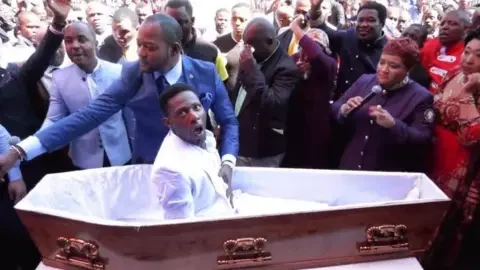
A video spread widely online showing a Pastor Lukau praying over a man in a white suit who was lying in a coffin in the middle of a healing service. Lukau shouted ‘rise up,’ and the man sat up gasping and moving his mouth, prompting wild cheers from the congregation. The church initially claimed the man had died days prior and was brought to the church on the way to a funeral. After intense public ridicule and criminal charges the church later backtracked, admitting that the man was already alive when he arrived at the premises and that the pastor had merely ‘completed a miracle’ rather than performing a literal resurrection. Such fraud is the very opposite of what Jesus was about. Truth and love were prime values for him.
The point is not having ‘great faith’ in a Saviour, but faith in a ‘great Saviour’.
If you are at a party with a notable person and you get into conversation, the temptation will be to try and impress them. You may mention some good actions you have taken, some famous people you also know. However in this situation the blind men have nothing to impress Jesus with except that they had come to him. They simply said:
“Have mercy on us, Son of David!”
They are asking Jesus to be treated with undeserved kindness, with grace. We all need to understand that before God we have nothing to offer him. All we have comes from him. We are powerless.
Do we all realise how small and insignificant we are compared to the Lord God who created us. We desperately need him. We don’t just need a bit of help here and there when we are in trouble, we don’t just need a little spiritual inspiration, we need God’s mercy. The promise he has given us all that if we come to him, he is gracious and kind and will show us mercy.
“Yet the Lord longs to be gracious to you; therefore he will rise up to show you compassion. For the Lord is a God of justice. Blessed are all who wait for him!” Isaiah 30:18
Paul quotes this verse from Exodus and then reminds his readers what our salvation depends on:
“It does not, therefore, depend on human desire or effort, but on God’s mercy.” Romans 9:16
There were many who were impressed with Jesus:
“The crowd was amazed and said, ‘Nothing like this has ever been seen in Israel.’” Matthew 9:33
2. Opposition to the Messiah
In contrast the religious people hated all that Jesus did and said. They knew that he was claiming to be God’s Messiah and he did not fit with their understanding:
“ But the Pharisees said, ‘It is by the prince of demons that he drives out demons.’” Matthew 9:34
They cannot deny the miracles they had seen, the mute man had just spoken.
There is a similar situation today. There is immense historical evidence for Jesus, his miracles and especially his resurrection. The Old Testament keeps pointing to Jesus. His character and his compassion for those in need is remarkable. He had immense power for good but he was not only rejected, he was actively opposed and hated.
Even today those who speak clearly about Jesus are considered to be intolerant and anti-social. We are accused of disrupting the cohesiveness of a multicultural society. This is similar to the opposition Jesus faced from the Sadducees and Pharisees. Didn’t Jesus warn his followers:
“Remember what I told you: ‘A servant is not greater than his master.’ If they persecuted me, they will persecute you also. If they obeyed my teaching, they will obey yours also.” John 15:20
3. Speaking about Jesus as God’s Messiah
After Jesus had touched the blind mens eyes, an act that no orthodox Jew would readily perform because they recognised that illness and evil spirits were associated. After the excitement of being able to see Jesus said something that seems strange:
“. . . and their sight was restored. Jesus warned them sternly, ‘See that no one knows about this.’” Matthew 9:29-30
We are meant to be puzzled. It must have been thrilling for the men to be able to see. They would naturally long to tell everybody what has happened to them. But that is precisely the problem. They would naturally talk about the miracle whereas Jesus wants those with faith in him to talk about who he is and why he had come. Jesus said to the repentant Zacchaeus:
“For the Son of Man came to seek and to save the lost.” Luke 19:10
We have the same problem in some churches today. Church members love to talk about the atmosphere, the singing, the friendliness and even the sermons but how seldom do people speak about the Lord Jesus.
It is no coincidence that the next short miracle Matthew describes is the healing of a man born mute, he had never been able to speak. It is significant that he was brought to Jesus. Who brought him? This is always a major purpose of those who believe in Jesus.
It is also interesting that he is described as being possessed by a demon. In those days all sickness was attributed to Satan. There will be no sickness in heaven. Even the woman with kypho-scoliosis (a bent and twisted back) has this attributed to an evil spirit:
“. . . and a woman was there who had been crippled by a spirit for eighteen years. She was bent over and could not straighten up at all.” Luke 13:11
It is surely no coincidence that after telling the blind men not to tell others that the next healing of this mute man. Now he can speak why would he keep quiet. If Jesus did not want his followers to talk about him why does Matthew emphasise that Christians must never be ashamed of their commitment to him:
“Whoever acknowledges me before others, I will also acknowledge before my Father in heaven.” Matthew 10:32
Jesus did want people to know the truth about him and his reason for coming to earth:
“Jesus went through all the towns and villages, teaching in their synagogues, proclaiming the good news of the kingdom and healing every disease and sickness.” Matthew 9:35
The difference is that those healed would talk more about them and the miracle that had experienced and less about the King and his kingdom. All they had to share was their experience, however dramatic that it, it would be better if they said nothing.
Jesus did not come merely as a healer. In the world today many people are hurting and it is easy for preachers to capitalise on this need and they benefit from this. However Jesus is not offering people the best life now, he has far more to offer.
Even if the healed men said: “Jesus is the Son of David,” Jesus would still want them to keep quiet as listeners would misunderstand them. The popular belief in the Messiah was a political leader who would free his people for the Roman occupation.
Today, when people talk about Jesus they sometimes still have a political agenda, what they would like Jesus to do. Thus the stopping illegal immigrants into a so-called Christian country, the abolition of euthanasia and abortion can have a Christian sound to it, but all to often it is not associated with the Kingship of Jesus over all our lives.
Jesus challenges us not to put our agenda onto Jesus but to listen to his. He wants people to understand who he really is.
So we must be clear what Jesus wants us to proclaim about his gospel or good news. How do these healings fit into the big picture. Matthew quotes from Isaiah and he does this ten times. Together they describe how the Messiah will be identified and what he was coming to do. He loves Isaiah 53 which reminds his readers that God’s suffering servant who would be despised, afflicted, wounded, killed and crushed. He would be ‘cut off’ with anguish of soul so that he could be the means of forgiving his people from the consequences of their sin.
This is why Jesus and only Jesus can and will bring about a new world free from sickness and death.
Yes, we must speak of Jesus but our hearers must be told that Jesus came to meet our most urgent need, to put his people right with God. He gave his life in humiliation and shame because of his love for you and me.
Count von Zinzendorf
In 1719, a 19 year old German nobleman, Count von Zinzendorf, saw Fetti’s painting ’Ecce Home’ painting in the Düsseldorf museum. Attached to the frame of this specific painting in Germany was an inscription that read:
“"Ego pro te haec passus sum. Tu vero quid fecisti pro me.”
This means:
”This I have done for you; what are you doing for me?”
The image and its inscription profoundly changed his life. He went on to revitalise the Moravian Church, launching the modern Protestant missionary movement. He made a vow:
”From now on I will do whatever He leads me to do”
Zinzendorf transformed from a wealthy young aristocrat into the pioneer of the modern Protestant global missionary movement. Because he was a nobleman, Zinzendorf's family strictly forbade him from becoming a theologian or preacher and he was obliged to fulfil his familial duties. He completed his Grand Tour of Europe and accepted a position in October 1721 as the King’s Judicial Counsellor in Dresden. However, he treated his prestigious government job as secondary; his apartment in Dresden immediately became a weekly hub for informal prayer, Bible study, and religious reform meetings.
In 1722, wanting a dedicated space to put his faith into practice, Zinzendorf purchased a large plot of land from his grandmother in Berthelsdorf, Saxony. He originally envisioned this estate as a model Christian community for local peasants.
However that same year, a group of heavily persecuted, German-speaking Protestant refugees from Moravia and Bohemia arrived at his estate seeking asylum. Zinzendorf gladly took them in, granting them land to build a village. They named this settlement Herrnhut, which translates to ‘The Lord’s Watchful Care’.
As hundreds of religious refugees from different theological backgrounds flocked to Herrnhut, bitter arguments broke out over doctrine. Zinzendorf left his government job, moved to Herrnhut full-time, and physically went from house to house to resolve grievances. His efforts culminated on 13 August 1727, when the community experienced a profound spiritual revival during a communion service. The divided refugees united, officially renewing the Moravian Church under Zinzendorf's leadership. Zinzendorf turned the Moravians into a global missionary force. In 1732, he personally commissioned the first two Protestant missionaries to go to the Caribbean island of St. Thomas to minister to enslaved populations. Over the next few decades, Zinzendorf sent Moravian missionaries all over the world—including to Greenland, Africa, North America, and England, where they would eventually cross paths with, and deeply influenced John and Charles Wesley.
In 1735, John Wesley and his brother Charles sailed to Georgia as Anglican missionaries. During a terrifying Atlantic storm that panicked the English passengers, a group of Moravian families remained completely calm, singing hymns peacefully.
When John Wesley asked if they were afraid, they replied that they did not fear death. This starkly exposed Wesley's own spiritual anxieties and ignited his deep desire for their level of serene, unshakeable faith.
Upon returning to England, John Wesley was mentored by Moravian leader Peter Böhler, who taught him about the nature of saving faith and the necessity of personal conversion to follow Jesus Christ. This directly led to the defining spiritual moments for both brothers in May 1738. Charles Wesley submitted to Christ alone for salvation on 21 May 1738. John Wesley attended a meeting at Aldersgate Street on 24 May 1738 where someone was reading Martin Luther’s preface to the Romans. There, John experienced his famous conversion, noting that his heart felt "strangely warmed" and that he finally felt an assurance of personal salvation.
The Moravian Church profoundly shaped early Methodism by providing the theological framework for what a personal faith means, the possibility of assurance of salvation, and offering models for discipleship training and global missions. The Moravian practice of dividing congregations into small, localized sub-groups for intensive discipleship and confession heavily inspired Wesley’s famous Methodist ‘class meetings’ and ‘bands. The Methodists adopted the Moravian practice of the "Lovefeast" (a communal meal of fellowship, testimonies, and prayer). Furthermore, Moravian vibrant hymn-singing deeply influenced Charles Wesley's prolific career as a hymn writer. Their emphasis was on a ‘heart-centered’ relationship with Jesus as Lord and Saviour and this became the bedrock of Methodist identity.
BVP
This article has been posted on the website www.bvpslmer.com where there are many other articles on a wide range of topics from a Christian perspective.
Christchurch Baldock is a Bible teaching, gospel centred, local church. More details can be found on its website. It meets every Sunday morning at 10.30 am in Knights Templar School, Baldock.
Bernard can be contacted at berniepalmer1@sky.com