Matthew 8:1-4 A Leper is Healed
President Ronald Reagan's said that he felt the nine most terrifying words in the English language are,
'I’m from the government, and I'm here to help.'"
Yet there are times when a problem is so massive that a massive solution is needed. When Hitler invaded Poland and persecuted the Jews something massive had to be done. When the unions had too much power and were paralysing Britain, something radical was needed.
In Jesus’ day there we’re many Jews who also thought that their greatest problem was political, they were a country occupied by the Romans and they longed to be free. Political Zealots were everywhere saying that revolution was the only answer. Jesus appeared with a better solution:
“Then he said to them, “So give back to Caesar what is Caesar’s, and to God what is God’s.” Matthew 22:31
Leprosy is a picture of sin
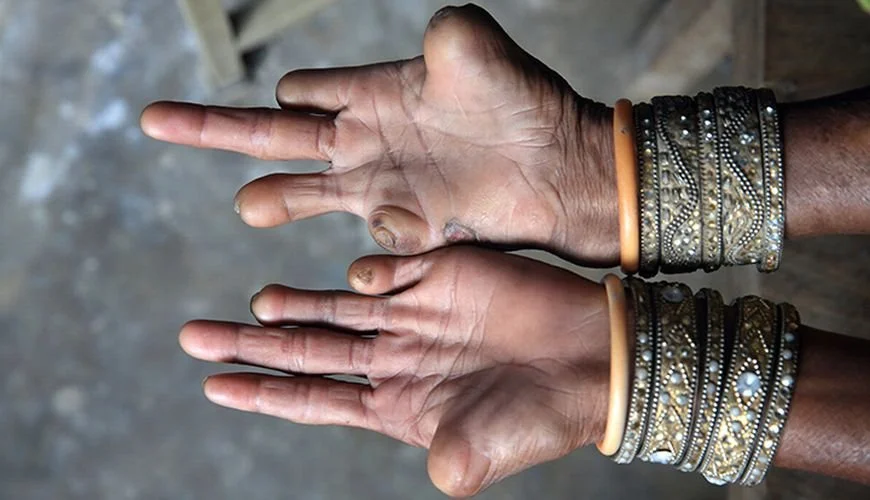
The healing of this man of his leprosy is not only a demonstration of Jesus’ power but is also a description of the massive problem affecting society and shows that a massive answer is available. Leprosy is mentioned over 40 times in the Bible. In those days the term was used to include many chronic diseases that affected the skin and body but would include infections with Mycobacterium leprae (also known as Hansen's disease or leprosy). These are chronic bacterial infections affecting the skin, peripheral nerves, nose and mucous membranes. The disease progresses very slowly, with an incubation period that can range from 1 to 20 years. Eventually, as the disease progresses, people develop skin nodules, and slowly lose fingers, toes noses and feeling as the bacteria infiltrates the tissues.
Ancient Jewish Law listed 61 defilements and leprosy was second only to the contact with a dead body in seriousness. Those whose disease was confirmed were prohibited from coming with 6 feet of other people and this was extended to 150 feet when the wind was blowing. Sufferers were excluded from family and friends and were forced to live in leper communities.
There are several parallels between having leprosy and being soiled by sin.
It is an internal disease affecting nerves and soft tissues that has chronic devastating effects. It takes a long time for its symptoms show. Sin similarly is a disease of the ‘heart’ which becomes hardened and numbs the conscience. Jesus said:
“What comes out of a person is what defiles them. For it is from within, out of a person’s heart, that evil thoughts come - sexual immorality, theft, murder,adultery, greed, malice, deceit, lewdness, envy, slander, arrogance and folly.” Mark 7:20-22
2. The consequences are loathsome and unattractive. The feet and hands become numbed as the nerves are damaged. The body aches. Ulcers appear on the hands, feet and face that will not heal. In the same way sin stupefies us and we become blind to the severity of the problem. Sufferers with advanced disease gave off an awful odour. Their voice can became rasping as the vocal cords become damaged. Sin also influences the way we talk.
3 Leprosy results in separation from friends and loved ones. Most breakdowns of marriage are the result of sinful behaviour of many kinds. Primarily sin results in a permanent separation from the God who created and loves us.
4. Leprosy was then considered incurable. Sin is also a disease that leads to physical and spiritual death. However now leprosy is curable, just as a remedy for sin is now available.
5. One of the plagues inflicted on the Egyptians was the plague of boils that afflicted the whole land of Egypt. Recurrent boils were a feature of leprosy. Later, God’s people were warned that they must remain faithful to God as otherwise they will be afflicted just as the Egyptians were:
“The Lord will afflict you with the boils of Egypt and with tumours, festering sores and the itch, from which you cannot be cured.” Deuteronomy 28:27
6. Miriam, Aaron’s sister and a prophetess, together with Aaron himself, complained about Moses’ privileged status because they thought that God also spoke through them. The Lord was angry at their presumptuous sin and afflicted her with leprosy.
“And the cloud departed from off the tabernacle; and, behold, Miriam became leprous, white as snow: and Aaron looked upon Miriam, and, behold, she was leprous. And Aaron said unto Moses, Alas, my lord, I beseech thee, lay not the sin upon us, wherein we have done foolishly, and wherein we have sinned.” Numbers 12:10-11
5. Naaman was the Army Commander of the king of Aram who developed leprosy. He was sent to the King of Israel to be cured but he answered:
“Am I God? Can I kill and bring back to life? Why does this fellow send someone to me to be cured of his leprosy?” 2 Kings 5:7
Elisha told him to bathe in the river Jordan 7 times and, when eventually he did this, he was cured. He then realised that only the Lord God could cure his leprosy and he said:
“Now I know that there is no God in all the world except in Israel. . . . for your servant will never again make burnt offerings and sacrifices to any other god but the Lord.” 2 Kings 5:15-17
6. When a person was to be certified as healed they had to go through a ceremony involving ‘blood and water’. This was a reminder that God had delivered them from captivity in Egypt through the blood of the Passover lamb and by the miraculous division of the waters of the Red Sea so they could escape from the enemy. Leviticus 14 gives a detailed description of this ceremonial cleansing which involved sacrificial blood and water, the water being sprinkled on him seven times. Although the sufferer was already healed physically this passage reads,
“The person to be cleansed must wash his clothes . . .” Leviticus 14:8
After eight days two lambs had to be sacrificed, one as a sin offering and the other as a guilt offering.
There is no suggestion that an individual with the disease was more sinful than others. This was showing that sin has consequences but that God can heal his people, but only through the shedding of blood.
The cleansed leper had sacrificial blood applied to their right ear lobe, right thumb, and right big toe. This symbolic ritual served as a physical consecration, representing that their whole life, actions, and daily walk were redeemed, cleansed, and fully dedicated to God. The specific body parts represent total holistic restoration:
Right Ear: Symbolises that they will listen to and obey God's Word.
Right Thumb: Symbolises that their work, service, and actions are dedicated to holy purposes.
Right Big Toe: Symbolises that their path, lifestyle, and where they walk are directed by God's ways.
Culturally and ceremonially, this ritual (Leviticus 14:14) mirrored the ordination of the priests (Leviticus 8:23), essentially indicating that the healed individual was fully restored to the community and commissioned to live a completely new, consecrated life. After the blood was applied, the priest would also place holy oil over those same areas, symbolising the empowerment of the Holy Spirit.
It is therefore clear that leprosy was intended by God to be a picture of sin affecting people.
The Leper in Matthew
Matthew chapters 8 and 9 contains the accounts of 10 miracles, half of the miracles described in the whole book. They are undoubtedly put together for a reason. Matthew has just given us three chapters describing in detail Jesus’ Sermon on the Mount, where his authoritative words defines mankind greatest problem, our sin. He now explains who Jesus is and what he came to do.
This story about a leper being cleansed comes immediately after the teaching of this remarkable sermon. It is a parable as well as a miracle.
These miracles make it clear that Jesus is no ordinary preacher but reveal that Jesus is the Messiah who came to deal with our sin and its devastating consequences. Today there are many who think that society’s greatest problems are political. Jesus says that sin is even more serious.
This healing of a leper is recorded in all three synoptic gospels. In Matthew’s version the leper asks Jesus,
“Lord if you are willing, you can make me clean.”
He doesn’t just want to be healed, he wants cleansing. This is emphasised even more in Mark’s version where the focus is obviously on cleansing and not healing, the word ‘clean’ or ‘cleanse’ coming four times in five verses (Mark 1:40-45). The leper recognised that he had a deeper disease that God alone can save him from.
1. The Devastating Effect of Sin
There is no suggestion that the leper suffered from this disease as a punishment for personal sin. There has often been a popular idea that suffering is somehow the result of karma. Broadly, karma is the principle of cause and effect: one's actions, intentions, and thoughts shape a person’s future in this world. Good actions lead to positive outcomes, while harmful actions result in suffering. Even after death there is a reincarnation into either a better or a worse situation, dependant on how a person has lived - but this is still in this world.
The Bible teaches that, though sometimes a person’s actions may directly have consequences in this life, there is a corporate effect of sin. A person’s suffering is often not the direct effect of their sin but because they are part of a sinful community. We are all ‘sons of Adam’ and like him have collectively rebelled against the rule of our maker. We live in a cursed world with its death and decay.
“By the sweat of your brow you will eat your food until you return to the ground, since from it you were taken; for dust you are and to dust you will return.” Genesis 3:19
The leper represents a visible, walking picture of man’s greatest problem. Sin means we are going to die, we are outcasts from God’s people and we cannot even worship God in a way that pleases him, just as lepers could not go to the temple. Families were broken. They had to cry out,
“Unclean, unclean.”
This is the state of each of us in God’s eyes. The world does not have an answer for our sin. An abundance of increasingly stringent rules may restrict some of the outward actions but do not change people’s hearts and strong rules inevitably lead to rebellion. Medical discoveries, scientific advances and political innovations only delay the inevitable. Death and decay is still our lot.
The atheist Todd May has written a book called ‘Death’. He argues that, since death is the inevitable cessation of our existence and there is no afterlife, the most rational response is to embrace our fragility, live in the present, and engage deeply in meaningful, satisfying projects. This is no great solution for those who are suffering or facing death and decay directly. We all need a solution to death and its consequences.
This is a big problem and it does need a radical solution. For us to have a wonderful, bright eternal future needs more than clever politicians. They cannot resolve the problem of death and judgment.
A youth worker in Liverpool in the 1980s said:
“I was shocked by the povery I saw. Two things struck me. The people who wanted to change things were powerless to do so and whoever did have real power seemed to have little inclination to listen or care.”
Little changes! However Jesus says he can help each of us.
2. What does the leper do?
He comes to Jesus for the help that only he can give:
“When Jesus came down from the mountainside, large crowds followed him. A man with leprosy came and knelt before him and said, “Lord, if you are willing, you can make me clean.” Matthew 8:1-2
He must have had to pass through the crowd. Whether he called out ‘Unclean, Unclean’ we are not told. He was, however, willing to break all social rules to come to Jesus. He was convinced that Jesus was able to help him so he let nothing get in his way. What faith!
What gives him that confidence? Note he calls Jesus ‘Lord’. Does this mean he recognised who Jesus really is? He certainly recognised that he could do the impossible. He then ‘knelt’ before Jesus. In the Greek, this is the same word used of the Wise Men who knelt before the baby Jesus and worshipped him. Both the leper and the wise men treated Jesus like a divine king, acknowledging Jesus’ authority.
How did he know this about Jesus? He had probably heard of the other miracles Jesus had performed. Perhaps he knew the Scriptures that the Messiah would be a healer. However he recognised who Jesus was and he had the determination to come humbly to Jesus, saying:
“Lord, if you are willing, you can make me clean.” Matthew 8:2
What a lesson this is for all of us. We also need to acknowledge our sin before God, acknowledge that Jesus alone has the power and authority to both forgive us and empower us to defeat the sin that lurks in all of us and ask him to save us.
Unfortunately there are many who either don’t think their problem is that bad or who don’t realise who Jesus is, and so they say:
“No thanks, I will try to solve the problem myself.”
In May 1940, King George VI recognised the desperate situation Britain was in and called the British nation to observe a National Day of Prayer. The Allied troops were in a desperate situation, stranded on the beaches at Dunkirk, and the King lead the country to an unprecedented nationwide response. As the British Expeditionary Force faced imminent annihilation, the King asked the nation to pray for deliverance. He and many like him recognised that God’s help was desperately needed. Millions packed into churches across the UK. Observers at the time later cited an extraordinary change in the weather and a calm English Channel as the answer to these prayers, allowing the ‘little ships’ to successfully evacuate over 335,000 Allied troops. King George VI subsequently called seven National Days of Prayer throughout the course of World War II, typically coinciding with major military crises, such as the Battle of Britain, the Blitz, and the D-Day landings.
It is striking that many turn to prayer when they are desperate but, when everything is on an even keel, God is forgotten. I well remember picking up a hitch-hiker who had been a soldier in the Falklands War. He had been in the Battle of Tumbledown Hill. His company were descending the hill down towards Port Stanley when they suddenly came under intense machine gun fire from the Argentinian army. His friend next to him was shot in the head and died immediately. They rapidly tried to dig in but then he added:
“We all prayed”
“Even the atheists?” I asked.
“Oh yes, we all prayed.”
“Do you still pray now?”
“No, I don’t need to now!”
He hadn’t realised the danger he is still in and has not realised that Jesus can help him. We look to ourselves or to human leaders but the deepest problems are beyond us. Only God can help the problem of our sin:
“You can make me clean.”
He recognised Jesus power but the leper did have one query. He started,
“Lord, if you will, you can make me clean.”
Is Jesus willing to help? Does he care about the immensity of the problem we face. We need to know the answer to this query. The answer is clear. If anyone truly recognises their problem and turns to Jesus for help, then he is always ready and willing to save us. Our greatest problem is death and judgment. Jesus is the answer to both major problems. He says that death is just a doorway to the next life, which is either heaven or hell.
Jesus says to the leper:
“Jesus reached out his hand and touched the man. “I am willing,” he said. “Be clean!” Immediately he was cleansed of his leprosy.” Matthew 8:3
Jesus was full of compassion for this man in need, he touched the leper and instead of Jesus becoming unclean, it was the leper who instead received God’s cleansing.
That however was just the beginning of his becoming one of God’s cleansed people. He now had to obey what God had said in the Scriptures,
“Then Jesus said to him, “See that you don’t tell anyone. But go, show yourself to the priest and offer the gift Moses commanded, as a testimony to them.” Matthew 8:4
Doing what Scripture says is always evidence that a cleansing by the Spirit has taken place.
A real cleansing
The leper was not only healed of his disease, he was also cleansed of his sin because he had come to trust and follow Jesus. In this miracle Jesus demonstrated that he has the authority and power to solve the greatest problems we face, death and decay and judgment. It is Jesus who brings hope to humanity.
How can Jesus do this for humanity? The purpose of Matthew’s gospel is to show that Jesus achieved this by dying on that cross as our substitute to pay the price for our sin.
When will this deliverance be experienced? We still suffer disease and death and Christians are certainly not immune from this. The rest of this chapter gives the answers but briefly our future is beyond this world. Jesus is very clear that those who trust and follow him will be received into God’s heaven. Those who reject his rule will be excluded from his kingdom, heaven.
The decision is ours. Firstly, will we acknowledge that our greatest problem is our rebellion against the rule of God? Secondly, will we acknowledge that Jesus is the Son of God who has been given his Father’s complete authority and that he came to save our greatest problem. If we come to Jesus he is more than willing to accept us, he longs to help all who come to him.
Jesus is willing and able to save everyone who comes humbly to him asking for his mercy.
BVP