Matthew 4:12-17. Jesus Alone can Restore Us
In 1998 William Hague, who was later to become leader of the Conservative Party said in the first television interview about his religious beliefs:
“I certainly regard myself as a Christian and my politics are founded on Christian ethics and beliefs.”
He highlighted the ethical underpinnings of Tory policy which he believes should be consistent with the Christian faith, especially the similarities with regard to support for families and belief in limited government. It was striking that he emphasised ethics but omitted to emphasise the centrality of Jesus.
In a local radio broadcast I was invited to sit on a panel with a Sikh, a Muslim, a Jew with myself as a Christian. It was noticeable that all groups emphasised the importance of family and moral values, but the great difference was how we selfish human beings can become right with God and empowered to live in a way that pleases God. The centrality of Jesus, his death for our sin and his resurrection so we could also experience new life were we were widely different.
There are many religions and political parties that admire the moral teaching of the Sermon on the Mount that Jesus gave. However they have seldom seen the context or how it ends. Matthew wrote his record of the gospel to put the focus on a unique Jesus, the only Son of God and our only Saviour. Jesus was not just a great moral teacher, to be put alongside others religious and ethical teachers to give us in the West a helpful steer to help us see our way through the moral maze of the 21st century.
The purpose of Matthew’s record is to show how different Jesus is from everybody else. His lineage showed he was a direct descendant of King David, His extraordinary birth to a virgin, his miracles, his fulfilling the 330 prophecies about the Messiah given in the Jewish Scriptures, culminating in his execution and resurrection, and the content of his teachings are all recorded so we can know that Jesus is God’s King, his Messiah, who came to put people right with God. What John the Baptist taught is the essence of what Jesus taught as was to become the message of his church.
Another prophecy fulfilled
When Jesus heard that John the Baptist had been imprisoned by Herod Antipas, the Tetrarch of of Galilee and Perea (land east of the river Jordan), Jesus deliberately returned to Galilee. Up till this time he had lived in the unpopular area of Nazareth but he moved to the more significant town of Capernaum and this became his centre of operations.
“Leaving Nazareth, he went and lived in Capernaum, which was by the lake in the area of Zebulun and Naphtali”. Matthew 4:13
Matthew stresses where Jesus moved to as this fulfilled another Old Testament prophecy about the Messiah.
“. . . to fulfil what was said through the prophet Isaiah: “Land of Zebulun and land of Naphtali, the Way of the Sea, beyond the Jordan, Galilee of the Gentiles - the people living in darkness have seen a great light; on those living in the land of the shadow of death a light has dawned.” Matthew 4:14-16
Isaiah based his vision on the devastation of the northern lands of Israel around 733 BC when Tiglath-Pileser king of Assyria first invaded and captured just the northern areas of the Kingdom of Pekah, king of Israel:
“In the time of Pekah, king of Israel, Tiglath-Pileser king of Assyria came and took Ijon, Abel Beth Maakah, Janoah, Kedesh and Hazor. He took Gilead and Galilee, including all the land of Naphtali, and deported the people to Assyria.” 2 Kings 15:29
These maps help explain the relationship between Naphtali and what came to be known as Galilee
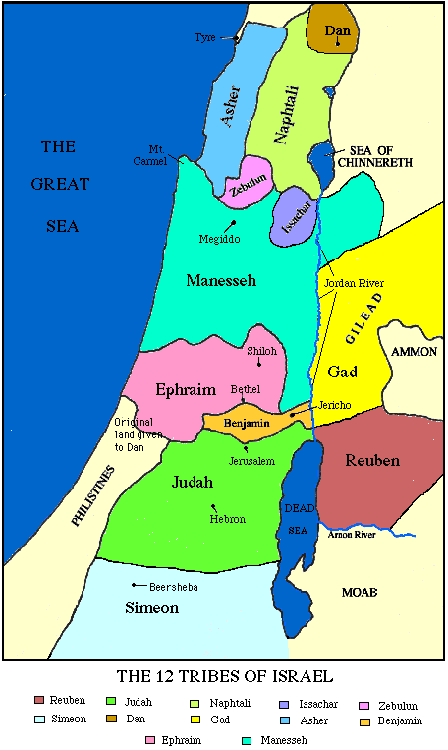
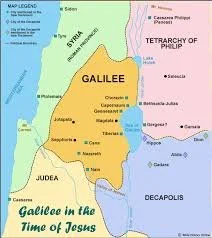
It had been precisely these same lands in the north of Israel that, 150 years earlier, Ben-Hadad, King of Syria, had captured from Basha, King of Israel:
“He conquered Ijon, Dan, Abel Beth Maakah and all Kinnereth in addition to Naphtali.” 1 Kings 15:20
No wonder it had always been a despised and rejected area of the Promised Land. In our world Donbas, Gaza and Southern Sudan are in the same situation as Gilead, Galilee and Naphtali were in Isaiah’s time. The people there were having a wretched time being a captive nation. Yet God promised through Isaiah:
“ . . . but in the future he will honour Galilee of the nations, by the Way of the Sea, beyond the Jordan. The people walking in darkness have seen a great light; on those living in the land of deep darkness a light has dawned. You have enlarged the nation and increased their joy; they rejoice before you as people rejoice at the harvest.” Isaiah 9:1-3
The ‘Way of the Sea’ was the major highway that went from Egypt to Damascus. It was along this route that most invaders from the East came.
Isaiah was looking forward to a time when these dispossessed people will see ‘a great light’. They were, metaphorically, in a dark place but a light will be coming. Notice that Isaiah used the past tense to emphasise that this promise was a good as done because it is the Word of God.
Matthew is making the point that this ancient prophecy was now fulfilled. Never before or since has that area known real peace but Matthew is saying that Jesus is the ‘light of the world’ and he came from precisely this area.
This prophecy is so relevant today for those who are going through dark times, there is a real light at the end of the tunnel, there is real hope because God himself has entered his world to save us and change us. Isaiah wrote:
“. . . on those living in the land of deep darkness a light has dawned.” Isaiah 9:2
Matthew follows the Septuagint version and says:
“. . . on those living in the the land of the shadow of death a light has dawned.” Matthew 4:16
Isaiah said:
“You have enlarged the nation and increased their joy.” Isaiah 9:3
This is not talking about a physical nation but about the Kingdom of God whose members will be filled with a deep joy that nothing can overcome.
So often when passages from the New Testament are quoted there is much to be gained from knowing the context. Many of the Jews would have understood this. Isaiah’s reference to Gilead, Galilee and Naphtali precedes the glorious prophecy that a child will be born who will be God himself and this child will become the Saviour of the world. He would become a blazing light, a ruler who will remove the darkness people were experiencing:
“For to us a child is born, to us a son is given, and the government will be on his shoulders. And he will be called Wonderful Counsellor, Mighty God, Everlasting Father, Prince of Peace.Of the greatness of his government and peace there will be no end. He will reign on David’s throne and over his kingdom, establishing and upholding it with justice and righteousness from that time on and forever. The zeal of the Lord Almighty will accomplish this.” Isaiah 9:6-7
This is extraordinary. This ruler is divine, he shares the nature of God. His kingdom will continue for ever. This can only be Jesus.
What is also extraordinary is the prophecy that just precedes the mention of Gilead, Galilee and Naphtali. It is must less well known but is staggering to those who study it. Isaiah is told that the Lord will not to follow popular thinking and share the fears of those around. People were terrified that Tiglath-Pileser would continue his invasion. Instead:
“The Lord Almighty is the one you are to regard as holy, he is the one you are to fear, he is the one you are to dread.” Isaiah 8:13
The Lord God was the rock on which they could stand securely and he will again be the sanctuary for all Jews, whether they lived in Israel or Judah or anywhere else:
“He will be a holy place; for both Israel and Judah he will be a stone that causes people to stumble and a rock that makes them fall.” Isaiah 8:14
This divine person will divide people, many stumbling when he comes:
“And for the people of Jerusalem he will be a trap and a snare.Many of them will stumble; they will fall and be broken, they will be snared and captured.” Isaiah 8:14-15
This is precisely what happened when Jesus appeared. People were divided over him, Satan snared them into rejecting their Messiah. However, this is the wrong way to react. God tells us all through Isaiah, not to focus and mull on our fears but trust in the living God who has revealed himself in his word:
“Bind up this testimony of warning and seal up God’s instruction among my disciples.” Isaiah 8:16
Isaiah then makes the decision that all people should make
“I will wait for the Lord, who is hiding his face from the descendants of Jacob. I will put my trust in him.” Isaiah 8:17
When people face problems, even today, such as when a loved one dies or guidance is needed, they may try to find comfort through spiritualists. This is nothing new. They did this in Isaiah’s time:
“When someone tells you to consult mediums and spiritists, who whisper and mutter, should not a people enquire of their God? Why consult the dead on behalf of the living?” Isaiah 8:19
The Lord is appalled at this reaction, why turn away from the living God who has revealed himself in his Word and turn to evil ways? Isaiah continues:
“Consult God’s instruction and the testimony of warning. If anyone does not speak according to this word, they have no light of dawn.” Isaiah 8:20
We are being clearly told that it is through the Bible that we can know both what God thinks and what he has done to save us. The promises of God are utterly reliable and that is a key message of the whole Bible.
Another preacher appears
Jesus’ emphasis was also the same as John the Baptist’s, God sees our hearts and our only hope is to completely change the direction in which we have been living and put him, God’s King on the throne of our lives. It is hardly surprising that the authorities were rattled.
“From that time on Jesus began to preach, ‘Repent, for the kingdom of heaven has come near.’” Matthew 4:17
This is the Kingdom that God is going to ensure is established.
If we combine the first words two spoken sentences of Jesus in Matthew’s gospel we read:
“Repent, for the kingdom of heaven has come near.”
“Come, follow me,” Jesus said, “and I will send you out to fish for people.” Matthew 4:19
Jesus is clearly announcing that this Kingdom of God where people can experience his peace is intimately related to himself, ‘Come follow me.’
Jesus is utterly different to all other religious leaders. He is so egocentric. Throughout the gospel this humble man unashamedly asks everyone to put him at the centre of their lives because he is none other than the Son of God. He defines Christianity in terms of himself, his rule and his Lordship. This is why ethical reconstructions that use the name Christian are totally inadequate.
Buddha taught the Four Truths and the Eight-fold path and emphasised reincarnation but he never pointed to himself. Muhammad possibly taught the Five Pillars of Islam but he would not point to himself. Hindu holy men may bid others to live pious lives but they would never say ‘in me’.
In the Sermon on the Mount this central theme is repeatedly made clear. Jewish teachers would interpret the Law but Jesus said:
“When Jesus had finished saying these things, the crowds were amazed at his teaching,because he taught as one who had authority, and not as their teachers of the law.” Matthew 7:28
Jesus unashamedly is claiming to be the ultimate authority:
“But I tell you that anyone who is angry with a brother or sister will be subject to judgment.” Matthew 5:21
“Blessed are you when people insult you, persecute you and falsely say all kinds of evil against you because of me.” Matthew 5:11
He even claims the right to decide who will enter heaven and who will not. At the judgment day he will say to some so-called Christian leaders:
“Not everyone who says to me, ‘Lord, Lord,’ will enter the kingdom of heaven, but only the one who does the will of my Father who is in heaven.” Matthew 7:21
Jesus is saying throughout the Sermon that it is our response to him that is the deciding factor on the day of judgment. Before he gave this sermon Jesus first insisted:
“Come, follow me,” Matthew 4:19
There are only two reasonable reactions to what Jesus was teaching. Either he is a wicked, deranged, egocentric maniac or they are the claims of God himself.The call of Jesus ‘Come follow me” has always been the message of the church. This is how the Bible ends:
“The Spirit and the bride say, ‘Come!’ And let the one who hears say, ‘Come!’ Let the one who is thirsty come; and let the one who wishes take the free gift of the water of life.” Revelation 22:17
Note that when people hear Jesus and come to him, their reaction will be to continue the work and say to others, ‘Come’.
BVP