
If someone says to you, “Tell me what you really think!’ they are on a dangerous path, as some devastating home truths may come out.
Yet in this section Jesus shares some home truths about people he has met up in Galilee and they are most uncomfortable. What is even more disturbing is that they are so relevant to our society today.
This chapter begins with John the Baptist. He wants those who are still his followers to ask questions about Jesus. John knew that his role was to prepare the way for Jesus. However the ministry of Jesus was not what John had expected - where is God’s judgment of his enemies?
Jesus replied to John’s disciples who came asking for the evidence that he is God’s Messiah - look back at the miracles I have done. These mighty works demonstrated that Jesus had an extraordinary power for good that no-one else has ever had. More than that, they fulfil many Old Testament prophecies. Jesus puts himself right in the centre and says:
“Blessed is anyone who does not stumble on account of me.” Matthew 11:6
Jesus turns to us all and says:
“Whoever has ears, let them hear.” Matthew 11:15
It is our responsibility to listen to what Jesus says.
The response to Jesus ministry
Jesus answers this advice directly and not in a way that some will want to hear:
“To what can I compare this generation? They are like children sitting in the marketplaces and calling out to others.” Matthew 11:16
He is referring to the people of his time but again his answer is relevant to all generations. Jesus, as he so often did, is referring back to the Old Testament Scriptures when using this phrase. Jesus recognised that the opening of Psalm 78 referred to his ministry. This psalm starts:
“My people, hear my teaching; listen to the words of my mouth. I will open my mouth with a parable; I will utter hidden things, things from of old - things we have heard and known, things our ancestors have told us. We will not hide them from their descendants; we will tell the next generation the praiseworthy deeds of the Lord, his power, and the wonders he has done.” Psalm 78:1-4
The effect of teaching God’s ways to subsequent generations would have great benefits. The psalm continues:
“. . . he commanded our ancestors to teach their children, so the next generation would know them, even the children yet to be born, and they in turn would tell their children. Then they would put their trust in God and would not forget his deeds but would keep his commands.” Psalm 78:5-7
The psalmist knew that people of every generation will have to decide how they will treat God. However it then goes on to give a warning, the warning Jesus picks up on:
“They would not be like their ancestors - a stubborn and rebellious generation, whose hearts were not loyal to God, whose spirits were not faithful to him.” Psalm 78:8
The psalmist then goes on to remind them that the true God is a supernatural God who will reveal himself by miracles.
This generation’ refers to any people who are hostile to God.
Jesus observes the response of children when different characters come amongst them and suggests that people are just like children, making emotional responses based on prejudices and not on reasoned argument.
A flute player would come to a joyful wedding and the children would dance.
When a dirge is played at a funeral the children would not get involved.
Jesus said,
“They are like children sitting in the marketplaces and calling out to others:‘We played the pipe for you, and you did not dance; we sang a dirge, and you did not mourn.’ Matthew 11:16-17
Why did Jesus give these two examples? This chapter, Matthew 11 is about two main characters, John the Baptist and Jesus and this is what Jesus is referring to. John was a dour character who warned people about judgment, he was not known for eating and drinking with people:
“For John came neither eating nor drinking, and they say, ‘He has a demon.’”Matthew 11:18
His message felt like a ‘dirge’, bad news, so the ‘children’ would not listen.
Jesus was the opposite. He was known to go to parties and to mix socially with all types of people, non Jews and the riff-raff of society. This was their excuse for not listening to him either, the people would not dance. Jesus explains what he meant:
“The Son of Man came eating and drinking, and they say, ‘Here is a glutton and a drunkard, a friend of tax collectors and sinners.’” Matthew 11:19
Jesus is saying that people will find reasons to reject whatever they don’t like, even if their reasons are contradictory. It is as if people are not thinking clearly but are driven by inner desires. Jesus is criticised for being a friend of tax collectors and sinners, as if that were a problem. That is exactly who Jesus is, he is God’s Mighty Eternal King but he wants to be friends with and sinners. He has no time for those who are self-righteous.
So anyone who comes to them with a message about God’s King, and that this King must take precedence in people’s lives, they will always find some way to reject this. However this means that they will miss the wonderful benefits of the truth. Jesus answers the great questions of life, such as, ‘Why am I here?’, What is the purpose of life?’, ‘What happens when I die and face God?’
Doesn’t this diagnosis ring true of our world today? Few consider thoughtfully the claims of Jesus and make a thought-through response. Unfortunately most people make knee-jerk responses against Jesus, usually based on what they have heard from family, friends, back ground or of past experiences of religious activities. Which ever way Jesus is presented to them they will find a way to object - anything, even illogical arguments will be used to shut out the message.
However their response doesn’t change the facts. Hence Jesus says:
“But wisdom is proved right by her deeds.” Matthew 11:19
God is the wise one. Proverbs, chapters 1-4, teach that wisdom is the very essence of God. God longs for all people to find this wisdom.
“The fear of the Lord is the beginning of knowledge, but fools despise wisdom and instruction.” Proverbs 1:5
“Then they will call to me but I will not answer; they will look for me but will not find me, since they hated knowledge and did not choose to fear the Lord.” Proverbs 1:28-29
“. . . but whoever listens to me will live in safety and be at ease, without fear of harm.” Proverbs 1:33
“Trust in the Lord with all your heart and lean not on your own understanding; in all your ways submit to him, and he will make your paths straight.” Proverbs 3:5-6
“The beginning of wisdom is this: Get wisdom. Though it cost all you have, get understanding.” Proverbs 4:7
God’s wisdom, his Messiah, is proved by what he did, and so it is with those who accept his rule. All Christians are given God’s Holy Spirit so we can become like him.
The person John the Baptist pointed to is Jesus, the Lord God who created the universe. Jesus is God’s wisdom in the flesh. In time, it will become obvious what God’s truth is, the objections simply do not fit the facts. The person John pointed to has appeared and none of us are even ‘worthy to undo his shoes’! People may object but the facts do not change. In time it will become even more apparent what is wisdom and what is foolishness. Jesus exposes the different responses to him.
2. Jesus’ response to ‘this generation’
John wants his followers to know for certain whether Jesus is the one that God has promised or not. These prophecies do say that when God’s Messiah comes there will be a defeat of all God’s enemies. However Jesus did not act is this way, he warned people instead:
Jesus denounces an irrational refusal to repent.
“Then Jesus began to denounce the towns in which most of his miracles had been performed, because they did not repent.” Matthew 11:20
Jesus spells out that all people who hear what he teaches and see the miraculous signs should repent and say:
“This is the Messiah sent from God, consequently I must turn and follow him.”
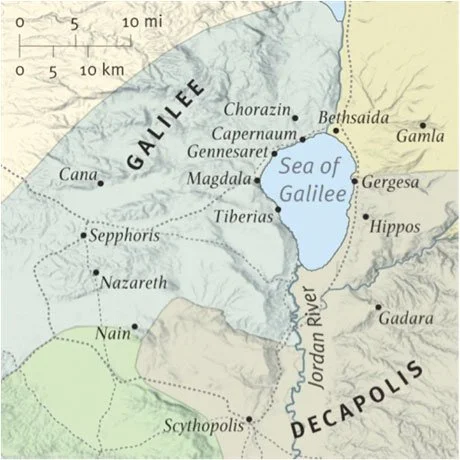
Jesus then mentions towns that he had recently visited in the north of Galilee where he had performed miracles but its inhabitants had refused to turn to him:
““Woe to you, Chorazin! Woe to you, Bethsaida! For if the miracles that were performed in you had been performed in Tyre and Sidon, they would have repented long ago in sackcloth and ashes.” Matthew 11:21
Tyre and Sidon were further north though still quite close.

Island city of Tyre
Throughout the Old Testament there are many mentions of these two cities. Jesus used the pagan cities of Tyre and Sidon to highlight the way God’s chosen people, the Jews, refused Him. The island city of tyre was besieged by Alexander the Great and eventually destroyed after roadways were built across the sea to enable the Greek soldiers to conquer it. It was never rebuilt. The Bible, in Ezekiel 26 (especially verses 4–5, 14, and 19), predicts that Tyre will become an uninhabited ruin, a bare rock, and just a place for fishermen to spread their nets.
In contrast the Israelites of Jesus’ day believed themselves to be righteously following God, yet they did not recognise God in their midst. Jesus, in essence, shamed Chorazin, and Bethsaida. They, who were supposed to be God’s representatives on earth, refused to listen to Jesus; yet pagan cities would have quickly repented if given the same evidence. Jesus’ comments demonstrate the importance of responsibility and stewardship.
“From everyone who has been given much, much will be demanded; and from the one who has been entrusted with much, much more will be asked” Luke 12:48
Jesus tells the people living in these two cities straight:
“But I tell you, it will be more bearable for Tyre and Sidon on the day of judgment than for you.” Matthew 11:22
He then addresses those living in his own town, Capernaum. They thought they were rich but in fact were incredibly poor in God’s eyes.
“And you, Capernaum, will you be lifted to the heavens? No, you will go down to Hades. For if the miracles that were performed in you had been performed in Sodom, it would have remained to this day. But I tell you that it will be more bearable for Sodom on the day of judgment than for you.” Matthew 11:23-24
What a comparison this was! Sodom was renowned in the days of Abraham and Lot for its flagrant sin, its rebellion against God and its immorality. When Lot was living there, God called them to leave before destroying the city by raining down fire and brimstone from heaven. This was a vivid example of what becomes of those who defy the living God. Jesus is saying that if Sodom had witnessed the miracles Jesus demonstrated, they would have turned to Christ.
A common response, when the challenge of Jesus is presented, is for people to say, ‘Not enough evidence. We cannot be certain. It is not that clear.’ They think this justifies them continuing to live just as they want.
It is rubbish to say there is not enough evidence. The book ‘Stepping Stones to Faith’ outlines how much evidence there is. Jesus did enter this world and gave us ample evidence that his miracles are real. We can check the Old Testament prophecies, they alone are very persuasive. We do have natural instincts inbuilt within us that says that life has a purpose and that truth and integrity matter.
Some say that Jesus failed to make his claims clear. A master at my school once told us that Jesus never claimed to be God. What rubbish. He cannot have read the evidence of the apostles given in the gospels!
So today, anyone refusing to recognise who Jesus is and who refuses to repent is acting irrationally. It is not surprising that they do not want to investigate the evidence. In the book ‘Stepping Stones’ each group of evidence is portrayed as different stepping stones across a river. One bank describes the selfish world we are in, which has just a veneer of kindness, whereas the other bank is God’s ideal world. As people cross over the stones they can reasonably say, ‘Yes, Yes, Yes’ as the evidence is disclosed. But as they come to the position where they have to take a step of faith , based on all the evidence, many feel that they do not want to come under the authority of Jesus as their king. Instead they make a giant leap of blind faith back into this world’s values. What is astounding is that very few realise that rationally they ought to disprove all the evidence of the ‘Stepping Stones’ but this they won’t do.
The decision to repent and turn to Jesus as our Lord and Saviour matters very much indeed. Jesus warns us that there is a devastating day of judgment approaching:
“But I tell you, it will be more bearable for Tyre and Sidon on the day of judgment than for you.” Matthew 11:22
Capernaum was largely a Jewish town, they thought they would be safe on the Day of Judgment because the people went to the synagogue, accepted the doctrines and followed Jewish rules. Jesus warns them, as he warns us,
“But I tell you that it will be more bearable for Sodom on the day of judgment than for you.” Matthew 11:26
Can you imagine any clergyman saying this to churches today? Unfortunately the same stubbornness that was in Capernaum is still around today. Capernaum thought they would be safe but they are in for a shock - hell approaches!
It is hard to imagine a worse situation, God raining down fire and sulphur. Jesus is saying that it will be worse for those in Capernaum because they had rejected the one hope God has given them, they had rejected Jesus.
The relevance of this message for today is obvious. Jesus is trying to shake us out of our complacency. Jesus is the King. The evidence for this is so strong, so to reject his rule will have terrible consequences. Sin runs deeply in all of us, rejection of God runs deeply in all our hearts. People will do whatever they can to avoid his rule, some even dare to suggest there is inadequate evidence. Please do review the evidence in ‘Stepping Stones’ and ask ‘Who was Jesus?’ Did he exist? -Yes. Did he do extraordinary miracles? - Yes. Does his teaching resonate with what we know to be true?- Yes. Did he fulfil those Jewish prophecies about the Messiah? - Yes. Is the evidence for his resurrection convincing? - Yes. Were those close to Jesus convinced so they were willing to give their lives to serve him? Yes. Am I naturally self centred and not God centred and so need God’s forgiveness? -Yes.
Jesus is so loving to those who come to him in need, but here we learn that Jesus has another side. The judgment Jesus warns us all about is coming on the Day of Judgment. He will then enact what the Old Testament and John the Baptist talked about.
Why do people delay in accepting him? The next passage talks about the amazing offer god makes to us all.
BVP
If you would like to discuss further please get in touch with me on - berniepalmer1@sky.com
The website www.bvpalmer.com contains many interesting articles on a variety of important subjects, as well as videos and details of my books .
‘Christchurch Baldock’ meets at 10.30 am every Sunday in Knights Templar School, Baldock.