Mark 14:12-26. The Last Supper and the Lord’s Supper
Mark chapter 14 focuses on the desertion of Jesus by those around him.
The chapter begins with the determination of the Chief Priests to find a way to arrest and kill Jesus (v.1-2). Then we read that Judas went to the chief priests to betray Jesus to them for money (v.10-11) Sandwiched in between these two accounts, in a style typical of Mark, is the account of the one faithful unnamed woman who loved Jesus and anointed his head with a jar full of expensive perfume whilst he was dining in the home of Simon the Leper. Judas was upset at this waste of money, but we read in John’s gospel that he was a thief (John 12:6), to prosper in this world meant more to him than anything else. Later in the chapter we read that Peter himself would deny any association with Jesus three times, that Peter, James and John failed to support Jesus in his distress, that Judas would bring the temple guard to arrest Jesus in the Garden of Gethsemane, and finally all the disciples fled, including a young man, possibly Mark himself who ran away naked from Jesus after nearly being caught by the soldiers. The chapter continues with details of Jesus’ first trial before the antagonistic High Priest in which he affirms that he is ‘the Christ, the Son of the Blessed One’ for which he was condemned. The final story in the chapter are the denials of Jesus by Peter. This is one of the most depressing chapters in the gospels. Yet throughout all this, Jesus remained faithful. In Paul’s final letter to Timothy he picks up on this persistent faithfulness of Jesus in contrast to the way his followers so often behave.if we are faithless.
“. . . if we are faithless, he remains faithful, for he cannot disown himself.” 2 Timothy 2:13
The next story that Mark includes in this chapter on betrayal and desertion is his brief account of the last supper, the Passover feast. This annual feast was a highpoint in the Jewish year when they celebrated the manner in which the Lord had rescued them from captivity in Egypt. The economy of words used in the description of all that happened suggests a deliberate selection to emphasise what is important.
During that day Jesus had sent Peter and John into Jerusalem to prepare for the Passover feast that evening (Luke 22:8). They were to meet a man carrying a jar of water. This would have been unusual as it was normally a woman’s job. This man showed them a large upper room where the
feast was to be eatenThis account tells us how we should understand this feast in its context as this has great applications to how we should worship God today.
The Old Testament original Passover
In Exodus 12, God gives Moses and Aaron instructions for the first Passover, just before delivering the Israelites from slavery in Egypt. This was the last of the ten plagues inflicted on the Egyptians.
Each Israelite family was to select a spotless lamb and bring this into the family for a week. Then it was to be slaughtered and its blood smeared on their doorposts of the house as a sign for God’s angel of death to “pass over” their homes. They were to roast the lamb and eat it with unleavened bread and bitter herbs, symbolizing their quick departure and the bitterness of slavery.
You can imagine the oldest son of the family pestering the father, ‘Have you smeared the blood on the doorposts yet? Any answer such as ‘I’ll get around to it soon’, would be met with anguish. That blood really mattered to him.
At midnight, God struck down all the firstborn in Egypt, but He spared the Israelites who had obeyed His instructions. They were saved by the blood. This final plague led Pharaoh to allow the Jews to be freed from slavery. The Jews were repeatedly told to celebrate this event in perpetuity:
“This day shall be for you a memorial day, and you shall keep it as a feast to the Lord; throughout your generations, as a statute forever, you shall keep it as a feast.” Exodus 12:14
“And you shall observe the Feast of Unleavened Bread, for on this very day I brought your hosts out of the land of Egypt; therefore, you shall observe this day, throughout your generations, as a statute forever.” Exodus 12:17
“You shall observe this rite as a statute for you and for your sons forever. And when you come to the land that the Lord will give you, as he has promised, you shall keep this service.” Exodus 12:24-25
Leviticus 23:4-8 reaffirms the command to celebrate Passover annually and Deuteronomy 16:1-8 gives details about how the Israelites should observe Passover when they settle in the Promised Land. This command was meant to remind future generations of God’s deliverance of his people rom Egypt.
After the Israelites settled in the Promised Land, sacrifices were made at the Temple in Jerusalem (Deuteronomy 16:5-6). Following Passover night, the Feast of Unleavened Bread lasted a full week (Exodus 12:15-20).
The Jewish Haggadah
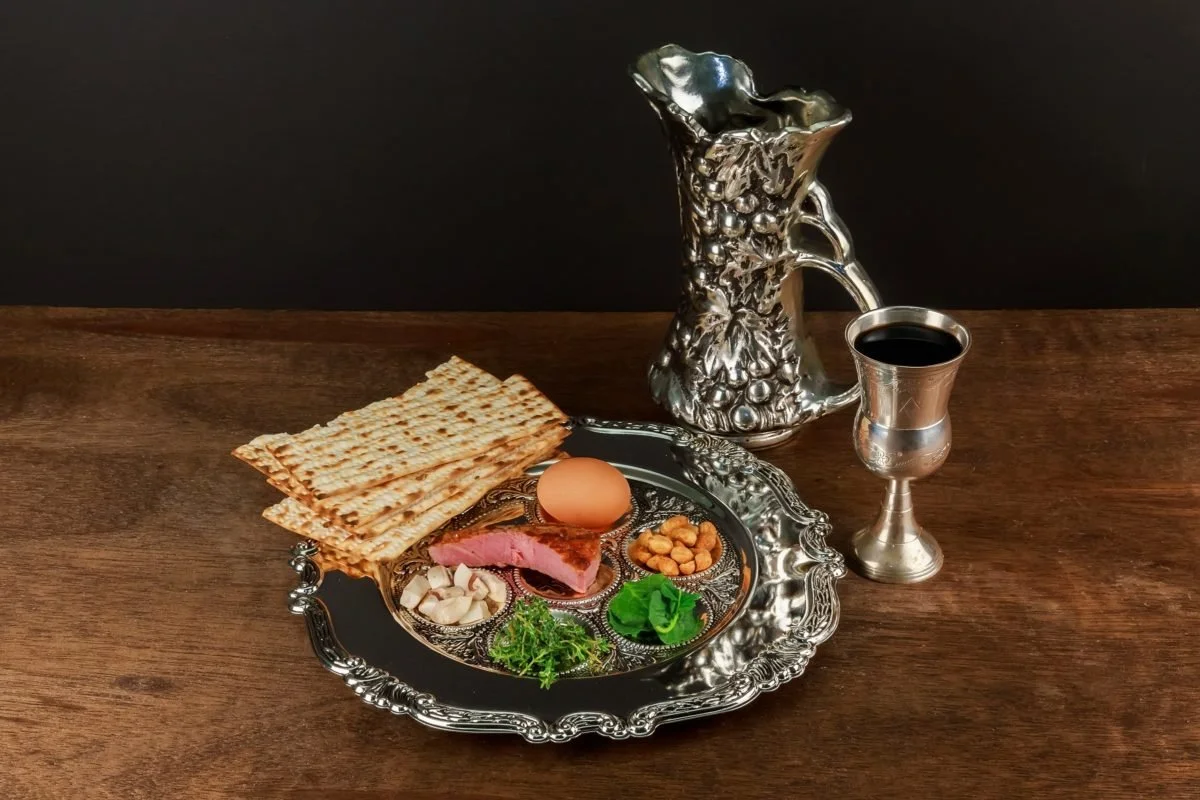
The modern seder meal involves the use of many symbols to help people to remember what God did for his people in the past. Many elements of the Haggadah, a Jewish text that guides the Passover Seder or meal, foreshadow Jesus’ Last Supper, which was a Passover Seder. Jesus likely followed a version of the Haggadah before instituting Communion (Luke 22:19-20) although their Haggadah would have involved eating the flesh of the Passover lamb. In a modern Jewish Passover, since the Temple was destroyed (70 AD), the Passover lamb is no longer sacrificed. Instead of a lamb sacrifice, Jewish families hold a Seder, a ritual meal with symbolic foods. The following are the symbols used
Matzah – Unleavened bread, as in biblical times.
Maror – Bitter herbs (often horseradish) to symbolize slavery.
Charoset – A sweet mixture representing mortar for brick-making.
Zeroa (Shank Bone) – A reminder of the sacrificial lamb.
Karpas (Vegetable, e.g., parsley) – Dipped in saltwater to symbolize tears.
Beitzah (Egg) – A symbol of mourning and new life.
Four Cups of Wine - Represent the four promises of redemption in Exodus 6:6-7.
Families read from the Haggadah (Hebrew: הַגָּדָה, “telling”). It fulfils the Biblical command to teach future generations about God’s deliverance from Egypt (Exodus 13:8) retelling the Exodus story and asking the “Four Questions” about why this night is different.
The modern Haggadah contains
1. Opening Blessings & Kiddush (Sanctification of the Wine). The Seder begins with a blessing over the first cup of wine.
2. The Four Questions (Ma Nishtana). The youngest at the table asks: “Why is this night different from all other nights?” These questions highlight Passover’s unique customs.
3. The Maggid is the telling the Exodus Story from Exodus 12 with midrash (commentary).
It quotes Deuteronomy 26:5-8, summarizing Israel’s slavery and deliverance and explains the symbolic foods (matzah, bitter herbs, etc.).
4. The Four Sons is a parable describing four types of children (Wise, Wicked, Simple, and One Who Does Not Know How to Ask), teaching different ways to engage in Passover discussion.
5. The Ten Plagues. Participants recite each plague while dipping a finger in wine, symbolizing reduced joy.
6. Dayenu (“It Would Have Been Enough”) is a song listing God’s miracles and expressing gratitude.
7. Pesach, Matzah, and Maror in which the significance of the Passover Lamb, Unleavened Bread, and Bitter Herbs are explained.
8. Hallel (Psalms of Praise) when Psalms 113-118 are sung to praise God for redemption and the final Cups of Wine
9. The Seder Meal is then a full meal followed by Afikoman (dessert matzah).
10. Closing Prayer: “Next Year in Jerusalem!” a hope for future redemption and the rebuilding of the Temple.
The whole of the Haggadah was to remind Jewish families of the redemption God won for them. Constant repetition is an excellent way to help people to remember the past and anticipate the future God has in store for his people. Earl Edmunds wrote in his commentary on Luke:
“The passover was a celebration of two events. It commemorated the deliverance from Egypt long ago and anticipated the coming Messianic deliverance in the future. As with the Lord’s supper, it looked back and looked forward.
It is a great experience to witness a Jewish Passover and see the father recount the old Exodus story and answer his children’s questions. In the Haggadah the father then says these words as he breaks the bread:
“This is the bread of affliction which our forefathers ate in the land of Egypt. All who are hungry let them come and eat. All who are needy let them come and celebrate the passover with us. Now we are here. Next year may we be in the land of Israel. Now we are slaves. Next year may we be free.”
Jesus’ interpretation of the Passover meal
It is likely that Jesus would have said words such as these at that Passover feast. But notice how he used these words but applied them to himself:
“Then Jesus declared, “I am the bread of life. Whoever comes to me will never go hungry, and whoever believes in me will never be thirsty.” John 6:35
“Come to me, all you who are weary and burdened, and I will give you rest. Take my yoke upon you and learn from me, for I am gentle and humble in heart, and you will find rest for your souls. For my yoke is easy and my burden is light.” Matthew 11:28-30
Jesus saw himself as the Messiah, God’s Chosen King, who fulfilled all the Old Testament stories and prophecies. During the Haggadah Jesus changed the usual text:
“While they were eating, Jesus took bread, and when he had given thanks, he broke it and gave it to his disciples, saying, “Take it; this is my body.”
His body and blood were still there in that upper room. Thomas Cranmer wrote in his book ‘Controversies’ that this meant the bread and wine could only be symbolic terms. The elements were not actually his body and blood.
Just as the elements in the Haggadah were representative reminders of past events so their use in the future would commemorate the past event of the death of Jesus. Marcus Barth , a Swiss theologian has concluded:
“The eucharist is not a passion play like a mass. Christ’s death is preached and his dying re-enacted.”
This is what the apostle Paul taught:
“For whenever you eat this bread and drink this cup, you proclaim the Lord’s death until he comes.” 1 Corinthians 11:26
Jesus did not mean when breaking the bread,
‘This is my person, my whole person.”
Dr. R.T France, a renowned New Testament scholar, referred to the above quote by Cranberry:
“Cranberry rightly argues that the use of soma is a deliberate reference, not so much to the person of Jesus as to his death.”
He suggests a better translation would be:
“This is my corpse.”
In my surgical practice I have seen many people who have had horrendous motor-bike accidents. They often come into the Accident and Emergency Department as corpses, covered with blood. This is the effect of a violent death and it is always a very difficult scene to come to terms with. This is surely what Jesus means when he separates his corpse from his blood. His violent death is imminent. He is about to become the final sacrificial lamb of the passover. By his blood, his death on our behalf, we are saved.
When David was fleeing from the persecution of King Saul, David became very thirsty. Three of his mighty men broke into the Philistine camp at the risk of their lives to draw water from the well of Bethlehem. When they brought this back to David, he refused to drink the water,
“He poured it on the ground as an offering to the Lord. David said, “Lord, I cannot drink this water. It would be like drinking the blood of the men who risked their lives for me.” This is why David refused to drink the water.” 2 Samuel 23:16-17
We too might hesitate to drink the blood of the Lord Jesus literally but when we remember that is is by his death for us that we are saved, we should be thrilled to be reminded that it is by Christ’s death that our sins can be forgiven and we are very grateful indeed. These are some key verses that stress this apostolic understanding:
1. “But God demonstrates his own love for us in this: While we were still sinners, Christ died for us. Since we have now been justified by his blood, how much more shall we be saved from God’s wrath through him!” Romans 5:8-9
2. “For if, while we were God’s enemies, we were reconciled to him through the death of his Son, how much more, having been reconciled, shall we be saved through his life!” Romans 5:10
3. “For what I received I passed on to you as of first importance: that Christ died for our sins according to the Scriptures.” 1 Corinthians 15:3
4. “He himself bore our sins” in his body on the cross, so that we might die to sins and live for righteousness; “by his wounds you have been healed.” 1 Peter 2:24
5. “For Christ also suffered once for sins, the righteous for the unrighteous, to bring you to God. He was put to death in the body but made alive in the Spirit.” 1 Peter 3:18
The Biblical concept of remembrance
For the Jews the Passover was a day of remembrance:
“This is a day you are to commemorate; for the generations to come you shall celebrate it as a festival to the Lord – a lasting ordinance.” Exodus 12:14
As we have seen, this is the apostles understanding of the Lord’s supper, it is to help people to remember what Jesus has done:
“For whenever you eat this bread and drink this cup, you proclaim the Lord’s death until he comes.” 1 Corinthians 11:26
Some have resented that this reduces the Communion service as ‘mere memorialism’! Would they say that about Guy Fawkes night on November 5th, someone’s birthday party, VE,VJ day or Christmas day ?
Robert Atwell, who later became Bishop of Exeter once asked a congregation:
“What is the most frequent commandment in the Bible?”
Some suggested ‘Love God’, others ‘Love your neighbour’ and other ‘obey God’. To everybody’s surprise it is ‘Remember’. This word comes about 130 times in the New International Version and around 160 times in the English Standard Version. The phrase ‘Do not forget’ comes a further 19 times in the New International Version. These verses are timeless:
“Only be careful, and watch yourselves closely so that you do not forget the things your eyes have seen or let them fade from your heart as long as you live. Teach them to your children and to their children after them.” Deuteronomy 4:9
“. . . be careful that you do not forget the Lord, who brought you out of Egypt, out of the land of slavery.” Deuteronomy 6:12
This is why Jesus said,
“Do this in remembrance of me.” Luke 22:19
Just as the Passover feast was instituted so the Jews would never forget what God did to free his people from slavery in Egypt, so the Christian equivalent, the Lord’s supper is to remind us that our salvation is utterly dependant on what Jesus has done to free us from sin and so allow us to become members of his kingdom.
If we forget who Jesus is and all he has done for us we are in real peril. In Robert Atwell’s address he went on to say:
“Memory is the matrix of identity which is why Alzheimer’s is so terrifying. When memory fragments the soul is lost. We no longer know who others are or who we are. As the wife of a former colleague said to me of her demented husband, ‘The light is still on but there’s no-one at home.”
Authentic Christian ministry is a ministry of remembrance. We remember the completed word of God and the completed work of Christ. Both lie in the past. We live in the light of what God has done for us. In our homes, in our pulpits and in Communion services we look back to hear God’s timeless word for today and to rest in Christ’s once for all sacrifice. These give us access into the Father’s presence both now and in eternity.
What is not needed is a new word from God or a new work of Christ or a re-offering of his once for all sacrifice at an altar by a modern priest. To do such things will take us away from what Jesus did once for all, they will take us away from Scripture, the Word of God, and will demean the preaching of the cross as our only hope of becoming right with God and members of his kingdom. We must say no to new prophets and priests who put themselves as intermediaries between us and our Lord. These can replace the historic Lord Jesus and result in a different spirit and a different gospel. Institutions and individuals take over from the pre-eminence of the Lord Jesus.
So, at the Lord’s supper we are invited to:
Look back in thankfulness to the Lord’s cross.
Look in with repentance and self examination.
Look up to the throne of God and our advocate there with the Father.
Look around at the family of God – the body of Christ.
Look forward to the great marriage supper of the lamb and a reunion with all the saints.”
Jesus wants us to centre our lives on him, to remember all he has done and still does for us, in other words to be committed to living with and for him, our Lord and Saviour.
BVP
February 2025