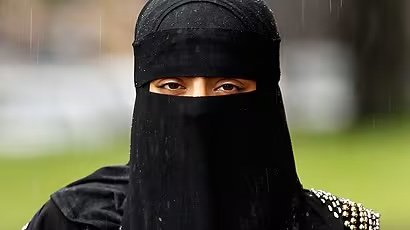
“When I became a Muslim I accepted the teachings, lifestyle, dress and habits of that faith.”
Yet so often the religious rules that are taught have been modified with time - take the dress of women as one example.
On 16 September 2022, 22-year-old Kurdish-Iranian woman Mahsa Amini, died in a hospital in Tehran, Iran, under suspicious circumstances. The Guidance Patrol, the religious morality police of Iran's government, had arrested Amini for allegedly not wearing the hijab in accordance with government standards. The Law Enforcement Command of the Islamic Republic of Iran stated that she had a heart attack at a police station, collapsed, and fell into a coma before being transferred to a hospital.[4][5] However, eyewitnesses, including women who were detained with Amini, reported that she was severely beaten and that she died as a result of police brutality, which was denied by the Iranian authorities. The assertions of police brutality, in addition to leaked medical scans, led some observers to believe Amini had a cerebral hemorrhage or stroke due to head injuries received after her arrest.
Historical and religious texts from the 7th century, including the Quran, Hadith, and pre-Islamic poetry, indicate that covering the torso was not strictly practiced by all men and women in pre-Islamic and early Islamic Arabia, much as some African and South American people still dress.. Clothing was often minimal, and exposure of the chest was a common cultural norm.
In the harsh, arid climate, many rural Bedouin men wore simple loincloths and went bare-chested. While women generally wore longer tunics (qamis), the exposure of the upper chest and cleavage was a common sight in everyday tribal life prior to sweeping social reforms.
According to early Islamic historical accounts found in the Hadith, such as Sahih Bukhari 1665, it was a common pre-Islamic pagan custom for both men and women to circumambulate the Kaaba completely naked. Which Ka’ba is being referred to is interesting as there is no evidence of a major city in Southern Arabia called Mecca existing in the sixth century. It could well refer be referring to the Ka’ba in Petra which had a very cosmopolitan society.
Sahih al-Bukhari 369 and Sahih al-Bukhari 4655 detail how the Prophet Muhammad sent Ali to make an official public announcement abolishing this practice:
“No pagan is allowed to perform Hajj after this year, and no naked person is allowed to perform the Tawaf around the Ka’ba."
The same detail is also explicitly corroborated in Sahih Muslim (Book of Pilgrimage, Hadith 2954), which notes that women specifically would circle the Kaaba naked and cite pre-Islamic Arabian poetry such as the Mu'allaqat by 6th-century poet Imru' al-Qays, which describes women wearing vests with wide openings that exposed their breasts.
When Islamic dress codes were introduced, the requirement to cover the torso and wear a veil often distinguished free women from slave women. Slave women were historically permitted, and sometimes expected, to remain bare-chested.
Key Qur’an Verses
The earliest extinct versions of the Qur’an only appear three generations after Muhammed and this is a problem when saying that these are without doubt the original words dictated by the archangel Gabriel to Muhammed.
The Quranic verses regarding modesty imply that toplessness was widespread and normal. Surah An-Nur (24:31) commands women to "draw their head coverings over their chests," and Surah Al-Ahzab (33:59) instructs them to wrap their outer garments closely. If women were already habitually covering their chests, these specific instructions would not have been necessary. Let us look at these two surahs.
"And tell the believing women to lower their gaze and guard their private parts and not expose their adornment except that which [necessarily] appears thereof and to wrap [a portion of] their head-covers (khumur) over their chests…" Surah 24:31
The Interpretation of the Qur’an for the Hijab (Face Visible)
The majority of early scholars, including the Prophet's companion Abdullah Ibn Abbas, argued that ‘except that which appears thereof’ explicitly refers to the face and the hands. They note the text commands women to cover their chests (juyub), not their faces.
The Interpretation for Niqab (Face Covered)
Other early scholars, like Abdullah Ibn Masud, argued that ‘except that which appears thereof’ only refers to the outer trailing edges of a woman's clothing. They argue that the face is a woman's primary "adornment" and must be hidden.
This verse reads:
“Prophet! Say to your wives, and your daughters, and the believing women, to draw some of their outer clothing over themselves. That is more appropriate for their being recognised, and not hurt. “ Surah 33:59.
The Interpretation for Hijab
Scholars note that the verse specifies the garment is drawn close so women can be ‘recognised’ as honourable, which implies the face is left identifiable.
The Interpretation for Niqab
Prominent early commentators stated that when this verse was revealed, women interpreted ‘drawing cloaks over themselves’ to mean pulling the garment down from the head to cover the entire face, leaving only one eye uncovered to see the road.
There is clearly no definitive ruling from the Qur’an
2. Key Hadiths (Prophetic Traditions)
Scholars supporting the Niqab (face veil) lean heavily on narratives detailing how the immediate family and companions of the Prophet behaved. The difficulty about using these Hadith as authoritative is that the earliest copies available appear may hundreds of years after Muhammed died.
The Reaction to the Veil Verses
A famous narration found in the highest-authenticated collection, Sahih al-Bukhari, outlines how women responded to the revelation of Surah An-Nur:
Narrated Aisha (wife of the Prophet): “May Allah have mercy on the early emigrant women. When Allah revealed the words: '...and to draw their veils over their chests,' they tore their thick outer garments and covered their faces with them.”
The Practice During Travel
Another narrative from Aisha describes her behaviour while on a journey with the Prophet:
“Convalescents and riders used to pass by us when we were with the Messenger of Allah. When they came near us, we would let down our outer garments from our heads over our faces, and when they had passed on, we would uncover our faces.”
The Rule of Pilgrimage (Ihram)
A key Hadith used by both sides of the debate involves the rules of the Islamic pilgrimage:
The Prophet said: "A woman in the state of Ihram (pilgrimage) should not wear a Niqab (face veil), nor should she wear gloves."
Hijab Advocates argue this proves the face is not a private part (awrah) that must always be hidden, as Allah would not command women to uncover something inherently forbidden.
Global centres of Sunni Islamic learning, such as Al-Azhar University in Egypt and the Zaytuna Institutes in the West, teach that the face and hands do not need to be covered. They actively support the Hijab but view the Niqab as a cultural custom rather than a religious mandate.
The Muslim Brotherhood and Associated Movements:
This political Islamist movement (and its offshoots across the Middle East, North Africa, and Turkey) popularised the modern Hijab as a symbol of Islamic identity and anti-colonialism. They generally do not enforce or heavily push for the Niqab.
Mainstream Shia Islam:
Shia religious authorities (such as those in Iraq and Lebanon) view the Hijab as an absolute requirement. They generally rule that covering the face is not obligatory, though some traditional sub-groups or families choose to wear a Chador (a full-body cloak that can be pulled tight over the lower face).
The Iranian Government:
Iran follows a Shia Islamist governing framework. It legally mandates the Hijab for all women in public, but the government does not require the Niqab.
Niqab Advocates
counter-argue that this prohibition proves the Niqab was so normal and widespread among Muslim women that a specific exemption had to be carved out for the pilgrimage ritual.
Salafism / Wahhabism:
This reform movement seeks to emulate the practices of the earliest generations of Muslims. They argue that the Niqab is either strictly obligatory (wajib) or highly recommended to protect societal morality. It is heavily practiced in Saudi Arabia and the Gulf States.
The Taliban:
Rooted in a strict, tribal interpretation of Deobandi Islam combined with Pashtun cultural codes (Pashtunwali). They legally enforce the full body and face covering, often via the all-enveloping burqa or strict niqabs.
There can be little doubt that dress codes have been used by politically active religious leaders to control the behaviour of those under their control. The women living in areas controlled by one particular Islamic sect will trend to dress in the same way. It is both a way for the women to be accepted and also a means of control. It is interesting to see how this seemingly minor issue has become the dividing feature of many in modern Iran.