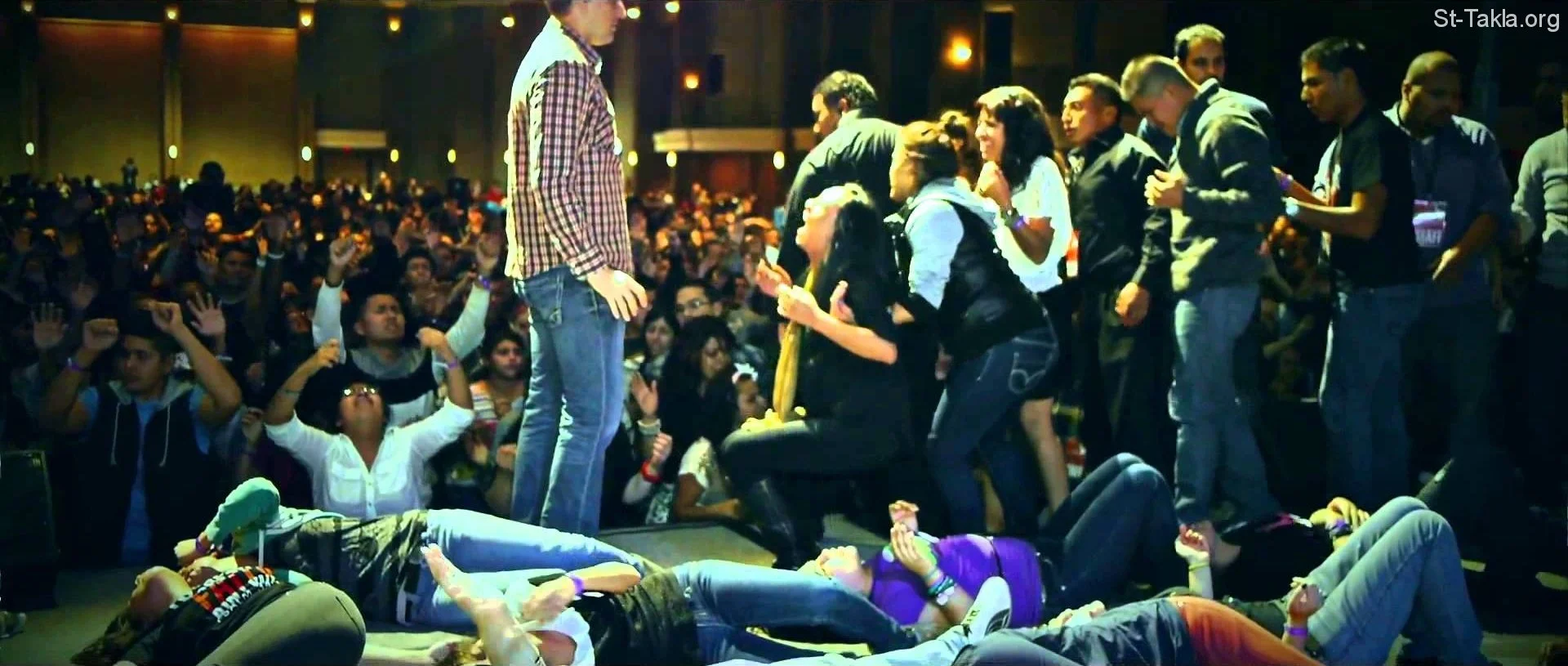
Ecstatic, highly emotional meetings featuring glossolalia (speaking in tongues) are a universal human phenomenon found across many different religions, cultures, and historical eras - they are not exclusive to Christian Charismatics. While the modern Charismatic and Pentecostal movements have heavily documented and popularised this practice over the last century, cross-cultural studies show that the underlying behaviour is a cross-cultural feature of altered states of consciousness. People want to experience the presence of God. This can lead to very dangerous teaching.
Some years ago I met a new patient in her thirties who had developed breast cancer. When we were discussing possible treatments I asked her if she had a faith that helped her at a time like this or wasn’t sure about these things. She explained that in her teens she had been very troubled and had been involved with drugs and other unhelpful activities. A friend took her along to her church which had long services with much singing and long times of ecstatic, so-called, speaking in tongues. One day she asked one of the church elders how she could know for sure if she was saved. He replied,
“Let me hear you pray in tongues.”
She had learned how to do this from others so she was able to oblige.
“You are all right then. Speaking in tongues is a gift of the Spirit so you must be saved.”
Soon after this she fell out with some in the church and never went again. What a joy it was to explain to her what Jesus and his apostles taught and she did then come to believe in Jesus and became one of his servants. I suspect there are still many who are unsettled by extreme practises of some churches, such as ecstatic worship and strange ways of praying using meaningless sounds that do not seem to be within the emphases of Jesus or his apostles.
Linguists and anthropologists have documented glossolalia and ecstatic worship in a vast array of non-Christian settings.
Historical & Ancient Religions
Long before the New Testament was written, ecstatic speech and unintelligible utterances were standard components of ancient Greek religion. The Delphic Oracle (the Pythia) and the highly emotional, frenzied nocturnal gatherings of the Cult of Dionysus featured practitioners entering trances and speaking in unlearned tongues.
Records from ancient Egypt, Assyria, and Canaan describe prophets and mystics entering states of intense religious ecstasy where they uttered divine revelations in incomprehensible phrases.
In Arctic, Siberian, and North American indigenous traditions, shamans regularly enter trances accompanied by rhythmic drumming and chanting. During these intense emotional states, they express what is traditionally interpreted as the ‘language of spirits’ to heal people or prophesy.
Syncretic and traditional faiths such as Haitian Vodou, Brazilian Candomblé, and the Shango cults of Trinidad and West Africa centre around ritual meetings where drumming, dancing, and high emotion induce altered states. Adherents, experiencing spirit possession frequently speak in unintelligible or sacred non-native tongues.
Major World Religions
Islam (Sufism):
Certain esoteric or mystical branches of Islam, such as some Sufi orders, engage in dhikr (devotional acts of remembrance) that involve intense physical movement, rhythmic breathing, and chanting. In highly charged emotional states, practitioners sometimes lapse into ecstatic, unguided glossalalia.
Buddhism:
In Tibetan Buddhism, specific state oracles (like the Nechung Oracle) enter deep trance states to be possessed by protective deities. During these highly agitated states, they mumble or rapidly chant obscure words that must be interpreted by trained monks.
The Khlysty (Russian: Хлысты, literally ‘whips’) were an underground Christian sect which emerged in Russia in the 17th century. The beliefs and practices of its members included ecstatic rituals, worship of charismatic leaders, and a rejection of the priesthood and holy books. They believed in direct communication with the Holy Spirit and practiced the ritual of 'radenie' (literally, "rejoicing"), which was characterised by dancing, speaking in strange ways, and prophesying. Throughout their history, the Khlysts were pursued by accusations of sexual immorality and faced persecution from other religious groups and from the government. In the 18th century, doctrinal changes led to schisms, and by the 1970s, only a few isolated groups remained. The Russian mystic Grigori Rasputin was associated with the Khlysts although he is not known to have been a member of the sect.
Kundalini and ‘Being Slain in the Spirit’
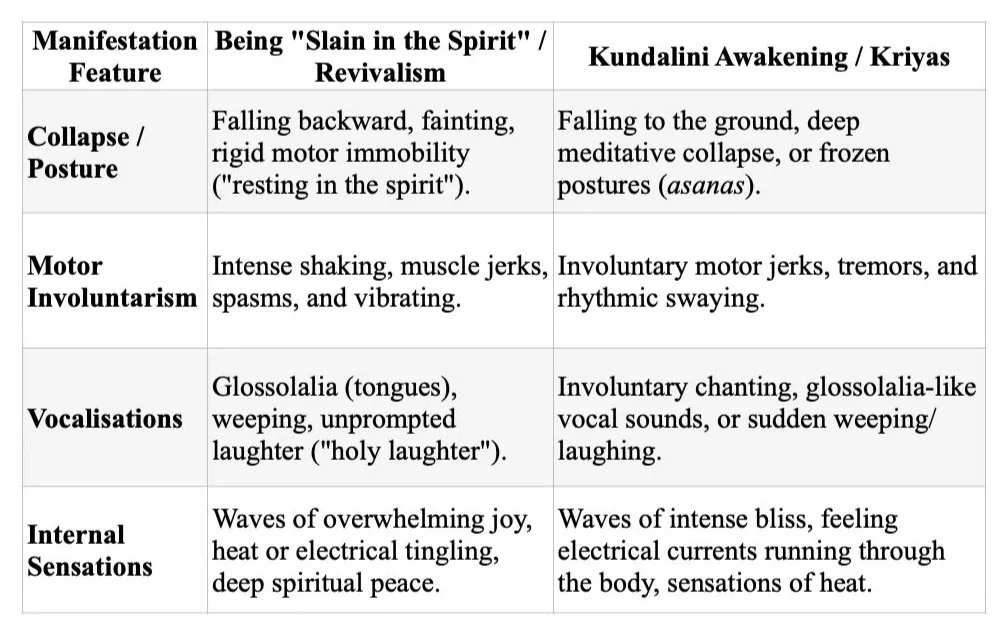
The Kundalini experience is the awakening of a latent, powerful spiritual energy that Hindu yogic traditions believe resides at the base of the human spine. It is very similar to the experience of those who have been ‘slain in the Spirit’ at charismatic meetings. When triggered, whether through intense meditation, breathing exercises, or a sudden spiritual crisis, this energy moves upward and is experienced throughout the whole body.
Physically and emotionally, it feels like a rushing up the back. People often report intense body tremors, flashes of light, spontaneous weeping or ecstatic laughter, and a profound sense of ego-dissolution. When it reaches the top of the head, it results in a state of cosmic consciousness and overwhelming bliss. The phrase ‘uncoiling of the snake’ is the central metaphor used to describe this energetic awakening. In Sanskrit, the word ‘Kundalini’ literally translates to "the coiled one."
From a psychological, physiological, and theological standpoint, a Kundalini awakening and being ‘slain in the spirit’ in some charismatic Christian circles are deeply linked. While they originate in completely different cultural worlds, ancient Eastern Vedic mysticism as opposed to modern Western Charismatic Christianity, the overlap in human behaviour and the way the body reacts is striking. There are many videos available on line that show both phenomena that are well worth watching.
1. The Behavioural Similarities
When a Charismatic believer is ‘slain in the spirit’ (or experiences the related manifestations seen in revivals like the Toronto Blessing), the outward physical behaviours mirror what yogic traditions call ‘kriyas’, involuntary movements triggered by a Kundalini awakening. This table summarises the similarities:
2. The Shared Mechanism inducing these experiences
Both the Kundalini and being ‘slain in the spirit’ seem to happen in similar ways. They rarely occur when a person is on their own but typically require the presence of a powerful religious figure.
In Charismatic churches a preacher lays hands on a believer, touches their forehead, or waves a hand across a crowd to transmit the anointing of the Holy Spirit, causing people to instantly collapse.
In Eastern Mysticism a guru touches a student, often on the forehead, looks at them, or uses a mantra to directly transmit spiritual energy, and this frequently triggers an immediate shaking, bliss, or fainting.
Neuroscience and psychology look past the religious terminology to identify a shared psycho-physiological mechanism. Both experiences are offered as a form of profound spiritual cleansing or catharthis. Strong or repressed emotions are experienced which often lead to a sense of relief or feeling of cleansing. When a person enters a state of deep hyper-suggestibility, fuelled by intense expectation, repetitive rhythmic music, and collective group dynamics, the nervous system reaches a point of sensory overload. To cope, the brain triggers a massive autonomic discharge. The sudden collapse (‘slain’) or intense shaking (‘kriyas’) is effectively a neurological reset switch. The prefrontal cortex temporarily steps aside, releasing deep emotional blockages, which brings immense psychological relief and overwhelming waves of endorphin-driven bliss.
The Kundalini experience is not viewed as an external deity, but rather a latent, spiritual life-force, portrayed as a snake, that is coiled at the base of every human's spine. When awakened, it moves upward through the energy centres (chakras) to dissolve past karma and bring self-realisation or universal consciousness.
Charismatics have maintained that being ‘slain in the spirit’ is an encounter with the literal, external Holy Spirit of God. It is meant to break personal spiritual strongholds, heal physical or emotional trauma, and deepens their relationship with Jesus Christ.
So often this experience has a limited duration and too often people return in future weeks for further treatment. A true Christian experience is life-changing for ever.
Does the Bible help us decide how to react to such phenomena?
The Bible addresses spiritual encounters rationally and gives us several core principles:
Test the Spirits
The Bible warns that not all spiritual experiences come from God. Believers are told not to be naive about spiritual matters but to carefully assess what we are being told. The test is always ‘Is this what Jesus and his apostles taught us?’
“. . . test the spirits to see whether they are from God." 1 John 4:1
Paul emphasises that the teaching given by the apostles is the way to test any doctrine. At the end of this paragraph he confirms this:
“We are from God, and whoever knows God listens to us; but whoever is not from God does not listen to us. This is how we recognise the Spirit of truth and the spirit of falsehood.” 1 John 4:6
Self-Control vs. Loss of Control
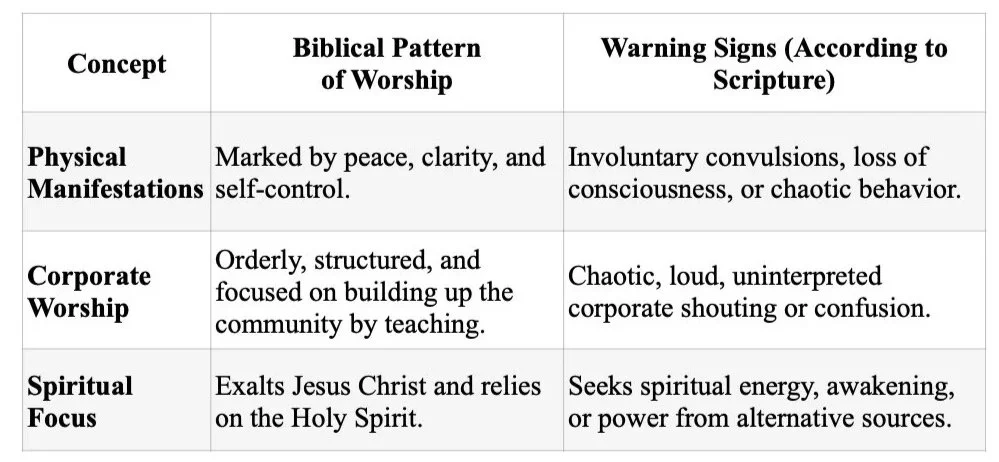
A fruit of the Holy Spirit is self-control (Galatians 5:22-23). Biblical descriptions of the Holy Spirit generally involve peace and soundness of mind:
“For the Spirit God gave us does not make us timid, but gives us power, love and self-discipline.” 2 Timothy 1:7
Such a thoughtful, loving disciplined life contrasts with experiences where a person completely loses control of their body or mind. During charismatic meetings, as the tempo increases, a leader may say something like, ’I can feel the spirit moving amongst us.” By this he usually means that people are becoming more emotional, there is a palpable excitement and expectancy building up. However in Scripture the fruit of the Spirit’s presence is very different:
“ But the fruit of the Spirit is love, joy, peace, forbearance, kindness, goodness, faithfulness, gentleness and self-control. Against such things there is no law. Those who belong to Christ Jesus have crucified the flesh with its passions and desires.” Galatians 5:22-24
When we follow Christ, self-control is always a feature, yet this will be associated with a deep joy, peace, kindness and gentleness.
The Source of Power is God, not experiences
Scripture strictly forbids seeking spiritual power or enlightenment through altered states of consciousness, pagan rituals, or esoteric practices. All religions throughout the world have always had groups who love the supernatural ecstatic experiences.
Some Christians have always tried to impress others with their spiritual status and powers, but the apostles warn against being fooled:
“Do not let anyone who delights in false humility and the worship of angels disqualify you. Such a person also goes into great detail about what they have seen; they are puffed up with idle notions by their unspiritual mind.” Colossians 2:18
Church services should always be conducted with visitors in mind. If the Christians behave weirdly they will not be impressed with what we have to say:
“ So if the whole church comes together and everyone speaks in tongues, and inquirers or unbelievers come in, will they not say that you are out of your mind?” 1 Corinthians 14:23
Chaotic loss of self-control, mimicking the wild frenzied states seen in the prophets of Baal is not what God wants; contrast those false prophets behaviour with the dignified assured actions of Elijah in 1 Kings 18:26-29.
The Bible has much to say about prayer and meditation but Scriptural prayers are meaningful and expressed in meaningful words. Christian meditation differs fundamentally from the ecstatic, mind-emptying techniques found in some ancient mystery religions and some modern esoteric movements. Scripture praises meditation that is content-filled, focusing the mind on what God teaches in Scripture:
“. . . but whose delight is in the law of the Lord, and who meditates on his law day and night.” Psalm 1:2
The Bible is critical of any spirituality that seeks an out-of-body ‘union with God’. That completely blurs the distinction between the Creator and the creation, or that bypasses the centrality of faith and the resulting obedience to God’s will. Living through an obedient faith is very different to the religious lives of heathens:
“Let no one be found among you who . . . practices divination or sorcery, interprets omens, engages in witchcraft, or casts spells, or who is a medium or spiritist or who consults the dead. Anyone who does these things is detestable to the Lord; because of these same detestable practices the Lord your God will drive out those nations before you.” Deuteronomy 18:10-12
Biblical Tongues contrasted with Ecstatic Tongues
The gift of ‘languages’ or ‘tongues’ in the book of Acts was clearly a supernatural phenomenon where all Christians were able to explain the message about Jesus to foreigners in Jerusalem. They recognised that the language spoken was a real human language that was even expressed in the same dialect of the hearers. Whenever this miraculous sign occurs in Acts it always has this meaning, the gospel was explained in the language of the listeners. When Paul was at Ephesus he saw that Gentiles were able to express the gospel in other languages It would therefore be very surprising if the meaning of ‘languages’ in the Paul’s letter to the Corinthians was any different.
In his letter, 1 Corinthians, Paul is critical of the way their meetings were being run. It would appear that people were speaking in different languages at the same time and people could not understand what was being said. This would not be surprising as Corinth was a major maritime city with sailors and travellers coming from all around the known world. Paul insists that Christian meetings should be orderly so that all people can learn. He emphasises that the teaching gifts of apostles, prophets and teachers must come first, but adds the word ‘then’ before mentioning further gifts. He puts tongues at the end of the list!
“And God has placed in the church first of all apostles, second prophets, third teachers, then miracles, then gifts of healing, of helping, of guidance, and of different kinds of tongues.” 1 Corinthians 12:28
Helping, guiding and languages are normal gifts today that help a church in a multi-national environment and probably were then. 1 Corinthians 13 is a purple passage that is often read at marriage services. Few realise that it is actually a criticism of the Corinthian church because they have desired to have supernatural gifts such as ‘the gift of languages’ instead of the real mark of the Spirit, love.
Later he urges those who have the ‘gift of languages’ to desire the more important gifts such as prophecy, the teaching of God’s message to others.
Paul establishes strict rules to prevent chaos in the church meetings saying:
“For God is not a God of disorder but of peace" 1 Corinthians 14:33
No more than two or three people should speak in other languages in a single meeting, and they must take turns:
“If anyone speaks in a tongue, two, or at the most three, should speak, one at a time, and someone must interpret. If there is no interpreter, the speaker should keep quiet in the church and speak to himself and to God.” 1 Corinthians 14:27-28
Note that there is no special gift of ‘interpretation’. Anyone who can speak a language should be able to translate. Note also that the languages used were ones that were capable of being translated for the benefit of the listeners.. Others can then assess and check what is said in the name of God. If there is no interpreter present, the speaker must remain silent in the church and speak only to themselves and God. Note that the whole emphasis is not having ecstatic experiences but to learn what God has to say to his people. The primary goal of any public spiritual manifestation must be to build up and encourage the church body, not to create an individual spectacle:
“What then shall we say, brothers and sisters? When you come together, each of you has a hymn, or a word of instruction, a revelation, a tongue or an interpretation. Everything must be done so that the church may be built up.” 1 Corinthians 14:26
How can "meaningless noises" be translated?
If ‘tongues’ in Corinth were ecstatic or heavenly utterances rather than structured human vocabulary, the concept of ‘translation’ becomes a difficulty.
The Greek word used for interpretation is hermeneia (interpretation/explanation). In this view, the process works through supernatural insight rather than linguistic decoding. However the gist of what God is saying through the tongue speaker should be similar to the one the interpreter gives.
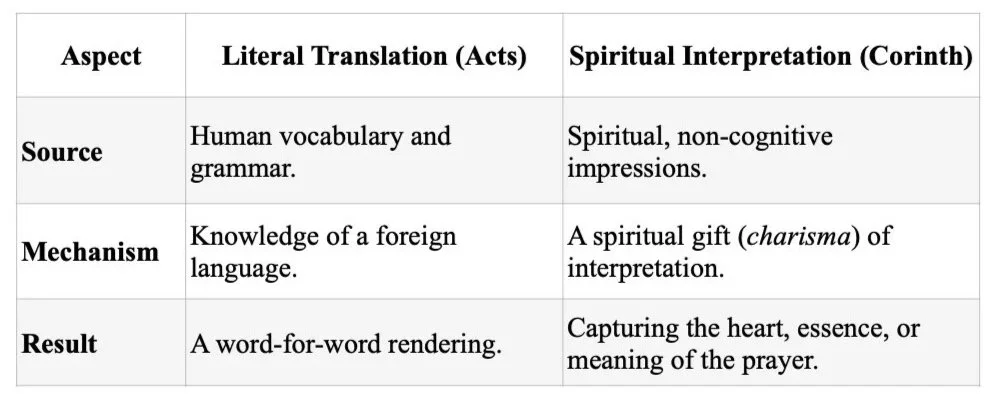
In essence, proponents of this view argue that the Holy Spirit provides the interpreter with the meaning of the utterance, allowing them to communicate the essence of the message to the congregation, even if the original speech lacked earthly grammar.
Others’ think that Corinthian tongues were called ‘meaningless’ or ‘barbarian:
“If then I do not grasp the meaning of what someone is saying, I am a foreigner to the speaker, and the speaker is a foreigner to me.” 1 Corinthians 14:11
The likely explanation of this passage when taken with the rest of Scripture, is that those people speaking in the church of Corinth were foreigners and there was no-one who knew their language.
Other ancient evidence about ‘tongues’
Just north of Corinth was Delphi, famous for the Pythia, the priestess who muttered incoherent, ecstatic utterances while in a trance, which priests then ‘interpreted’ into poetic Greek. Cults like those of Dionysus and Cybele also practiced ‘enthousiasmos’ (being filled with a deity), resulting in frenzied, non-cognitive shouting. Some scholars like Gregory Lockwood have suggested that Corinthian believers were dragging their old pagan habits into the church. In this view, the ‘meaningless noises’ Paul critiques weren't actually a gift from the Holy Spirit at all, but a chaotic counterfeit mimicking pagan trances. Paul's strict instructions to silence uninterpreted tongues may have been a gentle way of shutting down pagan-style hysteria without completely quenching the genuine spiritual gifts.
Irenaeus (c. 180 AD) wrote in his book ‘Against Heresies’ about some believers who "speak through the Spirit in all kinds of languages”. John Chrysostom (c. 347–407 AD) writing from Antioch and Constantinople began his homilies on 1 Corinthians 12 by stating:
""This whole place is very obscure: but the obscurity is produced by our ignorance of the facts referred to and by their cessation, being such as then used to occur but now no longer take place. And why do they not happen now? Why look now, the cause too of the obscurity hath produced us again another question: namely, why did they then happen, and now do so no more?"
By the 4th century, supernatural phenomenon had largely died out in the mainstream church. Augustine addressed the question why they had ceased:
“In the earliest days, ‘the Holy Spirit fell on those who believed, and they spoke in languages they had never learned, as the Spirit gave them the words’ (Acts 2:4). Those were signs suited to that moment. The Spirit needed to be shown at work in every language, as a sign that the gospel of God would spread through every language across the whole earth. That happened as a sign, and then it passed away.
Today, when we lay hands on people so that they may receive the Holy Spirit, do we expect them to speak in tongues? When we laid hands on these infants, did any of you wait to see whether they would speak in tongues? And when you saw that they didn't, was any of you so misguided as to say, ‘These children haven't received the Holy Spirit, because if they had, they would speak in tongues like people did back then’?
So if the presence of the Holy Spirit is no longer shown through miracles like that, how is it shown? How can someone know they have received the Holy Spirit? Let them look into their own heart. If they love their brother or sister, God's Spirit lives in them. . . . Examine your heart. If love for your fellow believers is there, you can be at peace. There can be no love without the Spirit of God, since Paul declares, ‘God's love has been poured out into our hearts through the Holy Spirit, who has been given to us.’” Augustine's homilies on 1 John (Tractate 6)
What Science and Linguistics have Revealed
Linguistic studies, notably by anthropologist William J. Samarin, have analysed recordings of both Charismatic Christians and non-Christian tribal practitioners. From a structural standpoint, the glossolalia produced across different cultures is virtually indistinguishable. It universally consists of a stream of speech-like syllables patterned with rhythm and intonation, but lacking real grammatical structure.
Furthermore, neurological research using brain scans indicates that during these experiences, activity decreases in the frontal lobes, the area of the brain responsible for wilful control and language filtering. This suggests that highly emotional, communal spaces across any religion can trigger a biological ‘switch’ that allows the brain to generate fluent, uninhibited unintelligible speech, which the specific cultures then interpret through its own theological lens.
Neuro-imaging and psychological research provide a fascinating look at what happens inside the brain during ecstatic religious experiences and glossolalia. The scientific data highlights how the brain shifts states when a person transitions from ordinary conscious speech to an ecstatic trance.
The Neuro-imaging Breakthrough
The definitive functional neuro-imaging study on glossolalia was led by neuroscientist Dr. Andrew Newbergat the University of Pennsylvania School of Medicine used SPECT scans (Single Photon Emission Computed Tomography) to measure regional cerebral blood flow, which correlates directly with brain activity, in practitioners while they were speaking in tongues, comparing it to when they were singing ordinary gospel music. The scans revealed a profound and unique frontal lobe shut down. When we speak normally, our frontal lobes (specifically the prefrontal cortex), the area responsible for willpower, planning, and intentional control, light up intensely. During glossolalia, activity in the frontal lobes decreased significantly. This biological shift perfectly matches what practitioners describe: they feel they are no longer in conscious control of the words, but are instead ‘surrendering’ to a higher power or spiritual flow.
Traditional language centres in the brain like Broca’s and Wernicke’s areas do not drive glossolalia. The brain is generating complex sounds and speech-like rhythms without using the standard processes used to construct meaningful language.The thalamus (the brain's sensory gatekeeper) and parts of the parietal lobe showed increased activity. The parietal lobe processes our sense of self and spatial boundaries. While quiet meditative states usually decrease parietal activity (causing a feeling of dissolving into nothingness), the increase during glossolalia corresponds to an active, intense feeling of the self being ‘touched’ by or connecting to an external presence. This is true for all religious ecstatic experiences.
2. Structural Changes from Long-Term Practice
While functional scans show what happens during the event, structural MRI studies published in 2020 looked at the long-term physical impact on the brain in those individuals who have practiced glossolalia for years. They possess increased grey matter volume in the left frontal pole and right middle frontal gyrus. These areas are responsible for goal-oriented behaviour. This suggests that entering an ecstatic trance is actually a highly specialized, learned neuro-cognitive skill. The brain actively reorganises itself to help the practitioner successfully inhibit regular vocabulary so the ecstatic vocalizations can flow without interference.
3. The Psychological Health of Practitioners
Historically, early twentieth-century psychoanalysts wrongly assumed glossolalia was a symptom of hysteria, schizophrenia, or emotional instability. Modern psychological metrics have completely overturned this assumption.
Studies examining evangelical and charismatic populations (including a notable study of nearly 1,000 practitioners in England) have consistently found that people who speak in tongues score higher on measures of emotional stability and show lower rates of depression and neuroticism than non-practitioners within the same demographics. By temporarily allowing the logical, self-monitoring brain to take a back seat, practitioners release pent-up emotional energy and anxiety in a safe, community-sanctioned environment. This triggers a strong release of neurotransmitters associated with peace and euphoria, leaving participants with a lasting sense of psychological well-being.
The science of ‘ecstatic tongues’
Modern linguistic researchers have sought to test the validity of glossolalia (ecstatic speaking in tongues) as a translatable language. Charismatic Christians believe that tongues can be interpreted supernaturally, researchers have put this to the test by creating controlled translation trials. The results of these prominent trials and linguistic analyses reveal a stark contrast between what is actually happening and what some would wish was happening.
The most famous trials involved recorded sessions of a person speaking in what he claimed to be an ecstatic tongue. John Kildahl and Paul Qualben (and later replicated by other researchers) recorded a single, continuous stream of glossolalia from a charismatic believer. They then separately played this audio recording to several different individuals who claimed to have the spiritual gift of interpretation.
The independent translations did not match at all. For the same segment of audio, one interpreter translated it as a profound prayer about the second coming of Christ, while another interpreter translated it as a message about God providing financial blessings to the local church. From a scientific standpoint, there was zero consistency and no structural semantic encoding in the sounds. The so-called ‘translations’ just reflected the theology, emotional state, or immediate environment of the interpreter rather than a decoded vocabulary.
Linguists have also analysed the structural ratio between a segment of glossolalia and its supposed translation. In any real human language, a 10-second spoken phrase might translate to a roughly equivalent 10-second phrase in another language. Researchers, like William J. Samarin from the University of Toronto, analysed live church services where a brief tongue was spoken, followed by a long translation, or vice versa. The mathematical ratio between the length of the ‘tongue’ and the length of the ‘interpretation’ was wildly erratic. In many recorded trials, a speaker would utter a highly repetitive, 4-second string of syllables (e.g., repeating three or four basic sounds), which the interpreter would then "translate" into a long, complex, 45-second theological discourse. This proved that the glossolalia itself did not possess enough phonemic variation or informational density to actually contain the complex sentences offered in the translation.
Anthropologist Felicitas Goodman and linguist William Samarin conducted trials where they recorded and cross-examined glossolalia from completely different parts of the world (the US, Brazil, Africa, and Japan). The trials revealed that glossolalia is restricted by the speaker's native language. A native English speaker speaking in tongues will use English vowels and consonants rearranged into pseudo-words. A native Japanese speaker will use Japanese phonetic structures.
According tp Paul’s teaching to the troubled church in Corinth, modern churches should focus, not on offering people mystical experiences but teaching about what it means for us to worship God all through the week. Translators of those individuals speaking in a foreign language are vital..
Ecstatic speech should never be used in public to show that a person is ‘spiritual’ yet it is noticeable that in Church meetings those making such utterances do so just loud enough for others to know that they are gifted.
In view of these findings some believers view glossolalia primarily as a meaningless emotional release or a way to pray when ‘words fail’. This raises a serious question, why should words ever fail? If we talk to those we love with meaningful words, why should we not follow the example of Jesus and his apostles and speak to our heavenly Father with normal meaningful words? There are many prayers in the bible and these use meaningful words.
This brings us back to ask, ‘How should Christians test what is presented them?’ John’s answer is clear. Did Jesus emphasise this when he spoke to the crowds. Did the apostles emphasise this? Remember what John, representing the apostles said:
“We are from God, and whoever knows God listens to us; but whoever is not from God does not listen to us. This is how we recognise the Spirit of truth and the spirit of falsehood.” 1 John 4:6
BVP
This article has been posted on the website www.bvpalmer.com where there are many other helpful articles and videos.
Christchurch Baldock is a Bible teaching, gospel centred, local church. More details can be found on its website. It meets every Sunday morning at 10.30 am in Knights Templar School, Baldock
Bernard can be contacted at berniepalmer1@sky.com