Bread and Wine, Blood and Water - Why?
Liberal Christianity is a movement that re-interprets Christian teaching by prioritising modern knowledge, science and ethics over what Jesus and his apostles taught. It emphasises the importance of reason and experience over doctrinal authority. This has always been a problem, Paul has warned us:
“See to it that no one takes you captive through hollow and deceptive philosophy, which depends on human tradition and the elemental spiritual forces[a] of this world rather than on Christ.” Colossians 2:8
The Blood of Christ
In the 18th and 19th century people would often be asked by Christians:
“Have you been redeemed by the blood of the lamb?”
Today this way of talking makes little sense to most.
In 1876 Robert Lowry wrote a hymn that sounds strange to many today:
“What can wash away my sins
Nothing but the blood of Jesus
What can make me whole again
Nothing but the blood of Jesus
O Precious is the flow
That makes me white as snow
No other fount I know
Nothing but the blood of Jesus”
For centuries, Christians have been talking and singing about the blood of Jesus. In the Bible so much is written about ‘the blood’. Numerous Old and New Testament passages highlight the essential significance of Christ's death, emphasising themes of atonement, reconciliation, and triumph over death. Some key passages include the following:
Why is blood so important in Christianity? There is no Christianity without the blood. In the New Testament, the death of Jesus is the foundation of the Christian faith. It was the voluntary sacrifice of God’s son where he bore the sins of his people. His death on that cross, for which ‘the blood ‘ is an abbreviation, enables people to become right with God. The Apostle Paul even states that it is a matter "of first importance".
Throughout the Bible becoming one of God’s people, believing, involves both an acceptance of the forgiveness of my sins but also the start of a new life living for God. Both aspects are vital.
John the Baptist called on people to ‘repent’ and ‘believe’. He called people both to turn away from their old way of life (Matthew 3:1-12) as well as believe in ‘the Lamb of God who takes away the sin of the world’ (John 1:29).
The greatest problem we all have is that we have a selfish nature, sinful hearts, and the sin we commit separates us from God. This is the blight of being human. There is hope however because of Jesus and his death on that cross. He came to earth to die so he could take the penalty of our sin. God loves us and wants to save us.
An Englishman had converted to Islam under the influence of his Middle Eastern wife. A Christian spoke to him about Christ, but the Muslim replied that Christianity was not anything like what Jesus originally taught. He was extremely offended by the idea of the blood of Christ making atonement for sin. He said that Paul had invented the idea, and one only needed to be a good person to be accepted by God. So the Christian asked him,
“Do you really think Paul invented the Christian faith?”
“Yes,” he answered, “Before Paul, no one believed that Jesus died for the sins of the world.”
“Interesting, because the whole of the Old Testament is all about how people can be saved and it is always by the death of an animal as a substitute to pay the price for sin. This was a picture looking forward to what God’s Messiah would fulfil when he was sacrificed. Isaiah (written 700 years before Christ’s birth) says, ‘
“He was wounded for our transgressions, He was bruised for our iniquities; the chastisement for our peace was upon Him, and by His stripes we are healed. All we like sheep have gone astray; we have turned every one, to his own way; and the LORD laid on Him the iniquity of us all. . . . For He was cut off from the land of the living; for the transgressions of My people He was stricken. And they made His grave with the wicked–but with the rich at His death . . . “ Isaiah 53:5-9
That’s the Old Testament saying that the Messiah was going to give His life as a sacrifice for sin. Paul didn’t invent the idea of Christ making atonement for sin, God did!”
The man stood speechless.
Similarly in the New Testament the teaching that Jesus died to take responsibility for people’s sins in central:
“ For what I received I passed on to you as of first importance: that Christ died for our sins according to the Scriptures,” 1 Corinthians 15:3:
“But God demonstrates his own love for us in this: While we were still sinners, Christ died for us.” Romans 5:8
“He is the atoning sacrifice for our sins, and not only for ours but also for the sins of the whole world.” 1 John 2:2
This means that the sacrifice of Jesus enables us to be ‘at-one’ with God’
“He himself bore our sins in his body on the cross, so that we might die to sins and live for righteousness; ‘by his wounds you have been healed’.” 1 Peter 2:24
“. . . so Christ was sacrificed once to take away the sins of many; and he will appear a second time, not to bear sin, but to bring salvation to those who are waiting for him” Hebrews 9:28:
“God made him who had no sin to be sin for us, so that in him we might become the righteousness of God.” 2 Corinthians 5:21
It is because Jesus took on himself the penalty of being separated from God instead of us that we can enjoy a close relationship with God Almighty.
The Death of Jesus
When John describes what happened as Jesus died he does so in a very graphic way. Jesus died relatively quickly, he was only on the cross for 6 hours before he died. The longest a person was known to have survived was 9 days. They double checked that he really was dead:
“One of the soldiers pierced Jesus’ side with a spear, bringing a sudden flow of blood and water. The man who saw it has given testimony, and his testimony is true. He knows that he tells the truth, and he testifies so that you also may believe.” John 19:34-35
This vivid description does give us a likely final cause for Jesus death, there must be a cavity, probably the pericardial cavity around the heart that suddenly filled with blood and stopped his heart. This collection of blood would settle with the res cells going to the bottom leaving the plasma at the top. When this cavity was punctured it would drain first the red blood cells and then the clearer plasma. For blood to settle in this way meant Jesus had to have been dead for over 30 minutes. However this is almost certainly not the only reason John emphasised this occurrence - for him it had a spiritual significance.
The blood that came first reminds us that the substitutionary blood of God’s one and only sacrificial lamb is essential. All the animal sacrifices are just pictures of this real event. Water represents the washing of sin from our lives. Christians are now to live new lives.
John refers to this in one of his letters:
“Only the one who believes that Jesus is the Son of God. This is the one who came by water and blood - Jesus Christ. He did not come by water only, but by water and blood. And it is the Spirit who testifies, because the Spirit is the truth. For there are three that testify: the Spirit, the water and the blood; and the three are in agreement. We accept human testimony, but God’s testimony is greater because it is the testimony of God, which he has given about his Son.” 1 John 5:5-10
These verses provide three pieces of evidence for the truth that Jesus is the Son of God. The water most likely refers to Jesus' baptism. At that time he associated himself with the rest of humanity declaring that repentance and rising to live a new life are vital if people are to be part of God’s chosen people. This was when God the Father publicly proclaimed,
“This is my Son, whom I love”. Matthew 3:17
It was at his baptism that the Holy Spirit descended upon Him marking the beginning of His public ministry and His identification with humanity.
The blood is always about the need for a substitute to take our sin and refers to Jesus' crucifixion and sacrificial death. This event showed the reality of His human nature and the atoning power of His shed blood for the forgiveness of sins.
“But if we walk in the light, as he is in the light, we have fellowship with one another, and the blood of Jesus, his Son, purifies us from all sin.” 1 John 1:7
The Holy Spirit constantly bears witness to who Jesus is, both through the Scriptures and internally within the hearts of believers, confirming the truth of Jesus' divine and human nature.
“The Spirit himself testifies with our spirit that we are God’s children.” Romans 8:16
True Christians really believe that Jesus is divine, the Son of God, and that it is only through the shedding of his blood that God can be satisfied. It is Jesus who washes us of sin and motivates us to live new lives for him. It is the Spirit who applies these truths in every Christian.
Passover
When the Israelites were slaves in Egypt they were told to hold the first Passover. A lamb was to live with the family for a week and then on that day had to be killed and its life-blood smeared on the doorpost and lintel of the home. Then when the angel of death passed by the eldest son in that house was safe. Any older son in a family not protected by the blood died.
“The blood will be a sign for you on the houses where you are, and when I see the blood, I will pass over you. No destructive plague will touch you when I strike Egypt.” Exodus 12:13
Can you imagine the horror of families who did not recognise the importance of this life-blood and contrast this with the gratefulness of those who understood the need to obey God. In such ways we are taught that without blood there is no salvation.
“In fact, the law requires that nearly everything be cleansed with blood, and without the shedding of blood there is no forgiveness.” Hebrews 9:22
In this way the blood of the sacrifice has satisfied God’s need for justice. The death of Jesus is the ultimate sacrifice that all the Old Testament sacrifices looked forwards to.
That however was not the end of the story. The family had then to roast the body of this lamb they had loved and eat it before starting out on a new journey to the Promised land. God intended his people to remember that the lamb had given itself for them and apply this to the way they lived. Unfortunately in many families although the ritual may have continued the implications did not.
Day of Atonement
Yom Kippur is the holiest day in Judaism. The formal Hebrew name of the holiday is ‘Yom HaKippurim’, 'day [of] the atonements’. In Leviticus 16 we read that the High Priest, who is a type of or who fulfils the role of Jesus, takes the blood of the sin offering into the Most Holy Place in the tabernacle (and later the temple) and sprinkles it before the Lord seven times. Only the High Priest could enter God’s presence and offer the sacrificial blood for his own sin. He then takes two goats, one of which is sacrificed for the sins of the people and its blood would be sprinkled on the ‘atonement cover’ of the Ark of the Covenant. The blood of the sacrifice taught God’s people that there was to be no other way to get right with God.
This idea is taken up in the book of Hebrews:
“But when Christ came as High Priest . . . He did not enter by means of the blood of goats and calves; but he entered the Most Holy Place once for all by his own blood, thus obtaining eternal redemption.” Hebrews 9:11-12
The High Priest then symbolically places the ‘wickedness and rebellion’ of all the people on the head of the second goat which was then taken far away into the desert. This is a different picture. God wants to imitate sinfulness of his people to be taken far away so they could live new lives, that of a close loving relationship with their Lord. Having been cleansed by the blood they were to:
“Love the LORD your God with all your heart and with all your souls and with all your strength.” Deuteronomy 6:5
In such ways we are taught that without blood there is no salvation.
This emphasis on the necessity for the blood of the sacrificial lamb to cleanse people of their sin is taken up in John’s book of Revelation:
““These are they who have come out of the great tribulation; they have washed their robes and made them white in the blood of the Lamb.” Revelation 7:14
Only Jesus is able to save us because, as the only God/man, he alone could pay the price for our sin and so enable us to be right with God.
Other Old Testament links
The book of Leviticus, particularly following the detailed instructions for the atoning sacrifices in the first half of the book, contains extensive teaching on living a different, holy life as a consequence of God's provision for atonement. The link between sacrifice/atonement and the call to holy, obedient living is a pervasive theme throughout the Old Testament, particularly in the surrounding books of the Pentateuch (Exodus, Numbers, Deuteronomy) and echoed by the Prophets.
Relying on the sacrifice, without there also being a change of heart and therefore behaviour, does not satisfy God.
“The multitude of your sacrifices - what are they to me?” says the Lord. “I have more than enough of burnt offerings, of rams and the fat of fattened animals; I have no pleasure in the blood of bulls and lambs and goats. When you come to appear before me, who has asked this of you, this trampling of my courts?
Stop bringing meaningless offerings! Your incense is detestable to me. New Moons, Sabbaths and convocations - I cannot bear your worthless assemblies. Your New Moon feasts and your appointed festivals I hate with all my being. They have become a burden to me; I am weary of bearing them. When you spread out your hands in prayer, I hide my eyes from you; even when you offer many prayers, I am not listening. Your hands are full of blood!
Wash and make yourselves clean. Take your evil deeds out of my sight; stop doing wrong. Learn to do right; seek justice. Defend the oppressed. Take up the cause of the fatherless; plead the case of the widow.” Isaiah 1:11-17
David reflects this understanding, stating:
“For You do not desire sacrifice, or I would give it; You do not delight in burnt offering. The sacrifices of God are a broken spirit, a broken and a contrite heart.” Psalm 51:16-17
We need both the atonement for our sins, which we cannot do ourselves, and a new life which requires a new power.
John the Baptists’ Teaching
John the Baptist’s prime role was to prepare people for the coming of Jesus. He said of him,
“Look, the Lamb of God who takes away the sin of the world.” John 1:29
Does John just mean that Jesus will be the atoning sacrifice, just as the blood of the sacrificial lamb symbolically paid the price for peoples’ sin, or did he also mean that the death of Jesus would also change the hearts of people so they do not want sin and so offend God?
Jesus’Teaching
It is because of the death of Jesus we can all feel secure if we are devoted to living with and for him. There are some who have a warped sense of assurance. They feel that because they are in a recognised denomination and are committed to the church that they must be safe. That is not true. Even popular, gifted, ordained church leaders may not be right with God. Jesus himself warned:
“Not everyone who says to me, ‘Lord, Lord,’ will enter the kingdom of heaven, but only the one who does the will of my Father who is in heaven. Many will say to me on that day, ‘Lord, Lord, did we not prophesy in your name and in your name drive out demons and in your name perform many miracles?’ Then I will tell them plainly, ‘I never knew you. Away from me, you evildoers!’” Matthew 7:21-23
The only way to God is through an utter reliance on the death or blood of Christ.
When the Sanhedrin member, Nicodemus, visited Jesus with his questions, Jesus interrupted him and said,
“You must be born again.” John 3:3
He didn’t understand. He thought that as he had been regularly involved in the temple sacrifices his sin had been forgiven. Jesus rejects this view and says:
“Jesus answered, “Very truly I tell you, no one can enter the kingdom of God unless they are born of water and the Spirit. Flesh gives birth to flesh, but the Spirit gives birth to spirit.” John 3:5-6
By referring back to what the Prophet Ezekiel said, Jesus is explaining his use of idiom. This Old Testament passage was one that Nicodemus, as a teacher of Israel, would have known well. Jesus is emphasising both aspects of the gospel, forgiveness and empowerment to live a new life, that he alone can give. He will bring a people together, will wash them of their sins and then put a new heart, a new spirit into them: Ezekiel foresaw what the coming of Jesus would result in.
“I will gather you from all the countries and bring you back into your own land. I will sprinkle clean water on you, and you will be clean; I will cleanse you from all your impurities and from all your idols. I will give you a new heart and put a new spirit in you; I will remove from you your heart of stone and give you a heart of flesh. And I will put my Spirit in you and move you to follow my decrees and be careful to keep my laws.” Ezekiel 36:24-27
Ezekiel was written during the captivity in Babylon but he uses the future tense. This prophecy was fulfilled by Jesus.
John
It is highly significant that John does not mention the institution of the communion service - his emphasis is always on the need to believe in Jesus. Perhaps by the time he was writing gospel rituals in the church were taking over from true belief.
However, when addressing the crowds seeking Him after he had fed the five thousand the previous day, Jesus said,
“I am the living bread which came down from heaven. If anyone eats of this bread, he will live forever; and the bread that I shall give is My flesh, which I shall give for the life of the world” John 6:51
Then Jesus said to them,
“Very truly I tell you, unless you eat the flesh of the Son of Man and drink his blood, you have no life in you. Whoever eats my flesh and drinks my blood has eternal life, and I will raise them up at the last day. For my flesh is real food and my blood is real drink. Whoever eats my flesh and drinks my blood remains in me, and I in them. Just as the living Father sent me and I live because of the Father, so the one who feeds on me will live because of me.” John 6:53-57
Here Jesus explains that a Christian has a real dependance on Jesus. The way he explained this was to become the meaning of the communion service he later instituted. What he longs for is to have people living closely to him, dependant on his sacrificial substitutionary death for them, that is on his blood that he gave so our sins could be forgiven. What motivates us to continue living to please God is the memory of how Jesus gave himself, his body, to serve us. How can anyone grasp this truth and not be grateful?
Bishop Phillips Brooks (1835 - 1893) wrote in his book ‘Perennials’:
“No man in this world attains to freedom from any slavery except by entrance into some higher servitude. There is no such thing as an entirely free man conceivable.”
Paul
Paul repeatedly reminds us that we are ‘dead in our sins’ (Ephesians 2:1) and therefore helpless and hopeless. We cannot save ourselves by the way we live, our only hope is for god to give us a new start, to be ‘born again’. This new beginning involves having our sins washed away - that deals with what we have done in the past. Then the gift of the Holy Spirit gives us the power to overcome temptations and sin in the future.
“He saved us, not because of righteous things we had done, but because of his mercy. He saved us through the washing of rebirth and renewal by the Holy Spirit, whom he poured out on us generously through Jesus Christ our Saviour, so that, having been justified by his grace, we might become heirs having the hope of eternal life.” Titus 3:5-7
Everywhere in Scripture we are reminded of the necessity of ‘the blood’ to save us and this concept always looks to the sacrificial death of Jesus.
“But now in Christ Jesus you who once were far away have been brought near by the blood of Christ.” Ephesians 2:13
In his book ‘The Normal Christian Life’ Watchman Nee points out that in Paul’s letter to the Romans the first five chapters deal with the problem of the sins that all people commit and that the blood of Jesus is the only remedy. In chapters 5 to 8 Paul addresses the inherent bias to sin that is in all people and how the body of Christ is the antidote. He not only forgives past sins but delivers us from succumbing to present temptations
“What a wretched man I am! Who will rescue me from this body that is subject to death? Thanks be to God, who delivers me through Jesus Christ our Lord! . . .
Therefore, there is now no condemnation for those who are in Christ Jesus, because through Christ Jesus the law of the Spirit who gives life has set you free from the law of sin and death.” Romans 7:24-8:2
The blood and the spirit give us confidence
God wants us to be confident, even bold, in our approach to our heavenly Father. This confidence, that we can enter God’s presence in prayer at any time, is not because of what we do but is completely dependant on the death of the Lord Jesus on our behalf. The Lord accepts us because of him.
“Therefore, brothers and sisters, since we have confidence to enter the Most Holy Place by the blood of Jesus, by a new and living way opened for us through the curtain, that is, his body, and since we have a great priest over the house of God, let us draw near to God with a sincere heart and with the full assurance that faith brings, having our hearts sprinkled to cleanse us from a guilty conscience and having our bodies washed with pure water.” Hebrew 10:19-22
No church or minister should ever move away from these fundamentals. When people feel secure they are much more likely to serve the living God and be active in his church:
“But if we walk in the light, as he is in the light, we have fellowship with one another, and the blood of Jesus, his Son, purifies us from all sin.” 1 John 1:7
God wants all of us, his people, to be confident about how we stand in his eyes. There are no sins that are unforgivable other than a rejection of the pardon offered through Jesus Christ. This means everybody can have an eternal hope:
“If God is for us, who can be against us? Romans 8:31
“He who did not spare his own Son, but gave him up for us all—how will he not also, along with him, graciously give us all things? Who will bring any charge against those whom God has chosen? It is God who justifies. Who then is the one who condemns? No one. Christ Jesus who died—more than that, who was raised to life—is at the right hand of God and is also interceding for us.” Romans 8:32-34
It is because of the death of Christ, his blood, that God sees us as being righteous.
“For in the gospel the righteousness of God is revealed - a righteousness that is by faith from first to last.” Romans 1:17
We have nothing to add to this gift of righteousness, it has been won for us by the death of Christ, by His blood. What the High Priest did on Yom Kippur, the Day of Atonement, looked forward to the day when the Lord himself would permanently fulfil what they modelled year by year.
“He did not enter by means of the blood of goats and calves; but he entered the Most Holy Place once for all by his own blood, thus obtaining eternal redemption.” Hebrews 9:12
This is the teaching of all the apostles:
“I write this to you so that you will not sin. But if anybody does sin, we have an advocate with the Father—Jesus Christ, the Righteous One. He is the atoning sacrifice for our sins, and not only for ours but also for the sins of the whole world.” 1 John 2:1-2
Martin Luther, the Protestant reformer was frequently tempted to mull over past sins. Satan often recited the list of all his transgressions to cause him to despair but Luther learned to give a defiant response. He would simply acknowledge those sins and then triumphantly add the declaration,
“The blood of Jesus Christ, God's Son, cleanses us from all sin.” 1 John 1:7
A believer's ultimate authority is Christ and what he has done for us, it is not our own track record. When the Devil condemned Luther, he agreed with the diagnosis of sinfulness but reminded Satan that the remedy was not in himself but lay with the Lord Jesus.. Rather than trusting in his own righteousness, Luther chose to:
“. . . fly to Christ, who gave himself for my sins.”
The accusation of sin becomes a weapon against the accuser. For Luther, being called a sinner was not an insult but a reminder of the very reason Christ died. As he famously commented on Galatians 1:4,
“So when you say I am a sinner, you do not terrify me but comfort me immeasurably, for Christ died for sinners.”
What a shame it is that many Christians are still haunted by Satan who keeps reminding them of things they regret having done in the past. The blood of Christ is meant to clear our consciences clean. A troubled conscience is paralysing:
“How much more, then, will the blood of Christ, who through the eternal Spirit offered himself unblemished to God, cleanse our consciences from acts that lead to death, so that we may serve the living God!” Hebrews 9:14
This is why it is a disaster for churches and Christians to move away from focusing on Jesus and his death for us, his blood:
“Who will bring any charge against those whom God has chosen? It is God who justifies. Who then is the one who condemns? No one. Christ Jesus who died - more than that, who was raised to life - is at the right hand of God and is also interceding for us.” Romans 8:33-34
It is only this deep-seated gratefulness to Jesus for dying for us that will motivate us to live lives dedicated to his service:
“Never be lacking in zeal, but keep your spiritual fervour, serving the Lord.” Romans 12:11
Therefore the ‘blood’, which is shorthand for the substitutionary atoning death of Jesus, must ever remain the core of Christian teaching. However we must also never forget what this cost the Lord Jesus. Those of us who are ‘in Christ’ need to remember that our lives are no longer our own but belong to Christ. We are now the redeemed slaves of Christ as well as being sons of God. He has bought us for a price, his own sacrificial death. What better family is there to be in? What a heavenly Father we have? This is what the service of communion is meant to remind us about.
Communiuon
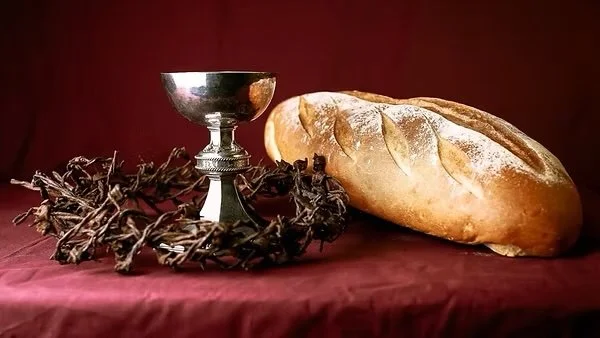
I used to be puzzled why communion services had bread and wine distributed. This was instituted by Jesus based on the Passover festival but why repeat the symbolism that his death is the means of my salvation? Couldn’t just either wine or bread be used? In many Roman Catholic Churches the lay people are only given a wafer, is that not sufficient to get the meaning of the last supper across?
There is nothing magical in how Jesus and his apostles teach about the communion service. There is no ‘transubstantiation’. We are not literally drinking his blood or eating his body. Jesus made this clear:
“And he took bread, and when he had given thanks, he broke it and gave it to them, saying, ‘This is my body, which is given for you. Do this in remembrance of me.” And likewise the cup after they had eaten, saying, “This cup that is poured out for you is the new covenant in my blood.” Luke 22:19-20
Note how Jesus distinguishes the giving of himself for his people and the giving of his blood which initiated the new relationship God was to have with his people from every nation.
When Paul reminds the Corinthian church that were getting several things wrong, he emphasises that the communion service was to help people remember both the death of Jesus for their forgiveness and the giving of himself for our motivation. God longs to motivate Christians to keep proclaiming Jesus and his death until he returns.
“For I received from the Lord what I also passed on to you: The Lord Jesus, on the night he was betrayed, took bread, and when he had given thanks, he broke it and said, “This is my body, which is for you; do this in remembrance of me.” In the same way, after supper he took the cup, saying, “This cup is the new covenant in my blood; do this, whenever you drink it, in remembrance of me.” For whenever you eat this bread and drink this cup, you proclaim the Lord’s death until he comes.” 1 Corinthians 11:23-26
It was Christ’s physical body that rose from the dead. This must be part of what Christians should remember about the body of Jesus. His resurrection is so motivating, it encourages us to live for Christ in the few years that we live here on earth.
It is important to note that the breaking of bread and drinking of the wine was to help Christians remember the two aspects of the gospel. We remember we have been forgiven as we figuratively ‘drink his blood’ and we will determine to be changed as we figuratively remember the incarnation and resurrection of Jesus, the body that he sacrificed to serve us, to save us and to motivate us.
Jesus identified Himself as “the living bread that came down from heaven” (John 6:51). Just as physical bread must be “broken” to be shared with others, so Jesus’ body had to be “broken” on the cross in order that the world could benefit. As physical bread serves to maintain bodily health, so Jesus’ body willingly going to that cross and especially his physical resurrection provides the incentive and spiritual energy for the believer to keep living the new life.
A church leader was discussing the problem of some church members who attend church and take communion but don’t seem to be enthralled with Jesus and seldom if ever talk about him or invite others to hear about him. He said,
“I fear that they like some of the wine but don’t like the bread.”
When asked what he meant he explained:
“They like the doctrine of being forgiven through Christ’s blood but like Nicodemus they have not appreciated the depth of their sin. They have also forgotten the bread, that Christians are now in the body of Christ and so like Him we must give ourselves for the growth of his church and for the salvation of others just as Jesus did. Such people cannot say: “For to me, to live is Christ and to die is gain.” (Philippians 1:21. Neither can they say: “I have been crucified with Christ and I no longer live, but Christ lives in me. The life I now live in the body, I live by faith in the Son of God, who loved me and gave himself for me” (Galatians 2:20).
Do we all understand what the blood and body really mean?
BVP