The Armour of God
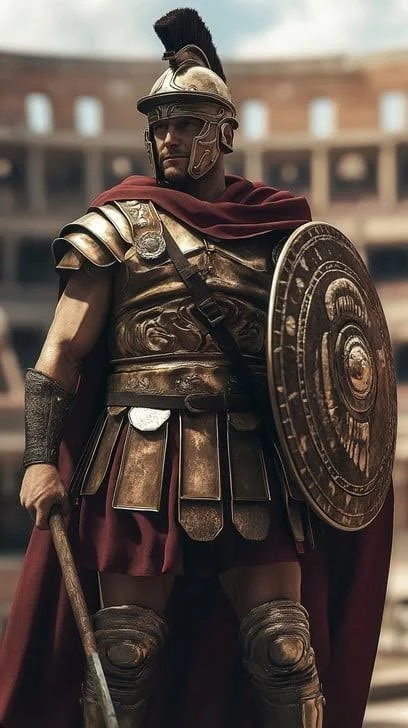
The picture of ‘armour’ is a repeated theme in the Bible.
The Armour of David
In 1 Samuel 17, armour serves as a way to contrast human strategy with divine power. The significance lies in the three distinct ways armour is presented in the narrative.
1. Goliath’s armour is described in meticulous detail, emphasising overwhelming physical power. Goliath wore a bronze helmet and a coat of scale armour weighing approximately 125 pounds. Bronze represented the pinnacle of military technology at the time. It is surely intentional that the Hebrew word for ‘scales’ is the same used for serpent skin in Leviticus, symbolically linking Goliath to the ‘serpent’ destined to have his head, as foretold in Genesis 3:15.
His armour signifies a total reliance on human ingenuity and "the arm of flesh". Its failure—one small stone bypassing it all—demonstrates that worldly defences are ultimately ineffective against God’s purposes.
2. King Saul attempts to dress David in his own royal armour, including a bronze helmet and a coat of mail. This is the armour he himself had worn while cowering from Goliath for 40 days. This represents man’s approach to spiritual battles relying on what the world regards as strength rather than depending on God.
Incidentally putting royal gear on David was a symbolic act of investiture, acknowledging David as the king’s official champion and foreshadowing the eventual transfer of the kingdom from Saul to David.
3.David tries on Saul’s armour but then discards it, choosing instead his shepherd’s staff, a sling, and five smooth stones. David states he cannot walk in the armour because he is ‘not used to them’. He rejects human methods in favour of the tools God used in the past to help him defeat lions and bears.
There is much to learn here. Churches and Christians are so often relying on traditional ways of ‘doing religion’ to overcome the spiritual forces of evil. We are encouraged to use our unique, God-given gifts to bring glory to God, such as friendships, informal discussions and the use of literature and videos to persuade people to follow Christ and not just rely on traditional church. Ways must be found to persuade the masses about the relevance and evidence for Jesus being God’s Messiah for all people. David relied on the protection of his Lord, his true protection was the ‘armour of God’. His victory without armour proves his core message:
“All those gathered here will know that it is not by sword or spear that the Lord saves; for the battle is the Lord’s, and he will give all of you into our hands.”. 1 Samuel 17:47
How we need to relearn this lesson, the battle against spiritual forces will be won when we rely on the Lord and follow his ways and not by our attempts at religious activities.
The Armour of the Messiah
Isaiah foretells the coming of god’s Messiah and what he will achieve in great detail. He tells us, along with other prophets that the Messiah will be a direct descendent of King David, the son of Jesse:
“A shoot will come up from the stump of Jesse; from his roots a Branch will bear fruit.The Spirit of the Lord will rest on him - the Spirit of wisdom and of understanding, the Spirit of counsel and of might the Spirit of the knowledge and fear of the Lord - and he will delight in the fear of the Lord. . . . He will strike the earth with the rod of his mouth; with the breath of his lips he will slay the wicked. Righteousness will be his belt and faithfulness the sash around his waist.” Isaiah 11:1-5
This gracious Messiah of God will be at war with the ungodly. Note his weapon is what comes out of his mouth. The Bible repeatedly tells us that the Word of God is the sword of the Spirit. The basis of his armour will be his belt, which we are later told is the belt of truth and his sash is faithfulness.
Later Isaiah again tells us of the anger God has with the ungodly behaviour of mankind. The only remedy is for God himself to act and come as the Messiah:
“The Lord looked and was displeased that there was no justice.He saw that there was no one, he was appalled that there was no one to intervene; so his own arm achieved salvation for him, and his own righteousness sustained him.
He put on righteousness as his breastplate, and the helmet of salvation on his head; he put on the garments of vengeance and wrapped himself in zeal as in a cloak.
According to what they have done, so will he repay wrath to his enemies . . .” Isaiah 59:15b-20
God’s armour will be his righteousness - who can look on the glory of God and live? The helmet of salvation was the helmet a king wore to rally his troops to himself. He will enact judgment on those opposed to him and bring redemption to his people, it symbolises his divine power to save His people from sin and injustice.
The important thing to note is that this armour is God’s armour.
The Armour of Christians
Paul uses the image of the ‘armour of god’ described by Isaiah and says this is also the christians armour: We are now involved in the battle against evil both in ourselves and in society so we need to use the same armour and weapons that God uses:
“Finally, be strong in the Lord and in his mighty power. Put on the full armour of God, so that you can take your stand against the devil’s schemes. For our struggle is not against flesh and blood, but against the rulers, against the authorities, against the powers of this dark world and against the spiritual forces of evil in the heavenly realms. Therefore put on the full armour of God, so that when the day of evil comes, you may be able to stand your ground, and after you have done everything, to stand.” Ephesians 6:10-13
The picture is that of a Christian under attack. It is our responsibility to act, we must be strong and oppose evil, it is up to us to don the armour of God. This is not passive at all. It is up to us to put all this armour on, failure to do so will leave us wide open to spiritual attack. God has called us to be his people so we can stand and keep standing up for him. We must be prepared as the attacks are sure to come. God’s armour will be his righteousness. His armour is based on truth.
The belt of truth
In Ephesians, the truth of the gospel is the foundation on which a relationship with God can be built. Today some people talk of ‘my truth’. This is an absurdity. What they really mean is their understanding of what is right which may or may not be true. Truth is an absolute idea, only God knows precisely what is really true. We are trying to discover the truth that God already knows.
A survey in the United States conducted by George Barna in 1991 revealed:
“While an estimated 74 percent of Americans strongly agree that ‘there is only one true God, who is holy and perfect, and who created the world and rules it today,’ an estimated 65 percent either strongly agree or somewhat agree with the assertion that "there is no such thing as absolute truth.
What a telling revelation! If more than 75 percent of the followers of Christ say nothing can be known for certain, does this indicate, as it seems, that they are not convinced that Jesus existed, or that He is who He claimed to be, that His Word in authentic, that God created the heavens and earth, or that eternal life awaits the believer? That's what the findings appear to mean. If there is no absolute truth, then by definition nothing can be said to be absolutely true.”
Some truths have to be revealed to us.
“And you also were included in Christ when you heard the message of truth, the gospel of your salvation. When you believed, you were marked in him with a seal, the promised Holy Spirit.” Ephesians 1:13
Here the "word of truth" is synonymous with the Gospel about Jesus, who he is and what he came to do for us. Belief in this truth is much more than accepting an idea or doctrine. It means accepting the person of Jesus to be my Lord as well as Saviour for life. The evidence of true belief is that we love Jesus, love his word, love his people, love to share the gospel with others and long to be with Jesus in eternity. It is the Holy Spirit in our lives that produces these characteristics.
Christians need to put on the ‘full armour of God’, if anything is omitted it will inevitably become a weak spot where we will be attacked.
The truth of the gospel is foundational. If Jesus is not the incarnation of god, if he did not fulfil the 330 or so messianic prophesies in the Old Testament. If he did not do extraordinary miracles, if he wasn’t crucified and if he did not rise from the dead and ascend into heaven then this news is not true. Paul himself wrote:
“. . . if Christ has not been raised, our preaching is useless and so is your faith. More than that, we are then found to be false witnesses about God, for we have testified about God that he raised Christ from the dead. . .And if Christ has not been raised, your faith is futile; you are still in your sins. . . . If only for this life we have hope in Christ, we are of all people most to be pitied.” 1 Corinthians 15:14-19
It is therefore good that there is so much evidence that the Christian faith is true - Jesus is the Messiah who rose form death after being crucified. Paul could write to the Ephesians:
“That, however, is not the way of life you learned when you heard about Christ and were taught in him in accordance with the truth that is in Jesus.” Ephesians 5:20-21
In the New Testament the word ‘truth’ (Greek alétheia) appears 110 times, most frequently in the John’s gospel (25 times) and in the letters of John (20 times). The adverb ‘truly’ (Greek aléthōs or amēn) is also frequently used. ‘Truly, truly’ (double Amen) appears 25 times, exclusively in the Gospel of John. The single "Truly" (Amen) appears over 50 times in the Synoptic Gospels (Matthew, Mark, and Luke) to introduce statements of authority. The adjective ‘true’ (Greek aléthēs or alēthinos) appears from 25 to 30 times in most Greek-based word counts. In the Gospel of John alone, Jesus describes his words as "true" at least 7 times.
The strength of the Christian message is that it is true. This is why sharing the truth of the gospel is the most effective way for people to be convinced. The message resonates with their intellects as well as with their instincts and consciences. So Paul could say:
“Instead, speaking the truth in love, we will grow to become in every respect the mature body of him who is the head, that is, Christ.” Ephesians 4:15
It is knowledge of the truth that will prevent us from being ‘blown here and there by every wind of teaching’ (Ephesians 4:14), we have the rock of truth to stand on.
Augustine wisely observed:
“When regard for truth has been broken down or even slightly weakened, all things will remain doubtful.”
The Breastplate of Righteousness
Temptation is one of Satan’s most effective weapons. He tempted Adama and eve in Eden, he repeatedly tempted the Children of Israel in the desert, he tempted Jesus and he tempts us every day. However Christians have a defence, armour against this:
“God is faithful; he will not let you be tempted beyond what you can bear. But when you are tempted, he will also provide a way out so that you can endure it.” 1 Corinthians 10:13
This armour, that fits on the belt of truth is ‘the breastplate of righteousness’. In the Bible ‘righteousness’ is used in two ways. God alone is righteous and nothing unholy can ever enter his presence. However God has ‘imputed’ his righteousness to those who are committed to following Christ. Jesus bore our sins on that cross and has given us the cloak of his righteousness, the righteousness of his Holy Spirit. It is only because of this imputed righteousness that we can hope to stand in his presence. In this section of Ephesians the word is used in a different way, it means ‘imparted’ righteousness and refers to the new way that Christians live, following the example of their Lord, Jesus Christ. It is this determination to live Godly lives that will defend us against temptations.
This new way of living comes from our being taught about Jesus. Note how learning and being taught about this new way of living is stressed, we are to become like the Lord Jesus:
“That, however, is not the way of life you learned when you heard about Christ and were taught in him in accordance with the truth that is in Jesus.You were taught, with regard to your former way of life, to put off your old self, which is being corrupted by its deceitful desires;to be made new in the attitude of your minds;and to put on the new self, created to be like God in true righteousness and holiness.” Ephesians 4:20-24
The Christian life is not primarily following good ethical principles, people of all religions try to do this, it is accepting the righteousness Jesus alone can clothe us with and then going on to follow his example. Everything centres of Jesus.
Following this summary of what the Christian life should be like Paul gives some examples.
Our speech
It is up to us to stop using lies and to be known as honest people. I love the example of Chief Inspector Foyle in the television series ‘Foyles War’. Although those around him, both the criminals and the authorities use deception and lies, he remains calm and scrupulously honest.
“Therefore each of you must put off falsehood and speak truthfully to your neighbour.” Ephesians 4:25
Our anger
How destructive anger can be, it destroys families, relationships and churches. It is our responsibility to put this behind us.
“‘In your anger do not sin’: do not let the sun go down while you are still angry,and do not give the devil a foothold.” Ephesians 4:26-27
Unrighteousness, persistent anger is devilish yet how many christians allow this to remain in them.
Our theft
The newspapers love to tell of clergymen and those in authority in churches who have succumbed to the temptation of stealing. Even more common is the habit of slandering others in our casual conversations and stealing people’s reputations:
“Anyone who has been stealing must steal no longer.” Ephesians 4:28
We must always remember that there are those who come from ungodly backgrounds where stealing, whether from others or from the taxman is a way of life. It is our responsibility to help such people.
Our speech
Gossip is a major problem in churches. It is so often considered a minor sin, yet the Apostle says:
“Do not let any unwholesome talk come out of your mouths, but only what is helpful for building others up according to their needs, that it may benefit those who listen.” Ephesians 4:29
So often what comes out of our mouths betrays what is really in our hearts, there is hope however if Jesus is in control there.
“And do not grieve the Holy Spirit of God, with whom you were sealed for the day of redemption. Get rid of all bitterness, rage and anger, brawling and slander, along with every form of malice. Be kind and compassionate to one another, forgiving each other, just as in Christ God forgave you.” Ephesians 4:30-32
Notice again that controlling these temptations is is our responsibility. We can only do this when we are living closely with Jesus. As we remember what the Lord Jesus has done for us we will be motivated, forget him and the door to temptation is flung open:
“Follow God’s example, therefore, as dearly loved children and live a life of love, just as Christ loved us and gave himself up for us as a fragrant offering and sacrifice to God.” Ephesians 5:1-2
Do we talk about the Lord Jesus to others, do we really love him? I well remember talking to a patient who was the church h warden of a local village church. At the end of the consultation I asked her how the church was going.
“It is getting difficult. We are getting older and fewer.”
“I am sorry,” I replied, “Tell me, do people in the church talk about the Lord Jesus with others in the village?”
“Good gracious me, No! We don’t even talk about him amongst ourselves.”
All I could think of saying was,
“If that is true, and stays that way, I fear the church must die.”
Our speech does matter.
Our sexual morality
How the papers love to attack God’s churches by delving into the sexual affairs of Christian leaders. Sexual misdemeanours are not just adultery or fornication but include the way we talk and look at people and look at promiscuous films and books. This has obviously always been a problem for churches as Paul goes on to say:
“But among you there must not be even a hint of sexual immorality, or of any kind of impurity, or of greed, because these are improper for God’s holy people.Nor should there be obscenity, foolish talk or coarse joking, which are out of place, but rather thanksgiving.” Ephesians 5:3-4
Although these are the principal ways that Satan will try to seduce us there are countless others. Some Christians try to belittle these ‘foibles’ but when we look at christ we can see what they really are. We are warned never to trivialise sin:
“For of this you can be sure: no immoral, impure or greedy person – such a person is an idolater – has any inheritance in the kingdom of Christ and of God.Let no one deceive you with empty words, for because of such things God’s wrath comes on those who are disobedient.Therefore do not be partners with them.” Ephesians 5:5-7
Our new life has begun
We are reminded that, although we used to live in these dark ways, Christians have put these behind us as we live to honour the Lord Jesus in what we say and how we live. Paul keeps emphasising that this is our responsibility:
“For you were once darkness, but now you are light in the Lord. Live as children of light (for the fruit of the light consists in all goodness, righteousness and truth)and find out what pleases the Lord.Have nothing to do with the fruitless deeds of darkness, but rather expose them.” Ephesians 5:8-11
Christians must not just walk in the light, we are to be the light to others around us. Too many Christians go to sleep in their walk with Jesus and then sleep-walk in the ways of the ungodly. Paul reminds us:
“‘Wake up, sleeper, rise from the dead, and Christ will shine on you’. Be very careful, then, how you live – not as unwise but as wise, making the most of every opportunity, because the days are evil.” Ephesians 5:14-16
All Christians are now the light of the world as we show the Lord Jesus to others. We must not slumber in our responsibilities but we must determine every day to glory in the Lord Jesus, our God and Saviour. No wonder Paul writes:
“Finally, be strong in the Lord and in his mighty power. Put on the full armour of God, so that you can take your stand against the devil’s schemes.” Ephesians 6:10-11
The Lord wants all of us to stand up firmly for him and because we are putting our heads above the parapet to put on the full armour of God, the armour he wore.
Feet fitted with the gospel
How often this is misunderstood. The context is the ‘armour of God’ that protects us from satan’s temptation. Some have suggested this has to do with there not being friction between Christians within a church. Whilst this is true it is surely not what Paul primarily meant. This is the full sentence:
“. . . and with your feet fitted with the readiness that comes from the gospel of peace.” Ephesians 6:15
This passage refers back to the teaching in the Old Testament. Isaiah had written:
“How beautiful on the mountains are the feet of those who bring good news, who proclaim peace, who bring good tidings, who proclaim salvation, who say to Zion, “Your God reigns!” Isaiah 52:7
The whole of the New Testament is about the need for people to learn about the gospel, the good news of how sinful people can be at peace with God. All Christians should be prepared and ready to pass on this message in some way or other. It is by sharing the gospel that we come to know our lord better. Paul wrote elsewhere:
“ . . . that the sharing of your faith may become effective by the acknowledgment of every good thing which is in you in Christ Jesus.” Philemon 6 (NKJV)
As Christians keep on teaching the gospel to others we come to know the mind of christ better. The NIV translates this verse:
“I pray that your partnership with us in the faith may be effective in deepening your understanding of every good thing we share for the sake of Christ. Philemon 6 (NIV)
The question is often asked today,
“Should people in responsible positions, such as doctors, nurses, teachers and leaders in the armed or police forces talk about Jesus when at work?”
Penn and Teller are a famous comic-illusionist act. Penn Jilette is an outspoken atheist. One day a quiet spoken Christian spoke to him about Jesus and salvation. Penn found the man to be impressively intriguing and discussed the question as to whether people should talk about such matters.
“I’ve always said, you know, that I don’t respect people who do not proselytise. I don’t respect them at all. If you believe that there’s a heaven and hell, and people could be going to hell, or not getting eternal life or whatever, and you think that, well, it’s not really worth telling them because it would make it socially awkward . . . How much do you have to hate someone to not proselytise? How much do you have to hate somebody to believe that everlasting life is possible and not tell them? I mean, if I believed, beyond a shadow of a doubt that a truck was coming at you, and you didn’t believe it, and the truck was bearing down on you, there is a certain point where I tackle you. And this is more important than that . . .”
Such clarity from an atheist! Paul similarly understood this far better than most of us today who say we are believers. Paul’s longing was that the Philippian Christians should determine to live with the two emphases of godliness and evangelism. He repeats them as if to make the point clearer.
“Whatever happens, conduct yourselves in a manner worthy of the gospel of Christ. . . . Then, whether I come and see you or only hear about you in my absence, I will know that you stand firm in one spirit, contending as one man for the faith of the gospel without being frightened in any way by those who oppose you.” Philippians 1:27-28
What a wonderful picture. A united church standing together as a well knitted team, boldly proclaiming to those around them that Jesus is relevant and that they need the salvation he brings. In a team sport such as rugby, success depends on every player working hard together with the others in the team – a coherent pack of forwards is hard to oppose. Should such cohesion not be the mark of each local church? This chapter continues to say that such a coherent evangelistic drive is a ‘sign’ to outsiders that the Christian faith is genuine, that judgement is approaching and that they are still not saved.
As we have seen, the word ‘feet’ is often used in the Bible as a synonym for gospel work. These are just some passages on this:
“Look, there on the mountains, the feet of one who brings good news, who proclaims peace!” Nahum 1:15
The prophet Habakkuk was called to share the word of God with the people of Judah just before the Babylonians invaded:
“The Sovereign Lord is my strength; he makes my feet like the feet of a deer, he enables me to tread on the heights.” Habakkuk 3:19
Paul certainly understood ‘feet’ to have this significance as he wrote:
“And how can anyone preach unless they are sent? As it is written: “How beautiful are the feet of those who bring good news!” Romans 10:15
When Jesus washed his disciples feet they recognised how humbly he was acting yet Jesus said to them:
“You do not realise now what I am doing, but later you will understand.” John 13:7
They did understand when they were given the great commission and when the holy Spirit came on them. They had been chosen to share the gospel of Jesus with others. The Lord is especially close to those who accept this commission.
The Shield of Faith
In the Roman army the shield was an essential item of defence. Opposing armies would fire arrows, sometimes with the tip dipped in tar and aflame, into a cohort of Romans. Their immediate defence was to stand closely together, lift their shields over their heads and overlock them so no arrow could penetrate. It is a beautiful picture of God’s army standing together.
“Above all, taking the shield of faith, wherewith ye shall be able to quench all the fiery darts of the wicked.” Ephesians 6:16
The idea is deeply rooted in the Old Testament, which frequently portrays God Himself as a shield for those who trust Him. In the Old Testament, the "shield" is not typically an abstract quality like faith, but rather God Himself. God told Abram,
“I am your shield,” Genesis 15:1
Immediately after this we read of Abram "believing" (having faith) in God.
In the Psalms and Proverbs numerous verses describe God as a shield to those who take refuge in Him, such as:
“You, O Lord, are a shield about me" Psalm 3:3
“The Lord’s word is flawless; he shields all who take refuge in him.” Psalm 18:30.
“He is a shield to those who take refuge in Him”. Proverbs 30:5
Paul's metaphor is similar, faith is called a shield because it is the means by which a believer ‘takes refuge’ in God's protection. In the book of Ephesians the word ‘faith‘ (Greek pistis) is used in two ways. Firstly ‘faith’ is presented as the essential human response to God’s love shown in the coming of Jesus Christ. It describes that decision to accept his claims and follow him for life for it is God alone who can save us, give us a real purpose for life and hope for eternity.
“For it is by grace you have been saved, through faith - and this is not from yourselves, it is the gift of God -not by works, so that no one can boast.” Ephesians 2:8-9
Secondly, faith is also presented as a unified corpus of what we believe. Thus Ephesians 4:5 declares there is "one Lord, one faith, one baptism” Here ‘one faith’ refers to both the subjective trust all believers share in Christ and the objective body of truth (the Gospel) that defines what Christ’s apostles have taught us. Paul prays for the church to reach the ‘unity of the faith and the knowledge of the Son of God as they grow into spiritual maturity.
“. . . until we all reach unity in the faith and in the knowledge of the Son of God and become mature, attaining to the whole measure of the fullness of Christ.” Ephesians 4:13
Paul is saying that it is essential that all who claim God’s protection for eternity, the shield, have both a personal trusting relationship with the Lord Jesus but also follow obediently the teaching he gave to his apostles. The usual way to distinguish which side a soldier was on was through shield designs, different legions having unique painted motifs. How important it is for Christians to be identifiable. When I was young Christians could be identified by an empty cross, signifying the fact that Jesus had risen from death, or a lapel badge such as Scripture Union or Crusaders. How are we identified today?
The helmet of salvation
“Take the helmet of salvation . . .” Ephesians 6:17
The helmet was the last piece of armour to be donned before battle. It was solid and quite heavy but it protected the head, eyes and neck, the control centre of a soldier!
One significance of the helmet is to make it obvious which army a soldier belonged to.
In modern armies, such as in the second world war the helmet is a means of identifying which side a soldier was on. In Roman times although the helmet shape was helpful it could not be relied on as there was considerable overlap between designs. The Romans copied the designs of their enemies helmets although officers could be distinguished by the plumes they wore in their helmets. Soldiers often used simple field signs, such as tying a coloured piece of cloth or a sprig of a specific plant to their helmet or arm. The shield was what primarily identified which side a soldier belonged to.
The Bible makes it clear that all Christians should make it obvious to those around which side they belong to. Like the helmet, our allegiance must clearly identify which side we are on. This is demonstrated by the way we behave and the way we speak about Jesus.
“If you declare with your mouth, “Jesus is Lord,” and believe in your heart that God raised him from the dead, you will be saved. For it is with your heart that you believe and are justified, and it is with your mouth that you profess your faith and are saved.” Romans 10:9-10
Surely this is what Paul means when he repeatedly says:
“ . . . stand . . . stand your ground . . . to stand. Stand firm . . ” Ephesians 6:11,13-14
Paul calls the helmet ‘the helmet of salvation’. Earlier in this letter he has stressed the necessity of salvation. The beginning of chapter 2 describes the natural state of all people, however pleasant we may appear outwardly:
“As for you, you were dead in your transgressions and sins,in which you used to live when you followed the ways of this world and of the ruler of the kingdom of the air, the spirit who is now at work in those who are disobedient.All of us also lived among them at one time, gratifying the cravings of our flesh and following its desires and thoughts. Like the rest, we were by nature deserving of wrath.” Ephesians 2:1-3
A feature of being spiritually dead is that we continue to give in to temptation and are not concerned to be God’s holy people inwardly. However God has saved us and enabled us to become followers of his Son, the Lord Jesus. We owe everything to him:
“But because of his great love for us, God, who is rich in mercy, made us alive with Christ even when we were dead in transgressions - it is by grace you have been saved.And God raised us up with Christ and seated us with him in the heavenly realms in Christ Jesus,in order that in the coming ages he might show the incomparable riches of his grace, expressed in his kindness to us in Christ Jesus. For it is by grace you have been saved, through faith - and this is not from yourselves, it is the gift of God - not by works, so that no one can boast.” Ephesians 2:4-9
This is what salvation means. But it doesn’t stop there, we have been saved by God for a purpose:
“For we are God’s handiwork, created in Christ Jesus to do good works, which God prepared in advance for us to do.” Ephesians 2:10
We were dead but God has saved us and given us eternal life to that we can battle for him. To be effective we must be certain which side we are on. Being uncertain about our being saved is the equivalent of going into battle without protective helmet.
This news of salvation will always be the joy of God’s people. In heaven it will be said:
“Now have come the salvation and the power and the kingdom of our God, and the authority of his Messiah. For the accuser of our brothers and sisters, who accuses them before our God day and night, has been hurled down.
They triumphed over him by the blood of the Lamb and by the word of their testimony;
they did not love their lives so much as to shrink from death.
Therefore rejoice, you heavens and you who dwell in them! But woe to the earth and the sea, because the devil has gone down to you! He is filled with fury, because he knows that his time is short.” Revelation 12:10-12
Our battle is against Satan who knows he will be defeated but for the present the battle rages in our hearts every day. Wearing openly the helmet of our salvation will help us to stand.
Merielle was a patient of mine who had just become a Christian in the last weeks of her life. This story is recounted in the last chapter of my book ‘Cure for Life’. She had advanced cancer and was moved to the local hospice where I visited her. She was still holding onto her Saviour and I wanted to reinforce her sense of security and safety. We looked at Romans chapter 8, which is a great chapter on assurance, which starts:
“Therefore there is now no condemnation for those in Christ Jesus.” Romans 8:1
To make this clearer I wrote her name on a piece of paper and placed it inside the Bible and explained,
“Let this Bible represent the Lord Jesus. You have now committed your life to him. You are therefore utterly secure. When God looks at you, he does not see your sin but the righteousness of Jesus. Furthermore because Jesus has now returned to heaven and is living with his Father and because you are now in him, you are guaranteed to be with him in heaven.”
The Bible keeps reassuring those who are personally committed to following Christ that they are completely safe. This word ‘safe’ has the same origin as the word ‘saved’. Paul confidently wrote,
“The Spirit himself testifies with our spirit that we are God’s children.” Romans 8:16
“But now in Christ Jesus you who once were far away have been brought near by the blood of Christ.” Ephesians 2:13
What a privilege it is to wear our Lord’s helmet.
BVP