Philip and the Importance of Baptism
A missionary in China was asked a question by a local Christian. He had met Baptist, Anglicans and Salvation Army missionaries with their different practices.
“Big wash and little wash I understand, but what is this dry clean?
Baptism, advocated by Jesus is a symbolic act, it is a public declaration of belief and a commitment to follow Jesus' teachings. Children of Christian parents will be taught the Bible’s message and taught how the Lord wants his people to live. In this regard there is very little difference between infant dedication and infant baptism, both groups of parents intend to raise their children in the faith and pray that they we remain true to Christ. Even when adults are baptised they still have to continue in the faith if they are going to be saved.
What a tragedy it is that some baptisms are void of such a commitment to Christ. The promises of the parents and God-parents are insincere. This is why the anabaptists in the 16th century rejected babies being accepted into the church. Calvin in his Institutes argued that the children of Christians are part of God’s covenant
There is surely no greater question than ‘How can I be saved?’, yet how few people ask it. Many try to find salvation by membership of a church or organisation. They say, ‘I’m an Anglican,’ or ‘I’m a Roman Catholic’, or Baptist, Methodist, Mormon, Jehovah’s Witness, Jew or Muslim.
We can even be very involved in a good Bible teaching church and still not be saved. The Bible is clear that religious rites, such as circumcision, baptism, confirmation, ordination or even consecration saves nobody. The Lord reminded the prophet Samuel,
“Man looks at the outward appearance, but the Lord looks at the heart.” 1 Samuel 16:7
Philip’s commitment
After Pentecost the early church hardly stopped in their efforts to share the gospel about how people can be saved. They were flogged and ordered not to speak about Jesus by the civil authorities but nothing could restrain them.
“Day after day, in the temple courts and from house to house, they never stopped teaching and proclaiming the good news that Jesus is the Christ.” Acts 5 v. 42
The apostles found this ‘ministry of the word of God’, the preparation, prayer and teaching so time consuming that they needed others to help them organise the day to day running of the church. So they chose seven people, ‘full of the Holy Spirit’. (Acts 6:3)
The chosen seven were therefore recognised as being men who were ‘living for God’ but were also wise, having the common sense that was needed to organise a church. Stephen and Philip were the first two on this list.
Isn’t this a lovely example of senior people in a church longing to be free for Bible teaching and evangelism, leaving the more junior deacons to do the administration. So often today it is the opposite. Today all too often the Bishops and Moderators choose to do the administration leaving the less experienced and often less trained to do the Bible teaching and evangelism.
Then came the martyrdom of Stephen and the subsequent persecution of the young church in Jerusalem by the Jewish authorities. (Acts 8:1)
The Christians were scattered, ousted from their homes and jobs. The Stalin or Milosevic of those days was a man called Saul! The effect of this persecution must have seemed to be disastrous to the early church leaders. The church structure was destroyed. People could no longer attend the Christian training sessions safely. The organisers were no longer needed as there was no longer a church structure to organise.
But God changed this seeming disaster into something wonderful. It is thrilling to see how He could turn an apparent defeat and make it into a victory! The key was simple, those scattered “preached the word” wherever they went. Jesus meant so much to them.
Philip was in all likelihood one of those church members who were scattered by the persecution. He also ‘preached the word’ wherever he went (Acts 8:4). The next verse says that he went up to Samaria to do this. What does this shorthand phrase ‘preach the word’ really mean? The answer is in verse 12.
“He proclaimed the good news of the Kingdom of God and the name of Jesus Christ.”
In other words he was saying that no-one need remain in the ‘kingdom of Self’ but they can transfer to become God’s people, in God’s Kingdom, by putting themselves under the authority of Jesus.
Something else was interesting about his approach. He obviously taught that a public response to Jesus was necessary. He didn’t leave them feeling comfortable by just telling them about the love of God. No, he explained that the only way they could be comfortable before God is to respond positively and openly to his Son, Jesus. He did not worry who he talked to, both men and women needed to respond to God’s Son. Both men and women responded and were baptised (Acts 8 v. 12). The phrase ‘both men and women’ is very striking, it was surely included because it was so remarkable. (If you read John the Baptist’s Sermon in Luke chapter 3, the illustrations are all to do with men, see verses 11,12 and 14)
Philip obviously longed for and expected both men and women to respond to this gospel. It is interesting what criteria Philip looked for in those he baptised. In Acts 8:14 it says that “they had accepted the word of God”. This would have meant accepting both the divine authority of Jesus, the ‘Word of God’ and therefore the teaching of Jesus. A person is not yet a Christian until they have accepted his authority over their lives.
So far so good. Philip understood,
1.That the word of God was central.
2.That Jesus is needed by all.
3.That a response to Jesus was needed.
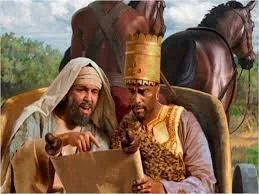
Philip was walking along the road that leads down from Jerusalem to Gaza when he is overtaken by a slow moving chariot. Contemporary pictures show these chariots as having four wheels. Can you imagine the scene as Philip looks up and sees an important man, probably wearing fine clothes, sitting behind his charioteer. There might also have been some outriders. It is likely that this Ethiopian eunuch was a man of integrity, he was trusted enough to be the official in charge of the Candace. The Candace was the traditional title of a Queen Mother, who used to run the country on behalf of her son, the king - he was reckoned to be too sacred for such mundane tasks. The eunuch appears interested in knowing God’s ways. He was reading his Bible and was happy to discuss what it means.
A Coincidence Happens!
It was at this point in the story that the coincidence happened. Was it just a coincidence? William Temple, an Archbishop of Canterbury was asked why he bothered to pray. He replied,
“I find it strange that when I pray, coincidences happen, when I don’t pray coincidences don’t happen.’
Philip hears the man in the chariot reading a scroll. Verse 30 says that Philip had to run to catch the chariot up and verse 38 says that the Ethiopian ‘gave orders to stop the chariot’. It seems likely therefore that the chariot was moving along at walking speed.
You and I might be overawed by such an important person, but not young Philip. He recognised that people such as this also need to hear the gospel. They are only human after all. A rector was driving in an undertaker’s car to take a funeral. They drove past a very rich house in his parish and were admiring it when the undertaker exclaimed,
“You know vicar, they all look the same when they come to us!”
Philip was alerted when he heard what the Ethiopian was reading. In those days all reading was done out loud.
“He was led like a lamb to the slaughter and as a lamb before his shearer is silent, So he did not open his mouth.”
Can you imagine the excitement that Philip felt as he recognised that passage from the word of God, from Isaiah 53?
In those days there would not have been a vast choice of scrolls that the eunuch could have bought in the Jerusalem bookshop, as everything had to be written out by hand, but it was still an amazing coincidence. Philip obviously knew Isaiah 53 well. He probably also knew that Jesus had taught that that chapter was about himself. Jesus had said,
“It is written, ‘And he was numbered with the transgressors’ and I tell you that this must be fulfilled in me.” (Luke 22 v. 37)
The Ethiopian was reading about Jesus! No wonder Philip was excited. This coincidence was too strange for words. He must have felt that God was behind this.
Do you ever feel like that, when something that someone says or does, demonstrates that they have an interest in the things of God, and you are prompted to stay around as an opportunity to speak for Christ may appear? Philip could not restrain himself. He runs up to the chariot. It seems likely that his boldness came from his recognition that God was in this coincidence.
The next point in the story is very important for us if we are to learn to be really effective for Christ.
Philip asked a direct question
If we haven’t learnt to ask questions of people we will miss out on so many opportunities. As Philip runs up to the chariot he asks the eunuch,
“Do you understand what you are reading?” Acts 8:30
Some may think this rather forward and rather risky. It could result in his being snubbed or ridiculed by this important man. The ruler could have said,
“Who are you, you young Jewish man to approach me in this manner whilst I am relaxing?”
Philip’s motto seems to have been,‘Nothing venture, nothing gain.’
The question he asked is brilliant. He did not say a casual “Good scroll that!” or “I’ve read that”. Instead he asks a personal question,
“Do you understand what you are reading?”
An urgency is also implied in this question as if he were asking,
“Do you understand that – it really does matter!”
How important it is for all of us to learn to ask polite but real questions. When we meet people who are going through problems we can sensitively ask,
“Do you have a faith that helps you at a time like this, or aren’t you sure?”
When talking to someone about religious matters you can ask,
“Are you a Christian yourself, or are you still uncertain?”
“Are you certain you are right with God and going to heaven or are you a bit unsure?”
There are many such questions. Giving people alternative answers does prevent us from cornering people and allows them to admit that they are uncertain and so lead on to further conversation. If we have not learnt this secret of effective personal work, please do learn it from Philip - learn to ask good questions.
“Do you understand what you are reading?”
As so often happens after asking a direct question, the reply opens up a very profitable conversation.
“How can I, unless someone explains it to me.”
How Philip must have been thrilled as the Ethiopian asked,
“Would you mind explaining to me who the prophet is talking about? Come up and join me in my chariot.”
Do you know this thrill of being in such situations?
Let us be clear, evangelism is explaining the story and significance of Jesus. We are not evangelising if we are not talking about him! Some people think that talking about their religious experiences is enough, but this is not true. Our role is to explain to others who Jesus is and what he has done.
Philip knew his Bible well
Firstly he was able to recognise those verses from the prophet Isaiah and was able to explain the significance of that chapter to an inquirer. More than that he was able to show from multiple passages in the Old Testament that these books were all about Jesus. (Acts 8:35) How many young Christians today could do that?
The interesting question to ask is how did he learn to do this?
The answer must be that he had been to training Bible Studies where the emphasis was to learn what a passage means and be able to explain and apply it to people we meet. They must have spent considerable time learning the words and meaning of God’s word. It is relevant that after Pentecost, when 3000 people were converted, the new Christians, “devoted themselves to the apostles teaching”. Surely this is how he knew that Jesus had said that Isaiah 53 was about himself, because Peter and John and the other apostles had taught them what Jesus had said at the last supper.
Those early Christians were undoubtedly ‘people of the Word’.
There is a hint of something else important in the manner in which Philip talked to the eunuch. He did not immediately jump up and recite a sermon to him that he had learnt by heart. He appears to have entered into a two-way dialogue with question and answer. There is an inference of this polite relationship in verse 34 –
“Tell me please, who is the prophet talking about?”
Philip had obviously learned to:
“Be prepared to give an answer to everyone who asks you to give the reason for the hope you have. But do this with gentleness and respect.” 1 Peter 3:15
Just as Philip had been taught the ‘Word of God’ as part of his early Christian training, so now he is teaching it to others. This is the essential cycle of the church. As in a relay race, we pass on the baton of knowledge of God’s Word to others. After his resurrection Jesus met his disciples in the upper room and what did he do then?
“He opened their minds so that they could understand the Scriptures” Luke 24:45
The Scriptures are still the way God speaks to us.
Philip taught that an open response to Jesus is needed
Philip was not satisfied to tell the message about Jesus, he explained that a response must be made to this message. This response can only be “Yes, I accept him” or “No, I don’t want him”. A response of “I understand” may be encouraging but it is inadequate. The only response that God finds acceptable is:
“Yes, I want to be committed to Jesus”.
Without repentance no-one can be a member of God’s eternal kingdom
The Ethiopian obviously understood this. He asked:
“Why shouldn’t I be baptised?” Acts 8:37
There and then that is what happened. He symbolically died to his old life by going under the water and rose again from it to live a new life. It is also a picture of his being washed of the sin of his old life and the beginning of a new holy life, lived with and for Jesus. Philip must have taught him that the prime object of life was to become right with God and then live closely to him. It is not primarily ‘join the church’ and live in harmony in the Christian community – these things are secondary. It is possible to be involved with a church and not have a personal relationship with Jesus for ourselves. It was Martin Luther who stressed that Christianity consists of personal pronouns. Saying
“Many religious people can say, “Jesus is Lord”. Only those right with God can say “Jesus is my Lord””!
After his meeting with the Ethiopian, the Lord took Philip away. They probably never met up again in this life. Yet it is said that the Coptic Church developed from that one man. How could that happen? What did the Ethiopian have to help him after his conversion? There were probably few other Christians around. The answer must be that he had the Bible and God’s Spirit to help him. There is certainly no indication that the Ethiopian was daunted over the possible problems he would face. Verse 39 says,
“He went on his way rejoicing”.
He had understood the answer to life. He was right with God because of Jesus. This joy is a common mark of true conversion. A few chapters later the jailer of the prison in Philippi became a Christian.
“He was filled with joy because he had come to believe in God – he and his whole family.”
Our prayer for Evan is that he also will come to believe and be committed to serving the Lord Jesus, as a result of the teaching of George and Sorcha, the grandparents and Godparents and Friends in the church. Our prayer for any here who are not yet living for the lord Jesus will change direction, repent and start to live a new life. Our faith is evidence based and if any here are uncertain about this evidence do look at the book ‘Stepping Stones’ on the stand outside as you drink coffee.
Philip’s circumstances changed but not his priority
It would be easy to think that this is the story of an idealistic young man who was able to behave in this way because he had the enthusiasm of youth and few responsibilities. There is evidence however that Philip did not change in later years. This is slightly speculative but this passage states that Philip:
“. . . travelled about, preaching the gospel in all the towns until he reached Caesarea”. Acts 8:40
Caesarea was sixty miles north of Gaza. What is it that normally causes a young man to settle down like this? It is likely that he met a young lady and got married. There is some evidence to support this. Twenty years or so later, the apostle Paul was returning from his second missionary journey and he arrived by boat at Caesarea.
“We reached Caesarea and stayed at the house of Philip the evangelist, one of the Seven. He had four unmarried daughters who prophesied” Acts 21:8-9
This means that Philip’s daughters were probably in their late teens. It therefore seems probable that, in spite of his responsibilities of a wife and large family he still longed that others should come to know Jesus. It is only at this time that he is given the title ‘Philip the Evangelist’. This is so encouraging, a different situation, a large family but living with and for Jesus is still his priority. That is the mark of a Christian.
BVP