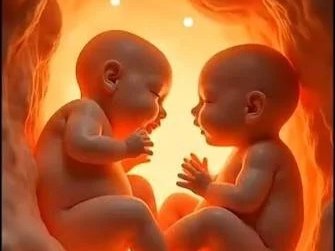
In a mother’s womb were two babies. One asked the other:
“Do you believe in life after delivery?”
The other replied:
“Why, of course. There has to be something after delivery. Maybe we are here to prepare ourselves for what we will be later.”
“Nonsense,” said the other. “There is no life after delivery. What would that life be?”
“I don’t know, but there will be more light than here. Maybe we will walk with our legs and eat through our mouths.”
The other said,
“This is absurd! Walking is impossible. And eat with our mouths? Ridiculous! The umbilical cord supplies nutrition. Life after delivery is to be excluded. The umbilical cord is too short.”
“I think there is something and maybe it’s different to life here.”
The other replied,
“No-one has ever come back from there. Delivery is the end of life, and in the after-delivery it is nothing but darkness and anxiety and it takes us nowhere.”
“Well, I don’t know,” said the other, “but certainly we will see mother and she will take care of us.”
“Mother?? You believe in mother? Where is she now?”
“She is all around us. It is in her that we live. Without her there would not be this world.”
“I don’t see her, so it’s logical that she doesn’t exist.”
To this the other replied,
“Sometimes, when you are quiet, you can hear her, you can perceive her. I do believe that there is a reality after delivery and we are here to prepare ourselves for that reality.”
Seeking God in our lives can at times seem illogical or impossible. We all know of people who insist that there’s no real point – that the material world is all there is! But seeking answers, being curious about life and death, wanting the truth - these are all great human qualities and we must pursue them. We instinctively want ‘knowledge’.
The word ‘science’ comes from the Latin ‘scientia’, which meant ‘knowledge’. All true knowledge has to be substantiated by evidence and reason. This is true for every area of life, including theological matters. Theology used to be called the ‘Queen of Sciences’ as it was considered supreme, encompassing all other aspects of knowledge which were ratified by the God who created us and had revealed himself to us. The greatest problem with religion has been when people have followed so-called prophets or religious leaders without a thorough investigation of their claims. The atheist Richard Dawkins was right in one respect when he wrote an open letter to his daughter Juliet. He laudably encourages her to think for herself:
“Next time somebody tells you something that sounds important, think to yourself: “Is this the kind of thing that people probably know because of evidence? Or is it the kind of thing that people only believe because of tradition, authority or revelation?” And next time somebody tells you that something is true, why not say to them: “What kind of evidence is there for that?” And if they can’t give you a good answer, I hope you’ll think very carefully before you believe a word they say.”
True knowledge, and this must include answers to spiritual questions, must be ‘evidence-based’ and this must include the search for answers to spiritual questions. Pope Emeritus Benedict XVI affirmed this when he gave a talk on the "Crisis of Culture" that is affecting the West. He referred to Christianity as the ‘Religion of the Logos’ because this is the Greek for "word", "reason", "meaning", or "intelligence". He said:
“From the beginning, Christianity has understood itself as the religion of the Logos, as the religion according to reason... It has always defined men, all men without distinction, as creatures and images of God, proclaiming for them...the same dignity. In this connection, the ‘Enlightenment’ is of Christian origin and it is no accident that it was born precisely and exclusively in the realm of the Christian faith....It was and is the merit of the Enlightenment to have again proposed these original values of Christianity and of having given back to reason its own voice... Today, this should be precisely [Christianity's] philosophical strength, in so far as the problem is whether the world comes from the irrational, and reason is not other than a 'sub-product,' on occasion even harmful of its development—or whether the world comes from reason, and is, as a consequence, its criterion and goal... we Christians must be very careful to remain faithful to this fundamental line: to live a faith that comes from the Logos, from creative reason, and that, because of this, is also open to all that is truly rational.”
The question then arises as to what is admissible evidence in this search for truth. Faith is not a blind leap in the dark but a commitment based on evidence. We wait for a train because there is historical and written evidence in the timetable that a train will come approximately at the time prophesied. It is a tragedy that some of those who deny the possibility of there being a creator limit themselves in what evidence they will accept. When Nikita Khrushchev was leader of the Soviet block he gave a speech at the plenum of the Central Committee of the Communist Party of the Soviet Union about the state’s anti-religious campaign. He gave as evidence the experience of the first Soviet cosmonaut, Yuri Gagarin, saying,
‘Gagarin flew into space, but didn’t see any god there.’
Clearly such an argument limits the search for God to sight. The obvious response would be to broaden the parameters and say,
“If he had opened the door, he could have done.”
Incidentally Yuri Gagarin was a member of the Russian Orthodox Church. This story illustrates how easy it is for evidence to be twisted or misused by someone to further their particular goal. There is so much evidence available. "To turn a blind eye" is a popular idiom that means to deliberately ignore or refuse to acknowledge information. It originates from the legendary naval story about British Vice Admiral Horatio Nelson during the 1801 Battle of Copenhagen.
‘To turn a blind eye’ to all the evidence is culpable. I have outlined som of this evidence in the book ‘Stepping Stones to Faith’
BVP