Features of a faith that comes from God
When taking my dog for a walk today I met a pleasant school-teacher with her two adult children. They said that their grandfather had been a devout Christian but then said,
‘We have our own truths we live by’.
This led to an interesting discussion about what is ‘truth’. As Plato understood, truth must be a concept that God alone knows completely. In science, medicine and in law we are trying to discover what we can of these truths. So when someone says ‘my truths’ they can only mean, ‘my present understanding’ or ‘what I have chosen to live by’. Everyone has faith is something or someone. Surely what we all need to discover is whether this faith is true and is in accord with God. If it isn’t, then it is untrue.
There are a multiplicity of faiths in our world that are often contradictory though may be related. Thus socialism, which for some is a faith, grew out of a Christian ethic about the equality of all people, as did communism which is a more aggressive form of socialism. When Marx was at school he wrote essays as if he were a Christian. Islam also grew out of an Arian form of Christianity, some coins of the early Caliphs had crosses on them and they lived in Damascus which was a Christian city. National Socialism, in Germany under Hitler, at first claimed to be based on Christianity, only later was Christianity rejected as it denied the doctrine that the strong could behave as they wanted. Faiths such as Hinduism and Buddhism are really philosophies, yet they are believed in by millions of people in a blind faith in the authority of the originators. Humanists are atheists who nevertheless want to keep to Christen ethics. Then there are Zionists and anti-Zionists. Each group is trying to find followers and to hold onto those born into their beliefs.
Logically, if faiths teach opposing doctrines they cannot all be true. How can the truth of a faith be established? A true faith must be one that God authenticates as it comes from him. These criteria are helpful guides, that help determine what is a true faith:
A faith from God must be evidence based
A faith from God must be supernatural
A faith from God must resonate with human needs
A faith from God must be loving
A faith from God must be powerful
1. A faith from God must be evidence-based
Evidence is the way to test any belief or faith. We are rational people, so any faith must be in accord with logical thought. To be a ‘flat-earther’ goes against the findings of science so must be rejected. The discoveries in the last century about the origins of Islam cast much doubt over its authenticity of the Standard Islamic Narrative and the reliability of the Qur’an. Archeology has shown the absence of any ancient buildings in Mecca, it cannot have been ‘the mother of all cities’. Philosophical faiths such as Buddhism, Hinduism, Confucianism and Taoism cannot be assessed logically as there are few objective facts that can be tested. How can doctrines such as repeated reincarnation or the laws of Karma be tested?
Any faith that disagrees with the substantiated evidence of good science will eventually crumble. This is being seen in many Islamic countries where a literal understanding of the Qur’an and Haddith is insisted on. Such regimes demand that people do not ask questions about the many conflicts. In such regimes faith trumps everything else. This is a major reason why many educated Muslims are turning their backs on the practice of Islam. A true faith from God must fit comfortably with discoveries about the world this God has made.
The Christian faith is completely dependant on the person of Jesus. He claimed to be the divine Son of God that the Jewish Scriptures said would enter God’s world as its Messiah. He performed remarkable miracles that were acknowledged even by his enemies. He said he would be crucified and would rise from the dead. He said that faith in him would spread to all nations. These doctrines can be verified. The evidence is very strong that Jesus did exist, his miracles and resurrection were witnessed by many hundreds of people. How did the church expand so fast when so heavily opposed by both the Roman authorities and the Jewish authorities and with no obvious military or worldly support? The truth of all this can be tested with contemporary writings and archeology.
Any idea or faith that is true, when questioned and thoroughly investigated, will stand even stronger. Investigating an untruth will reveal its difficulties and unreliability. Why are Muslims not encouraged to investigate the claims about Mecca? The absence of supportive archeology and a lack of adequate water supply proves it cannot be the ‘mother of all cities’, as the Qur’an and Hadith claim. The qibla or direction of prayer of early mosques was not towards Mecca, that only came about much later.
The Bible encourages people to test, examine, and prove what they believe to ensure it aligns with truth.:
“Test everything; hold fast what is good” 1 Thessalonians 5:21
We must also examine ourselves and our motives to ensure that we are thinking as God wants us to, according to his truth, which is the only real truth there is:
“Examine yourselves to see whether you are in the faith; test yourselves," 2 Corinthians 13:5
2. A faith from God must be supernatural
If a faith is from God, who himself must be supernatural to have created such a world, then there should evidence that a supernatural God is behind it. When God freed the Children of Israel from slavery in Egypt he proved that he was involved by the miraculous. He caused this ten plagues and separated the Red Sea so his people could cross safely but the Egyptian army was drowned. He provided water and quail supernaturally as they wandered in the desert. These miracles then ceased but God’s people were repeatedly told to look back at this evidence of God’s involvement.
Similarly Jesus authenticated his claims to be the divine Messiah, the Son of God, but performing extraordinary miracles that even his enemies could not deny. His resurrection after being crucified was not only very well substantiated by many witnesses but proves that his claims about who he is are true. Faith must be evidence based. A faith that comes from a supernatural God needs to be proved supernaturally
Someone may ask,
‘How can people believe in such a supernatural faith?’
If God created this world then he must be supernatural. The evidence for the supernatural is all around us. How can babies be formed by two cells uniting - that is a miracle. Where do our instincts for a purpose, in life, for values in life and for love come from if we are not created in the image of our creator. Who designed the eye? It is certainly not a random structure. These features cannot be derived from there chaotic random alignment of chemicals in a primordial soup!
When God rescued a people for himself, when they were slaves in Egypt, he showed that his salvation was of God by miracles, the ten plagues, the parting of the Red Sea and the Jordan and providing supernatural food, manna, for his people. God’s people were constantly reminded to look back to those times. Similarly when Jesus came his claim to be God’s Messiah were verified by the miraculous healings he performed. Finally he rose from the dead three days after being crucified there is so much evidence to support this. God must be supernatural, utterly beyond our comprehension if he is to create this universe and ourselves and then to break his own laws of nature at climactic times.
Today there are many who cannot see the supernatural in the creation of a baby, in the working of our eyes and ears, in the DNA language and so much more. Their faith is limited to a material world. Their ambitions are for success in this world. Jesus had some telling words to say to people with this attitude. A farmer had a superb harvest and decided to build more barns. Building barns was not the sin it was his attitude, his greed: He only thought about himself and had forgotten God
“Watch out! Be on your guard against all kinds of greed; life does not consist in an abundance of possessions.” Luke 12:14
This was the judgment:
“But God said to him, ‘You fool! This very night your life will be demanded from you. Then who will get what you have prepared for yourself?’ “This is how it will be with whoever stores up things for themselves but is not rich toward God.” Luke 12:20-21
Jesus is saying that how we think will not only influence our lives now, it will define our eternal destiny. He is saying that materialism is a false faith. The validity of all such statements that he made depends upon his authority. If he is from God we must take him very seriously, if he is not he is a fraud and should be rejected.
The inherent desires, that we all have, point us to our need for a faith that will stand the test of rigorous investigation but at the same time meet our needs. We are all going to die so the purpose of life must answer this problem and defeat it. What happens when we die? Jesus of all the founders of world faiths alone gives us answers to the biggest questions of life.
A headmaster wisely said to his pupils at a school speech day:
“The purpose of life it to find the purpose of life and then to make that the supreme purpose of your life!”
3. A faith from God must resonate with human needs
Religion is universal, everyone has a faith on which they base their lives. I recently met an immigrant from Afghanistan who said he had no faith whatsoever, he called himself an atheist. Yet he agreed that in his work he relied heavily on rational thought.
“Oh yes,” he said, “I do believe in rationality.”
We talked about his family and about the values and ethics he wanted them to grow into,
“Oh yes,” he said “I do believe in the importance of good behaviour.”
“So you are a believer, a man of faith. It is just that you have decided to accept God’s creation, the value of rationality and of ethical behaviour but to reject where these values come from. We are all believers in something, The question I had is how all the pieces can be fitted to gather if there is no God and Jesus was not the embodiment of God who rose from the dead.”
We live in a world full of difficulties and illness and tragedy. A true faith needs to acknowledge this and have answers. Escapist beliefs, such as Buddhism, deny reality.
We need answers
One of the features of humanity is that we are always looking for answers. Why does our universe function according to precise laws? We call them the laws of nature but nature cannot create laws, it just functions according to these laws. We live in a mathematical world. How can this be unless there is a rational, mathematical creator? It is fascinating that even three thousand years ago there were people asking questions, such as who designed the eye and ear:
“Does he who fashioned the ear not hear? Does he who formed the eye not see?” Psalm 94:9
“Ears that hear and eyes that see - the Lord has made them both.” Proverbs 20:12
It is absurd to think that these and all the other features of our creation developed randomly out of primordial soup. Professor Anthony Flew was a philosopher and an ardent atheist who often featured on the radio. When the structure and significance of the DNA code, and the language it contains, was discovered he realised that this could not be random. All language has to have a mind behind it.
We have guilt
One of the human characteristics is that we feel guilt when we do something wrong. Guilt is a major, often hidden, factor in much of the depression and anxiety observed today. While guilt can act as a helpful moral compass in small doses, persistent guilt is a significant, evidence-based contributor to the onset, severity, and perpetuation of mental health disorders. A core symptom of a major depressive disorder is feeling excessive or unwarranted guilt, often exacerbated by ruminating on minor past failures or taking responsibility for things entirely outside of one's control.
True faith is evidenced when the reality of my sin and the need of a pardon by God is recognised. This is not an intellectual nod to a theological doctrine but a genuine realisation. Most faiths fail to address this. Most teach that if a person joins their group and tries to follow its rules, God should be pleased with them. Religious and secular faiths cannot give people evidence based confidence that they are secure. The word of a prophet or teacher is not sufficient without strong supportive evidence. A true faith will have the answer to man’s greatest problem, at heart we do not want God to rule us so we cannot know his forgiveness.
Marghanita Laski (1915-1988) was a popular novelist and outspoken secular humanist. In a moment of candour, she said on a televised interview:
"What I envy most about you Christians is your forgiveness. I have nobody to forgive me.”
Christians have discovered the answer God has given us. We can know what it means to be forgiven because we have a scapegoat who paid the price for our sin when he died on that cross.. There is very strong supportive evidence for this being true.
We need a purpose
A lack of purpose can be detrimental to both mental and physical health, according to extensive psychological research. While it is normal to experience periods of drifting, a prolonged absence of meaning is often linked to significant negative outcomes. Lacking a sense of direction is a major driver of anxiety and depression, particularly in young adults. It can lead to chronic feelings of emptiness, hopelessness, and low self-esteem. Individuals with a strong sense of purpose show better emotional recovery from negative events. Without it, people struggle to ‘bounce back’ from stress, as purpose acts as a psychological buffer. Research by several institutions suggests that people with a clear purpose tend to live longer and have a lower risk of heart attacks, strokes, and dementia. A lack of purpose can lead to ‘purpose anxiety,’ making daily decision-making feel overwhelming. It is also associated with unhealthy coping mechanisms, such as substance abuse or obsessive behaviours, these can be used to fill the void.
Based on his experiences in Nazi concentration camps, Viktor Frankl discovered that a prisoner’s ability to survive was directly linked to their ability to find meaning and purpose, even in the most miserable circumstances. He observed that prisoners who connected with a future goal or a ‘why’ to live for were more likely to survive, as this purpose provided the mental and spiritual strength to endure extreme, life-threatening conditions. Frankl’s observations formed the basis of his psychotherapeutic method, logotherapy, which asserts that the primary motivation in human beings is the search for meaning.
Studies have shown that faith in an afterlife is associated with lower levels of end-of-life despair. including reduced feelings of hopelessness, ideas of suicide, and a decreased desire for a hastened death. This is relevant to the current debate about medically assisted suicide in terminally ill patients. A lady in her thirties had a locally aggressive cancer of the breast. She needed a mastectomy but could not bear the idea of losing her shape. We therefore performed a mastectomy with an immediate breast reconstruction. After the operation she said the if she had had to just be flat chested on one side she was going to commit suicide. I asked her,
“Are you ready to meet God then?”
This idea had never crossed here mind and led to a fascinating discussion about the purpose of life and how we can find answers.
4. A faith from God must be loving
A valid faith will be characterised by being evidence based, provide answers to the problems human face and will be characterised by a love for people. Many philosophers have emphasised the significance of virtues like honesty, courage, kindness, and truth as central to the success human society. Aristotle argued that practicing virtues, finding the ‘golden mean’ between extremes, is the key to achieving a well-lived life. Confucius focused on Ren (benevolence), teaching that a stable, harmonious society is built on honesty, respect, and kindness. Plato identified primary virtues as courage, moderation, wisdom, and justice. Arthur Schopenhauer reckoned loving-kindness and compassion as the fundamental basis of all true morality. It seems that these values are in-built into our make-up. This surely suggests that these are characteristics of the god who made us.
The priority of exhibiting these values is an area where many religions break down. The rules become more important than the values. In Communism, Islam, Nazism, sometimes in Judaism and in many other religions the creed matters more than personal integrity, rules matter more than people. Those who oppose the creed are considered as enemies that can be disposed of. Try to leave and there is much hatred.
A Muslim went to a Muslim Brotherhood school in Saudi Arabia where he received a good education nut in the religious lessons he said they were taught to hate those who oppose the teaching of Islam.
A genuine concern for the welfare of others is a mark of a true faith because this is a mark of the God who created us. We recognise that this is true because we have instincts within us that appreciate when people care for us. We all need to be loved, it is somehow within our make-up.
When Jesus was asked what the greatest commandment was he replied:
“Jesus answered by saying, “Love the Lord your God with all your heart, with all your soul, and with all your mind. This is the greatest and most important commandment. The second is like it: Love your neighbour as yourself. All the Law and the Prophets depend on these two commandments” Matthew 22:37–40
The reason a true faith will be revealed in love is because love is the nature of the God who created us in his image. The Bible confirms this reasoning:
“Anyone who does not love does not know God, because God is love”. 1 John 4:8
“And so we know and rely on the love God has for us. God is love. Whoever lives in love lives in God, and God in them”. 1 John 4:16
“But God demonstrates his own love for us in this: While we were still sinners, Christ died for us.” Romans 5:8
“For God so loved the world that he gave his one and only Son, that whoever believes in him shall not perish but have eternal life.” John 3:16
The Old Testament also emphasises that an everlasting abounding love is God’s nature:
“The Lord appeared to us in the past, saying: “I have loved you with an everlasting love; I have drawn you with unfailing kindness.” Jeremiah 31:3
"The Lord is compassionate and gracious, slow to anger, abounding in love." Psalm 103:8
James wrote, “I will show you my faith by my works” (James 2:18), and Paul reminds us that the first fruit of the Spirit is love (Galatians 5:22). But what does that actually look like? Going to church, tithing, praying, and reading our Bibles are all beneficial - they reflect a love and commitment to God. But they don’t necessarily express love for people.
Faith systems such as Nazism, Communism and radical Islam all place the creeds as more important than individuals. Jesus was the opposite, he was willing to die for others because he knew there is a bigger picture than our short lives here on this earth.
Real faith shows up in how we love imperfect people. It involves sacrifice, kindness, forgiveness, and intentional service — without expecting anything in return.
Jesus said the world would know we are His disciples by how we love one another :
“By this everyone will know that you are my disciples, if you love one another.” John 13:35
An opposite of love is hatred and anger. Anger is a temporary form of hatred. Angry people lose emotional and verbal control, expressing unkind and sometimes terrible ideas against others. A mark of a genuine faith is that God helps people to bring this under control and turn the other cheek. Unfortunately some faiths encourage the hatred and anger of others and this is a sign that that faith does not come from God and is not true.
Integrity will always be found in a true faith and in its genuine advocates. Integrity, doing what is right in God’s eyes builds people up. The opposite is ‘dis-integrity’ or ‘disintegration’. Failure to live as god wants so often leads to a person’s life disintegrating, their family disintegrating and eventually their society and even their nation disintegrating. This transparent sincerity resonates with the godly instincts within all of us and gives authenticity. Jesus was widely acknowledged to behave in a Godly way. He could say:
“Can any of you prove me guilty of sin? If I am telling the truth, why don’t you believe me?” John 8:46
Paul, the apostle who taught about Jesus as the church was being established could say:
“Now this is our boast: our conscience testifies that we have conducted ourselves in the world, and especially in our relations with you, with integrity and godly sincerity.” 2 Corinthians 1:12
5. A faith from God must have power
A true faith will provide a supernatural power to change people for the good. Hearing the stories of people who turn to a faith will often show what sort of faith it is. If the ‘faithful’ become angry , belligerent and unloving to others it is almost certainly not from God. A faith derived from God will be true, evidence based and have a supernatural aspect. It will resonate with human needs and will make people loving. These are the features of the true God. Moses was told of God’s character and so any faith from this God will produce his characteristics:
“And he passed in front of Moses, proclaiming, ‘The Lord, the Lord, the compassionate and gracious God, slow to anger, abounding in love and faithfulness,maintaining love to thousands, and forgiving wickedness, rebellion and sin. Yet he does not leave the guilty unpunished.” Exodus 34:6-7
Attempts to bypass truth in faith issues
The Bahá’í House of Worship in Wilmette, near Chicago, is a renowned multi-faith building, featuring symbols from various world religions (including Christian, Jewish, Hindu, and Islamic) on its pillars. Completed in 1953, the nine-sided temple promotes unity, offering a quiet space for prayer and meditation. This symbolises the longing that people of all faiths should accept each others beliefs. In a similar vein some churches have had ‘multi-faith’ services which have a tacit assumption that different faiths are acceptable to God.
Such thinking is antagonistic to the teaching of the Bible. The God who made us is a God who refuses to share his honour with any. He alone is God and he demands that all people recognise this. This is why we must all accept the faith that the true God has given us. The Bible explicitly teaches there is one God and he is the only way to salvation is through faith in Jesus Christ.
"For there is one God, and one mediator between God and men, the man Christ Jesus, who gave himself a ransom for all". 1 Timothy 2:5-6:
"Jesus answered him, 'I am the way, the truth, and the life; no one goes to the Father except by me'". John 14:6
"And there is salvation in no one else, for there is no other name under heaven given among men by which we must be saved". Acts 4:12
“One Lord, one faith, one baptism; one God and Father of all". Ephesians 4:5-6
"I am the LORD, and there is no other; apart from me there is no God". Isaiah 45:5
"...yet for us there is but one God, the Father, of whom are all things... and one Lord Jesus Christ". 1 Corinthians 8:6
The Old and New Testaments consistently affirm that there is only one true God, it declares that reconciliation with God is only possible through the sacrificial death and resurrection of Jesus Christ, who is identified as the only bridge between humanity and God. We turn our backs on this loving God at our peril.
How can truth be defined? As we have seen it is surely an absolute concept which, by a variety of means we are trying to discover. Some pointers to truth are inbuilt within us. These cannot be proved to be valid but we accept them. Our faith in rational thought is one. This is why science is such a good way to understand our world. Our desire for our faith to be evidence based is also inherent. We have inherent needs for a purpose and for forgiveness. We long to be loved. All this evidence is personified in Jesus.
Our family was discussing over dinner whether love or truth were more important. We came to the consensus that they cannot be separated as love is part of truth and truth is part of love. A faith without both is inadequate. The Bible teaches that both are characteristics of the true God.
Pascal's Wager is a 17th-century argument that suggests it is much more rational to live as if God exists than not. It was proposed by the French mathematician and philosopher Blaise Pascal in his posthumous work Pensées (1670). The argument suggests that it is far more rational to believe in God than to reject him.
There is much evidence that there must be a God who created our universe according to laws of nature and mathematics, who gives life a purpose and a basis for ethics. Such evidence would surely win in a court of law. However, as Pascal as shown, the existence of God cannot be proved with mathematical certainty but that people should ‘wager’ because of the likely outcomes:
If God exists, the reward is infinite gain, an eternal life in heaven. If God does not exist, the loss is finite and limited, sacrificing some worldly pleasures.
If God exists, the loss is infinite, an eternal rejection by God and suffering in hell. If God does not exist, the gain is only finite, a temporary independence or pleasure.
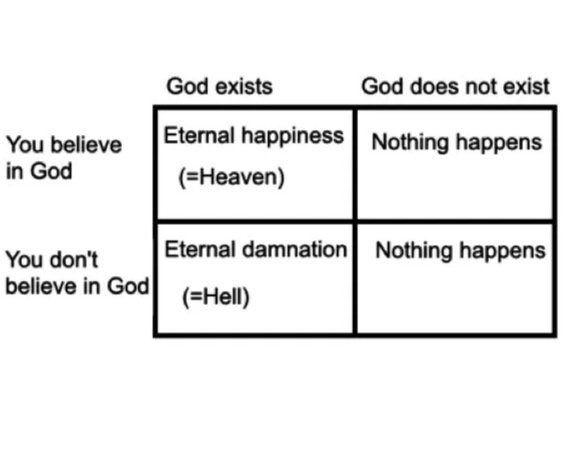
Pascal’s Wager
By this logic, any positive probability of God’s existence - even a very small one - makes the expected value of belief infinite, making it the only ‘rational’ faith to hold. The stakes are high.
All these pointers suggest that the greatest discovery anyone can make is to find that Jesus is indeed the answer to a valid faith that comes from God. A search for such a valid faith must therefore start with him and by reading the records of his life written by his close contemporaries. Many have discovered Jesus, his death and resurrection, his miracles, his character and his fulfilment of over 330 prophecies about the Messiah given in the Jewish Scriptures stands firmly even under the most rigorous investigation. This is why he alone can say:
“I am the way, the truth and the life. No-one comes to the Father except through me.” John 14:6
Truth, love, forgiveness and the supernatural must all be features of a true faith that comes from God. They are in different dimensions but together they make a robust faith that is worth living and dying for.
It is significant that, excluding the supernatural, these are the features that exist in strong families of every nation and creed. These values are what loving parents want their children to grow into. It is as though we instinctively know these values to be of God.
BVP