Matthew 7:1-6. Judge as you would be judged

People vary in how they relate to others. Some tend to be critical and censorious whilst others are more like sponges with little critical discernment. This passage from Jesus' Sermon on the Mount addresses the complexities of human relationships, but does so from the perspective of the Lord himself. All we do reflects the relationship we have with him. It specifically focuses on how to handle the faults of others without falling into self-righteousness. It moves from a warning against a censorious spirit to a call for holy discernment.
The Command to ‘Judge Not’ (v. 1-2)
The passage begins with the famous command:
“Judge not, that you be not judged.”
How often this is taken out of context, especially with regard to those of other faiths. It is true that the more we criticise others, the more likely we are to be criticised ourselves. However the whole point of the sermon is to remind us that it is the relationship with God matters more than anything else. God will judge us on the basis of the way we have judged others. Paul reminds us of this fact:
“You, therefore, have no excuse, you who pass judgment on someone else, for at whatever point you judge another, you are condemning yourself, because you who pass judgment do the same things. Now we know that God’s judgment against those who do such things is based on truth. So when you, a mere human being, pass judgment on them and yet do the same things, do you think you will escape God’s judgment?” Romans 2:1-3
Some have suggested that this is a total prohibition or all criticism. This command, however, cannot be the forbidding all forms of evaluation or the existence of law courts. In this passage we are told to assess who are dogs and who are pigs! Later in the same chapter, he tells followers how to discriminate between the good and the bad. To ‘recognise them by their fruits’ (v. 16), requires judgment.
Jesus is specifically condemning a harsh, fault-finding, or unmerciful attitude that seeks to condemn rather than restore. We have all seen people like this in our churches and societies.
Jesus warns that the standard of judgment we use for others is the same one God will use for us. If we want mercy from God, we should show mercy to others.
We all have to make decisions. Those who procrastinate and fail to make judgments are the wets of life. Jesus is outspokenly critical of those who oppose him, consider how he addresses the Pharisees and teachers of the law. He had no hesitation in saying to the scribes, who claimed to be experts in the Jewish Scriptures:
“You are in error because you do not know the Scriptures or the power of God.” Matthew 23:29
One of the most costly decisions any of us make concerns the place that the Son of God will have in our lives. We must all make a judgment about him.
“Whoever believes in the Son has eternal life, but whoever rejects the Son will not see life, for God’s wrath remains on them.” John 3:36
While dining at the home of a Pharisee named Simon, a ‘woman who lived a sinful life’ began to weep at Jesus' feet and anoint them with perfume. When Simon judged Jesus in his heart for allowing a sinner to touch him, Jesus told a parable about a moneylender who had two debtors; one owed 500 denarii (about 20 months' wages) and the other owed 50 (about 2 months' wages). Neither could pay, so the lender "frankly forgave them both.” Jesus asked Simon,
“Which of them will love him more?”
Simon replied,
“The one, I suppose, for whom he cancelled the larger debt.” Luke 7:43
This passage highlights three specific ‘judging’ traps that we often fall into. We often judge others because we think their ‘debt’ (sin) is 500 while ours is only 50. Jesus’ point is that neither could pay. Whether the debt is large or small, both are equally bankrupt without the lender’s mercy. Simon didn't say a word, but Jesus ‘answered’ his thoughts. It reminds the audience that judging isn't just about what we say; it's the posture of our hearts.
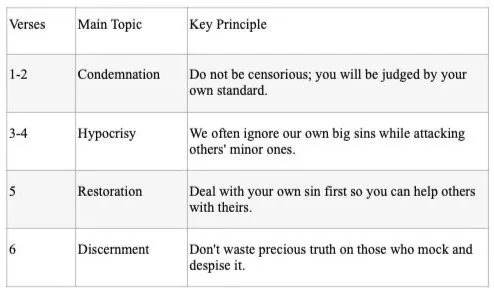
The Metaphor of the Speck and the Log (v. 3-5)
Jesus now uses a humorous illustration to expose hypocrisy in our relationships: This also applies to our relationship with God. A speck or splinter is a tiny fault in someone else's life.
The log or plank is a massive, glaring fault in our own life that we often overlook. Yet others can so easily see this and even more significantly, so can the Lord who will be our judge. We are too often ‘spiritually blind’ to our own large failures while being hyper-focused on the minor flaws of others.
Jesus is not saying we should ignore the speck; he says, first remove the log from your own eye. Only after self-examination and repentance can you ‘see clearly’ to help a brother or sister with their struggle.
Pearls Before Pigs (v. 6)
The final verse provides a necessary balance to the preceding verses, calling for discernment:
"Do not give dogs what is holy, and do not throw your pearls before pigs."
In this context, dogs and pigs represent people who show a hardened, mocking contempt for the gospel or for holy things. Some have tried to equate ‘dogs’ with Gentiles but Jesus cannot mean ‘Don’t share the gospel with Gentiles’ as throughout the Bible, the gospel is for the nations. The Great Commission Jesus gave to his church at the end of Matthew makes this very clear:
“ Therefore go and make disciples of all nations, baptising them in the name of the Father and of the Son and of the Holy Spirit,” Matthew 28:19
The Bible mentions God's concern for ‘all nations’ or ‘all peoples’ hundreds of times, weaving this theme from the first book to the last. While the exact count varies by translation, the Greek word for nations (ethne) appears 130 times in the New Testament alone, often translated as ‘nations’ or ‘Gentiles’.
While we should be merciful, we should not indiscriminately press the gospel or holy truth upon those who have clearly demonstrated they will only trample it and turn to attack us. This verse teaches that there is a time to walk away or remain silent when someone’s heart is persistently closed and hostile. Thus Jesus taught his disciples when they went on a trial run at mission:
“If the home is deserving, let your peace rest on it; if it is not, let your peace return to you. If anyone will not welcome you or listen to your words, leave that home or town and shake the dust off your feet. Truly I tell you, it will be more bearable for Sodom and Gomorrah on the day of judgment than for that town.” Matthew 10:13-15
Key Themes in Matthew 7:1-6
When we are tempted to say harsh things about someone, the Lord would have us THINK first. This is an acronym:
T - is it true?
H - is it helpful
I - is it instructive
N - is it necessary
K - is it kind
The Lord longs for all of us, his people, to be calm, kind, graceful and thoughtful and we must do all we can to help each other in this. We must learn to think.
David and Bathsheba
In 2 Samuel 12 we read that the Lord sent the prophet Nathan to King David after his affair with Bathsheba and the subsequent murder of her husband Uriah the Hittite. Natthan tells David about a rich man who had many sheep and a poor man who had one lamb that was part of their family. When a traveller came to the rich man he took the lamb of the poor man. Killed it and prepared it for dinner. We read:
“David burned with anger against the man and said to Nathan, “As surely as the Lord lives, the man who did this must die! He must pay for that lamb four times over, because he did such a thing and had no pity.” 2 Samuel 12:5-6
David had high standards but he didn’t think. Listen to what Nathan then said:
Then Nathan said to David, “You are the man! This is what the Lord, the God of Israel, says: ‘I anointed you king over Israel, and I delivered you from the hand of Saul. I gave your master’s house to you, and your master’s wives into your arms. I gave you all Israel and Judah. And if all this had been too little, I would have given you even more. Why did you despise the word of the Lord by doing what is evil in his eyes? You struck down Uriah the Hittite with the sword and took his wife to be your own. You killed him with the sword of the Ammonites. Now, therefore, the sword will never depart from your house, because you despised me and took the wife of Uriah the Hittite to be your own.’” 2 Samuel 12:7-10
The point is clear, God is a holy God and he hates sin. Nathan defines sin here as a failure to live as God has taught us in his word. There is only one hope of forgiveness, to return to the Lord and admit our sin and selfishness. David learnt this lesson:
“Then David said to Nathan, ‘I have sinned against the Lord.’” 2 Samuel 12:13
Nathan’s reply reiterates the gospel:
“The Lord has taken away your sin. You are not going to die. But because by doing this you have shown utter contempt for[a] the Lord, the son born to you will die.” 2 Samuel 12:13-14
What a joy it is to know that my sin can be forgiven. I can be accepted by God, but this does not mean that there are no consequences for my sin now. If I was a thief before becoming a Christian, I can be forgiven by God but may still have to go to prison! The difference will be that I can serve the Lord there.
Religion is not the answer to God’s judgment - Isaiah 66
People frequently ‘turn to religion’ when they face a crisis. The Lord has some critical words to say about religion, about trying to please God by turning over a new leaf. The book of Isaiah makes this very clear. God is very judgmental on those who think that their religion can ever satisfy a holy God - only perfection can satisfy him.
Isaiah wrote in the 8th century BC, when Israel had lost any real fear of God. Its faith had largely descended into formal religion and many of the religious and political leaders were in it for themselves. They had forgotten that God is real. Much of our society today reflects the same problems. Integrity and discipline in homes, in schools and often at work is slipping because we no longer have any principles to guide our lives.
Much of the long book of Isaiah describes God’s anger at the way he was being treated by his people though he also stresses that God himself is going to step into his world and remedy the problem. The book finishes in chapters 63-66 with a grand overview of what God is going to do.
The final chapter of Isaiah is about God’s judgment of his world but also about the hope he offers us. His answer is that a new kingdom is coming but that the old will be destroyed:
““As the new heavens and the new earth that I make will endure before me,” declares the Lord, “so will your name and descendants endure. From one New Moon to another and from one Sabbath to another, all mankind will come and bow down before me,” says the Lord.” Isaiah 66:22-23
This new world will be open to all people from all nations. It will be an ideal society. You can just feel how people living in Israel at the time, with the prospect of a deadly invasion by Babylon looming, must have felt home-sick for this paradise.
Who are these children who will be in heaven?
This is the main point of this chapter. He looks at some but rejects others:
“These are the ones I look on with favour: those who are humble and contrite in spirit, and who tremble at my word.” Isaiah 66:2b
Contrition
‘Contrite’ is an adjective that means feeling or expressing deep remorse, guilt, or regret for something wrong you have done. It typically implies not only saying you are sorry but also having a genuine desire not to repeat this.
Humility
What it means to be ‘humble’ is often misunderstood. Uriah Heep was the famously hypocritical villain from Charles Dickens's 1850 novel, ‘David Copperfield’. He is a sniveling clerk who constantly wrings his hands and insists that he and his mother are "ever so 'umble". However, this exaggerated modesty is entirely a calculated mask. In reality, he is a manipulative fraud who schemes to ruin his employer, steal fortunes, and control others. Because of Heep's iconic deception, his name has entered the English language as a byword for a sycophantic, falsely modest hypocrite. Have you noticed how many window cleaners are Jehovah’s witnesses. We had one highly intelligent Jehovah’s Witness deliver a parcel to our door and he accepted that the Watchtower discourages members from having ambitions as this is not to be humble.
C.S.Lewis wisely said:
“To be humble is not thinking less of yourself but thinking of yourself less.”
He believed it is a state of total self-forgetfulness, where a person stops focusing on their ego, insecurities, or the impression they make on others, freeing them to genuinely focus on God and their neighbours. In his book ‘Mere Christianity’, he argued that a truly humble person won’t be thinking about humility at all. They will simply be focused on others. If you are wondering whether you are humble, you are still focusing on yourself. He explains that humility does not mean denying your talents or pretending you are bad at something you are actually good at. It means accepting your gifts graciously, like a present, and giving credit where it is due. Lewis identified pride as the chief sin and puts us in direct opposition to God and others. Humility allows us to be liberated from self-absorption and experience genuine joy.
God looks with favour on those who are humble and ‘poor in spirit’ Jesus said this again right at the beginning of this Sermon on the Mount:
“Blessed are the poor in spirit, for theirs is the kingdom of heaven.” Matthew 5:3
There are however some people that the Lord will not listen to - those who depend on their religion. God has no need for human temples - heaven is his throne. Isaiah singles out the religious people who go to the temple, keep the temple rules but fail to listen to and obey what God has said in his word:
“But whoever sacrifices a bull is like one who kills a person, and whoever offers a lamb is like one who breaks a dog’s neck; whoever makes a grain offering is like one who presents pig’s blood, and whoever burns memorial incense is like one who worships an idol. They have chosen their own ways, and they delight in their abominations.” Isaiah 66:3
Their main fault was not to listen to what God has said in his word. How can anyone read this and not understand:
“For when I called, no one answered, when I spoke, no one listened. They did evil in my sight and chose what displeases me.” Isaiah 66:4
This point is again repeated:
“Hear the word of the Lord, you who tremble at his word.” Isaiah 66:5
God is not satisfied by us if we turn up at church, attend the prayer meeting and pay towards the upkeep of the church if, at root, we are not taking God’s word seriously. He says our sacrifices are meaningless. He detests our religious efforts to please him.
The churchgoer can inwardly think, ‘God must be rather pleased with me as I regularly turn up and help the cause. I lend my weight to the good cause.
What does God want of each of us?
“These are the ones I look on with favour: those who are humble and contrite in spirit, and who tremble at my word.” Isaiah 66:2b
What do you think, from this passage, is God’s opinion of a cleric who preaches regularly in a church or cathedral yet whose private life repudiates what the Scriptures teach.
The rest of Isaiah 66 teaches that God’s solution will be the birth of a baby and it will be this person who will be the focus of God’s eternal kingdom, he will be the sign that draws people back to God.
“Therefore the Lord himself will give you a sign: The virgin will conceive and give birth to a son, and will call him Immanuel.” Isaiah 7:14
It is the birth of this child that will give rise to this new kingdom:
“‘Before she goes into labour, she gives birth, before the pains come upon her, she delivers a son. Who has ever heard of such things? Who has ever seen things like this?
Can a country be born in a day or a nation be brought forth in a moment? Yet no sooner is Zion in labour than she gives birth to her children.”
As Jesus is ‘lifted up’ people are drawn to him:
“Just as Moses lifted up the snake in the wilderness, so the Son of Man must be lifted up, that everyone who believes may have eternal life in him.” John 3:14-15
Where will God’s people come from?
They will come from all over the world as the gospel message is proclaimed to them by god’s people:
“They will proclaim my glory among the nations. And they will bring all your people, from all the nations, to my holy mountain in Jerusalem as an offering to the Lord – on horses, in chariots and wagons, and on mules and camels,’ says the Lord. ‘They will bring them, as the Israelites bring their grain offerings, to the temple of the Lord in ceremonially clean vessels.” Isaiah 66:19-20
Notice who brings people into this kingdom. This Jerusalem is the spiritual city of God’s people that Relation 21 describes. Isaiah says that people from all over the world will come to the Lord’s own Son. One of the astounding features of the church is how this message draws people to Christ, even in countries when there is political and religious opposition.
The one feature that all these people have is clear:
““These are the ones I look on with favour: those who are humble and contrite in spirit, and who tremble at my word.” Isaiah 66:2b
What a wonderful picture this is. We can only judge as God judges. False religion must be opposed because the Lord repeatedly does this.We must however always remain calm and grateful as that is how our Lord lived when so cruelly judged and opposed bu others.
BVP